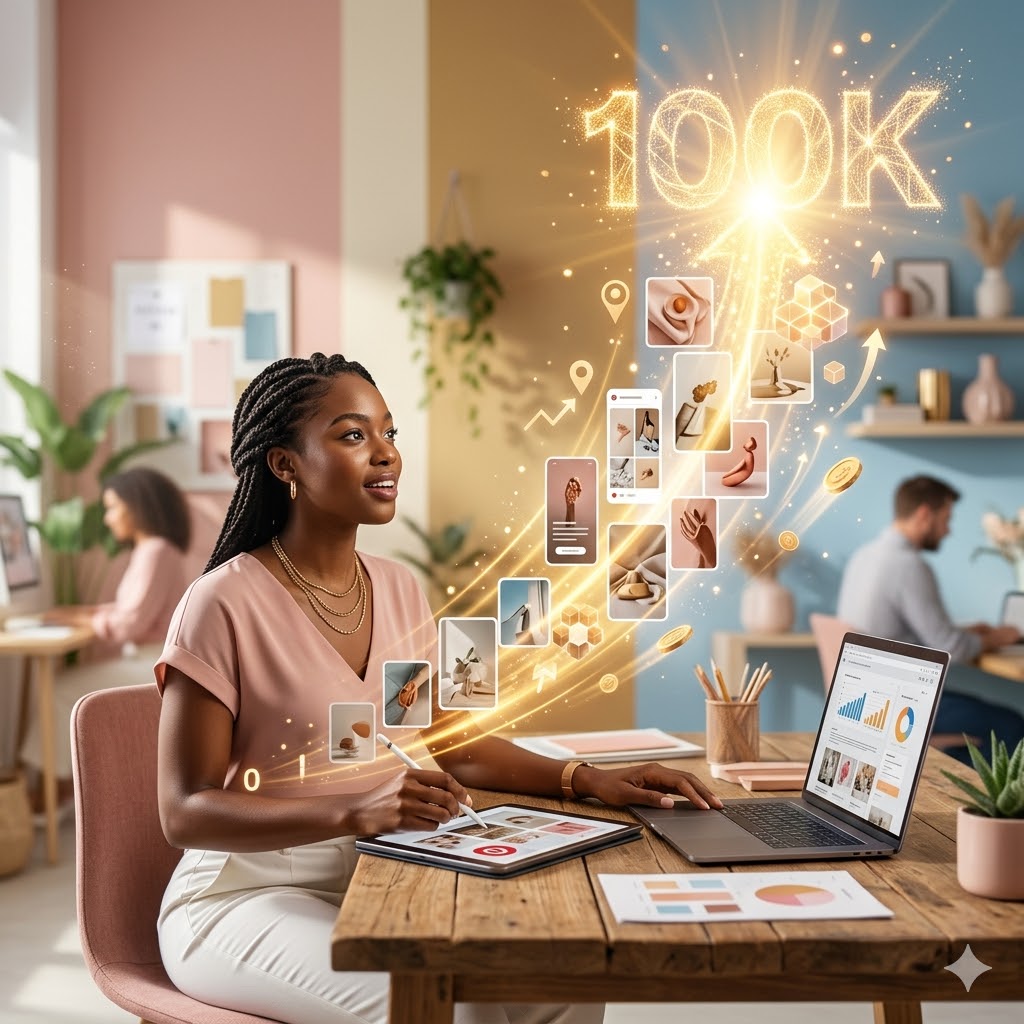
How to Make Money Using Pinterest Affiliate Marketing: The Exact Blueprint Behind 100K Views
The Pinterest Secret Most Creators Won’t Tell You
Learning how to make money using Pinterest affiliate marketing changed the way I look at earning online forever.
Most people scroll past Pinterest like it is just a mood board app for wedding planning and recipe ideas.
But the truth is, Pinterest is quietly sending millions of dollars to ordinary people every single month, and nobody is talking about the real method behind it.
This is not the watered-down version you have seen recycled in YouTube videos.
This is the actual system, the account setup, the niche research, the content strategy, and the affiliate linking process that takes a brand new Pinterest account from zero engagement to real commission income.
And before we go any further, if you are also looking for ways to build income streams with AI tools running in the background, AmpereAI is one platform worth bookmarking right now, because what you are about to learn pairs beautifully with smart automation.
Let us get into it.
We strongly recommend that you check out our guide on how to take advantage of AI in today’s passive income economy.
Table of Contents
Step 1: Setting Up Your Pinterest Business Account the Right Way
The first thing you need to do is go to pinterest.com, click Sign Up, and choose Create a Free Business Account.
You will enter your email address, create a secure password, add your date of birth, and click Create Account.
If you already have a personal Pinterest account sitting idle, you do not need to create a new one from scratch.
You can convert your existing personal account into a business account directly through your account settings, and your profile history stays intact.
During the setup process, Pinterest will ask you to describe your business type.
Select Content Creator from the list.
For your business name, you can use your real name or a temporary placeholder for now, because you will come back and optimize it once you settle on your niche.
Set your country to United States, even if you are based elsewhere, because this gives you access to a wider range of affiliate programs and higher-converting traffic demographics.
When Pinterest asks whether you have a website, select I Don’t Have a Website and continue.
For your business goal, choose Create Content on Pinterest to Grow an Audience.
When it asks about your brand focus, select Other for now, and close out the remaining prompts by clicking the X.
You will land on your Pinterest Business Dashboard, and this is where the work that actually matters begins.
If you are building this alongside a broader online income system, tools like ReplitIncome are designed to help you build income-generating apps and funnels that work alongside traffic sources exactly like Pinterest.
Step 2: Finding a Viral, High-Converting Niche Using Real Pinterest Data
This is the step where most beginners go completely wrong.
They pick a niche based on personal interest alone without ever checking whether real demand exists on the platform.
Here is the correct way to find your niche using data that Pinterest gives you for free.
Go to your Pinterest Business Hub, click on Audience Insights, and select All Pinterest Users.
What loads next is live behavioral data pulled from over 450 million active Pinterest users worldwide.
You will see a full range of high-performing categories laid out clearly, including Art, Home Decor, Entertainment, Education, Food and Drink, Beauty, and Fashion.
Scroll through this list and pick a niche with strong engagement numbers.
Home Decor, for example, consistently pulls over 84% user interest across the Pinterest platform, which makes it one of the strongest categories available for affiliate marketing right now.
When you click into a niche, Pinterest breaks it down further into subniches.
For Home Decor, you will see options like Wall Decor, Room Decor, Home Essentials, Bedroom Design, and Kitchen Styling.
Scroll down further and you will find demographic data including the age ranges, gender breakdown, and top countries engaging with that content category.
If you see strong activity from users in the United States, that is a green light.
American traffic converts significantly better when you are promoting affiliate products through platforms like Amazon Associates.
Click into a subniche like Room Decor and Pinterest will surface real pins that are already performing well.
Click on any of those high-performing pins and look near the top of the screen.
You will often see a Shop the Look button embedded directly into the pin.
Pinterest allows creators to tag individual products inside their pins using affiliate links, and when a viewer clicks on a product, shops, and completes a purchase, the creator earns a commission.
No physical products, no customer service, no shipping, and no website required.
This is exactly how people are quietly earning four figures monthly from a simple visual platform.
Step 3: Optimizing Your Pinterest Profile for Maximum Search Visibility
Building a Profile That Pinterest’s Algorithm Loves
Once you have selected your niche, it is time to make your profile match.
Click on your profile icon and select Edit Profile.
Start with your display name.
Use your real name or your brand name, but here is the key move that most people miss.
Add niche-relevant keywords directly after your name in the display name field.
For example, if your name is Maya Johnson and you are in the Home Decor niche, your display name would become something like Maya Johnson — Home Decor, Interior Design, Room Styling.
This is not decoration, it is search engine optimization directly inside Pinterest’s own platform.
Creators who apply this strategy have been documented reaching over 500,000 monthly profile views consistently.
Upload a high-quality profile picture next.
This can be a clear photo of your face or a clean logo, whichever option builds the most trust with the type of audience your niche attracts.
Write your bio with two to three niche-relevant keywords woven in naturally.
The bio should read like a helpful human wrote it, not like a keyword list was copy-pasted into a text box.
If you eventually plan to drive traffic to a blog, a landing page, or a tool like AmpereAI that helps automate parts of your workflow, the bio link field is where that goes.
Set your username, keep it clean and consistent with your brand identity, and click Save.
Creating Keyword-Targeted Boards That Pinterest Actively Promotes
Pinterest heavily favors accounts that maintain multiple well-organized boards with keyword-rich titles.
After your profile is saved, you need to create at least five boards, each focused on a specific topic within your niche.
Click on Saved, then click Create Board.
Name each board using natural search phrases that real people type into the Pinterest search bar.
A board titled “Moody Living Room Decor Ideas” will outperform one simply called “Living Room” every single time.
Once your boards are created, begin filling each one with high-quality content.
You can repin top-performing content from established creators in your niche to populate your boards quickly while your own original content is being created.
The more diverse and relevant the pins on your boards, the stronger your account’s reach and engagement signals become over time.
Step 4: Using Pinterest Trends to Find What People Are Actually Buying
Go to your Pinterest Business Hub and click on Pinterest Trends.
Once you are inside, navigate to the Interests section and select your niche.
Type your niche keyword into the search box.
Pinterest will surface the most popular trending keywords within that category, ranked by activity level.
Click the Weekly Change tab to sort results by the most recent spikes in popularity.
This is where you need to read the data carefully rather than just chasing whatever looks exciting.
You might see a keyword like Farmhouse Home Decor showing a 200% weekly increase, which sounds incredible until you click on it and look at the full trend graph.
If the graph shows flat nothing for thirty days and then a sudden spike on one specific date, that tells you the surge is a one-time event, not a sustainable traffic pattern.
Chasing those temporary spikes will give you a short burst of views and then total silence.
What you actually want to find are keywords with steady, consistent patterns.
A keyword like Moody Home Decor showing a 20% weekly change with a graph that rises, dips, and rises again without ever completely dying off is exactly what you are looking for.
That kind of trend gives you long-term traffic and recurring sales, which is the foundation of how to make money using Pinterest affiliate marketing over time rather than just for one week.
Scroll down further within Pinterest Trends and you will find related keywords that expand your content ideas automatically.
The Audience section will show you demographic breakdowns for each trend, and if the data shows a predominantly female audience for Home Decor, that is actually very useful information.
Research consistently shows that women are significantly more likely to act on purchase decisions in the home decor category, which means the commission potential is higher than average.
Step 5: Creating Scroll-Stopping Pinterest Images Without a Camera or Design Degree
Generating AI Image Prompts With ChatGPT
Now that you have your viral keywords, it is time to create original images that stop people mid-scroll.
You do not need a professional camera, a photography setup, or a graphic design background.
Open ChatGPT, which you can use for free with daily resets without needing the paid version, and prompt it to generate detailed image creation prompts based on your niche and keywords.
For example, you would input your niche, your trending keyword like Moody Home Decor Living Room, and ask ChatGPT to generate three different detailed visual prompts, each with a distinct style or atmosphere.
Here is the part that makes this step even more powerful.
At the end of each image prompt response, ask ChatGPT to also generate an SEO-optimized Pinterest title and description designed to rank in Pinterest search results.
You will receive ready-to-use titles and descriptions that include your keywords naturally, a compelling call to action, and relevant hashtags.
Turning Those Prompts Into Professional Images With Google Gemini
Copy your first image prompt and open gemini.google.com.
Paste the prompt into the text field, make sure the image generation toggle is switched on, and hit Enter.
Within seconds, you will have a high-quality, professionally rendered image of a real-looking living space featuring actual products like tables, shelves, lamps, curtains, and pendant lights.
Download the image immediately.
If you notice a small watermark in the corner, simply crop it out before saving the final version.
Repeat this process for all three prompts.
Store all three completed images in a dedicated folder on your device and rename each file using the descriptive title that ChatGPT suggested.
This makes organization clean when you start scheduling multiple pins daily.
For anyone building this kind of content creation system at scale, ReplitIncome is worth exploring as a way to generate app-based income streams that work alongside the content machine you are building here on Pinterest.
Step 6: Warming Up Your Account Before Posting Affiliate Content
This is the step that separates people who keep their Pinterest accounts long-term from people who lose them within the first month.
Pinterest’s algorithm is designed to detect new accounts that immediately flood the platform with affiliate links.
If you open a fresh account today and start uploading nothing but monetized pins tomorrow, the system will likely flag your account as spam and restrict or deactivate it before you ever earn a single dollar.
Here is the correct warming-up process.
For your first two to three weeks, post one to two normal non-affiliate pins each day, or simply repin high-quality content from established accounts in your niche.
The goal is to make your account look like a genuine, helpful resource rather than a selling machine wearing a content mask.
At the same time, engage naturally with the platform.
Leave thoughtful comments on pins in your niche.
Look for group boards in your category and request to join them.
This natural behavior signals to Pinterest that your account is a real community participant, and it accelerates your organic reach significantly.
After your first one to two weeks of consistent activity, you can begin introducing affiliate pins slowly.
A healthy daily posting ratio during this transition period would be two normal pins plus one affiliate pin per day.
After a full month of consistent engagement, you can gradually scale to three to five pins per day while maintaining that healthy balance between affiliate and non-affiliate content.
This patience is not optional.
It is the difference between building a sustainable Pinterest income stream and having your account wiped out before it ever gains traction.
Step 7: Uploading, Linking, and Scheduling Your Pins for Maximum Reach
Adding the Shop the Look Feature to Your Pins
Go to Pinterest and click Create Pin.
Upload the first AI-generated image you created.
In the title field, paste the SEO-optimized title that ChatGPT generated for that specific image.
Notice how your target keyword, something like Moody Living Room Home Decor, is woven into the title naturally rather than forced.
Paste the ChatGPT-generated description into the description field.
It should include a call to action and three relevant hashtag keywords that help your pin rank in both Pinterest search and Google image results simultaneously.
In the link section, leave it empty for now.
Do not paste your Amazon affiliate link directly into the link field.
Pinterest has been known to flag and ban accounts that drop raw affiliate links into the pin link section, and losing your account over this shortcut is not worth it.
For the board field, select the board that most closely matches your pin’s content.
Add six relevant tags in the tag field, making sure every tag directly relates to the visual content inside your image.
Now here is where the real earning happens.
Click Add Product inside the pin editor to access the Shop the Look feature.
Go back to your Gemini-generated image and right-click on a specific product visible in the scene, such as a living room table set.
Select Search Google for Image, then type Amazon into the search bar alongside the image results.
Google will surface Amazon product listings that closely match the item in your AI-generated image.
Click through to a matching Amazon product and log into your Amazon Associates account.
Use the Amazon Associates SiteStripe toolbar that appears at the top of every Amazon page when you are logged in to generate your affiliate link.
Choose the Full Link option, not the shortened version, because Pinterest sometimes rejects short affiliate links as invalid.
Go back to Pinterest, click Add Product, paste your full affiliate link, and Pinterest will automatically pull up that product with its image and title.
Enable the affiliate disclosure toggle, which labels the item as an affiliated product for transparency and compliance.
Add up to five different products to each pin this way, one for each key item visible in your image, such as the side table, the curtains, the pendant light, the shelf, and the lamp.
Scheduling Your Pins at Peak Engagement Times
Pinterest performance is directly tied to when you post.
The three peak engagement windows on Pinterest in 2026 are 8:00 AM when users check Pinterest over morning coffee, 2:00 PM during lunch break scrolling sessions, and 8:00 PM when people are actively planning home projects and lifestyle purchases.
Schedule your three daily pins across these three time slots.
Out of your three daily pins, only one should be an affiliate pin in the early stages.
The other two should be normal, non-monetized content that adds genuine value to your boards and keeps your account looking natural and community-oriented.
This balance is what protects your account while still giving you daily affiliate exposure.
If you are pairing this Pinterest strategy with a broader income system that runs while you sleep, AmpereAI offers AI-powered tools built for exactly that kind of always-on earning model.
The Reality of How Long This Takes and Why You Should Not Quit
Nobody who is being honest with you will tell you that Pinterest pays out overnight.
The creators earning consistent four-figure months from Pinterest affiliate marketing all share one common variable, and it is consistency applied over time rather than intensity applied in bursts.
If you post three different pins every day, each featuring different images within your niche, and you maintain the affiliate-to-non-affiliate content balance described above, you will start seeing measurable traffic growth within the first sixty to ninety days.
Real commission income typically becomes visible around the three-month mark for accounts that follow this system without cutting corners.
That commission math is not complicated either.
A single product priced at $480 on Amazon with a 3% commission rate earns you $14.40 per sale.
If 100 people purchase that product through your link in a single month, that is $1,440 from one product on one pin.
Scale that across five products per pin and three monetized pins per week, and the income potential becomes very clear very fast.
ReplitIncome is built around a similar compounding logic, where small automated systems stack on top of each other to generate income that grows without requiring your direct presence every hour.
The Pinterest strategy you just learned operates the same way.
Every pin you schedule today is a digital asset that can generate clicks and commissions weeks and months from now while you are building the next one.
Putting It All Together for 2026 and Beyond
Here is a clean summary of the full system you now have in your hands.
You set up a Pinterest Business Account and optimize your profile with keyword-rich naming, a strong bio, and at least five targeted boards.
You use Pinterest Audience Insights and Pinterest Trends to identify niches and keywords with proven, sustained demand rather than chasing temporary spikes.
You use ChatGPT free version to generate detailed AI image prompts and SEO-optimized pin titles and descriptions.
You use Google Gemini to generate professional-quality product images without a camera, crop any watermarks, and save your images in an organized folder system.
You warm up your account for three to four weeks with non-affiliate content and natural platform engagement before introducing monetized pins.
You sign up for Amazon Associates, use the SiteStripe toolbar to generate full affiliate links for products visible in your AI images, and add them to your pins using Pinterest’s Shop the Look feature.
You schedule three pins per day across the 8 AM, 2 PM, and 8 PM time windows, keeping only one pin per day monetized in the early stages.
You stay consistent for ninety days and let the compounding traffic do its work.
This is the full, unfiltered blueprint for how to make money using Pinterest affiliate marketing in 2026, built entirely on tools that exist right now and strategies that real accounts are using to generate real income today.
And if you want to take your online income beyond just Pinterest and into AI-driven automation, visit AmpereAI and explore what is possible when your income strategy runs around the clock without you having to be there every minute.
For building app-based income streams that pair with the traffic you generate through Pinterest, ReplitIncome is one of the most practical tools available right now for creators serious about stacking multiple income sources in 2026.
We strongly recommend that you check out our guide on how to take advantage of AI in today’s passive income economy.