How to Bring Timeless Luxury and Quiet Elegance Into the One Room You Use Every Single Day
12 Old Money Style Bathroom Ideas That Transform Any Space in One Weekend
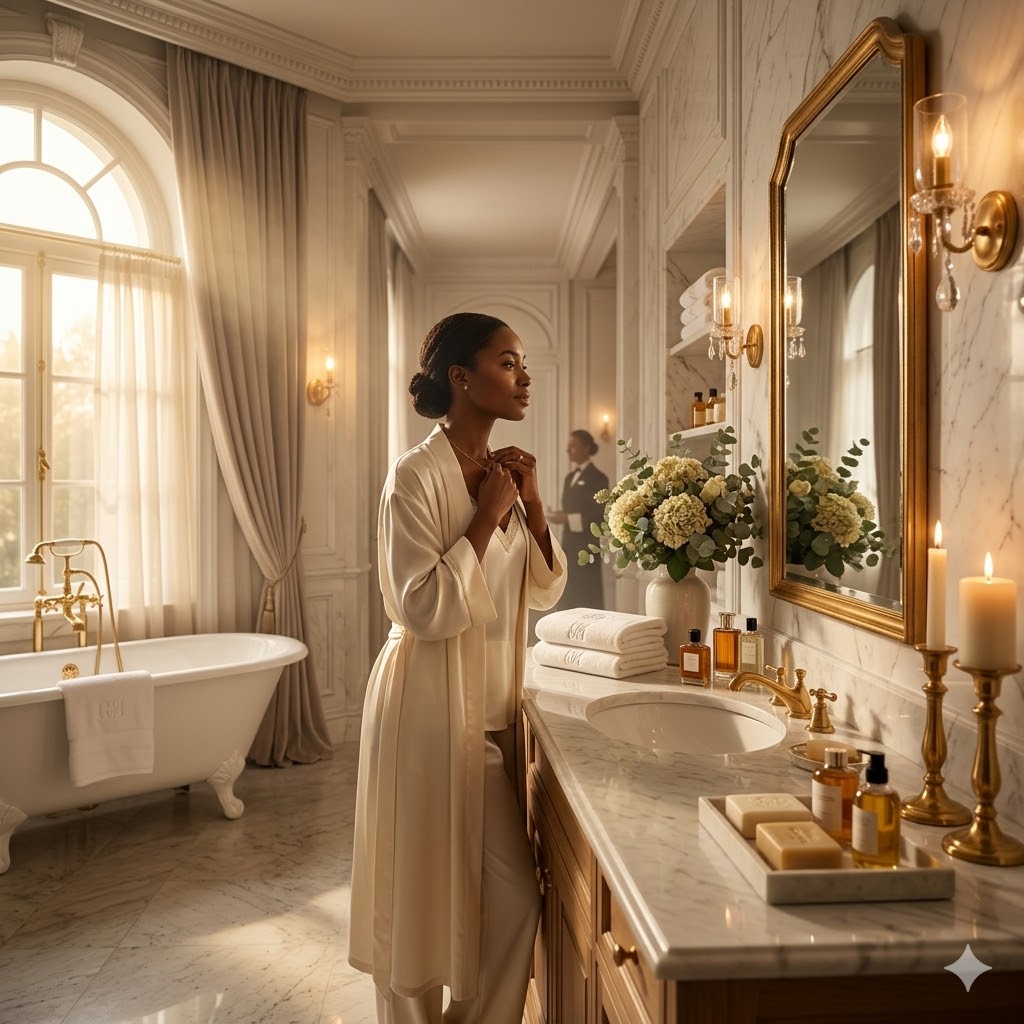
Your old money bathroom aesthetic begins the moment you open that door and decide that your space deserves better than ordinary.
There is a very specific feeling you get when you walk into a luxury hotel bathroom.
The air feels calmer.
The light feels warmer.
Everything looks like it was placed there on purpose, with intention and with taste.
That feeling is not accidental, and it is not exclusively reserved for five-star resorts or multi-million dollar homes.
It is the result of very deliberate design choices — choices that communicate elegance without screaming for attention, which is exactly what the old money aesthetic is all about.
Quiet.
Refined.
Timeless.
In 2026, more homeowners are trading loud, trend-driven bathroom designs for something with more depth, more character, and more staying power.
The good news is that achieving this look does not require a complete gut renovation or a designer budget.
It requires understanding which details truly matter and then executing them with care.
This article walks you through twelve bathroom decor ideas that draw from both classic old money design principles and the kind of practical upgrades that real interior designers use with their real clients.
Every tool, product, and reference mentioned here is real and verifiable.
Nothing has been invented to sound impressive.
1. Start With a Double Sink Vanity — The Anchor of Every Luxury Bathroom
A well-chosen double sink vanity is one of the first things design professionals reach for when they want to give a bathroom that immediate old money bathroom aesthetic upgrade.
Walk into any five-star hotel suite — think the Four Seasons, the Ritz-Carlton, or a St. Regis property — and the double sink is almost always present, sitting at the center of the vanity area like the room was built around it.
And in many cases, it was.
The reason double sinks communicate luxury so effectively is not just about function, although the function is real and meaningful for couples and busy households.
It is about symmetry.
Old money design has always prioritized balance, and a double sink vanity creates a naturally symmetrical focal point that anchors the entire bathroom.
When you choose a vanity in a rich walnut finish, a matte white with brushed brass hardware, or a deep navy blue with polished nickel, you are not just picking a cabinet.
You are setting the tone for everything else in the room.
The extended counter space that comes with a double sink also removes visual clutter, because you now have room to properly organize your essentials without things feeling cramped or chaotic.
Clean counters are a hallmark of old money spaces.
They signal that everything has a home and a purpose.
If you are considering a double sink vanity upgrade, brands like Kohler, James Martin Furniture, and Restoration Hardware all offer options across different price points that carry that refined, hotel-caliber look.
2. Large Format Marble for Walls and Floors — Because Nothing Reads Old Money Like Stone
There is a reason marble has been the material of choice for palaces, cathedrals, and luxury residences for centuries.
It does not go out of style.
It only gets more beautiful.
Large format marble tiles — think slabs that are 24 inches by 48 inches or larger — are one of the most powerful tools in old money bathroom aesthetic design because they eliminate the visual noise of excessive grout lines.
When your eye moves across a wall or floor that is covered in uninterrupted marble veining, the brain registers spaciousness, richness, and calm all at once.
That is the exact emotional response luxury hotel designers are engineering when they specify large format stone for their projects.
The veining in marble, whether it is the soft grey lines in Carrara, the dramatic gold runs in Calacatta Gold, or the warm earthy tones in Emperador, tells a story of age and permanence.
These are materials that look like they have always been there and will continue to be there long after trends have come and gone.
For homeowners who cannot accommodate the cost of natural stone, high-quality large format porcelain that mimics marble convincingly is now widely available from brands like Emser Tile, Floor and Decor, and Porcelanosa.
The visual result, especially from the doorway of the room, is nearly indistinguishable from the real thing.
Apply it to your shower surround, your floor, or even a single accent wall behind the vanity, and watch how dramatically the room shifts.
3. Sconces on Either Side of the Mirror — Lighting the Way Designers Do
Most bathrooms get this wrong.
They install a single overhead light or a basic light bar above the mirror, and then wonder why the space never quite feels finished.
Professional interior designers — including well-known voices in the space like Carrie Waller of Penny Modern, who has worked with clients across different budget levels — consistently point to side-mounted sconces as one of the most impactful and often overlooked bathroom upgrades available.
When light comes from the sides of your face rather than from above, it is more flattering, more even, and far closer to what luxury hotels and high-end restaurants actually use.
Mounting sconces at roughly face height on either side of your mirror transforms the entire quality of light in the bathroom.
It softens shadows.
It makes morning routines feel more intentional.
It elevates the atmosphere from practical to genuinely pleasant.
If hardwiring new sconces is not within your current budget or renovation scope, battery-operated wall sconces from brands like Threshold by Studio McGee, available at Target, are a genuinely stylish and flexible solution.
Many of these come with remote controls, adjustable brightness settings, and rechargeable batteries — meaning no electrician, no drywall work, and no drama.
Look for brushed brass or matte black finishes to stay within the old money bathroom aesthetic language.
4. A Large Framed Mirror That Makes a Statement
Think of your bathroom mirror the way a stylist thinks about a statement piece in an outfit.
It is not just functional.
It is defining.
A large framed mirror above your vanity does three things simultaneously: it reflects and amplifies light, it makes the room feel larger, and it establishes the visual personality of the entire space.
In old money design, the frame matters enormously.
An ornate gold-leafed frame signals classical European elegance.
A heavy, dark wood frame suggests the kind of old American wealth you see in historic manor homes.
A slim, brushed brass frame reads as quietly modern with heritage undertones.
None of these choices are wrong.
They all communicate intentionality, which is the core of what old money bathroom aesthetic design is really about.
Mirrors with arched tops or pill-shaped silhouettes also add a softness and curvature that balances the hard angles typical of most bathroom layouts.
You can find beautiful options at places like HomeGoods, Anthropologie Home, and Restoration Hardware, or source vintage pieces from Facebook Marketplace and have them refinished in the finish of your choice.
Rub and Buff, a widely available metallic wax product, can transform the frame of an inexpensive mirror into something that looks custom and expensive in under an hour.
5. A Floating Vanity With Under-Cabinet LED Lighting
Floating vanities have been a staple of luxury bathroom design for over a decade, and they have not lost their relevance because they solve a real problem elegantly.
By lifting the cabinetry off the floor, a floating vanity creates a visual gap that tricks the eye into reading the room as larger than it actually is.
The floor appears to extend further.
The ceiling appears higher.
The room breathes.
This is particularly valuable in smaller bathrooms where every optical illusion of space counts.
What takes this from stylish to genuinely hotel-caliber is the addition of LED light strips underneath the cabinet.
When soft, warm light spills from beneath the vanity onto the floor, it creates an ambient glow that is both visually sophisticated and practically useful for nighttime bathroom trips.
Motion-sensing LED strips — which activate automatically when someone enters the room — are widely available on Amazon and from brands like Govee and Kasa Smart, and they add a level of quiet intelligence to the space that feels intentional and luxurious.
This combination of floating form and ambient underlighting is a consistent feature in five-star hotel bathrooms around the world, and it is one of the most accessible ways to bring that same sensibility into a personal space.
6. Mix Your Metals — Don’t Let Everything Match
One of the clearest signals that a bathroom was designed by a professional is the deliberate mixing of metal finishes.
Matching everything — the faucet, the towel bar, the cabinet hardware, the mirror frame — in the exact same finish is actually a mark of amateur design, not luxury design.
Luxury designers mix metals because doing so adds depth, visual interest, and a sense of collected-over-time sophistication that is central to old money bathroom aesthetic sensibility.
Old money spaces never look like they were purchased all at once from a single showroom.
They look like they evolved.
The practical approach to mixing metals is to follow a ratio.
Keep roughly 80 percent of your hardware in one dominant finish and use the remaining 20 percent as an accent.
Combinations that work particularly well include brushed brass with matte black, polished nickel with aged bronze, and chrome with warm gold.
What you want to avoid is mixing two finishes that are too similar without enough contrast — for example, brushed nickel alongside polished nickel.
The difference is too subtle to read as intentional and ends up looking like a mismatch rather than a design choice.
7. Towel Display That Looks Like Room Service Just Came Through
How your towels are displayed matters as much as the quality of the towels themselves.
This is a point that experienced designers make repeatedly, and it is completely true.
A bathroom with expensive tile and beautiful fixtures can still feel flat and unfinished if the towels are mismatched, crumpled, or just tossed over a bar without thought.
The hotel approach to towel display — which fits perfectly within the old money bathroom aesthetic — involves folding towels into precise thirds and hanging them side by side on a towel bar, or rolling them neatly and standing them in a basket or on an open shelf.
Stacking small washcloths on a wooden tray near the sink is another simple detail that reads immediately as luxurious.
For the towels themselves, you do not need to spend a great deal.
Target’s Threshold Performance Towels are frequently cited by budget-conscious designers as offering hotel-quality weight and softness at an accessible price point.
Keeping your towels in a neutral color palette — white, ivory, stone, or soft grey — reinforces the timeless, restrained palette that old money design relies on.
8. Art on the Walls — Because Luxury Spaces Are Never Purely Functional
Bathrooms are rooms that guests use, and rooms that guests use form impressions.
Adding framed art to your bathroom walls is something that most homeowners skip entirely, and luxury designers almost never do.
Art adds personality, depth, and a sense that the space was curated by someone with genuine taste.
For an old money bathroom aesthetic, the best art choices lean toward black and white photography, architectural drawings, landscape prints with muted palettes, or framed botanical illustrations.
These are the kinds of images you would find in the bathroom of a Georgian estate or a well-appointed London townhouse.
They communicate education, travel, and a long relationship with beautiful things.
You do not need to spend significantly on art.
Target’s Threshold by Studio McGee line includes framed prints with quality finishes at accessible price points.
Etsy is another excellent source for printed and framed art in a wide range of aesthetics, including antique maps, vintage portraits, and nature studies that all fit beautifully within the old money design language.
Use Command strips if you want to avoid drilling, and hang art at eye level or just slightly above for the most balanced visual result.
9. A Real Rug Instead of a Basic Bath Mat
The fuzzy rectangular bath mat is one of the most common fixtures in ordinary bathrooms and one of the most reliable ways to undercut an otherwise elegant space.
Luxury bathrooms do not use standard bath mats.
They use rugs.
This shift — from mat to rug — is one of the most immediate visual upgrades available to anyone working within the old money bathroom aesthetic, and it costs very little to execute.
A flatweave cotton rug, a vintage-style Persian runner, or even an indoor-outdoor rug in a muted geometric pattern instantly connects the bathroom to the rest of the home and signals that the space was designed with continuity in mind.
For practicality, washable rugs are the most sensible choice.
Ruggable is a well-known brand that offers two-piece rug systems — a non-slip base pad that stays on the floor and a removable cover that goes directly into the washing machine.
Their catalog includes options in vintage, modern, and organic styles that work beautifully in a refined bathroom setting.
Amazon also carries a wide selection of washable flatweave rugs in neutral tones that suit the old money palette well.
10. Raise the Shower Curtain as High as It Will Go
This one is simple, inexpensive, and immediately effective.
The same principle that makes floor-to-ceiling curtains in a living room feel grand applies directly to shower curtains in a bathroom.
When you hang your shower curtain as close to the ceiling as possible — rather than at standard rod height — the eye is drawn upward.
The room reads as taller.
The space feels more generous and deliberate.
This is a technique used in small bathrooms and large ones alike because it works regardless of the actual square footage.
Extra-long shower curtains in lengths of 84 inches or 96 inches are available on Etsy, Amazon, and through specialty home retailers.
For an old money bathroom aesthetic, choose curtains in linen, heavyweight cotton, or textured polyester in white, ivory, or soft stone tones.
Avoid busy prints or novelty patterns.
The goal is a curtain that looks like it belongs in a spa, not a catalog sale.
Pair it with an extra-long liner to keep water contained, and finish the look with ring clips in a metal finish that coordinates with your other hardware choices.
11. Matched Countertop Accessories in Quality Materials
Walk into any five-star hotel bathroom and look at the countertop.
You will notice that the soap dispenser, the lotion pump, the toothbrush holder, and any other visible accessories all belong to the same family.
Same finish.
Same material.
Same visual language.
This cohesion is not accidental — it is one of the details that separates spaces that feel considered from spaces that feel assembled.
Within the old money bathroom aesthetic, countertop accessories should be kept in materials like glass, ceramic, brushed stone, or high-quality resin in a matte finish.
Avoid plastic wherever possible, and avoid collections that mix too many different finishes or shapes.
A simple set — soap dispenser, small tray, toothbrush holder — in a unified aesthetic takes up very little counter space and makes a disproportionately large visual impact.
Target, West Elm, and CB2 all carry coordinated bathroom accessory collections at different price points that translate this principle into accessible products.
A small tray to corral the accessories adds one additional layer of organization and polish that the eye immediately registers as intentional.
12. Layer Your Scents Like a Luxury Hotel Does
Old money design understands that true luxury is not just visual.
It is experiential.
And one of the most powerful sensory tools available in a bathroom — and one of the most consistently overlooked — is scent.
High-end hotels layer their scents deliberately.
They do not just place a single candle on a shelf.
They build a scent environment using multiple sources — a reed diffuser for continuous background fragrance, a candle for warmth and occasion, and sometimes dried botanicals or fresh eucalyptus hung near the shower for a natural, spa-like depth.
The eucalyptus and mint combination is a classic in this category.
Reed diffusers from brands like Nest New York, Diptyque, and Vitruvi all offer sophisticated fragrance profiles that align with the restrained, refined sensibility of old money aesthetic bathrooms.
For more accessible options, Target’s Studio McGee line includes reed diffusers in clean, botanical scents like sage and white tea that work well in a layered fragrance approach.
The key is contrast and balance — pair something earthy and grounding, like cedarwood or vetiver, with something lighter and fresher, like eucalyptus or bergamot.
The result is a bathroom that smells expensive before anyone looks at a single tile or fixture.
Bringing It All Together
These twelve ideas are not a checklist to complete all at once.
They are a set of principles to apply gradually, with intention and with an eye toward cohesion.
The old money bathroom aesthetic is ultimately about permanence.
It is about choosing things that look like they have always belonged there and will continue to belong there long after whatever trend is currently popular has faded.
Double sink vanities that anchor the room.
Large format marble that silences visual noise.
Sconces that flatter and soften.
Statement mirrors that define character.
Floating vanities with ambient underlighting.
Deliberately mixed metals.
Towels displayed with hotel precision.
Art that suggests a life well-lived.
Rugs that connect the room to the rest of the home.
Shower curtains that reach for the ceiling.
Matched accessories that speak quietly and clearly.
Layered scents that complete the sensory experience.
Each one of these choices, made well and placed thoughtfully, moves your bathroom closer to the kind of space that feels like a reward every single morning you walk into it.
That is what old money design has always been about.
Not showing off.
Just living well.

We strongly recommend that you check out our guide on how to take advantage of AI in today’s passive income economy.