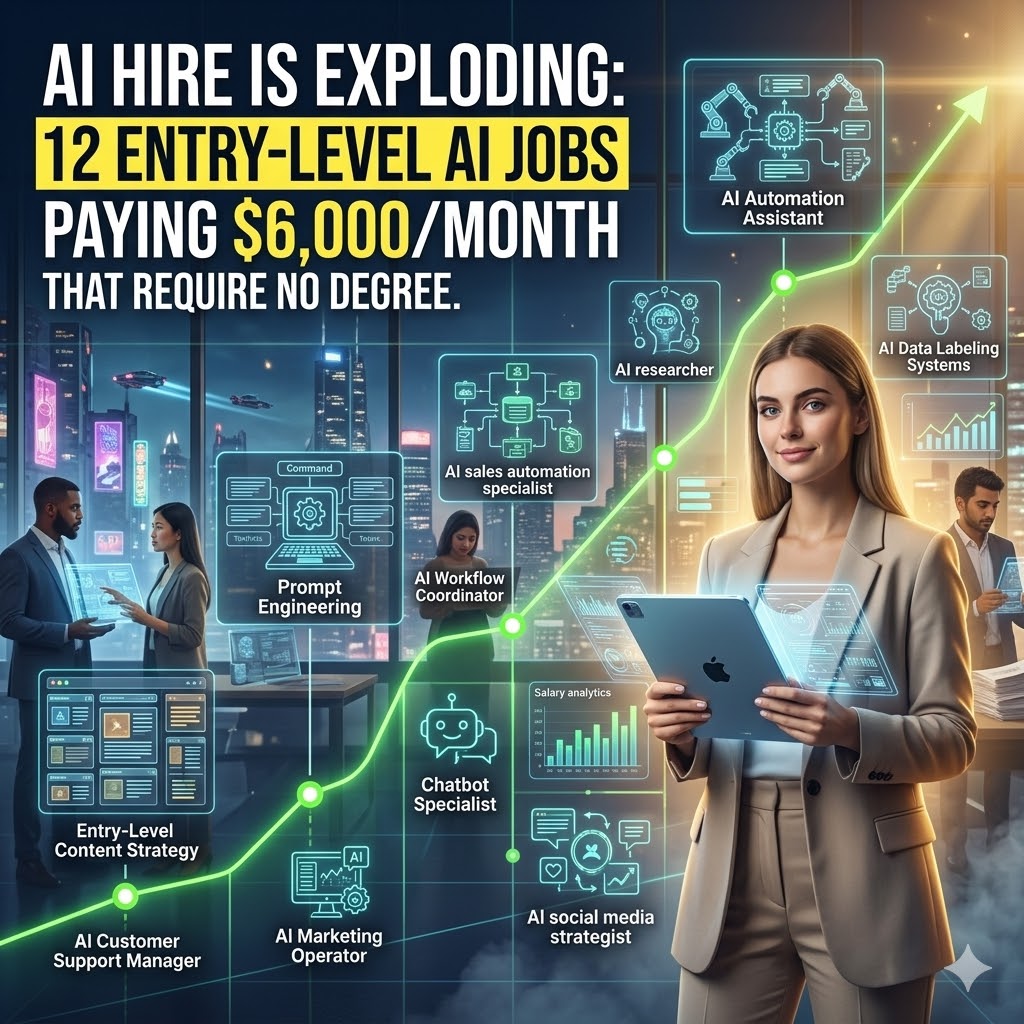
12 AI Careers Paying $6,000/Month in 2026 — No Degree, No Prior Tech Background
The AI Job Market in 2026 Is Nothing Like What You’ve Been Told
The AI hire wave sweeping across industries in 2026 is not just for computer science graduates or Silicon Valley insiders — it is wide open, and it is paying real money fast.
Right now, companies across healthcare, finance, law, and tech are rushing to fill hundreds of thousands of roles tied directly to artificial intelligence.
These are not ghost job listings.
These are active, paid positions, and many of them start at $6,000 per month or more without a single college degree requirement.
According to a PwC analysis of nearly one billion global job advertisements in 2025, workers with verified AI skills earn an average of 56% more than equivalent workers without those skills.
That number alone should stop you in your tracks.
The World Economic Forum published data in 2026 confirming that AI skills carry a 23% wage premium in today’s labor market — nearly three times the 8% wage premium attached to a four-year bachelor’s degree.
Think about what that means: a skill you can build in three to six months is now worth almost three times more than four years and $80,000 in student loans.
This article is going to walk you through 12 real, entry-level AI jobs hiring right now in 2026 that pay $6,000 per month or more, require no degree, and are accessible to people from almost any background.
We strongly recommend that you check out our guide on how to take advantage of AI in today’s passive income economy.
Table of Contents
Why the AI Hire Explosion Is Happening Right Now
The Floor of the Old Career Ladder Is Collapsing
Data from the Burning Glass Institute shows that between 2018 and 2024, entry-level software development roles as a share of total job postings dropped from 43% down to 28%.
Entry-level data analysis positions fell from 35% to 22% in the same period, and overall entry-level job postings are down approximately 35% since January 2023.
The traditional career path — graduate, apply for entry-level work, climb slowly — is shrinking at the exact same moment that AI skill roles are multiplying.
Lightcast independently analyzed 1.3 billion job postings and confirmed an average $18,000 annual salary increase for any role that lists AI skills as a requirement — and this applies to any job category, not just AI-specific titles.
Oxford University researchers reviewed 11 million job postings and found that from 2018 to 2023, demand for AI skills grew 21%, while mentions of university degree requirements in those same AI postings fell 15%.
The market is not asking for your diploma.
It is asking for what you can do.
Unique job postings requiring AI skills jumped from just 55 in January 2021 to nearly 10,000 by May 2025, which is a 180-times increase in just four years.
The door is not opening — it is already wide open, and the people walking through it right now are not waiting for permission.
12 Entry-Level AI Jobs Paying $6,000/Month or More in 2026
1. AI Trainer and RLHF Specialist
What the job actually is:
RLHF stands for Reinforcement Learning from Human Feedback, and it is literally the process by which AI systems like ChatGPT, Claude, and Google Gemini learn to behave helpfully.
Humans compare pairs of AI-generated outputs, rate their quality, flag safety issues, and write better example responses, and the AI learns from those human judgments.
At the entry level, general annotation work on platforms like Scale AI, Outlier AI, and Merkle pays between $15 and $25 per hour.
But here is where it gets interesting fast: those exact same platforms pay medical professionals, lawyers, and financial experts between $130 and $450 per hour for the same type of task simply because of domain expertise.
Merkle’s publicly available data shows their average hourly rate across all domain experts is $81 per hour, with senior domain experts at four-plus years of professional experience earning over $200 per hour.
One freelancer publicly documented earning $60,000 in just three months working AI trainer contracts at $80 per hour starting in late 2025.
Full-time data annotation and equivalent roles average $115,000 per year, while senior RLHF specialists at companies like Anthropic and OpenAI earn between $120,000 and $180,000 plus equity.
The data annotator role category has grown 150% year over year as of 2026, and the overall labeling and evaluation market is projected to reach $17.1 billion by 2030 at a 28.4% annual growth rate.
2. AI Quality Analyst and LLM Evaluator
What the job actually is:
Companies deploying large language models need real human beings to systematically test those models, find failures before customers do, document biases, and verify outputs in real use cases like healthcare, law, and finance.
According to ZipRecruiter’s March 2026 data, the national average salary for this role is $65,000 per year, with AI quality and evaluation specialists earning between $80,000 and $110,000 annually.
This role barely existed before 2025 — the SkillSets 2026 Salary Guide explicitly describes it as “a new role that barely existed before 2025.”
The time to qualify is roughly two to four months of structured self-study with no computer science degree required.
This is also the gateway role for anyone building toward the domain expert premium described in role number one above — you start as a generalist evaluator, build domain-specific credibility in your field, and the hourly rate follows naturally.
The entry-level AI hiring for quality analysts positions are currently most active in fintech, healthcare software, and enterprise SaaS companies deploying AI into regulated workflows.
This role rewards people who think critically, communicate precisely, and understand how to pressure-test a system — skills that come from journalism, psychology, law, education, and countless other non-technical fields.
3. AI Product Manager (AIPM)
What the job actually is:
AI Product Managers do not build the models — they define what the models should do, manage the product roadmap, translate between the technical team and the business side, and own the product decisions that determine whether an AI product succeeds or fails.
The US average salary for an AIPM is $133,000 per year according to the most recent available data, with entry ranges between $100,000 and $120,000 and senior ranges of $150,000 to $200,000 and above.
Netflix has posted AIPM roles with total compensation ranges from $300,000 to $900,000.
As of late 2023, there were nearly 6,900 open AIPM postings in the United States, and that number has grown significantly since.
The no-degree pathway is direct: prior product management, operations, marketing, or project management experience forms the foundation, and layering on Microsoft’s AI Product Manager Professional Certificate — which takes roughly three months — provides the credential needed to compete.
Most AIPM job postings explicitly list experience and portfolio above education requirements, making the degree line increasingly optional in this field.
Industries actively hiring for AIPMs right now include fintech, healthcare, enterprise SaaS, and the entire generative AI startup ecosystem.
4. Conversational AI Designer
What the job actually is:
Someone has to design exactly how AI systems talk to people — how a chatbot responds when a customer is angry, how a voice assistant handles a confusing question, and how an AI guide maintains its tone consistently across thousands of different interactions.
This is not a coding role.
It is a UX, writing, and linguistics role, and companies are actively recruiting people from user experience design, technical writing, linguistics, communications, and even English literature backgrounds.
According to ZipRecruiter’s April 2026 data, the national average for conversational AI designers is $83,000 per year, with senior roles ranging from $110,000 to $140,000 according to CDI compensation data.
The time to qualify is four to eight months of structured learning with no computer science degree required in any active job posting for this role.
The AI hire demand for conversational designers is growing fastest at companies that deploy AI customer service at scale — think banking, healthcare portals, insurance, and telecommunications.
If you have spent years as a writer, UX designer, communication professional, or anyone whose career involved getting words exactly right and making complex language feel simple and human, this field is actively importing your skill set.
5. AI Safety Red Teamer
What the job actually is:
Red teaming in AI means your job is to break the AI before bad actors do — find the jailbreaks, expose the biases, surface the confident wrong answers that could cause real harm in a medical consultation, a legal decision, or a financial recommendation.
This role comes from security culture but does not require hacking skills.
Many of the best AI red teamers working today come from journalism, psychology, law, and philosophy because the core skill is not technical exploitation — it is adversarial creative thinking.
LinkedIn has publicly posted its own AI safety red teaming roles at $55 to $65 per hour, with mid-level full-time ranges of $120,000 to $160,000.
Senior red teaming roles at Google, Mandiant, Intopic, and Netflix sit between $132,000 and $226,000 and above.
The smarter AI gets, the more red teaming it needs — as models move into medicine, law, and finance, the stakes attached to a single confident wrong answer rise significantly.
Demand for human adversarial oversight does not decrease as AI improves; it increases, which means this is one of the most structurally secure AI hire categories in the entire field.
6. AI Governance Analyst
What the job actually is:
The EU AI Act came fully into force in 2025 and is now the most comprehensive AI regulation in the world.
Companies deploying what the regulation classifies as high-risk AI systems — in hiring, credit scoring, healthcare, and law enforcement — face mandatory compliance requirements with penalties up to 35 million euros or 7% of global annual turnover, whichever is higher.
Companies urgently need people who can audit AI systems, document decision-making processes, assess bias and fairness, and defend their AI deployments to regulators — and that is not a coding job.
Drops February 2026 Talent Intelligence Report found that demand for AI governance skills at Fortune 500 companies grew 81% year over year.
The International Association of Privacy Professionals (IAPP) 2025 survey of 1,600 professionals across 60 countries found the following salary structure for AI Governance Specialists: junior median at $130,000 per year, mid-level median at $158,000 per year, and senior median at $273,000 per year.
That senior median places AI governance specialists in the top 3% of all US earners.
The no-degree pathway is direct — backgrounds in law, policy, human resources, risk management, compliance, or social sciences are the accepted on-ramps, and the IAPP’s AI Governance Professional (AIGP) certification at $649 for members takes eight to twelve weeks to prepare for and sit through Pearson VUE.
AI compliance professionals who add AI risk expertise to their existing credentials are reporting salary increases of 30% to 40% because the demand is structural, non-discretionary, and the supply of qualified people is nowhere close to meeting it.
7. Junior Data Scientist
What the job actually is:
Junior Data Scientists work within AI and analytics teams to clean, organize, and interpret large datasets that machine learning systems use to make predictions and decisions.
According to University of San Diego salary data, entry-level junior data scientists earn between $98,000 and $151,000 annually, making this one of the highest-paying entry points in the entry-level AI hiring market for 2026.
Many companies hiring for this role in 2026 are placing demonstrated portfolio work — real projects completed in Python, R, or SQL — above formal degree requirements in their screening process.
Platforms like Kaggle, which is owned by Google, allow anyone to build a public data science portfolio by competing in real data challenges for free, and hiring managers at companies including Shopify and Airbnb have publicly stated they review Kaggle profiles as a primary signal.
The role is evolving rapidly as AI tools automate portions of the data cleaning workflow, which means junior data scientists who understand how to prompt and supervise AI-assisted analysis are commanding significantly higher starting offers.
8. Machine Learning Apprentice
What the job actually is:
Machine Learning Apprentices work alongside senior ML engineers to help build, test, and refine the models that power AI applications across industries from healthcare diagnostics to personalized retail recommendations.
Entry-level salaries for this role range from $72,000 to $131,000 per year according to University of San Diego compensation data.
Structured apprenticeship programs at companies including IBM, Microsoft, and Google have explicitly removed degree requirements from their ML apprentice tracks in response to the documented talent shortage across the field.
The AI hire expansion in machine learning is currently most concentrated in healthcare AI, financial services modeling, autonomous systems, and natural language processing applications.
Practical bootcamp programs from providers like Fast.ai and DeepLearning.AI — both of which are free or low-cost — have produced ML apprentice candidates hired directly by major technology companies without a bachelor’s degree.
9. Junior Software Engineer (AI-Focused)
What the job actually is:
Junior Software Engineers working on AI-focused teams in 2026 are not building AI from scratch — they are integrating existing AI APIs, maintaining AI pipelines, testing AI-powered features, and writing the code that connects AI models to real products.
Entry-level salaries in this category range from $108,000 to $173,000 per year according to University of San Diego data, making this the highest-paying entry-level category on this entire list.
OpenAI runs a program called the OpenAI Residency, which pays approximately $220,000 per year — roughly $18,000 per month — and is explicitly designed for people with backgrounds in physics, mathematics, neuroscience, or software engineering who lack formal machine learning experience.
That detail is critical: OpenAI, the company most associated with the AI revolution, is paying $220,000 a year for people who do not have AI credentials because what they actually need is people who are exceptionally good at thinking in their domain.
Coding bootcamps that specifically prepare candidates for AI-adjacent software roles — including App Academy and Flatiron School — have documented graduate placement rates for AI-adjacent roles that continue to grow year over year.
10. Junior Data Analyst (AI Tools Specialist)
What the job actually is:
Junior Data Analysts who specialize in AI tools are being hired to use platforms like Microsoft Copilot, Google Looker, and Tableau AI to generate business insights faster than traditional analytical methods allow.
Entry-level salaries for this role range from $64,000 to $109,000 per year according to University of San Diego data.
The Microsoft AI-900 Azure AI Fundamentals certification — which costs $99, requires no coding, and takes two to three weeks to complete — directly qualifies candidates for $65,000 entry roles in this category.
The Microsoft AI-102 certification, which sits one level above AI-900 and targets the $85,000 to $120,000 salary band, proves prompting and workflow skills that data analyst employers are specifically screening for in 2026.
Total cost for both Microsoft certifications: $198 and approximately six weeks of study with no prior technical background required.
For anyone entering the AI hire market from a business, marketing, finance, or administrative background, the junior data analyst with AI tools specialization is the clearest and fastest-documented path to $6,000 per month.
11. AI Prompt Engineer (Embedded Role)
What the job actually is:
The standalone “prompt engineer” job title that made headlines in 2023 with salary claims of $175,000 to $300,000 has largely evaporated as Gartner officially declared in July 2025 that context engineering has replaced prompt engineering as the relevant industry skill.
However, the underlying skill — knowing how to give precise, structured instructions to AI systems — did not disappear.
It got embedded into nearly every other professional role, and the professionals who have this skill built into their existing job title are consistently commanding higher salaries than colleagues who do not.
Developers, product managers, data analysts, governance specialists, and content strategists who can demonstrate AI prompting and context engineering skills are earning between $20,000 and $40,000 more annually in equivalent roles according to Lightcast job posting data.
The no-degree AI hire pathway for this skill is fastest through structured prompt engineering courses on platforms like DeepLearning.AI’s “ChatGPT Prompt Engineering for Developers” course — which is free — and Anthropic’s publicly available prompt engineering documentation.
12. AI Research Assistant
What the job actually is:
AI Research Assistants support machine learning research teams by gathering and preparing training data, reviewing academic literature, running experiments under the supervision of senior researchers, and documenting findings.
Entry-level salaries range from $70,000 to $117,000 per year according to University of San Diego data.
The story of Allison Harbin is the clearest documented example of how this role actually works in 2026: she holds a PhD in art history from Rutgers — not computer science, not data science — and contracted with Google Gemini’s team in October 2023 to help train their AI system by evaluating outputs and providing expert human judgment on quality, accuracy, and nuance.
She is now earning over $100,000 a year at a healthcare technology company working fully remote with no relocation and no computer science background whatsoever.
CNBC covered her story specifically because it challenges everything people believe about who gets hired in AI — her credential was not a degree in the right field, it was the ability to think with rigor, evaluate complex outputs critically, and communicate precisely.
Those are the exact skills that AI labs need more of as models get more powerful, and they are present in people from hundreds of non-technical professional backgrounds.
The Fastest Certification Path Into AI Hiring in 2026
Under $850, Under 6 Months, No Technical Background Required
For anyone looking to enter the AI hiring boom as fast as possible without spending thousands of dollars on boot camps, here is the certification stack that currently offers the highest documented return on investment:
Microsoft AI-900 Azure AI Fundamentals — $99, no coding required, two to three weeks to complete, qualifies for $65,000 entry roles.
Microsoft AI-102 AI Business Professional — $99, no coding required, two to three weeks to complete, targets the $85,000 to $120,000 salary band and specifically proves prompting and workflow skills.
IAPP AI Governance Professional (AIGP) — $649 for members, eight to twelve weeks of preparation, sits through Pearson VUE, and maps directly to the junior AI governance specialist median salary of $130,000 per year.
The total investment is under $850 and under six months from start to first qualified application.
Applying what investment professionals call the $100 rule: for every dollar spent, salary data should suggest at least $1,000 in annual senior premium — with $850 spent against a $130,000 entry salary in a field with 81% demand growth, the math works decisively in your favor.
A compliance officer with twelve years of experience in financial services who spent six months getting the AIGP certification and building AI risk vocabulary on top of her existing expertise did not change careers — she changed her value proposition within the career she already had, and saw a 35% salary increase as a direct result.
What Your Existing Background Is Actually Worth in the AI Economy
Your Domain Expertise Is the Asset AI Labs Cannot Build Without You
The most important thing to understand about the AI hire landscape of 2026 is this: AI labs are not only looking for coders.
They are looking for people who know things.
A radiologist working as a Merkle domain evaluator earns more per hour from AI labs than they earn in their clinical setting.
An investment banking analyst quoted by CNBC described working as a Merkle finance evaluator as having what he called “hard to imagine a better hourly job from a pay perspective.”
The skill you already have from your career, your education, or your years of professional expertise is exactly what AI companies cannot build without human input.
Your background is not a liability in the AI economy.
Your background is your competitive advantage.
The Oxford University researchers who analyzed 11 million job postings put it plainly: the traditional path of university education leading to higher pay is no longer the default outcome for AI professionals.
What the market is paying for right now is demonstrated skill, domain expertise, critical evaluation, and the ability to keep learning as the field evolves.
Conclusion: The Door Is Open Right Now
The entry-level AI hiring surge in 2026 is the most significant career opportunity most people will encounter in their working lifetime — and it is happening right now, not in five years.
The data annotator role has grown 150% year over year.
The AI governance market is growing at 81% year over year at Fortune 500 companies.
The labeling and evaluation market is projected to reach $17.1 billion by 2030.
A $220,000-per-year residency program at OpenAI is actively recruiting people without AI credentials.
The AI job market does not care where you went to school.
It cares what you know, what you can evaluate, what you can govern, and what you can build — and there has never been a moment in history where those capabilities were more valuable, more accessible to learn, and more urgently needed by the companies building the future.
The twelve roles in this article are real, the salaries are documented, the certification paths are affordable, and the demand is structural.
The only question is whether you are going to walk through the door.

We strongly recommend that you check out our guide on how to take advantage of AI in today’s passive income economy.