Why the World’s Most Elegant Homes Never Shout — They Whisper
When a Room Speaks Before You Do
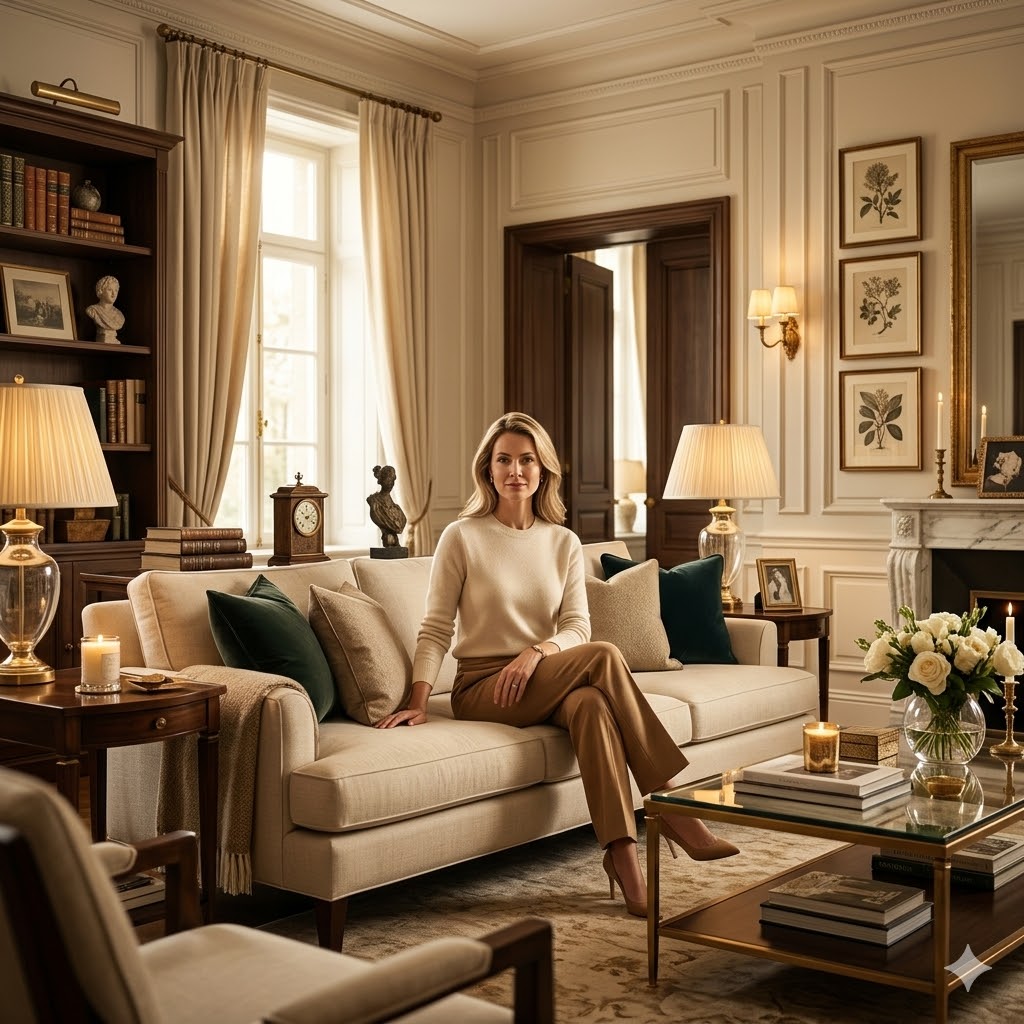
Old money living room design has a language all its own, and the moment you walk through the door, it speaks directly to your senses before a single word is said.
You have probably stepped into someone’s home and felt it immediately.
Not the blinding flash of a gold chandelier or the aggressive sparkle of mirrored furniture.
Something quieter.
Something deeper.
A sense that everything in the room has earned its place over decades, maybe even centuries.
The sofa sits low and wide, covered in a fabric so well-worn it looks deliberately faded.
The curtains hang heavy from floor to ceiling, pooling slightly at the base like they have always been there.
There is no attempt to impress anyone.
And yet, the room impresses everyone.
This is the soul of the old money living room formula — quiet luxury that never chases trends because it was never built on them in the first place.
The good news is that this formula is not locked inside a Connecticut estate or a London townhouse.
It is a set of principles, a philosophy about space, comfort, and beauty that anyone can learn, apply, and live inside every single day.
This article breaks down that formula completely, piece by piece, so you can bring the same effortless elegance into your own home.
We strongly recommend that you check out our guide on how to take advantage of AI in today’s passive income economy.
Table of Contents
The Core Philosophy — Why Old Money Rooms Never Shout
Before you move a single piece of furniture or buy a single throw pillow, you need to understand the mindset behind the old money living room aesthetic.
Because this is not just a decorating style.
It is a set of values that gets expressed through color, material, proportion, and restraint.
The ultra-wealthy families who built these interiors over generations were not trying to impress visitors.
They were building spaces that worked for real life — for reading by the fire, for long conversations over wine, for rainy Sunday afternoons that stretch without schedule.
Every piece in an old money living room was chosen for its quality and its longevity, not its price tag.
That is actually the biggest distinction between new money decorating and the old money quiet luxury interior design formula.
New money buys for visibility — the statement coffee table, the oversized abstract canvas in electric teal, the conversation-starting sculpture that arrived last Tuesday.
Old money buys for permanence — the Persian rug that has been in the family since 1948, the reading chair that was reupholstered three times because the frame is too good to replace.
Restraint is the discipline.
Quality is the religion.
Time is the proof.
When you walk into a room built on those three principles, you feel it in your chest before your eyes even process what they are seeing.
The Color Palette — Neutrals That Age Like Fine Wine
The first and most immediate signal of an old money living room aesthetic is the color palette, and it is almost always built from a family of muted, dusty, time-worn neutrals.
Think aged linen, warm ivory, dusty sage, tobacco brown, faded burgundy, and the kind of cream that has yellowed slightly around the edges of old books.
These are not colors you find on a trend forecast.
They are colors you find in nature, in history, and in rooms that have been quietly inhabited for decades.
The walls in a classic old money living room are rarely stark white.
Instead, they carry the warmth of an antique white or a soft stone gray, sometimes brushed with a very pale sage or a hazy blue-green that designers at firms like de Gournay or Farrow & Ball have perfected into their most iconic shades.
Farrow & Ball, the British paint house founded in 1946 and long favored by traditional English country homes and aristocratic estates, produces colors like Elephant’s Breath, Mole’s Breath, and Dead Salmon — names that sound eccentric but translate on a wall into something breathtaking in their calm authority.
These are paints that old money living room quiet luxury interiors have leaned on for generations precisely because they carry depth and complexity without demanding attention.
The ceiling in these rooms is almost always painted the same shade as the walls, or a tone lighter, which creates a cocooning sense of enclosure that feels safe, anchored, and warm.
Accent colors appear sparingly.
A faded rust in the pattern of an antique rug.
A deep navy in the piping of a throw pillow.
A single shelf of leather-bound books whose spines range from cognac to oxblood.
Nothing competes.
Everything belongs.
The Furniture Formula — Built to Last Three Generations
Sofas and Seating — The Art of Comfortable Authority
The furniture in an old money quiet luxury living room never looks like it just arrived from a showroom.
It looks lived-in, cared-for, and deeply intentional.
The sofa in these rooms is typically large, low-profile, and upholstered in a natural fabric — linen, cotton velvet, or a woven wool that has softened over years of use.
It is not the kind of sofa that photographs well in a design magazine with perfectly fluffed cushions and a strategically placed fig branch.
It is the kind of sofa that has shaped itself slightly to the bodies that have settled into it over decades.
Brands like George Smith, the British furniture house that has been handcrafting upholstered sofas in the United Kingdom since 1991 using traditional joinery and natural materials, embody this principle completely.
Their sofas are not cheap, but they are built to be reupholstered, not replaced, which is exactly the old money approach to furniture investment.
The sitting arrangement in these rooms always prioritizes conversation over display.
Chairs face each other at slight angles.
A pair of wingback chairs flanks the fireplace, each with its own side table and reading lamp.
Nothing is pushed against the wall in a desperate attempt to create open space.
The seating clusters together the way people naturally gather — close enough for intimacy, spacious enough for comfort.
Tables and Storage — Wood That Tells a Story
The coffee table in an old money living room is almost always made of wood, often antique, often worn, and never made of glass.
Glass coffee tables belong to a different conversation — one about modernism and minimalism that sits outside this particular world.
Here, you will find a low rectangular table in walnut or mahogany, perhaps with a slightly uneven patina, perhaps with a small scratch on one corner from a grandchild’s toy in 1987.
The scratch stays.
The scratch is the point.
Bookshelves are floor-to-ceiling, always full, never styled with empty space and decorative objects arranged in groups of three.
These books have actually been read.
Side tables are mismatched by design, each one carrying its own history, its own origin story.
A small drum table from a estate sale in Virginia.
A lacquered Chinese occasional table picked up at an auction house in London’s Portobello Road market.
Nothing matches perfectly, but everything coordinates, because the underlying palette and the underlying commitment to quality creates a visual harmony that no matching furniture set can replicate.
The Textiles — Where Old Money Quiet Luxury Lives in Detail
Rugs That Anchor the Entire Room
If there is one single element that does more heavy lifting in the old money living room quiet luxury formula than anything else, it is the rug.
Not a machine-made reproduction.
Not a contemporary geometric pattern in charcoal and white.
An antique or semi-antique Persian, Turkish, or Central Asian rug with a faded, jewel-toned pattern that has mellowed into something achingly beautiful over decades.
Companies like Mansour Modern in Los Angeles and Nazmiyal Collection in New York have built entire reputations around sourcing these antique rugs, and the designers who furnish the homes of old money families return to them again and again.
The rug is large enough to sit under all four legs of every major piece of furniture in the seating area.
It defines the room’s zone.
It gives the floor a warmth and texture that no hardwood plank alone can provide.
And because it is old, because it carries the hand of a weaver who worked in Tabriz or Kashan or Anatolia a hundred years ago, it brings a weight of history into the room that no new purchase can imitate.
Curtains, Throws, and Cushions — Layered Like a Story
The curtains in an old money living room hang from a pole set close to the ceiling, not the window frame.
This elongates the room visually and creates that sweeping, grand sense of volume that makes high-ceiling rooms feel even more palatial.
The fabric is always heavy — linen, wool, or a woven cotton in a natural, undyed shade — and the curtains are always floor-length, with just enough extra length to pool at the base.
Throws are draped casually over chair arms, not folded precisely.
Cushions are plump and slightly mismatched — different sizes, similar tones, varied textures.
A knitted wool cushion next to a printed linen cushion next to a plain velvet cushion in the exact shade of the rug’s faded rose.
The Objects — Provenance Over Price Tag
Art That Has Been Chosen, Not Curated
The art in an old money living room quiet luxury space is deeply personal and rarely obvious.
You will not find a large-scale abstract print purchased from a contemporary gallery specifically to fill a wall.
You will find a small, dark oil painting of a landscape that has been in the family since the 1920s.
You will find a collection of botanical drawings in mismatched frames arranged on a smaller wall near the library shelves.
You will find a single portrait, slightly faded, of someone no one in the current generation ever met but whose presence still anchors the room.
The art tells a story.
It does not perform.
Decorative Objects — Less Is More, Always
The mantelpiece in these rooms carries a few carefully chosen objects — a pair of antique candlesticks, perhaps, a small bronze sculpture, a clock that may or may not still keep accurate time but whose face is beautiful enough that it does not matter.
The shelves hold books, a few framed photographs, and perhaps a piece of pottery from a trip abroad taken twenty years ago.
What is never present is the anxiety of empty space filled with objects purchased specifically for the purpose of filling it.
Old money interiors are not minimalist.
But they are disciplined.
Every object is there because it belongs, because it has a reason, because it has earned its square inch of space through meaning or beauty or both.
The Lighting — Warm, Layered, and Deliberately Low
Lighting in an old money quiet luxury living room is never harsh, never overhead-only, and never the cold white temperature of modern LED strips that flatten everything they touch.
These rooms are lit in layers.
A central chandelier or pendant, often antique brass or oxidized iron, provides ambient light at a warm, low wattage.
Pairs of table lamps on either side of the sofa — in ceramic or turned wood bases, with linen or silk shades — create pools of warm light that make reading comfortable and conversation intimate.
Floor lamps positioned beside reading chairs complete the picture.
The cumulative effect is a room that glows rather than blazes, a room that feels like late afternoon light on a warm autumn day even at ten o’clock on a winter evening.
The Final Ingredient — Time
There is one element of the old money living room formula that cannot be purchased, replicated, or rushed.
Time.
The faded rug has faded because it has been walked on for forty years.
The sofa has shaped itself to human bodies because human bodies have sat in it for decades.
The books are dog-eared because they have been read, loaned out, returned, and read again.
The scratch on the coffee table carries the memory of a specific afternoon that no one who was not there would understand.
This is what separates the old money quiet luxury living room from its imitations.
You can buy every element, follow every rule, and execute every principle — and you will build a room that is genuinely beautiful, genuinely calm, and genuinely elegant.
But the rooms that stop you cold, that make your chest tighten slightly with something that feels like recognition, are the ones that have been inhabited with intention over long periods of time.
The formula is the starting point.
Living in it, loving it, and letting it absorb your life is what completes it.
Start today.
Choose one piece — one rug, one lamp, one chair — that is built to last thirty years.
Treat it accordingly.
And trust that over time, your room will begin to whisper the same quiet, confident, permanent language that old money living rooms have always spoken.

We strongly recommend that you check out our guide on how to take advantage of AI in today’s passive income economy.