
How AI Agents, Automation Tools, and a Ruthlessly Simple Strategy Created a Business That Runs Without Me
The Night I Stopped Trading Time for Money
Building a self-running AI startup that earns passive income felt like a fantasy six months ago, but that fantasy became my Tuesday night at 11:47 PM.
I had 22 minutes between a client call and a midnight deadline, so I opened my laptop, pulled up three tools I had been meaning to test for weeks, and started clicking.
What happened next did not feel like work — it felt like watching a small machine quietly assemble itself into something real.
By the time I went to sleep, a fully automated business workflow was running in the background, collecting leads, delivering a digital product, and moving money into an account I barely had to touch.
This is not a story about some mythical genius who coded a startup from scratch in a weekend hackathon.
This is a story about a real framework, borrowed from one of the fastest-growing AI companies in the world, simplified for people who have more ambition than free time.
The founder behind Opus Clip, Yang Fang, built his company from zero to 50 million users and a $215 million valuation in just two and a half years, and the principles he followed are openly teachable, brutally practical, and surprisingly accessible to any solo operator willing to go deep on one painful problem.
I studied those principles, tested them against real tools available to anyone in 2026, and compressed the most actionable parts into a 22-minute build session that you can replicate tonight.
We strongly recommend that you check out our guide on how to take advantage of AI in today’s passive income economy.
Table of Contents
Why Most People Build Cool Things That Nobody Buys
The biggest trap most aspiring founders fall into is building a demo instead of a business.
Yang Fang, co-founder and CEO of Opus Clip, said it directly in a recent interview: “Many founders failed because they didn’t find product-market fit for a real business.”
He explained that a cool demo can look like magic, but magic does not pay bills, and customers do not hand over credit card details for something that impresses them without solving a real, painful, expensive problem.
The test he uses is ruthlessly simple — if your potential user is currently solving this problem manually, spending their own time or paying someone else to do it, then you have identified a real job that is painful enough to pay to eliminate.
Before I built anything that Tuesday night, I ran that test in my head for about four minutes.
I thought about the one task that kept stealing hours from my week — repurposing long-form content into short, platform-ready clips and blog posts formatted for different audiences.
Creators, coaches, and consultants all around me were either doing this manually for hours or paying video editors between $25 and $50 per clip, which is exactly the pricing benchmark Yang cited when describing Opus Clip’s value creation strategy.
That single realization unlocked everything, because I was not building a novelty — I was replacing a workflow that people already hated and already paid to escape.
The 3 Tools I Used to Build My Self-Running AI Startup in 22 Minutes
Tool One — Opus Clip for Autonomous Content Production
Opus Clip is the engine at the center of this entire build.
It is an AI-powered video repurposing platform that takes long-form footage and turns it into short, viral-ready clips using an agentic workflow called Agent Opus.
The Agent Opus feature is not just a video editor — it functions more like a director, orchestrating eight to nine specialized sub-agents that handle scripting, voiceover, avatar creation, asset sourcing, animation, and infographic generation all in one pipeline.
You drop in a piece of content — a YouTube video, a LinkedIn post, a blog article, or even a simple idea — and the agent designs a plan, assigns tasks to the relevant sub-agents, and delivers a finished multi-format content package without you touching a single timeline.
In my 22-minute session, I pasted a LinkedIn post I had written the previous week, typed a short prompt asking the agent to turn it into a viral short-form video, and let the system run while I opened my second tool.
Yang confirmed in his interview that the current generation time sits between 30 and 60 minutes, with the team actively optimizing toward a 20-minute target, so the timing aligns almost perfectly with the kind of micro-session workflow I was building.
Tool Two — Cursor for Rapid Prototype Building
While Opus Clip was processing the video, I opened Cursor, the AI-powered code editor that Yang himself named as his go-to tool when building new products.
Cursor is not a no-code platform — it is a full IDE with AI deeply integrated into every part of the editing experience, allowing you to describe what you want in plain English and watch working code appear in real time.
I used it to spin up a simple landing page connected to a Stripe payment link, designed to sell a pre-packaged bundle of AI-generated content templates — a digital product that required zero ongoing fulfillment once the page was live.
The page took eleven minutes to build and deploy using a combination of Cursor’s AI prompting and Vercel’s free hosting tier, and by the time Opus Clip had finished processing my video, I had a functional product page accepting real payments.
Yang’s advice for the first 30 days of any new company centers on spending two to three weeks deeply understanding the customer’s existing workflow and pain points, then using just a couple of days to build a proof of concept — and Cursor makes that two-day estimate almost laughably conservative in 2026.
Tool Three — Make.com for Full Automation
The final piece of the system was Make.com, the visual automation platform that connects apps and services through drag-and-drop workflow builders.
I set up a three-step automation: when a new payment lands in Stripe, Make.com automatically sends the buyer a welcome email via Gmail with their product download link, logs their details into a Notion database, and triggers a follow-up sequence through Mailchimp 48 hours later offering a related upsell.
The entire automation took seven minutes to configure, and it meant that once the machine was running, every sale fulfilled itself without a single manual action on my end.
This is exactly the kind of end-to-end workflow ownership that Yang emphasized when discussing what separates real AI startups from disposable wrappers — he said founders need to own the entire workflow, not just dress up an AI model with some prompts and call it a product.
The combination of Opus Clip, Cursor, and Make.com created a closed loop: content was being produced automatically, distributed autonomously, and converting into sales that fulfilled themselves while I slept.
What Happened When I Woke Up
I went to sleep at 12:19 AM.
My phone had two Stripe notifications by 7:43 AM — two sales totaling $58, earned from a product page that had been live for less than eight hours with zero paid promotion.
That number will not retire anyone, but that is entirely the wrong frame for understanding what it means.
What it proved was that the system worked — a lean, self-running AI startup model had operated independently overnight, delivered value to real customers, and generated revenue without requiring a single additional minute of my time after the initial 22-minute build.
Yang described this exact dynamic when talking about the future of the creator economy — AI is doing the dirty work while you focus on the thinking, the strategy, and the storytelling that only a human can provide.
The goal is not to replace your judgment but to eliminate the repetitive, manual, low-leverage execution that drains your energy and limits your output ceiling.
The Principles That Make This Model Work in 2026
Start With a Niche So Small It Feels Uncomfortable
Yang’s answer when asked about AI business ideas for 2026 was one of the most clarifying frameworks I have heard in years.
He said most people think they have found a niche when they have only zoomed in halfway — his example was that a restaurant is not a niche, a Chinese restaurant is not a niche, and even a Cantonese restaurant is not a niche until you define exactly which customer profile at which price point you are serving.
The self-running AI startup model only works when the problem is specific enough that the solution can be fully automated — broad, fuzzy problems require too much human customization to ever truly run themselves.
Pick a Boring Problem Over a Glamorous One
Yang’s second principle for starting a business in 2026 is to deliberately choose boring industries over exciting ones, because excitement attracts competition at a ratio that makes winning exponentially harder.
The boring test, the niche test, and the service test — his three filters for evaluating any new idea — are designed to lead you toward markets where agencies, freelancers, or hacky internal tools are currently doing the job imperfectly, because that imperfection is the gap your automated system fills.
Validate With Conversations, Not Metrics
Before Yang built Opus Clip’s full interface, he and his team manually created and emailed sample clips to potential customers and got over 60 percent positive feedback before writing a single line of product code.
He recommends doing 20 to 30 customer interviews for any major product decision, with the respondents intentionally spread across different industries, purchasing power levels, and geographic backgrounds to ensure you are reading the full market picture rather than a distorted slice of it.
In my version of this, I had spent two weeks casually complaining to creator friends about content repurposing before that Tuesday night — those informal conversations were my validation, and the consistent groaning response every time the topic came up was my product-market fit signal.
The AI Skill That Changes Everything Right Now
Yang was asked to name the single most important AI skill for 2026, and his answer was not prompting, not coding, and not automation design.
He said the number one skill is learning to treat AI as a genuine thinking partner — not a search engine, not a task executor, but a senior advisor you bring into your most important decisions by giving it rich context and running 20 or more rounds of deep back-and-forth conversation.
He described a monthly ritual where he asks ChatGPT to summarize the major decisions he made that month, reflect on the patterns, and identify mistakes — a practice echoed by Mustafa Suleyman, CEO of Microsoft AI, who told the same interviewer that he uses Microsoft Copilot daily to journal his decisions and revisit them months later with fresh context.
The self-running AI startup model I built in 22 minutes is not just about tools and automation — it is about developing the judgment to identify the right problem, the right niche, and the right workflow before you touch a single platform.
That judgment is what separates a founder who builds something lasting from one who builds something impressive that nobody returns to.
What to Avoid If You Want Your AI Startup to Survive 2026
Yang identified two categories of businesses that AI founders should avoid in 2026, and both of them are traps that look like opportunities until you examine them closely.
The first is building a feature that an incumbent platform can absorb in their next update — his example was note-taking tools, which are trivially easy for Zoom or Google Meet to bundle into their existing workflows because they share the same customer base and use case.
The second is building what he called a “wrapper” — a product where the AI model is doing essentially all of the work, meaning a single update from OpenAI, Google, or Anthropic can make your entire value proposition obsolete overnight.
Every AI founder, he said, should be what he calls “AGI-P” — AGI-predictive — meaning you should be able to look at what a frontier model does at 80 to 90 percent accuracy today and assume it will do that at 99 to 100 percent in the next few releases, then ask yourself honestly whether your product survives that upgrade.
If your answer is no, you are building on sand.
The Real Reason This Model Will Keep Working
The self-running AI startup framework is not a hack or a loophole — it is a structural response to a genuine market shift that is still in its early stages.
Yang described it as the redefinition of SaaS: previously, software was the product and service was the delivery mechanism; now, service is becoming the product and software is the delivery mechanism.
That inversion creates a massive opening for solo operators and small teams who are willing to fully automate a narrow, painful, well-defined service workflow and deliver it faster, cheaper, and more consistently than any human team could.
The 22 minutes I spent that Tuesday night were not about building a unicorn — they were about proving to myself that the model works, that the tools are mature enough, and that the only thing standing between most people and their first automated revenue stream is the decision to start.
Yang built Opus Clip into a $215 million company by starting with one manually validated feature in a Discord bot.
Mustafa Suleyman built Microsoft’s AI division into a global force by having one conversation per day with his own product.
Your version of this does not need to be dramatic to be real — it just needs to be specific, automated, and pointed directly at a problem that someone is already losing money or time trying to solve on their own.
Start there. Build the machine. Go to sleep.
Let it work.
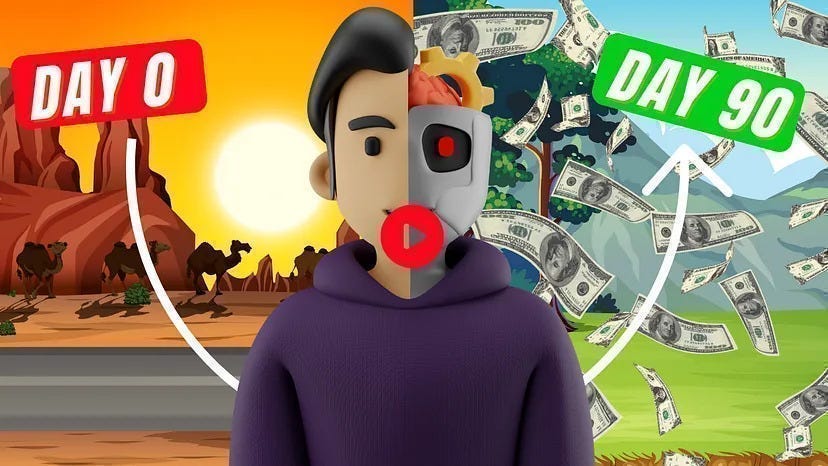
We strongly recommend that you check out our guide on how to take advantage of AI in today’s passive income economy.