
How to Build a One-Person AI Business That Earns $10K/Month in 21 Days
A one-person AI business is a company run by a single founder who uses AI tools like Claude to handle research, content, sales support, and operations instead of hiring staff.
In 2026, this model works because AI can now do the repetitive work that used to require a full team, while the founder focuses on strategy, taste, and decision-making.
This guide walks through the exact 21-day plan I would follow if I were starting an ai business from zero today.
👉 Free download: Start a 1-Person Business With Claude AI — Free Quick-Start Guide
AI has already changed sales, marketing, design, accounting, and dozens of other jobs.
For a lot of people, that feels frightening.
But it also means something else.
If AI can replace a task, that same task can become the foundation of your own ai business, because you no longer need a big team to do the work.
Anyone with a laptop and a plan can now build a profitable, lean ai business in a matter of weeks, not years.
That is the whole idea behind this 21-day approach.
You are not trying to build a company with employees and overhead.
You are trying to build a business where you set the direction and AI does the heavy lifting.
We strongly recommend that you check out our guide on how to take advantage of AI in today’s passive income economy.
Table of Contents
Why a One-Person AI Business Works Right Now
AI will keep replacing skill-based tasks like writing DMs, running numbers, or designing graphics.
If your current job is mostly hands-on, repetitive work, that work is exactly the kind AI is getting good at.
The opportunity is not to compete with AI.
The opportunity is to sit above it, the same way a pilot sits above an autopilot system.
You decide where the business goes.
You set the goals and the standards.
AI does the actual labor, from writing first drafts to organizing research to building simple workflows.
Then you review the output, fix what is weak, and send it back out.
Think of it like launching and landing a rocket.
AI can fly the rocket once it is in the air, but it still needs a human to set the destination and to catch it safely on the way down.
That is the core skill behind every successful one-person ai business today.
A single founder with two or three AI tools can now do the work that once took a small team.
There is no payroll, no office lease, and no meetings that eat your whole week.
You keep more of what you earn, and you build the business around the life you actually want, not the other way around.
👉 Get access to: The AI Traffic Vault
Days 1–3: Find Your Profitable AI Business Idea
The hardest part of any one-person ai business is not the execution.
It is picking the right idea in the first place.
Most people freeze here because they have too many options and not enough clarity.
The fix is to look for the overlap between three things: your existing skills, what you enjoy doing, and what the market already pays for.
When those three circles overlap, you have found a real business idea instead of a guess.
A simple way to speed this up is to ask Claude to act as a business coach, list your skills and interests, and then have it search for real people already making money doing something similar.
That last step matters, because it means you are validating the idea against real examples instead of hoping it works.
👉 Free download: The Claude AI Digital Product Starter Pack — 10 Done-For-You Prompts for Beginners
Once you have a short list of ideas, decide on your offer structure based on where you are starting from.
If you already have a skill but a small audience, a higher-priced offer, in the $2,000 to $5,000 range, is usually the fastest way to real income, because you only need a handful of buyers.
If you have a large audience but less proof of expertise yet, a lower-priced product like a guide, template, or prompt pack is the easier starting point.
Sandy Lee is a useful real-world example here.
She built her original following of more than 550,000 people teaching Spanish to Korean speakers, then pivoted into teaching AI-powered content systems on her channel, Sandy Lee AI, after she started applying AI tools like Claude Code to her own workflow.
According to multiple interviews, she now earns income across several streams tied to that one skill set, including consulting, sponsorships, and a paid content system she built herself.
Her story shows that the idea does not need to be original.
It needs to be built around something you already know how to do.
Days 4–7: Build Your Positioning Before You Build Content
Making content and building a personal brand are not the same thing.
You can post every day and still get nowhere if people cannot tell what makes you different.
Before you touch a script, answer three questions.
Why does this ai business exist, beyond making money?
What makes your background, personality, or story different from everyone else talking about the same topic?
And what gap in the market is nobody filling yet?
Nate Herk is a good case study for spotting gaps.
He built his channel, Nate Herk | AI Automation, from zero to hundreds of thousands of subscribers in under a year by teaching no-code automation tools like n8n, after leaving a business intelligence role at Goldman Sachs.
He is strong on tutorials and workflow breakdowns, but he talks less about his own life, his background, or how he built his audience in the first place.
That is a real gap.
Someone building a one-person ai business around personal branding, storytelling, or the human side of using AI could stand out in that exact space without competing head-on.
You can find gaps like this yourself by asking Claude to research a specific creator’s channel, list their main topics, and point out what they are not covering.
That single prompt can save you hours of manual research and give you a genuinely different angle to build around.
👉 Get access to: The AI Blog Monetization Quickstart Guide
Days 8–14: Find and Build Content Ideas With AI
Once your positioning is clear, the next step in building your ai business is creating content without staring at a blank page for hours.
Instead of guessing what might work, look for outliers, meaning individual posts or videos that performed far better than a creator’s usual average.
A video that gets four times a creator’s normal views is a strong signal that the topic or format is working right now.
You can track this manually by watching a handful of accounts in your niche, or you can ask Claude to research a specific channel and report back which recent videos are outperforming the rest.
Once you have an outlier, do not copy it directly.
Study why it worked, then rebuild it in your own voice, with your own experience layered in.
This is the fastest reliable way to create content for a one-person ai business without sounding like a copy of everyone else in your niche.
The goal is always the same: borrow the structure, keep the substance yours.
👉 Get access to: The AI Traffic Vault
For writing, feed Claude a transcript or script from a top-performing piece of content in your niche, along with a sample of your own past writing, and ask it to break down the hook, structure, and pacing before drafting a version in your voice.
Treat the AI draft as a starting skeleton, not a finished product.
Rewrite the weak sections, cut anything that does not sound like you, and add the specific details from your own experience that AI cannot invent on its own.
That last step is what keeps your ai business content from blending into the flood of generic AI-written posts already online.
Days 15–21: Package, Price, and Launch
By the third week, you should have a clear idea, a defined positioning, and a small library of content built around real audience interest.
Now it is time to turn that into an offer.
Keep your first product simple.
A single guide, a short course, or a done-for-you template pack is enough to start generating revenue while you keep building your audience.
👉 Get access to: The Medium Mastery
Price your first offer based on the structure you chose in week one.
If you are going the high-ticket route, focus your content on proving expertise and let a small number of serious buyers reach out directly.
If you are going lower-ticket, publish consistently and point every piece of content toward one clear next step, whether that is a guide, a template, or a short paid resource.
👉 Free download: Start a 1-Person Business With Claude AI — Free Quick-Start Guide
Track what content actually drives interest, and double down on that specific angle instead of spreading yourself across every format at once.
A one-person ai business grows fastest when you repeat what is already working rather than constantly starting something new.
By day 21, the goal is not perfection.
The goal is a working system: one idea, one audience, one offer, and a repeatable way to create content without burning out.
What This Looks Like Long-Term
None of this means AI runs your ai business for you.
AI can research, draft, and organize, but it cannot decide who you are trying to reach or why your work matters to them.
That part still belongs to you.
The founders who do well with this model treat AI the way a pilot treats an autopilot system, useful for the long stretches, but never in charge of the takeoff or the landing.
👉 Get access to the full package: Start a 1-Person Business With Claude AI
If you want the complete system laid out step-by-step, from finding your idea to publishing your first offer, the resources linked throughout this guide walk through each stage in more detail.
Building a one-person ai business in 21 days is ambitious, but it is realistic if you stay focused on one idea instead of chasing five at once.
Start with the overlap between your skills and the market, build your positioning before your content, and let AI handle the repetitive work while you make the calls that actually matter.
👉 Free download: The Claude AI Digital Product Starter Pack — 10 Done-For-You Prompts for Beginners
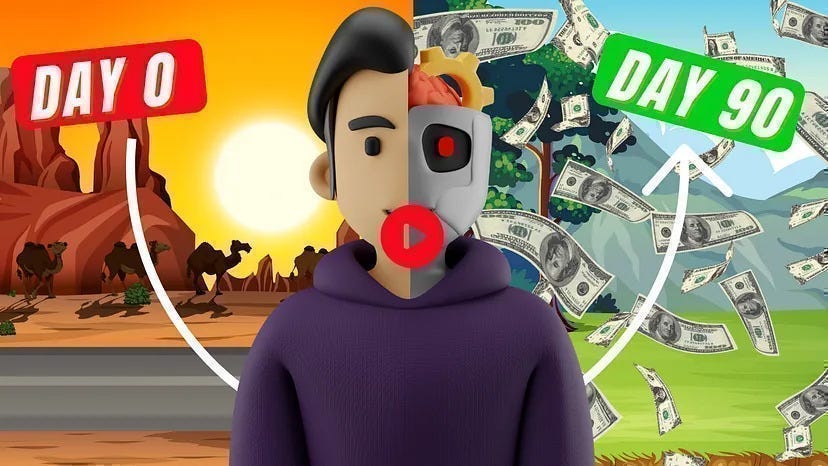
We strongly recommend that you check out our guide on how to take advantage of AI in today’s passive income economy.