These 13 Machines Turn Cheap Materials Into $1,000+ Weeks
Overlooked machines that generate income exist quietly in garages, spare rooms, and small workshops across the country, turning raw materials most people throw away into products farms, restaurants, gyms, and shoppers pay for every single day.
They don’t trend on social media.
They don’t need a warehouse or a team of ten.
They need a bit of space, a modest upfront investment, and someone willing to learn a real skill.
This guide walks through 13 of those overlooked machines that generate income, what they actually do, and why the demand behind each one is bigger than most people realize.
👉Free download: Start a 1-Person Business With Claude AI — Free Quick-Start Guide if you want to pair a physical machine business with a digital income stream that runs alongside it.
Let’s get into the list.
We strongly recommend that you check out our guide on how to take advantage of AI in today’s passive income economy.
Table of Contents
1. Egg Tray Making Machine
Old newspapers, cardboard, and waste paper are not garbage to this machine, they’re raw material.
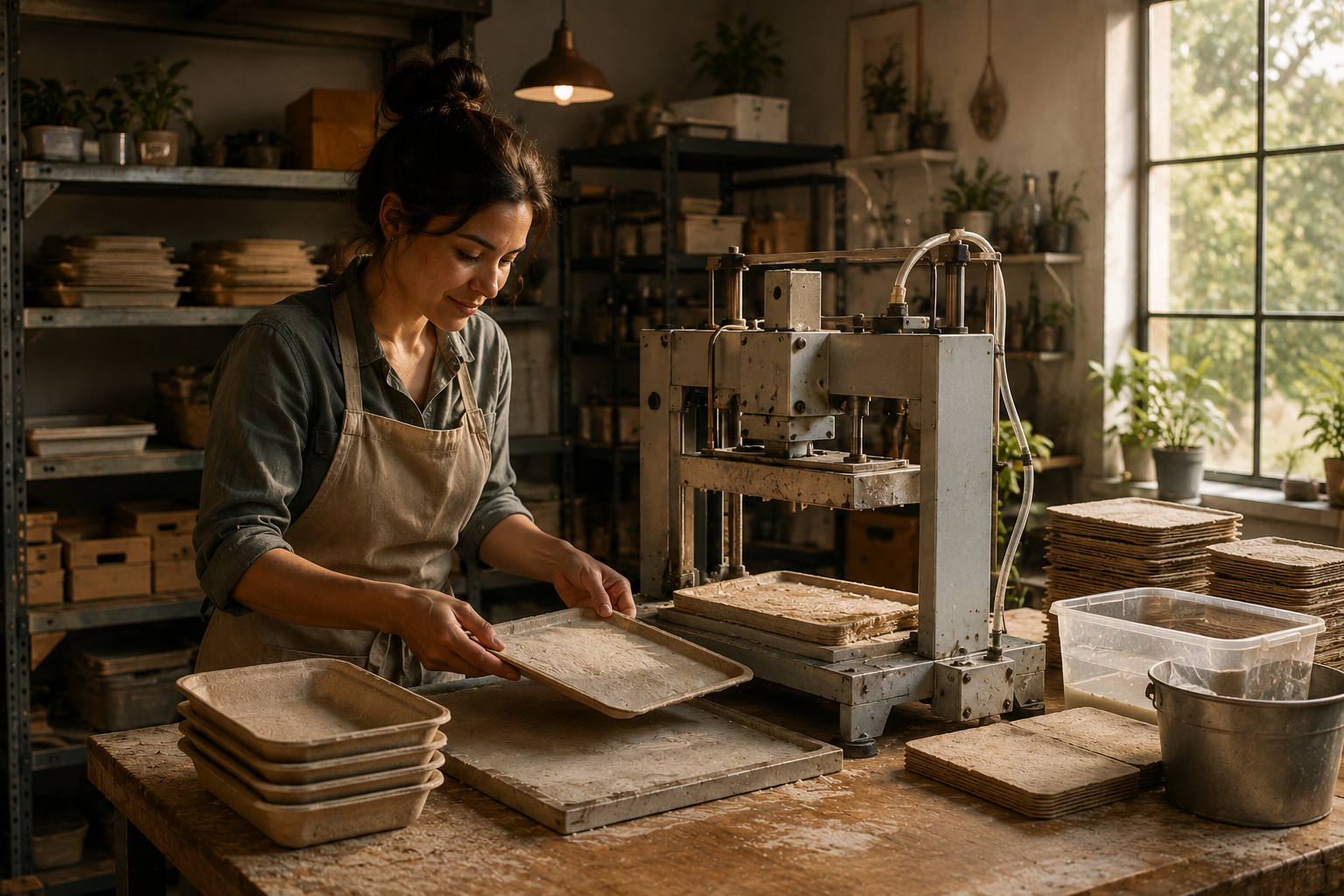
The equipment pulps waste paper with water into a slurry, then presses that slurry into the molded trays used to hold eggs at farms, grocery stores, and distribution centers.
Egg tray demand is tied directly to egg production, and the U.S. Department of Agriculture tracks table egg output in the tens of billions annually, which means packaging demand never really slows down.
A small pulp-molding machine can fit into a standard garage and typically runs on regular household power, though larger models need three-phase electricity.
Drying space matters more than most first-time buyers expect, since wet trays need somewhere to cure before they’re stackable.
Some manufacturers now sell units with a built-in dryer to solve exactly that bottleneck.
Local egg farms, especially smaller operations that don’t buy in factory-scale bulk, are often the easiest first customers.
This is one of the more overlooked machines that generate income because the raw material is essentially free and the buyer base is local and recurring.
2. Paper Plate Making Machine
Disposable tableware is a permanent category, not a trend, and paper plates sit at the center of it as consumers move away from plastic.
The machine works like a heated press, feeding in specially coated paper stock and stamping out finished plates in a continuous cycle.
Fully automatic machines are commonly rated for tens of plates per minute, which scales quickly into thousands of plates over a single shift.
Party supply stores, caterers, school cafeterias, and event planners are the steady buyers, with demand spiking around graduation season, summer cookouts, and the holidays.
Paper plate manufacturers like Chinet and Hefty operate at massive scale, but that leaves regional and wholesale gaps that small producers can serve locally.
Buyers increasingly ask specifically for paper over plastic or foam, which plays directly into the strengths of this machine.
Startup costs vary widely depending on automation level, so it’s worth comparing semi-automatic and fully automatic models before committing.
This is a straightforward entry point among overlooked machines that generate income because the end product is something every household already buys.
3. Charcoal Briquette Making Machine
Charcoal is a bigger category than most people assume, with U.S. retail charcoal sales reported at roughly $750 million in a recent year according to Statista-tracked industry data.
The machine converts sawdust, wood chips, coconut shells, or agricultural waste into charcoal through pyrolysis, a heat-based process that breaks material down without full combustion.
Sawmills and furniture shops frequently treat sawdust as a disposal problem, which means it can often be sourced cheaply or even free.
Hookah lounges and specialty barbecue suppliers pay a premium for consistent, clean-burning charcoal, which is a different buyer than the average backyard grill owner.
Local fire codes and outdoor burning regulations vary by state and county, so it’s worth checking with local authorities before scaling production.
The Hearth, Patio & Barbecue Association has reported that the large majority of outdoor cooking product owners already have a grill or outdoor kitchen, which points to a stable, non-shrinking customer base.
Coconut shell charcoal in particular commands higher prices in premium and export markets compared to standard wood briquettes.
Among overlooked machines that generate income, this one turns a literal waste disposal cost into a revenue line.
4. Food Packaging Machine
Packaging is often the difference between a product that stays a hobby and one that gets shelf space.
A food packaging machine automates sealing, whether that’s vacuum sealing, heat sealing, or pouch filling, so the final product looks consistent and professional.
Small food producers making spice blends, dried fruit, granola, or baked goods frequently find that better packaging alone lets them raise prices.
Proper sealing also extends shelf life, which matters for anyone selling through farmers markets, small retailers, or online.
The FDA’s guidance on food labeling and packaging is worth reviewing early, since compliant labeling is required before products can legally go to retail.
Machines range from tabletop units suited to a home kitchen business up to semi-industrial equipment for higher volume.
👉Get access to: The AI Blog Monetization Quickstart Guide if you’re planning to document and sell this kind of small food business build-out as content alongside the product itself.
This machine belongs on any list of overlooked machines that generate income because packaging upgrades are one of the fastest ways to justify a price increase.
5. DTF Printer
Direct-to-film printing changed custom apparel by removing the limitations of older screen printing and heat transfer methods.
The process involves printing a design onto special film, applying adhesive powder, curing it with heat, then pressing it onto fabric.
Unlike older transfer methods, DTF works on dark and light fabrics alike and holds up through repeated washes.
The custom t-shirt printing market has been valued in the multiple billions of dollars globally in 2026 industry reports, with digital printing methods like DTF among the fastest-growing segments.
Local sports teams, school groups, small businesses, and event organizers are consistent buyers for short-run custom apparel that larger manufacturers won’t touch profitably.
Setup costs for entry-level DTF systems are lower than industrial screen printing equipment, which makes this accessible for a home-based operation.
Turnaround speed is a real advantage, since a design can go from file to finished shirt in minutes rather than days.
This is one of the more visible overlooked machines that generate income, since demand for personalized apparel keeps climbing year over year.
6. Cold Press Juicer
Cold-pressed juice occupies a premium shelf position because of how it’s made, not just what’s in it.
A cold press juicer crushes produce slowly instead of using high-speed blades, which limits heat and oxidation and preserves more nutrients and flavor.
Commercial-grade models from brands like Goodnature and Norwalk are built for exactly this kind of small-batch production business.
Health food stores, gyms, and farmers markets are natural first buyers for a locally made juice line, especially in markets where a big-box cold-press brand hasn’t fully saturated shelf space.
Buying produce in volume and pressing it fresh keeps the cost per bottle low relative to the retail price a finished juice can command.
Leftover pulp doesn’t have to go to waste either, since community gardeners and composting programs often want it.
Health department licensing requirements for food and beverage production apply here, so check state and county rules before selling.
Among overlooked machines that generate income, this one benefits from a customer base that keeps growing as more people prioritize functional nutrition.
7. Chamber Vacuum Sealer
Vacuum sealing is the quiet infrastructure behind a lot of small food and outdoor businesses.
A chamber vacuum sealer creates an airtight seal strong enough to dramatically extend shelf life for meat, produce, and prepared foods.
Commercial models from brands like VacMaster and Avid Armor are common choices for small producers stepping up from consumer-grade sealers.
Hunters need game meat sealed after processing, home gardeners want surplus produce preserved, and small bakeries and meal-prep businesses need products sealed for shipping.
Offering vacuum sealing as a paid service, rather than only using the machine for a single product line, opens multiple income streams from one piece of equipment.
Chamber sealers can also handle liquids and marinating, which broadens what kind of service work is possible.
This machine pairs naturally with the food packaging machine above if the plan is to build out a full small-batch food production setup.
It’s a practical entry on the list of overlooked machines that generate income because the service model requires very little marketing beyond word of mouth.
8. Color Label Printer
Labels are often the first thing a customer judges a product by, before they’ve even opened it.
A color label printer lets a small producer print professional, waterproof labels on demand, in whatever batch size a given production run actually needs.
That matters because ordering from a commercial print shop usually comes with minimum order quantities that don’t make sense for a small operation.
Small-batch honey, sauces, candles, and skincare producers are the most common users, since these categories rely heavily on shelf appeal to justify pricing.
Popular commercial label printer brands like Afinia and Primera are widely used across small-batch food and product businesses for exactly this reason.
Switching from handwritten or generic printed labels to a professional design is one of the lowest-cost upgrades a small producer can make.
Label design software, including free and low-cost tools, makes it possible to iterate quickly without hiring a designer for every version.
This is one of the smaller-footprint overlooked machines that generate income, since it can sit on a desk and still change how a whole product line is perceived.
9. Vacuum Emulsifier
Natural skincare is a category where consumers routinely pay $30 to $50 for a small jar of face cream, moisturizer, or balm.
A vacuum emulsifier mixes oil and water-based ingredients into a smooth, stable, air-free blend, which is difficult to replicate with hand mixing alone.
Texture consistency is a major factor in whether a skincare product feels premium, and vacuum emulsification solves that problem directly.
Raw ingredient costs for a small batch of face cream are typically a small fraction of the retail price the finished product can sell for.
Cosmetic products sold in the U.S. fall under FDA cosmetic labeling and safety guidance, so it’s worth reviewing those requirements before selling.
Small-batch skincare makers often start by selling through farmers markets, craft fairs, and their own online store before expanding into local retail.
Consistency from batch to batch is what keeps repeat customers coming back, which is exactly what this machine is built to deliver.
This sits comfortably among overlooked machines that generate income because the margin between raw ingredient cost and finished retail price is unusually wide.
10. Essential Oil Distiller
Pure essential oils sell by the milliliter, and prices for oils like lavender, peppermint, and citrus can run well above what the raw plant material cost to grow.
A steam distiller extracts concentrated plant essence through a heating and condensation process that dates back centuries but is now widely available in small tabletop and countertop units.
Home-grown lavender, mint, eucalyptus, and citrus peels are all viable starting materials for a small distilling operation.
The leftover water from distillation, known as hydrosol, has its own market among soap makers and natural cosmetics producers, so very little of the process goes to waste.
Soap makers, candle makers, and aromatherapy sellers are consistent buyers for smaller producers who can guarantee purity and sourcing.
Starting with garden-grown plants keeps upfront costs low, with the option to move into bulk-purchased herbs as demand grows.
The National Association for Holistic Aromatherapy is a useful resource for anyone serious about learning proper distillation and safety practices.
This is one of the higher-margin overlooked machines that generate income, since the price per milliliter of finished oil is dramatically higher than the cost of the raw plant material.
11. Industrial Lock Stitch Sewing Machine
An industrial sewing machine from brands like Juki or Brother handles heavy fabric, leather, and multiple layers that a home sewing machine simply can’t manage.
That capability opens up repair and alteration work that most home-based sewers have to turn away, including heavy work pants, canvas bags, and boat or patio cushions.
Custom tool bags, work aprons, and small-batch product lines are also realistic once the equipment can handle commercial-grade materials.
During periods of high demand for masks and protective gear, home-based operators with industrial machines were able to fill orders that smaller machines couldn’t keep up with.
Alteration and repair services tend to have very low material costs relative to what customers are willing to pay for quality work done quickly.
Local dry cleaners and tailoring shops are often open to referral partnerships with someone who can handle overflow work.
This machine rewards someone who already has basic sewing experience and wants to move into commercial-grade capability.
It’s a durable entry on the list of overlooked machines that generate income because the skill itself, not just the equipment, is what keeps customers coming back.
12. Knitting Machine
Hand-knitted goods sell at a premium specifically because of the time they take to make by hand, which is also exactly the bottleneck a knitting machine removes.
Domestic and mid-gauge knitting machines from brands like Silver Reed and Brother let a single operator produce sweaters, scarves, hats, and blankets in a fraction of the time hand-knitting requires.
Customization is where the real demand sits, including baby blankets with a name knitted in, seasonal patterns, and made-to-order sizing.
Etsy and similar marketplaces have an active market for machine-knitted goods that are marketed honestly as machine-made rather than misrepresented as hand-knit.
Customers who want a unique, well-made piece but won’t pay hand-knit pricing are the core audience for this kind of business.
Learning curve is real here, and most machine knitters spend real time learning tension, patterning, and finishing before selling their first piece.
Local knitting guilds and online machine-knitting communities are a practical way to shortcut that learning curve.
This is one of the more skill-dependent overlooked machines that generate income, since production speed only becomes valuable once quality is consistent.
13. Desktop Vacuum Former
A vacuum former uses heat and vacuum pressure to shape plastic sheeting over a mold, and the applications are broader than most people expect.
Small businesses use it for custom packaging trays, product display cases, and protective inserts, especially for items like chocolates, small electronics, or handmade goods.
Inventors and product designers use vacuum forming to create prototype cases and packaging before committing to expensive injection molding tooling.
Cosplay and costume makers are a surprisingly steady customer base, since vacuum-formed plastic is a common material for armor pieces and props.
Desktop models from companies like Formech are sized for small studios and don’t require industrial floor space.
Custom molds can be made from wood, resin, or 3D-printed plastic, which keeps prototyping costs manageable for a small operation.
Local product-based businesses that need short-run custom packaging are often an easier first customer than trying to compete with large-scale manufacturers.
This closes out the list of overlooked machines that generate income with one of the more versatile options, since a single machine can serve dozens of different applications.
Starting With the Right One
None of these are get-rich-quick setups, and every one of them requires real effort, some trial and error, and time to build a customer base.
The better approach is to pick one machine that matches both your interests and what your local market actually needs, rather than trying to run several at once.
Master that one machine, build a small base of repeat customers, and only then think about expanding into a second product line.
Whichever one on this list made you think “I could actually do that” is worth researching further this week, not someday.
👉Get access to: The AI Traffic Vault if you want a full system for getting the right buyers to find your small business online once you’ve picked a machine and built your first products.
👉Get access to: The Medium Mastery if you’d rather document the build-out of your machine business as content and grow an audience while you do it.
👉Free download: The Claude AI Digital Product Starter Pack — 10 Done-For-You Prompts for Beginners if you want to pair your physical product business with a digital product line using AI.
These 13 overlooked machines that generate income are all real, available, and already being used by small operators today, and the only real barrier left is picking one and starting.

We strongly recommend that you check out our guide on how to take advantage of AI in today’s passive income economy.