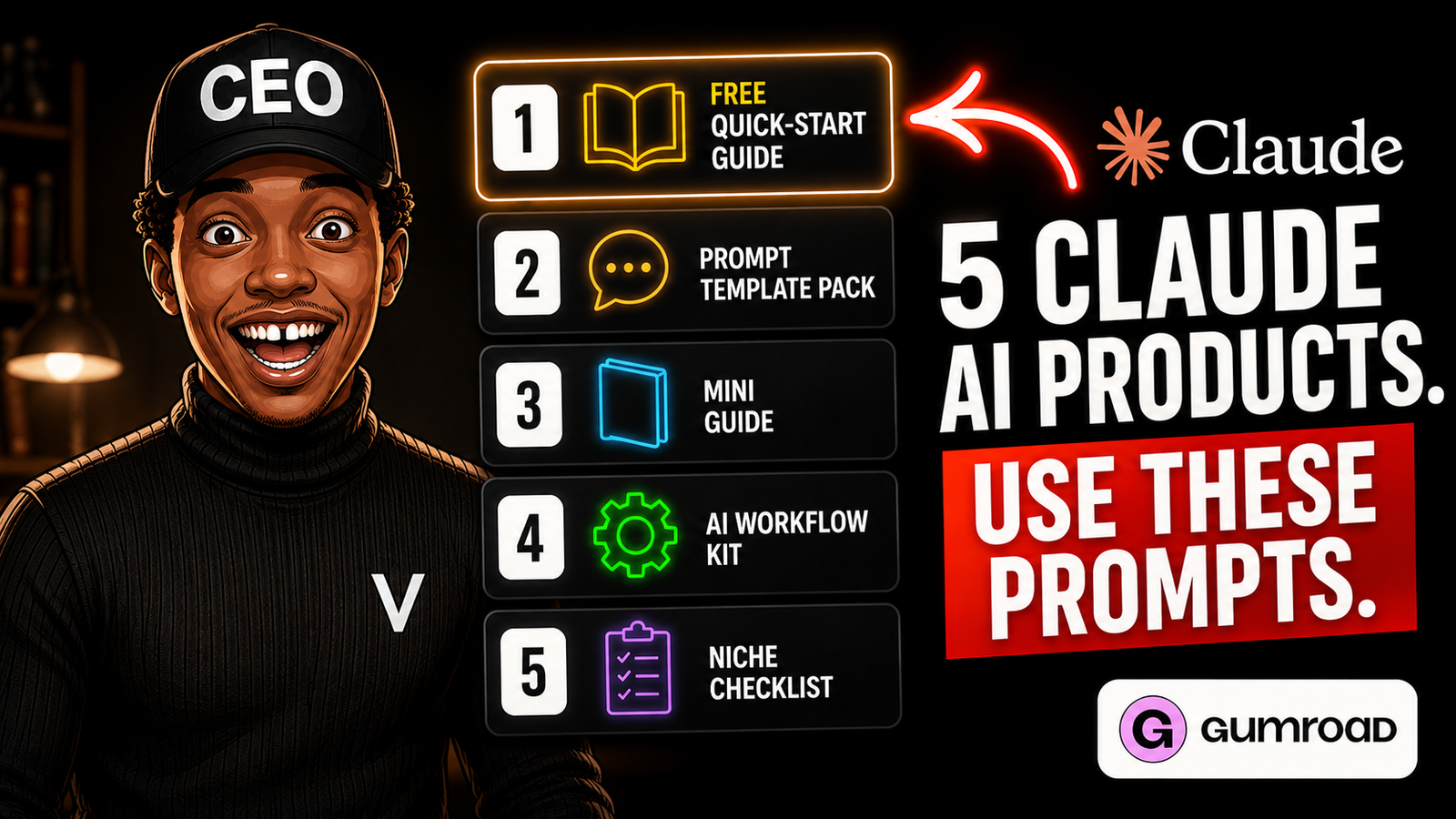
The experiment was simple. Five digital products. One day. Nothing but Claude AI to build them. Then put all five on Gumroad and track which one made money first.
The results were 148 total sales and $119.43 in revenue across five products — and the product that won the experiment revealed something about digital product strategy that most beginner creators have never considered. This article documents every product, every prompt used to build it, the complete results, and the reasoning behind the outcome.
Watch the full video here: https://youtu.be/GrHQuA5xD9Q
Table of Contents
Step 1 — The Prompt Template Pack
The Claude AI Digital Product Starter Pack at adegbenga.gumroad.com/l/bengz is a collection of 10 done-for-you Claude AI prompts for beginners who want to build and sell simple digital products online. It was built using one Claude AI prompt and took under 30 minutes from blank page to published Gumroad listing.
The prompt template pack works as a product type because it solves an immediate and specific problem — most beginners using Claude AI for the first time do not know how to write prompts that produce useful outputs. A done-for-you collection removes that friction entirely. The buyer opens the pack, copies a prompt, pastes it into Claude, and gets professional quality output on the first attempt.
The product is listed as pay-what-you-want starting at zero. It has generated 52 downloads and $10.64 in voluntary revenue. The pay-what-you-want model and its strategic significance is covered in detail in Step 2.
The Claude AI prompt used to build this product:
You are a digital product creation expert. I want to build a prompt template pack called The Claude AI Digital Product Starter Pack for complete beginners who want to use Claude AI to create and sell simple digital products online. Create 10 done-for-you prompts covering these specific tasks: writing a product description, naming a digital product, creating a sales page outline, writing a product launch email, generating a product title, writing a FAQ section, creating a refund policy, writing a thank you page message, generating upsell copy, and writing a social media promotional post. Each prompt must be clearly numbered and titled, written in plain simple language a complete beginner can understand, and formatted so it is ready to copy and paste directly into Claude AI. Make each prompt specific enough to get a professional quality output without requiring the user to have any prior knowledge of prompt engineering.
Step 2 — The Free Quick-Start Guide and the Pay-What-You-Want Strategy
The Start a 1-Person Business With Claude AI Free Quick-Start Guide at adegbenga.gumroad.com/l/rfqby is the product that made money first — and the strategy behind its pricing is the most important lesson in the entire experiment.
The guide is an 8 to 15 page document that gives a complete beginner the minimum viable information to take their first step toward building a one-person online business using Claude AI. It was built using one Claude AI prompt and took under 45 minutes to complete.
It is listed on Gumroad as pay-what-you-want with a zero dollar minimum. Anyone can download it for free. In 21 days it generated 92 downloads and $40.79 in voluntary revenue from buyers who chose to pay something despite having no obligation to do so.
The pay-what-you-want model produces this outcome for three reasons. First it removes the price barrier entirely — any visitor who lands on the product page can access the content without a financial decision, which dramatically increases download volume compared to any paid price point. Second it signals value — a product listed as pay-what-you-want implies the creator believes it is worth paying for while choosing to be generous, which is a different psychological signal than a product that is simply free. Third it creates goodwill — buyers who choose to pay something for a free resource feel a sense of reciprocity that makes them significantly more likely to purchase the next product in the creator’s lineup.
The downstream buyer journey this product creates is the real reason it won the experiment. Each of the 92 downloads represents a person who received genuine value, experienced the quality of the content, and is now in a warm relationship with the creator. A percentage of those 92 went on to purchase the paid Start a 1-Person Business With Claude AI guide at $17. That conversion from free download to paid sale is what the free product is optimized to produce.
The Claude AI prompt used to build this product:
You are an expert business coach specializing in helping beginners start one-person online businesses using AI tools. Create a complete quick-start guide called Start a 1-Person Business With Claude AI — Free Quick-Start Guide. The guide is for complete beginners who have never built an online business before. Structure it as follows: a one-paragraph introduction explaining what a one-person AI business is and why 2026 is the best time to start one, then five numbered steps that take the reader from having no product and no audience to having a live digital product for sale online using Claude AI. Each step should be written in plain conversational language, include one specific action the reader takes in that step, and be completable in under one day. End with a short motivational closing paragraph and a natural reference to the full paid guide called Start a 1-Person Business With Claude AI available for purchase. Total length 800 to 1000 words. Format for easy reading with clear section headers.
Step 3 — The Mini Guide
The Start a 1-Person Business With Claude AI paid guide at adegbenga.gumroad.com/l/ewfjmv is the mini guide product in this experiment. Listed at $17, it generated 4 sales and $68 in direct revenue over 21 days.
Four sales in 21 days from a cold audience with no existing following is meaningful not because of the absolute revenue figure but because of what it confirms — the paid product converts. As the email list grows and the free guide continues generating warm downstream buyers, those four sales become the baseline from which the revenue compounds.
The mini guide differs from the free quick-start guide in depth and completeness. Where the free guide gives the reader their first step, the paid mini guide gives them the complete system — chapters, examples, step-by-step instructions, and the full framework for building a one-person AI business. The $17 price point is chosen because it sits in the impulse purchase range for a warm audience — low enough that a subscriber who enjoyed the free guide does not need significant deliberation to say yes.
Step 4 — The AI Workflow Kit
The Flipboard Traffic Workflow Kit is a documented step-by-step operational system for using Claude AI to drive free traffic from Flipboard to digital products. It was built live using one Claude AI prompt and published to Gumroad during the recording of this video.
A workflow kit differs from a guide in format and intent. A guide explains concepts and provides frameworks. A workflow kit is purely operational — the buyer opens it and follows the steps like a recipe. Every step includes the exact action, the time required, and where relevant the exact Claude AI prompt to use within that step. The operational specificity justifies a higher price point than a general guide covering the same topic.
Step 5 — The Niche Checklist and the Premium Vault
The Bing AI Citation Checklist was built using one Claude AI prompt in under 20 minutes — a 25-item action checklist organized into five sections covering everything needed to optimize a blog post for Bing AI citation traffic.
The AI Traffic Vault at adegbenga.gumroad.com/l/kngyxh represents the premium tier of the product ladder at $97 — a bundled collection of the workflow kit, the checklist, the content strategy framework, and additional traffic tools packaged as a comprehensive system for the creator who wants everything in one place.
The complete five-product ladder creates a buyer journey that serves every level of readiness and budget. The free guide enters the subscriber into the system. The pay-what-you-want prompt pack builds early trust. The $17 mini guide and workflow kit serve the first-time paid buyer. The $97 vault serves the committed buyer who wants the complete system. Every product feeds the next one in the sequence.
The Real Lesson From the Experiment
The product that made money first was the free one. That outcome is not a coincidence — it is a strategy. A new creator with no existing audience has one problem above all others and it is not product quality or product variety. It is trust. Nobody buys from someone they do not trust yet. The fastest way to build trust at scale with a cold audience is to give something genuinely valuable away first and let the quality of that free resource do the trust-building work.
The pay-what-you-want model amplifies this by making the free product feel like a gift rather than a placeholder. The 92 downloads and $40.79 in voluntary revenue from a zero-minimum product is not the meaningful outcome. The meaningful outcome is 92 warm relationships with people who experienced real value and are now on a buyer journey toward the $17 and eventually the $97 product.
That is the system. Five products. One day. Claude AI. Free tools. Real results.
We strongly recommend that you check out our guide on how to take advantage of AI in today’s passive income economy.