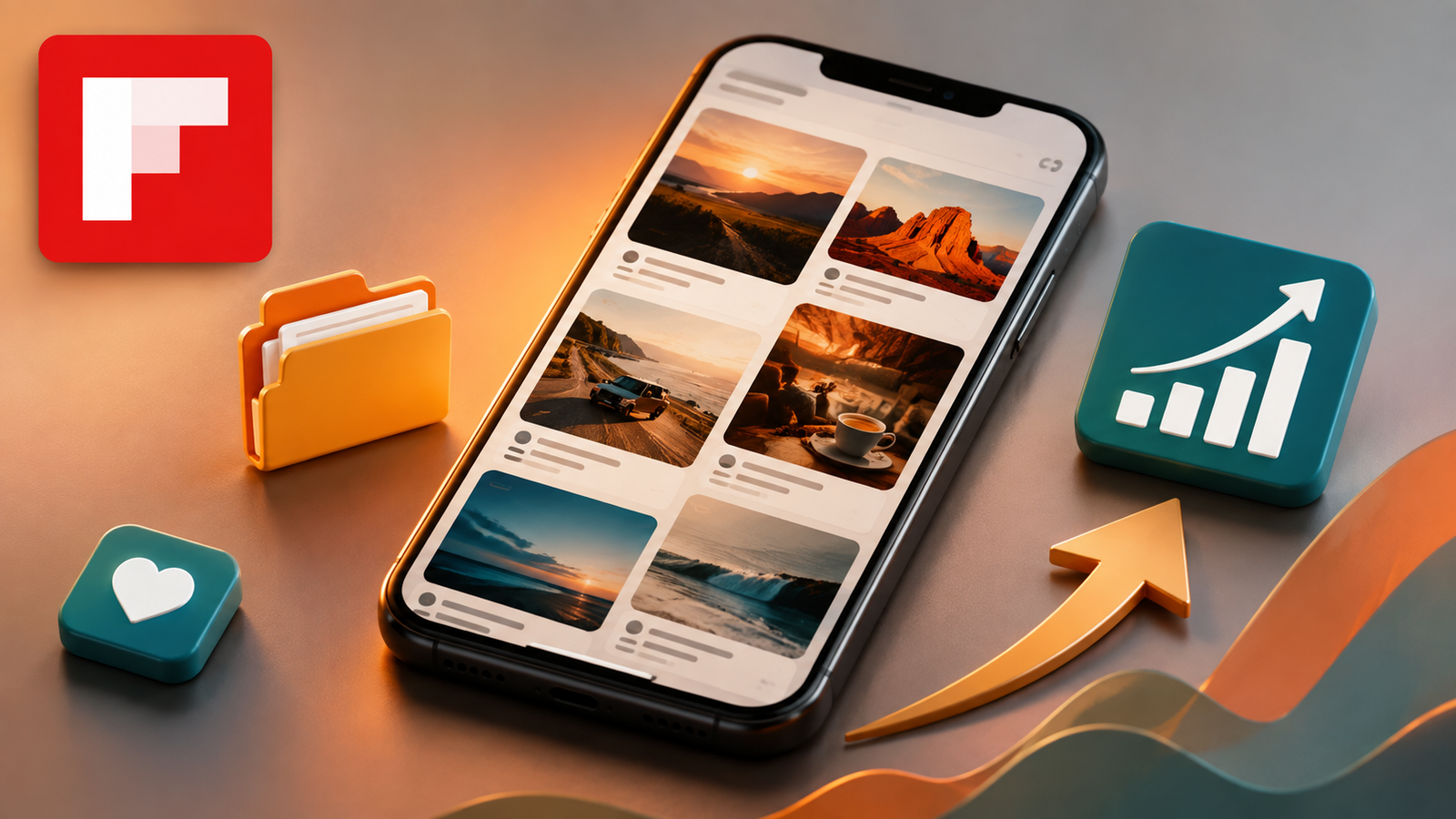
The 6-Month Flipboard Traffic Blueprint That Replaced My Google Search Traffic
Flipboard is a content discovery app with roughly 145 million monthly active users, and bloggers can use it to send thousands of free visitors to their websites by creating niche “magazines,” flipping fresh content daily, and curating other creators’ posts in a consistent 3-to-1 ratio.
This one channel has helped some publishers replace traffic they lost from Google updates entirely.
👉Get Access to : The AI Traffic Vault if you want the full 90-page breakdown of how creators are combining Flipboard, Medium, and AI search tools to rebuild their traffic outside of Google.
Below, I’m going to walk you through a real Flipboard traffic strategy for bloggers, one that’s already working for personal finance publisher Michael Dinich, founder of Wealth of Geeks, who has talked openly on the Niche Pursuits podcast and other interviews about pulling 500,000 to over 1 million page views a month from this one platform.
I’m not copying his story word for word.
I’m pulling the strategy apart, adding what’s changed in 2026, and showing you exactly how to apply it to your own blog.
We strongly recommend that you check out our guide on how to take advantage of AI in today’s passive income economy.
Table of Contents
What Flipboard Actually Is (And Why It’s Not Like Pinterest)
Flipboard launched back in 2010.
It works like a cross between a magazine rack and a social feed.
Users open the app, scroll through topics they follow, and “flip” articles they like into their own personal collections, called magazines.
The platform has reported around 145 million monthly active users, according to Flipboard’s own team and multiple media reports.
That’s a massive pool of readers who are actively browsing for content to read, not just checking on friends or scrolling for entertainment.
Here’s the part that makes Flipboard different from almost every other platform out there.
Most social networks want to keep people inside their own app.
Flipboard actually wants to send you outside the app, straight to your website, because that’s the entire point of the platform.
Multiple publisher reports have found Flipboard sitting among the top referral sources for many sites, often close to platforms like X and Google News.
That’s rare in 2026, when most platforms are actively trying to keep users scrolling instead of clicking away.
How It’s Different From Pinterest
Pinterest requires custom graphics, pins, and a lot of visual design work.
Flipboard pulls your featured image automatically from your article, so there’s no graphic design step at all.
You paste your link, Flipboard grabs your image and headline, and your flip is ready to publish in seconds.
This is one reason a solid Flipboard traffic strategy for bloggers can be run in well under an hour a day.
Step 1: Set Up Your Magazines the Right Way
Think of a Flipboard magazine as a folder, or a category page, built for a specific topic.
You don’t want to make a magazine for every tiny sub-topic on your blog.
Instead, build around 8 to 10 high-level magazines that map to the main categories on your website.
If you run a food blog, that might look like Quick Dinners, Healthy Desserts, and Meal Prep Ideas.
If you’re in personal finance, you might build magazines around Budgeting, Side Hustles, and Investing Basics.
The goal at this stage is top-of-funnel attraction, meaning you want to pull in a broad audience first, then narrow them down toward your specific niche once they’re following you.
Publishers who’ve scaled this strategy successfully have also built magazines around topics their audience cares about outside their core niche, similar to how a hardware store might sponsor a NASCAR team because a chunk of their shoppers happen to be NASCAR fans.
👉Get Access to : The Flipboard Traffic Workflow Kit if you want a done-for-you checklist for picking your 10 magazines, naming them for search, and setting up your first week of flips without guessing.
Step 2: Flip Fresh Content, Every Single Day
This is the part almost every blogger gets wrong.
Flipboard’s algorithm heavily rewards recency, and it tends to treat old, previously-flipped URLs as stale content.
That means if you flip the same article twice, Flipboard often pulls the original publish date, and your reach gets capped hard.
So what do successful Flipboard publishers do instead?
They clone the post.
They take an existing article, tweak the headline slightly, swap the featured image, add a canonical tag pointing back to the original for SEO purposes, and then flip that “new” version to Flipboard.
Once it’s run its course over a few days, they delete the clone and repeat the process with something else.
This single tactic is often the difference between a magazine that goes stale and one that keeps growing month over month.
Step 3: Win the Click With Your Headline and Image
Flipboard isn’t a search engine, so nobody is typing in keywords hoping to find your article.
People are scrolling, and they’re deciding in about half a second whether to tap on your flip or keep moving.
That means your headline, your featured image, and roughly the first 500 characters of your description are doing all the heavy lifting.
Boring, SEO-style headlines like “Best Chocolate Chip Cookie Recipe” tend to fall flat here.
Something punchier, like “The Best Chocolate Chip Cookies You’ll Ever Bake,” performs far better because it reads more like a headline you’d see on YouTube than one built strictly for Google.
If your niche is less visual by nature, an AI image generator can help you create an eye-catching image that still fits the topic.
This is exactly the kind of content-repurposing workflow covered inside 👉Get Access to : The AI Traffic Vault, which walks through headline formulas, image sourcing, and how to adapt SEO content for platforms that reward curiosity over keywords.
Step 4: Follow the 3-to-1 Curation Rule
Here’s where most bloggers quietly sabotage their own results.
They only ever flip their own content, because that’s the content that drives clicks back to their own site.
But Flipboard is built around community, not self-promotion, and profiles that only post their own links tend to struggle to gain followers.
A widely-used rule among successful Flipboard publishers is a 3-to-1 ratio: for every one piece of your own content you flip, flip three pieces from other creators in or near your niche.
This keeps your magazines active, signals to Flipboard that you’re a genuine curator rather than a spammer, and builds an actual following of people who are there when you do share your own posts.
A simple daily routine looks like this: open the “For You” homepage, flip a handful of trending posts related to your topics, refresh, repeat two or three times a day in short 15 to 20 minute sessions.
Some publishers have scaled this by training a virtual assistant or even a family member to manage the day-to-day flipping, since the process itself doesn’t require deep expertise once the magazines are set up.
Step 5: Understand the Timeline (And Don’t Quit Early)
If there’s one uncomfortable truth about this Flipboard traffic strategy for bloggers, it’s this: it’s slow at first.
Multiple publishers who’ve documented their Flipboard growth report a similar pattern, where the first five or six months feel like almost nothing is happening, and then growth accelerates sharply around month six or seven.
That’s not a coincidence, and it’s not a fluke either.
It appears to reflect how Flipboard’s algorithm builds trust in an account over time, rewarding consistent daily activity rather than short bursts of effort.
Trying to flip hundreds of posts on day one, hoping for an overnight spike, tends to backfire and can look like spam to the algorithm.
Commit to daily flipping for at least six months before judging whether this channel is working for your blog.
Turning Flipboard Traffic Into Money (Not Just Pageviews)
Getting visitors is only half the equation, because traffic you don’t own can disappear the moment a platform changes its algorithm.
That’s why the smartest Flipboard publishers treat every visitor as a chance to build something they actually control, like an email list.
A simple way to do this is with an exit-intent popup on articles that get most of their traffic from Flipboard, inviting readers to follow your profile or join your list before they leave.
Publishers who’ve built this system report that Flipboard traffic tends to convert into email subscribers at rates comparable to, or better than, Pinterest traffic on some sites.
Once that traffic is on your list, you can start monetizing it directly through affiliate offers, your own digital products, or display ads.
👉Get Access to : The AI Blog Monetization Quickstart Guide breaks down exactly how to turn a blog’s traffic, whether it comes from Flipboard, search, or social, into consistent monthly income using ads, affiliates, and digital products.
Why This Matters More in 2026
Google’s algorithm updates have hit even well-established, experienced publishers over the past couple of years, sometimes despite doing everything “right.”
At the same time, AI-generated search summaries are increasingly answering user questions directly on the results page, which can reduce the number of people who ever click through to a publisher’s website at all.
That’s pushed a lot of bloggers to diversify away from relying on a single traffic source, and Flipboard has become one of the more overlooked options in that mix.
Unlike algorithms that actively try to keep users inside their own ecosystem, Flipboard is structurally built to send readers out to publisher websites, which makes it one of the few platforms still aligned with what bloggers actually need.
If you’re also experimenting with Medium as a traffic channel alongside Flipboard, the same recency-and-curation logic tends to apply there too.
👉Get Access to : The Medium Mastery guide covers the Medium-specific version of this strategy, including how to diagnose and fix over-flipping issues that quietly cap your reach on that platform.
Putting It All Together
A working Flipboard traffic strategy for bloggers really comes down to five repeatable habits: build 8 to 10 focused magazines, flip fresh or cloned content daily, write headlines built for curiosity instead of keywords, follow the 3-to-1 curation ratio, and give the process a genuine six-month runway before judging the results.
None of this requires a big team or a big budget, and it can realistically be run in under an hour a day once your magazines are set up.
The publishers seeing real income from this channel aren’t doing anything mysterious, they’re just showing up consistently in a place most bloggers have never even opened.
👉Get Access to : The Flipboard Traffic Workflow Kit has the full daily checklist, magazine-naming templates, and cloning workflow laid out step by step, so you’re not guessing at any part of this process.
And if you want the complete traffic diversification system, covering Flipboard, Medium, and AI-powered search discovery in one place, 👉Get Access to : The AI Traffic Vault is the resource built specifically for that.
Flipboard isn’t going to replace every visitor you’ve lost from Google overnight, but for bloggers willing to show up daily for a few months, it’s one of the more realistic paths back to consistent, free website traffic in 2026.
We strongly recommend that you check out our guide on how to take advantage of AI in today’s passive income economy.