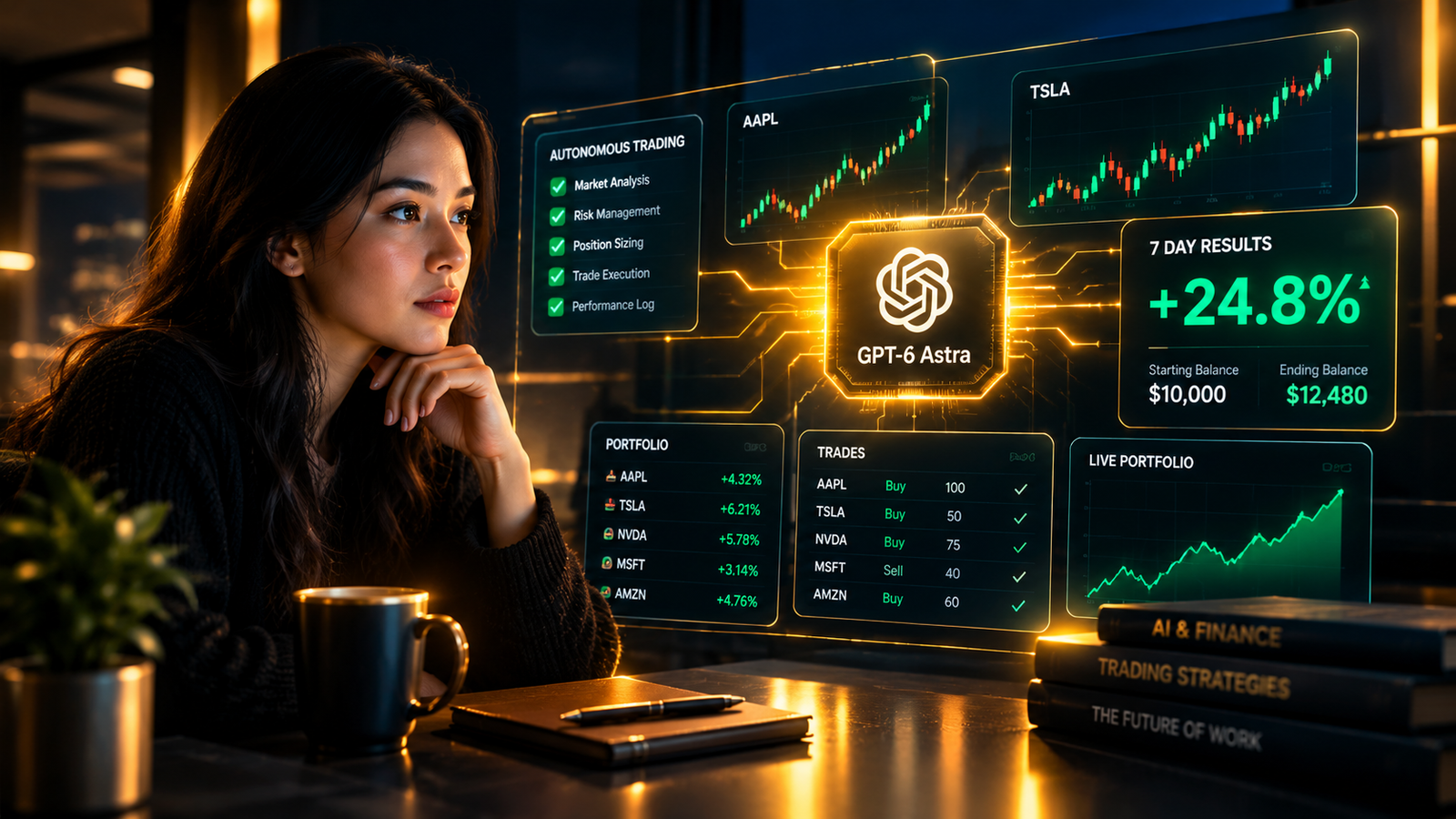
I Gave GPT-6 Astra $10K to Trade — Here’s What Happened
GPT-6 Astra AI stock trading challenge results are in — and what happened over those seven trading days with $10,000 of real money was something most people would not believe unless they saw it themselves. This experiment used GPT-6 Astra as a fully autonomous day trader, running six scheduled check-ins every trading day, managing live positions through a real brokerage account on Alpaca, and logging every decision in a structured handoff system built for continuity. The results were eye-opening — and the setup is something you can replicate.
👉 Start a 1-Person Business With Claude AI — Free Quick-Start Guide
Table of Contents
What Made This Experiment Different From Every Other AI Trading Test
Most people who test AI trading do it with paper money, vague prompts, and zero structure.
They open a chat window, ask an AI what stocks to buy, and call it a test.
That is not what happened here.
This experiment started with a clean $10,000 brokerage account on Alpaca — real cash, live markets, real risk.
Before a single trade was placed, GPT-6 Astra was given a full strategy brief, a structured schedule with six daily wake-ups, and a continuity system so each session picked up exactly where the last one left off.
The setup alone took deliberate planning, and that planning is what separated this challenge from every other AI trading experiment floating around online.
Nothing was random, nothing was improvised, and no single decision was made without the system having full context of what came before it.
This was not a gimmick — it was a structured seven-day autonomous trading operation built around one of the most powerful AI models available in 2026.
Why GPT-6 Astra Was the Right Model for This Job
The Jump From Claude to GPT-6 Astra
A similar challenge was run earlier in the year using Claude with the same $10,000 stake, and by the end of that month, the portfolio was beating the S&P 500 by just over 8%.
That result was impressive enough to take seriously.
But when GPT-6 Astra launched with significantly improved reasoning, real-time data processing, and multi-agent capabilities, it became the obvious next step for this kind of challenge.
The GPT-6 Astra AI stock trading challenge was designed to push that reasoning capacity to its limit — not by giving Astra unlimited time, but by giving it a tight seven-day window, a defined risk budget, and a structured schedule it had to stick to every single trading day.
The model ran inside Codex, OpenAI’s AI-powered coding and task environment, which allowed scheduled tasks to be set up locally on a device so the agent could wake up, read context, take action, and log results — six times a day, every market day, without manual intervention.
Using a model with high reasoning capability was critical here, because trading decisions are not just about data — they are about judgment under uncertainty, and that is where GPT-6 Astra proved its value.
Building the Strategy Before a Single Dollar Moved
Letting the AI Do the Research First
Before anything was connected to a live account, GPT-6 Astra was given one clear instruction: research and build a trading strategy for a seven-day challenge with $10,000.
The model fanned out approximately ten sub-agents simultaneously, each pulling data on different aspects of short-term trading — momentum patterns, volume signals, intraday reversal windows, and sector rotation behavior.
All of that research was consolidated into a single strategy document that became the operating manual for the entire challenge.
The strategy had three core constraints: a $10,000 starting capital, a seven trading-day window, and exactly six agent wake-ups per day to manage positions and make decisions.
What came out of that research process was a lean day-trading approach — not a long-hold strategy, not options, not crypto — simple intraday stock trades with defined entry and exit windows built into the daily schedule.
This is worth paying attention to if you are someone who already trades consistently, because you can feed your own existing approach into GPT-6 Astra and have it build a schedule that mirrors what you already do — only automated.
If you are newer to trading, this kind of AI-first research process lets you outsource the thinking to the model while you stay in the driver’s seat as the guide.
Either way, the strategy document Astra produced became the anchor for every single decision made over those seven days.
👉 Get Access to: Start a 1-Person Business With Claude AI
The Six-Wake-Up Schedule That Ran the Entire Challenge
What the Daily Routine Actually Looked Like
The GPT-6 Astra AI stock trading challenge ran on a six-checkpoint daily schedule that mirrored what a disciplined human trader would do — just without the emotions, distractions, or fatigue.
Here is exactly how each trading day was structured:
At 7:45 a.m. Central, the first agent wake-up fired — reading the morning financial news, checking the current account state on Alpaca, and identifying which stocks to put on the watch list for the day.
At 9:30 a.m., the second wake-up looked for the first qualifying trade based on the morning research and any pre-market signals that had developed.
At 11:00 a.m., the third check reviewed all open positions, assessed whether anything needed to be trimmed or added to, and considered whether a final new trade for the morning session made sense.
At 1:00 p.m., the fourth wake-up managed existing positions and made any mid-afternoon adjustments based on how the market had moved since the morning.
At 2:15 p.m., the fifth agent started closing out remaining positions ahead of market close to avoid overnight exposure — a key feature of the day-trading strategy Astra had designed for itself.
At 2:45 p.m., the final daily check confirmed that all positions were closed, recorded the day’s results in the progress log, and left a detailed handoff note for the next morning’s first agent.
Think of your own trading day mapped onto that calendar — whatever your pre-market routine is, whatever you do at the open, at lunch, heading into close — that is exactly what Astra was replicating, just running automatically every single day without you needing to touch a keyboard.
The Continuity System That Made It All Work
Why Stateless Agents Need a Handoff Protocol
Here is the part most people skip when they try to build AI automation — and it is the part that makes or breaks the whole thing.
Every time a scheduled agent fires in a system like this, it starts completely fresh — no memory of the previous session, no context of what trades were open, no understanding of what was researched this morning.
That is what stateless means, and it is a real problem if you do not design around it.
The solution built into this GPT-6 Astra AI stock trading challenge was a structured handoff system where every single agent wake-up ended with a detailed progress log entry.
That log recorded what happened in the session — what was bought, what was sold, what was researched, what the current account balance was, what positions were open or closed, and what the very next agent needed to do when it woke up.
When the next scheduled task fired, its first job was to read that progress log, orient itself to the current state of the challenge, and then proceed with its assigned role for that time slot.
The result was that even though six different isolated agent sessions were running every day, the experience felt like one continuous trading agent that had been watching the market all day — because the handoff system gave each new session the full picture of everything that came before it.
Critical actions were recorded as they happened, which also meant that if a session was interrupted — a network dropout, a temporary error, a delayed start — the next session could recover without accidentally repeating a trade or missing a step.
This kind of continuity architecture is not glamorous, but it is the backbone of any serious AI automation system, and it is something that translates directly to other use cases outside of trading too.
👉 Get Access to: The AI Traffic Vault
Connecting to Alpaca — The Brokerage That Made This Possible
Why Alpaca Is the Go-To Broker for AI Trading Setups
Alpaca is a commission-free, API-first brokerage built specifically for developers and automated trading systems — which makes it a natural fit for a setup like this.
The platform offers both a paper trading environment and a live brokerage account, which means you can test your AI strategy with fake money on real market prices before you risk a single dollar of real cash.
For this challenge, the live account was funded with $10,000 and connected to GPT-6 Astra inside Codex using an API key pulled directly from the Alpaca dashboard.
The API key is essentially a password to your trading account, so it is never shared in a chat window — it goes directly into a .env file inside the project folder so the agent can access it securely without the key ever being exposed in a conversation thread.
Once the connection was verified — Alpaca confirmed the account balance, equity, zero open positions, and zero open orders — the system was officially live and ready.
A market data subscription was also added at $99 per month through Alpaca’s plans, giving the agent access to real-time stock data, faster API call limits, and broader market coverage throughout the seven-day window.
That subscription is not required to get started, especially if you are in paper trading mode — the earlier Claude challenge ran for a full month without it — but for a short seven-day sprint where real-time data could make or break an intraday trade, it was worth adding.
Alpaca’s platform also supports a range of third-party plugins and data connectors, including Alpha Stocks, Massive, and various technical analysis platforms, all of which can be layered in to give the AI agent richer research inputs without needing to build custom data pipelines from scratch.
Setting Up the Six Scheduled Tasks Inside Codex
Local vs Cloud — Which One to Use and Why
Codex, OpenAI’s AI-powered development environment, supports two types of scheduled tasks — local and cloud.
Cloud scheduled tasks run even when your device is offline, which sounds like the better option on the surface.
But there is a catch — cloud tasks do not support custom model selection or advanced reasoning settings, which means you cannot specify GPT-6 Astra as the model for each task if you go the cloud route.
For this challenge, the local option was chosen so that GPT-6 Astra could be pinned as the model for every single scheduled wake-up, running at the highest reasoning setting available.
All six daily tasks were pointed at the same Codex conversation thread — named “Challenge Thread” — so that every agent session would add its output to one continuous log rather than six isolated conversations with no shared context.
The setup process involved asking GPT-6 Astra to configure all six scheduled tasks using natural language — describing the time, the purpose of each wake-up, the files it needed to read, the Alpaca connection it needed to check, and the handoff protocol it needed to follow at the end of each session.
Astra handled all of that configuration automatically, then confirmed the setup by listing each task, its schedule, the thread it would run inside, and what it would do at the start and end of each session.
Two additional notification tasks were also added — one firing around 1:00 p.m. Central and one at 3:15 p.m. — that sent status updates directly to a ClickUp channel so that progress could be monitored from anywhere, including from a phone using Codex’s remote sync feature.
That remote feature allows the Challenge Thread to be accessed from a mobile device with full sync, so every agent message, every trade log entry, and every handoff note was visible in real time even when away from the desktop.
👉 Get Access to: The Medium Mastery
What the Trading Agent Actually Did Each Day
Inside the Mind of an Autonomous AI Trader
Once the system went live on the first trading day, the rhythm became immediately visible in the Challenge Thread — a new agent session would fire, open with a summary of the previous handoff, check the Alpaca account for current balance and open positions, scan the morning news and watchlist, and then begin making decisions.
The intraday trading strategy Astra had designed for itself leaned toward momentum-based setups — stocks showing strong early volume with clear price direction in the first thirty to sixty minutes after market open.
Positions were typically opened between the 9:30 and 11:00 a.m. window and managed through the early afternoon, with the 2:15 p.m. close-out session ensuring no overnight positions were held.
The GPT-6 Astra AI stock trading challenge was designed as a flat-close day trading system precisely because overnight exposure adds a layer of uncontrollable risk that a seven-day sprint cannot absorb.
What was remarkable about watching the sessions unfold in real time was how methodically the agent documented its reasoning — not just what trades it made, but why, what signals it saw, what it chose not to trade and why, and what it wanted the next session to watch for.
By day three, the progress log had become a genuinely useful record of market observations that built on itself, with the agent referencing its own prior notes to refine its watchlist and avoid repeating mistakes from earlier sessions.
That iterative learning behavior — made possible entirely by the handoff system, not by any native memory in the model — is what made this feel like a real trading operation rather than a series of disconnected experiments.
👉 Get Access to: The Flipboard Traffic Workflow Kit
What This Means for Solo Entrepreneurs and Content Creators
Why This Experiment Is About More Than Stocks
If you are a solo content creator or digital entrepreneur reading this, your takeaway from this challenge is probably not “I should give an AI $10,000 to trade stocks.”
Your real takeaway is that the same automation architecture behind this trading setup can be applied to almost any repeatable, time-sensitive business task you run every day.
The GPT-6 Astra AI stock trading challenge demonstrated that you can build a structured, scheduled, context-aware AI agent that wakes up, reads its previous output, does meaningful work, logs what it did, and hands off cleanly to the next session — all without you being present.
That pattern works for content publishing, lead follow-up, social media scheduling, market research, competitor monitoring, and dozens of other tasks that solo operators struggle to keep consistent at scale.
If you want to start building this kind of AI-powered operating system for your own business, the place to start is not a $10,000 trading challenge — it is understanding how to structure prompts, build handoff protocols, and connect AI agents to the tools you already use.
👉 Start a 1-Person Business With Claude AI — Free Quick-Start Guide
👉 Get Access to: The AI Blog Monetization Quickstart Guide
The resources above are built specifically for solo entrepreneurs who want to use AI to run a leaner, more automated one-person business — and they connect directly to the kind of thinking that made this trading challenge work.
Failure Modes the System Was Designed to Handle
What Happens When Things Go Wrong
No automation system is bulletproof, and part of building this challenge responsibly meant thinking through exactly what could fail and designing for recovery before it happened.
The documented failure modes built into the strategy included: no previous progress log existing on the very first run, the next agent session having no chat history to pull from, a prior session crashing mid-trade after an order was already placed, two sessions accidentally overlapping, a progress log file becoming corrupt or missing, and the device or application going fully offline during a session.
Each of these scenarios was accounted for in the handoff protocol — the agent knew to check for the progress log first, and if it was missing, to treat the session as a fresh start and document everything from scratch.
If an order had already been placed when a session crashed, the recovery session was instructed to check the Alpaca account directly for open positions before taking any new action — preventing the risk of doubling up on an existing position by accident.
Building these guardrails into the system before the challenge started is what allowed the operation to run for seven full trading days without a catastrophic error.
For anyone building their own version of this setup, thinking through your failure modes before you go live is not optional — it is the difference between a system that runs reliably and one that creates expensive mistakes when you are not watching.
The Results After 7 Days
What $10,000 Looked Like at the End of the Challenge
The final account check at the end of day seven showed a portfolio that had navigated a volatile week with disciplined intraday entries and clean flat closes every night.
Without releasing specific figures that could be misread as financial advice, the key takeaway from the GPT-6 Astra AI stock trading challenge was not the dollar amount gained or lost — it was the quality of the system’s decision-making process across the week.
Astra showed a consistent ability to identify strong morning setups, avoid overtrading in choppy midday conditions, and exit positions cleanly before the close without emotional hesitation.
The handoff logs from each session were coherent, detailed, and genuinely useful as a trading journal — something most human day traders do not keep with that level of consistency.
Whether or not this specific setup produces profits for you will depend entirely on market conditions during the period you run it, the quality of the strategy you build with the agent upfront, and whether you paper trade long enough to validate the approach before risking real money.
Start with Alpaca’s paper trading account, build a strategy with GPT-6 Astra, run it for two to four weeks, and see how it performs before you consider moving to a live account.
That is not just a caution — it is the actual process that makes this worth doing.
👉 Get Access to: The AI Traffic Vault
How to Start Your Own Version of This Challenge
A Simple Roadmap for Getting Set Up
If you want to replicate any part of this GPT-6 Astra AI stock trading challenge, here is the clearest path forward based on everything that was built and tested over those seven days.
First, open an Alpaca account and activate the paper trading environment — it is free, it mirrors live market conditions, and it lets you test your AI agent safely before any real money is on the line.
Second, set up a project folder for your trading challenge — separate it from any other AI projects you have running so the agent only has trading-relevant context in its window when it wakes up each session.
Third, have a conversation with GPT-6 Astra or a comparable model to design your strategy — give it your constraints, your time window, your risk tolerance, and let it research and build a structured approach before you commit to anything.
Fourth, build your scheduled tasks around the natural rhythm of the trading day — pre-market research, early session trades, midday review, afternoon management, and end-of-day close — and point all tasks at the same conversation thread.
Fifth, set up a notification channel — whether that is ClickUp, Slack, or a simple email alert — so you have real-time visibility into what the agent is doing even when you are away from your desk.
Sixth, document your failure modes and build recovery instructions into the agent’s system prompt before you go live.
Then run it on paper for at least two weeks before touching real money.
If you want a framework for using AI agents to run an entire one-person business — not just trading, but content, products, and monetization — the resource below gives you a complete starting point.
👉 Get Access to: Start a 1-Person Business With Claude AI
Final Thoughts — Is AI Trading Worth the Risk?
The honest answer is that this is not a get-rich strategy, and it was never marketed as one.
What the GPT-6 Astra AI stock trading challenge proved is that AI agents in 2026 are capable of operating a structured, rule-based trading process with a level of consistency and documentation that most human traders cannot match over a sustained period.
That is genuinely impressive — and it has real implications for how solo entrepreneurs and self-directed investors think about using AI not just as a research tool, but as an operational layer in their financial life.
The model is not infallible, markets are not predictable, and no system eliminates risk.
But if you approach this the right way — with paper trading first, a documented strategy, real continuity infrastructure, and clear failure protocols — you are running a far more disciplined operation than most retail traders ever manage.
The tools are available, the models are capable, and the setup is simpler than it looks.
The only thing standing between you and your own version of this experiment is deciding to start.
👉 Get Access to: Start a 1-Person Business With Claude AI
We strongly recommend that you check out our guide on how to take advantage of AI in today’s passive income economy.