I Tried Making $10K With the Laziest AI Method I Could Find
Making money with AI influencers using tools like Claude AI for passive digital income is very real in 2026, but it is also a lot messier than most people on the internet want you to believe.
The screenshots are everywhere.
Someone posting $100,000 in 30 days.
Someone else showing $200,000 profit.
And then there are the faceless AI creators quietly pulling in thousands every single week without ever showing up on camera.
I decided to test the whole thing myself.
Not because I am a beginner.
Not because I was desperate for money.
But because I am the kind of person who refuses to believe something works until I have tried it with my own hands, my own budget, and my own set of rules.
👉 Free download: Start a 1-Person Business With Claude AI — Free Quick-Start Guide
Table of Contents
The Rules I Set Before I Started
I gave myself seven days.
I capped my starting budget at $99.
I could not use my face.
I could not use my voice.
And I had to have my first AI influencer fully created before the end of day one.
Those were my three rules, and I stuck to them.
The goal was to reach $10,000 in earnings by the end of the week.
And before you laugh at that number, understand that the people I had been watching online were claiming numbers far bigger than that in the same timeframe.
So the target was not random.
It was based on what other people were publicly saying was possible.
The question I needed to answer was simple: is this real, or is it just polished content designed to sell you a course?
What I found was somewhere right in the middle, and by the end of this article, you will know exactly where that middle ground sits.
Step 1: Studying What Was Already Working
Before I built anything, I spent time looking at AI influencers that were already out in the wild.
One of the most well-known examples is Lil Miquela, a fictional AI character who has accumulated over 2 million followers on Instagram.
She has appeared at major cultural events and worked with luxury brands including Prada and Calvin Klein.
Reports suggest that the team behind Lil Miquela earns upwards of $11 million per year from brand partnerships and sponsored content.
That number alone told me the ceiling on this strategy is not low.
Then I found accounts doing something very different.
There was an older AI persona positioned as a traditional wellness expert, sharing simple health habits and promoting a single supplement product in every video.
The comment sections on those videos were full of people asking where to buy the product.
No one was asking whether the person behind the camera was real.
I also found a British craftsman persona that appeared to be handcrafting wooden goods, building a following around a working-class, patriotic identity.
And an elderly female persona doing wild, unexpected things and pulling in over 2 million followers with pure entertainment value.
The key pattern I noticed across all of them was that none of them relied on a single income stream.
They were making money through brand deals, affiliate commissions, digital product sales, and merchandise.
That research alone was worth its weight before I spent a single dollar.
👉 Get Access to: Start a 1-Person Business With Claude AI
Step 2: Picking a Niche and Building the Characters
After studying the market, I noticed something that surprised me.
The three biggest money-making niches for AI influencers are health, wealth, and relationships.
Health and relationships were well represented.
But almost no AI account I found was talking about money, wealth, or financial strategy.
That gap in the market was exactly the kind of signal I look for.
I decided to create three separate AI influencers, one in each niche, to give myself the best possible chance of finding a winner quickly.
To generate the character concepts without wasting time, I used Claude, Anthropic’s AI assistant, on its free plan.
I typed a simple prompt asking Claude to create a character profile for an AI influencer in each niche, complete with a name, a backstory, a distinct look, and a clear selling point.
The health influencer came back as a 101-year-old man named Amos, with a shaved head, a long beard, and a background in traditional family remedies passed down through generations.
The wealth influencer was Grandma Vivian, a well-dressed, sharp-tongued woman who had built her fortune from nothing, survived three marriages, and now lived the kind of life most people only see in magazines.
The relationship influencer was Sienna, a 22-year-old with a stylish aesthetic who talked openly about dating, situationships, and what she actually wants in a partner.
Three completely different characters.
Three completely different audiences.
And not a single one of them required me to show my face or record my voice.
Step 3: Generating the Images With Higgsfield
For the actual image generation, I used a tool called Higgsfield AI.
Higgsfield is a platform designed specifically for creating realistic AI-generated photos and videos, and it integrates directly with Claude, which made the workflow extremely clean.
After signing up, I connected Higgsfield to my Claude workspace, which meant I could prompt Claude to write the detailed image generation prompts and then have Higgsfield execute them inside the same workflow.
For Amos, I generated several angles: a full-body shot, a close-up portrait, and multiple location scenes including a farmhouse porch, a vegetable garden, a rustic kitchen, and an open yard.
Every image came out looking completely believable.
The only adjustment I had to make was aging him up slightly, because the first batch of images made him look younger than intended.
One line of follow-up text fixed that in seconds.
For Vivian, I focused on locations that matched her wealthy persona: a private jet interior, a luxury sports car, an elegant sitting room, and a garden terrace that felt like afternoon tea in the English countryside.
She came out looking like a cinematic character, the kind of woman you would immediately want to follow just to see what she does next.
Sienna’s images were realistic in a different way, the kind of stylish, relatable quality you see from real lifestyle creators on Instagram and TikTok.
At this point, all three influencers had full visual identities, multiple settings, and a clear personality.
And I had not spent a dollar yet beyond the tool subscription.
👉 Free download: The Claude AI Digital Product Starter Pack — 10 Done-For-You Prompts for Beginners
Step 4: Creating the Content Without Writing a Word
This is where the strategy gets interesting, because I did not write a single piece of content manually.
Inside Claude, I used a feature called Skills, which are pre-built, reusable instruction sets that you can load into your chat and activate with a simple forward-slash command.
I found several content Skills online for free.
The first one I used was a content engine skill that generates a full list of video content ideas for a given character.
I activated it and typed a single instruction: generate content ideas for Sienna.
What came back was a complete content calendar with hooks, themes, and angle suggestions, all tailored to her personality and audience.
I selected three ideas that felt most likely to perform: a relatable situationship story, a piece of dating advice that felt personal and specific, and a pseudo-reveal style video that felt like she was about to share a psychological secret.
I then activated a script generation command and had Claude write out full scripts for all three ideas.
I repeated the same process for Amos and for Vivian.
Within an hour, I had a complete first batch of scripts for all three AI influencers, and I had typed almost nothing myself.
For the voiceovers, I went back into Higgsfield and used its audio generation feature.
I uploaded a character image, pasted in the script, and described the voice I wanted Claude to help me define, and Higgsfield produced a voice that matched the character.
Vivian sounded sharp, authoritative, and warm all at once, exactly the kind of grandmother you would trust with your money.
Amos had a calm, deliberate quality that matched the slow living philosophy of his character.
Sienna sounded young, expressive, and completely natural.
The finished videos combined the character images, the location backdrops, the scripts, and the voiceovers into short-form vertical content ready for Instagram Reels.
I also added captions using a free tool called CapCut, which takes no skill whatsoever to use.
Step 5: Launching the Accounts and Watching What Happened
I launched all three Instagram accounts on the same day.
Each account got an optimized bio, a profile image, and ten videos posted in quick succession.
For Amos, the bio read: 101 years old. Simple habits for peak energy, focus and longevity. Your AI Grandpa.
I added that last line deliberately, because I wanted to be transparent that the character was not a real person.
Then I stepped back and let the content run.
What happened next was not what I expected.
Within the first day, Sienna’s comment section started filling up with actual arguments between followers.
One person criticized her for the clothes she wore.
Another person defended her.
Then the original commenter came back with another reply.
Neither of them had spotted that Sienna was not a real person.
That moment told me something important about how people consume content on social media in 2026.
They respond to relatability, personality, and tension, not necessarily to whether the source is human or not.
After letting all three accounts run for a few days, I checked the results.
Vivian came in third.
Sienna came in second.
Amos came in first by a significant margin.
I decided to crown Amos the winner and focus all remaining energy on monetizing his account.
That decision, as I will explain shortly, turned out to be the one mistake I made that actually cost me money.
👉 Get Access to: The AI Traffic Vault
Step 6: Building the Digital Product
With Amos confirmed as the leading account, I needed a product to sell.
I ruled out brand deals because they take too long to negotiate.
I ruled out physical products because setting up a proper store was a separate project.
Ad revenue on Instagram Reels was not available.
And affiliate income through TikTok Shop was not accessible to me because I was only posting on Instagram.
That left digital products, which turned out to be the most logical choice anyway.
Educational influencers like Amos are perfectly positioned to sell something that teaches people a specific transformation.
Back inside Claude, I used a digital product skill and typed a single instruction: create a workbook as a digital product for Amos.
Claude returned three complete product concepts with clear descriptions of what each one would contain and why people would pay for it.
The first option stood out immediately: a 30-day challenge built around one simple habit per day, structured around Amos’s old-ways philosophy.
I chose that one and told Claude to build it.
What came back was a complete, structured workbook with 30 named daily rules, individual tick boxes for each day, a habit tracker designed to stick on the fridge, and a bonus section featuring traditional recipes connected to Amos’s backstory.
I read through the entire thing, made sure the information was accurate and logical, removed any language that felt mechanical or AI-generated, and then moved it into a product store.
For hosting the product, I used a platform called Stan Store, which offers a 14-day free trial.
I uploaded the workbook, added a cover image of Amos, set the price at $15.99 with a discounted price of $12, and pasted the product link into Amos’s Instagram bio.
The whole setup took less than two hours.
👉 Get Access to: The Medium Mastery
Step 7: The Final Numbers and the Lesson I Did Not See Coming
By the end of day seven, Amos had made 23 sales of the $12 workbook.
Total revenue: $276.
Now let me walk through the costs so you have the full picture.
Claude was used on its free plan.
CapCut for captioning was free.
Stan Store was covered by the 14-day free trial.
PayPal processing fees came to $19.52.
Higgsfield cost $99 for the subscription I needed to generate all the photos and videos.
Total costs: $118.52.
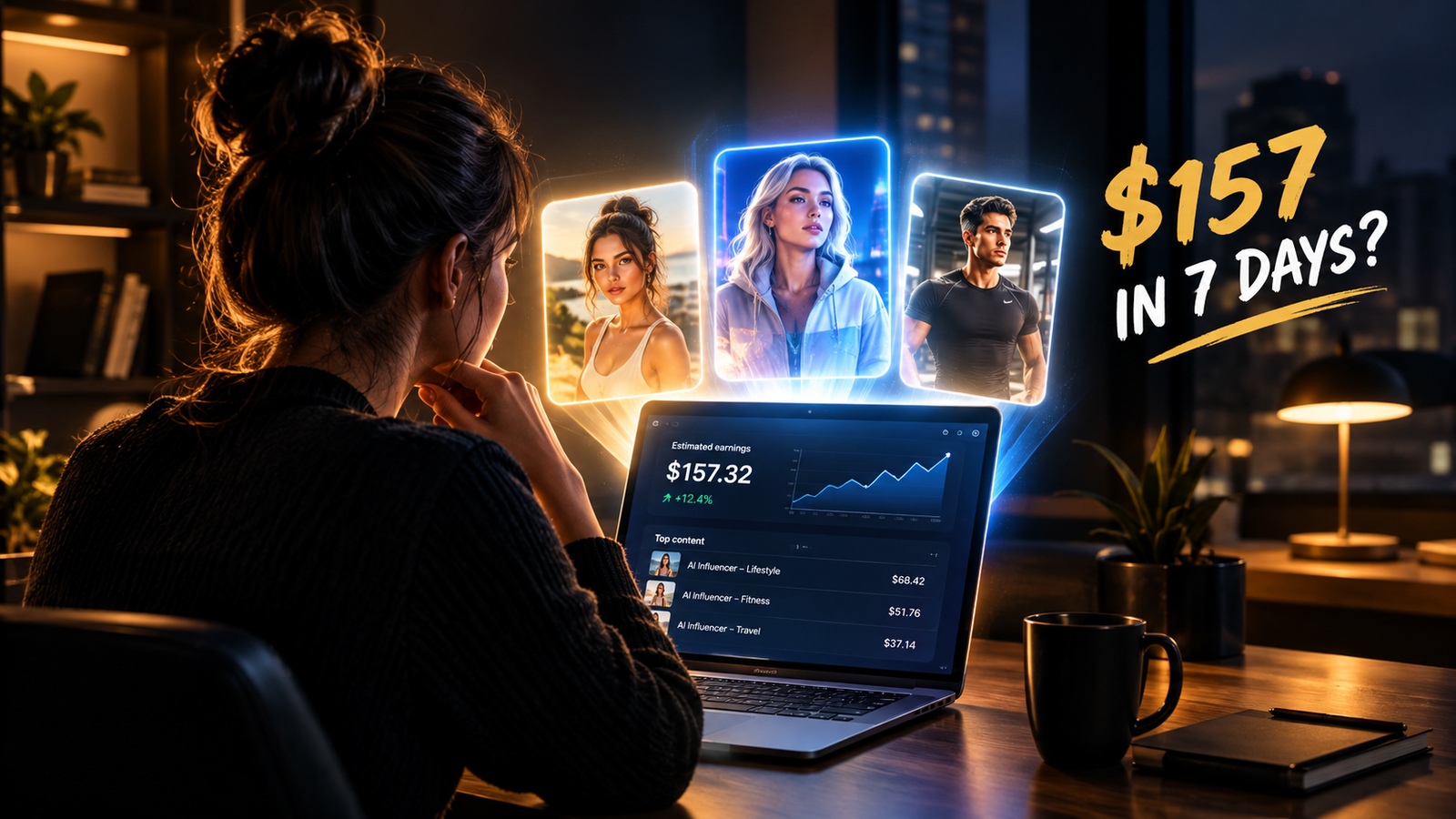
Total profit: $157.48.
I did not hit $10,000.
I did not hit $1,000.
But here is the part of the story that stings a little.
While I was focused entirely on Amos during the final days of the challenge, Vivian’s account quietly exploded.
One video crossed 250,000 views.
Two others crossed 10,000 and 20,000 views respectively.
The account I placed third had gone viral without me even watching it.
If I had kept posting on all three accounts and had either a product or an affiliate offer ready for Vivian, the numbers at the end of that week would have looked very different.
That is the actual lesson of this experiment.
Not that the method does not work.
Not that AI influencers are overhyped.
The lesson is that you cannot predict which account will break through.
You need to run multiple accounts simultaneously, keep them all active, and have a monetization system ready for whichever one catches fire.
Seven days is also not a fair amount of time to judge a strategy that compounds over weeks and months.
If Vivian’s account was pulling those kinds of numbers in week one without any focused effort, imagine what a consistent three-month posting schedule with an affiliate product ready in the bio would have produced.
👉 Get Access to: The Flipboard Traffic Workflow Kit
What I Would Do Differently Starting Today
If I ran this experiment again with the benefit of everything I now know, I would change five things.
First, I would post on TikTok and Instagram simultaneously from day one.
TikTok Shop affiliate income is available immediately, which means you can start earning from product promotions without needing to build your own product first.
Second, I would keep all three accounts active through the full duration of the test rather than narrowing down to one winner too early.
Third, I would have a digital product ready before I posted the first video, not after the first round of results came in.
Fourth, I would set up a simple affiliate relationship with one relevant product for each influencer so there is always something earning even before the workbook or standalone product is ready.
Fifth, I would add a low-cost email capture to the Stan Store product page so that buyers become part of a longer relationship, not just a one-time transaction.
None of these changes require more money.
They just require more strategy upfront.
The tools are already doing the heavy lifting.
Claude handles the scripting, the character concepts, the product structure, and the content calendar.
Higgsfield handles the image generation and video production.
The only thing these tools cannot do is make decisions for you.
That part is still yours.
👉 Free download: Start a 1-Person Business With Claude AI — Free Quick-Start Guide
Is This Method Worth Trying in 2026?
Yes, with one important caveat.
The lazy AI influencer method works, but it does not work the way the $100K screenshots suggest it does.
It works the way any real business works: slowly at first, then faster once you have data to work with.
What AI tools have changed is the barrier to entry.
In 2020, building a content brand from scratch required a camera, lighting equipment, editing software, a script, and either your face or the money to hire talent.
In 2026, you need a laptop, a $99 subscription, and a free Claude account.
The core business principles have not changed.
The execution cost has dropped to almost nothing.
And that changes who can play this game.
If you are a one-person business owner, a solopreneur, or someone testing income ideas on a tight budget, the AI influencer model is one of the most accessible income experiments available to you right now.
It is not passive.
It is not instant.
But it is real, and the upside over six to twelve months is significant for anyone willing to stay consistent.
👉 Get Access to: The AI Blog Monetization Quickstart Guide
Final Thoughts: What $157 Actually Taught Me
I did not make $10,000 in seven days.
I made $157.48 in profit from a $99 investment, using tools I had never used before, building characters I invented from scratch, and selling a product that did not exist before I sat down and asked Claude to build it.
More importantly, I now have three live Instagram accounts, a tested content workflow, a digital product that will keep selling with zero additional production cost, and a clear roadmap for what to do differently in the next thirty days.
That is not a failure.
That is a business foundation built in one week with less money than most people spend on takeaway food.
The lazy AI method does not make you rich overnight.
But it gives you something more valuable than a one-week windfall.
It gives you a system.
And systems, unlike lucky weeks, can be scaled.
👉 Get Access to: Start a 1-Person Business With Claude AI

We strongly recommend that you check out our guide on how to take advantage of AI in today’s passive income economy.