5 Flipboard Audience Angles That Turn 1 Old Article Into 5 Traffic Sources
A Flipboard strategy for existing articles means sharing one useful post with several audiences, using a fresh angle for each.
The article stays the same.
Only the way people find it changes.
You pick an audience first.
Then you write a new headline for them.
Next, you place it in a matching Magazine.
Finally, you track which angle wins.
This is how one article can earn five chances.
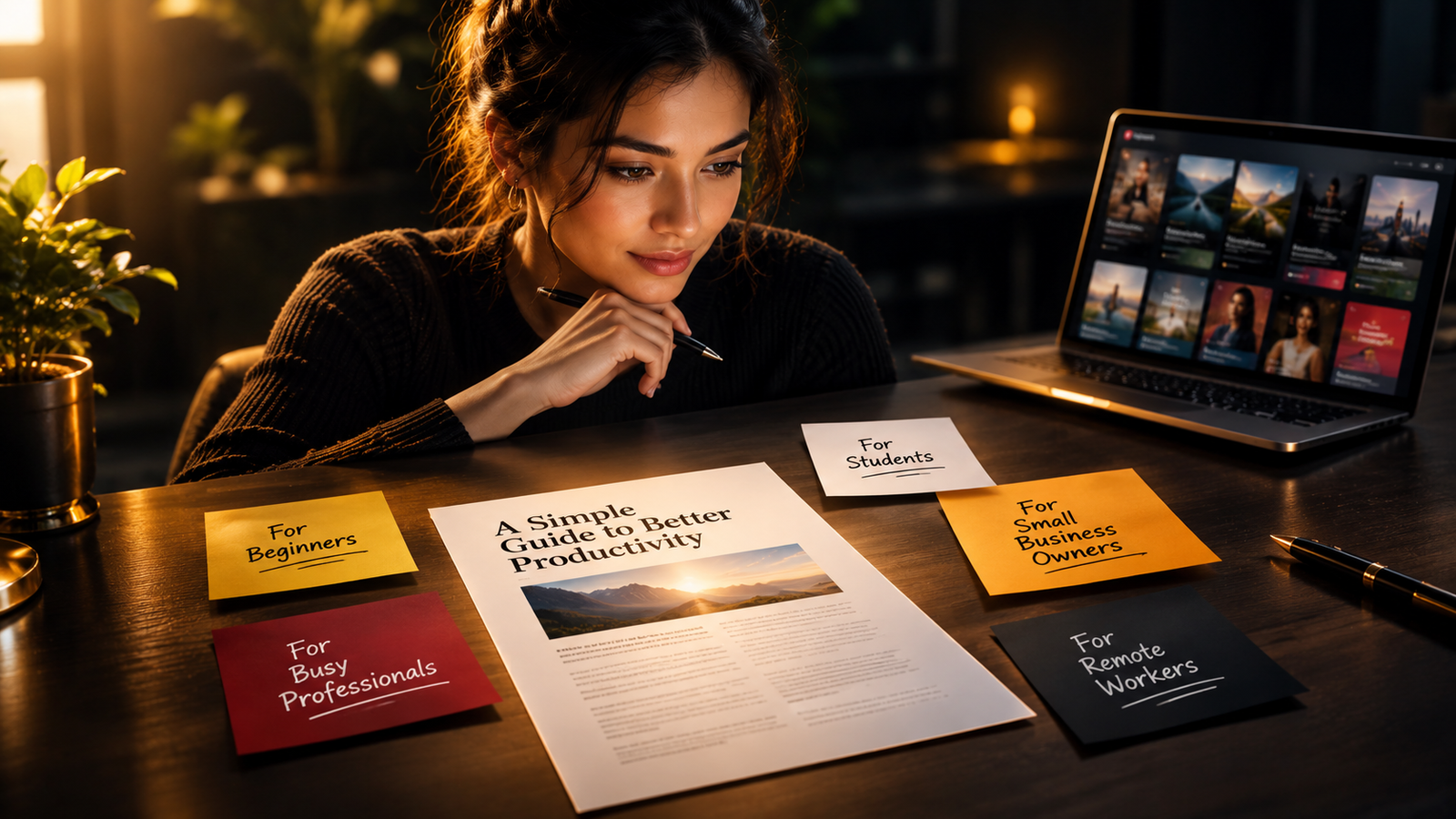
Picture a tidy desk with one strong article printed in the middle.
Around it sit five colored sticky notes, each holding a different headline.
Each note speaks to a different kind of reader.
That small picture is the heart of this guide.
Most creators race to write another post when traffic feels slow.
I think that race wears people out and wastes good work.
In this 2026 guide, I will show you a calmer path built on testing.
Let’s start with the simple idea behind it all.
👉Free download : Start a 1-Person Business With Claude AI — Free Quick-Start Guide
Table of Contents
Why a Flipboard Strategy for Existing Articles Beats Writing More
Most publishers write an article, share it once, and then move on to the next idea.
That habit feels productive because you always have something new to show.
But a new article is not the same thing as new attention.
Think about the last helpful post you wrote and how few people truly saw it.
A good Flipboard strategy for existing articles starts by asking a different question.
Instead of asking what to write next, you ask who else could use this.
That one question can turn a single post into five small campaigns.
Smart content repurposing may uncover traffic that is already sitting in your library.
Flipboard was launched in 2010 as a social magazine app by Mike McCue and Evan Doll.
It was built around topics, interests, and curated collections instead of a plain list of posts.
That design matters because readers there come looking for subjects, not for brand names.
Flipboard’s own publisher guidance says Magazines work best when they stay focused on specific themes.
It also suggests clear titles and descriptions so people know what they will find.
So the platform itself rewards packaging that fits one audience at a time.
A scattered pile of links does not do that job well.
A thoughtful angle for a clear audience does.
This approach is also kinder to your energy as a solo creator.
You do not need a team of writers or a giant budget to try it.
You need one useful article, a few honest guesses, and a simple notebook.
I run a small content business, and I have learned that testing beats guessing.
Every angle you test teaches you something about real readers.
A winning angle shows you where to put more effort next month.
A weak angle costs you very little and gives you a lesson.
That is why I trust this Flipboard strategy for existing articles more than random posting.
👉 Get Access to the full Package: Start a 1-Person Business With Claude AI
A Flipboard Strategy for Existing Articles in Action: The $500 Example
Let’s use a simple article called How to Save $500 Every Month.
Most businesses would publish it once and never look at it again.
I would test different audience angles around that same article instead.
The core advice never changes, and the facts stay exactly the same.
What changes is the doorway people use to walk into the article.
A single headline can only open the door for one kind of reader.
Five headlines can open five doors, each with its own welcome mat.
That is a Flipboard strategy for existing articles in its simplest form.
Audience One: Personal Finance
The personal finance reader wants quick, practical wins they can use this week.
For this group, the angle might be seven simple ways to find $500 in your monthly budget.
Notice how the headline promises a list, a number, and a clear goal.
Picture a young professional at a kitchen table with a laptop and a cup of tea.
A bank app glows on the screen, and a notepad sits right beside it.
She wants steps, not lectures, and a list gives her exactly that.
This is the broadest angle, so it often brings the largest crowd.
It is a strong first test for any money-based article.
Audience Two: Frugal Living
The frugal living reader loves small habits that quietly add up over time.
Here the angle could be the small spending leaks that may be costing you hundreds every month.
The word leaks gives the reader a clear picture of money slowly dripping away.
Imagine a kitchen faucet with a steady drip and a tiny coin dropping with every sound.
That image makes an abstract idea feel real and easy to fix.
These readers enjoy clever tricks, so your tone can feel playful and sharp.
They also often save and share good tips with friends.
That sharing habit can help one article travel much farther.
Audience Three: Money Management
The money management reader wants order, structure, and a clear system.
A fitting angle is a simple system for taking control of your monthly spending.
This headline sells calm and control, not just a list of tips.
Picture a tidy dashboard with three clean columns for needs, wants, and savings.
Every number sits in its place, and nothing feels rushed or messy.
Google Sheets or an app like YNAB can sit right beside this angle as a helpful tool.
These readers want to feel organized, so your wording should feel steady and clear.
The same article now feels like a fresh workbook made just for them.
Audience Four: Financial Independence
The financial independence reader thinks in years, not weeks.
Their angle could be how an extra $500 saved every month can change your long-term plan.
This version shifts the story from a small monthly win to a big future one.
Do a little math with them, since $500 each month adds up to $6,000 in a year.
Over ten years, that is $60,000 in simple savings before any growth.
These readers may know the FIRE movement, which stands for financial independence, retire early.
They enjoy big pictures and long timelines, so your tone can feel thoughtful.
Same article, new promise, and a very different kind of reader clicks.
Audience Five: Family Finance
The family finance reader has kids, bills, school fees, and very little spare time.
A good angle is how families can find an extra $500 without earning more money.
The key phrase is without earning more, because many parents cannot take extra work.
Picture a family dinner table with a jar labeled vacation fund sitting near the salt.
The kids are laughing, and a parent is quietly smiling at the growing jar.
That scene shows relief and hope, which is what this reader truly wants.
Your tone here should feel warm, honest, and free of judgment.
Five readers, five headlines, and still just one article doing all the work.
How Flipboard Topics and Magazines Fit Each Angle
Once you have five angles, you need five places where they make sense.
On Flipboard, readers follow topics and open Magazines, which are curated collections built around one theme.
Each Magazine acts like a small shelf in a big library.
You would not place a cookbook on the shelf for car repair.
In the same way, a family budgeting angle belongs near other family finance stories.
Matching the angle to the right shelf is the heart of a good Flipboard strategy for existing articles.
A poor match wastes the angle, even if the headline is great.
A close match gives the right reader a reason to stop and tap.
Picture the Flipboard app open on a phone during a morning commute.
A clean grid of tiles fills the screen, each with a bold photo and a short headline.
The reader’s thumb glides up, past dozens of stories, in just a few seconds.
Only the tiles that speak directly to that person earn a pause.
That is why the headline and the Magazine description matter so much.
They work together like a sign and a storefront.
If the sign says money tips for families, the right people walk in.
If the sign is vague, they keep walking.
Your Magazine titles should be simple and easy to understand at a glance.
Names like Family Budget Ideas or Frugal Living Tips tell people what to expect.
Your description should add one clear sentence about who the Magazine is for.
Keep each Magazine on one theme, just as Flipboard advises.
A tight Magazine builds trust, and trust makes this Flipboard strategy for existing articles grow faster.
Good curation also means adding strong stories from other trusted publishers, not only your own.
A Magazine full of only your links looks like an advertisement.
A Magazine with a healthy mix looks like a helpful guide.
👉Get Access to : The Flipboard Traffic Workflow Kit
The Five-Step Testing System You Can Start Today
Now let’s turn the idea into a simple routine you can repeat.
The routine has only five steps, and each one is small.
You can finish the first round in a single quiet afternoon.
Keep a notebook or a Google Sheets file open while you work.
Write down every angle, every Magazine, and every date you test.
Without notes, you will forget what you tried and why it worked.
With notes, you slowly build a map of what your readers love.
Here are the five steps that power this Flipboard strategy for existing articles.
Step One: Pick One Useful Existing Article
Start with a post that already helps people in a clear way.
Choose something evergreen, meaning it stays useful no matter the month.
A guide, a checklist, or a how-to post usually works best.
Skip news posts, since they go out of date very fast.
Open the article and read it as if you were a stranger.
Ask yourself which problem it solves and who feels that problem most.
Write that problem in one short sentence at the top of your notes.
That sentence becomes the anchor for every angle in your Flipboard strategy for existing articles.
Step Two: Find Three to Five Audiences
Next, list the different kinds of people who could gain from the same article.
Think about their goals, their worries, and what they hope to find, which is called reader intent.
A single how-to post on blogging might help students, side hustlers, small shop owners, and retirees.
Each group cares about a slightly different result.
Do not invent audiences just to reach a number.
Three honest audiences beat five forced ones every time.
If you cannot picture a real person in the group, remove it.
Keep only the groups you could describe to a friend in one breath.
Step Three: Create a Different Discovery Angle for Each
Now write one headline and one opening line for each audience.
The facts inside the article stay true and unchanged.
Only the promise on the outside changes to match the reader.
Use numbers, plain words, and one clear benefit in every headline.
Try to make the reader feel seen in the first five words.
Do not promise money or results that your article cannot truly deliver.
Honest packaging keeps readers happy and keeps your name trusted.
Clickbait may win a tap today, but it loses the follower tomorrow.
Step Four: Match Each Angle to a Flipboard Topic or Magazine
With your angles ready, search for the topics and Magazines where each one belongs.
Look at what other publishers are already adding to those Magazines.
Notice the tone, the headline style, and the kind of images they use.
If a Magazine fits, add your angle with a short, friendly comment.
If no Magazine fits, build a small new one around that audience.
Give it a clear name and a one-sentence description that explains its purpose.
Space out your flips over several days, because a calm Flipboard strategy for existing articles wins over time.
Slow and steady posting keeps your account looking natural.
Step Five: Track Which Angle Gets the Strongest Response
Finally, watch what happens and write the results in your notes.
Add a unique UTM tag to each link so Google Analytics 4 can tell the angles apart.
A UTM tag is just a short label added to the end of a web address.
Also check the view counts Flipboard shows you and your follower growth over time.
Compare the angles after two weeks, then again after four.
One angle will often pull ahead, and sometimes the winner will surprise you.
Put your next round of effort into the angle and the Magazine that did best.
Then repeat the routine, because a Flipboard strategy for existing articles improves with every round.
How to Measure Results Without Getting Lost in Numbers
Tracking sounds scary, but you only need three simple numbers.
First, count clicks from each angle to your article.
Second, watch how long people stay on the page after they arrive.
Third, notice whether readers click a link to a product or another post.
Google Analytics 4 can show all three if your UTM tags are neat.
Google Search Console and Bing Webmaster Tools can show how the same article performs in search.
That extra view helps you see if one angle also lifts search interest.
A good Flipboard strategy for existing articles measures small signals, not just big spikes.
Picture a simple spreadsheet with five rows for your Flipboard strategy for existing articles.
The columns read angle, Magazine, flip date, clicks, and reading time.
After a few weeks, you will see colors and patterns pop out.
A quick glance can tell you which headline style your readers love.
This simple chart beats hours of guessing and worrying.
Many creators skip tracking in their content distribution plan, and then they repeat the same mistakes.
A written record turns every test into a lesson you can use again.
If you want a ready-made routine, I built one for this exact job.
👉Get Access to : The Flipboard Traffic Workflow Kit
Mistakes That Can Hurt Your Flipboard Reach
The biggest mistake is flipping the same article too many times.
I learned this the hard way when I flipped one article up to 180 times a day into 15 Magazines.
My traffic dropped, and I had to rebuild my plan from scratch.
The fix was to use fewer Magazines per article and to curate other people’s stories too.
I also moved my posting to US Eastern morning hours, when many readers are awake.
A strong Flipboard strategy for existing articles uses fewer, better placements instead of loud, constant ones.
Think of it like a polite guest, not a person shouting in a crowded room.
Quality and patience protect your account and your reputation.
Another mistake is using weak or mismatched images.
Imagine a bright, clean photo of a family at a table beside a jar of savings.
That image fits the family angle and feels warm and real.
Now imagine a dark, cluttered picture with no link to the headline.
Readers scroll past it in less than a second.
In one of my own tests, switching to professional stock photos improved my Flipboard results.
Your results may differ, so test it yourself before you decide.
Remember that every picture is part of your Flipboard strategy for existing articles, not just decoration.
👉Get Access to : The AI Traffic Vault
Why Patience Pays: The Three to Six Month Test
This is not a promise of instant traffic, and anyone who says so is selling a dream.
It is a testing system, and your Flipboard strategy for existing articles needs time to show patterns.
Give each round at least a few weeks, then run the full routine for three to six months.
Measure what happens and put more effort into topics and angles that show real potential.
Some angles will stay quiet, and that is perfectly fine.
A quiet angle is still a lesson that saves you time later.
Over months, your notes become a private playbook that no competitor can copy.
I will not promise a dollar figure, because results depend on your niche, your offer, and your effort.
A Flipboard strategy for existing articles only pays off when readers have a clear next step.
Traffic alone does not pay the bills, so plan what readers will do after they arrive.
That next step could be an email list, a free guide, or a simple digital product.
A clear offer turns a casual reader into a subscriber or a customer.
Think of your article as a front porch with a welcome sign.
The offer is the open door that invites people to step inside.
If you are building a blog income plan around this traffic, a simple roadmap saves time.
I put the basics into one short guide for beginners.
👉Get Access to : The AI Blog Monetization Quickstart Guide
A Flipboard strategy for existing articles starts with one simple belief, that your best work deserves more than one chance.
You already have articles that help real people.
You now have a way to show them to five different readers.
Pick one post, choose your audiences, and write your angles today.
Match each angle to a focused Magazine and flip with patience.
Track your clicks, read your notes, and let the numbers guide your next move.
Keep going for three to six months, because a Flipboard strategy for existing articles rewards steady testing.
Next time, I will show you how to build a Magazine that is more than a folder full of links.
👉Free download : Start a 1-Person Business With Claude AI — Free Quick-Start Guide

We strongly recommend that you check out our guide on how to take advantage of AI in today’s passive income economy.