How Much Should You Charge for an AI Agent? A $23K Case Study Says This
Businesses are paying real money for AI agents right now, and one small automation team recently documented exactly how much: $23,000 across four separate builds, ranging from $1,650 to $12,000 per project.
This wasn’t a fluke or a lucky pitch.
It was the result of a pricing and delivery process that evolved with every client, and it holds lessons for anyone thinking about AI agent pricing for small businesses in 2026.
In this article, we’re breaking down each of the four agents, what they actually did, why businesses were willing to pay for them, and the exact framework you can use to price and sell your own.
Stick around to the end, because the most expensive build in this case study is also the one that teaches the biggest lesson about AI agent pricing for small businesses.
We strongly recommend that you check out our guide on how to take advantage of AI in today’s passive income economy.
Table of Contents
Agent One: The Personalized Outreach Agent ($1,650)
The first build in this case study was a personalized outreach agent.
A client could drop in a list of contacts, and the system would research each person and their company, then generate a customized outreach message along with a follow-up.
It didn’t send anything or run campaigns on its own.
It simply filled a database with research-backed, ready-to-use messages the client could plug into an email or DM sequence.
The build was priced at $1,650, a number that was honestly closer to a guess than a calculation, based loosely on a slightly smaller project sold before it.
👉Get Access to : The AI Traffic Vault
But even without a formal ROI model, the math worked out in the client’s favor.
If the client was spending two to three hours a week writing personalized messages by hand, and valued that time around $50 an hour, that’s roughly $400 a month in time saved.
At that rate, the system paid for itself in about four months, and every month after that was pure return, adding up to close to $5,000 saved over a year.
This is a common entry point for AI agent pricing for small businesses: a narrow, well-defined task with a clear time-saving story.
👉Free download : The Claude AI Digital Product Starter Pack — 10 Done-For-You Prompts for Beginners
Agent Two: The Sales and CRM Agent ($4,000)
The second agent handled something a little more central to revenue: customer inquiries, quote generation, and CRM data entry.
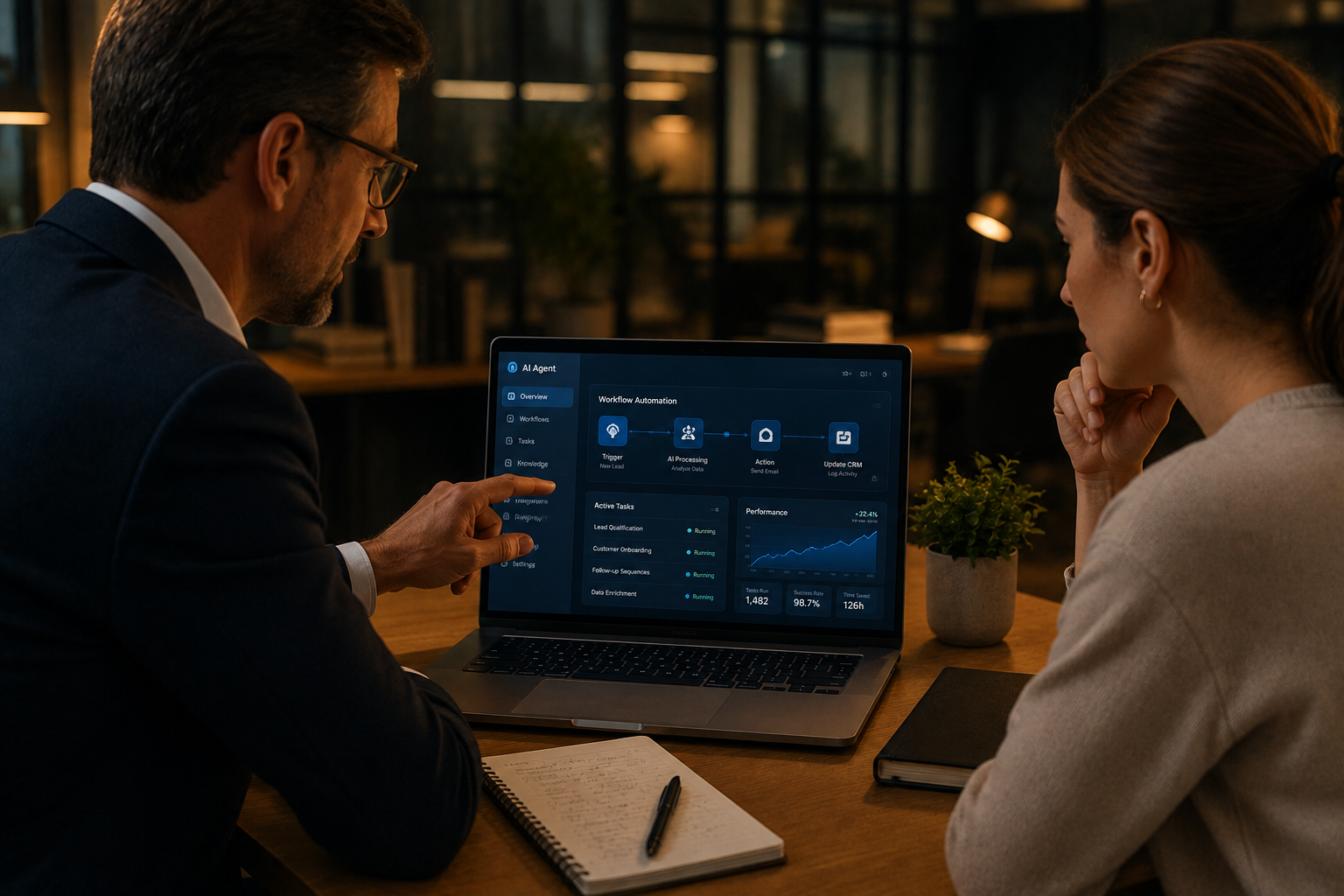
It talked to both the customer and the internal orders team, produced an accurate quote, and logged everything back into the CRM, including name, email, phone number, location, and a summary of the conversation.
This is where AI agent pricing for small businesses starts to shift from “time saved” to “growth enabled,” because the agent wasn’t just automating admin work.
It was giving the business a way to scale without adding headcount, which mattered a lot to an owner who wasn’t ready to hire.
That value justified a $4,000 price tag, and the client accepted it without much pushback.
The sales process behind this deal also matured compared to the first one: a discovery call, a technical review to confirm the build was feasible, a second discovery call, and a closing call.
One gap in this deal is worth noting for anyone learning AI agent pricing for small businesses: the team forgot to collect baseline data before the build, which made it harder to prove ROI afterward with hard numbers.
That’s a lesson worth building into your own process from day one.
👉Get Access to : The Medium Mastery
Agent Three: The Internal Slack Assistant ($6,000)
The third build was a personal assistant for a business owner and their team, living directly inside Slack.
It gave quick access to internal data, handled task management, and cut down the back-and-forth of switching between tools just to find basic information.
Pricing this one was harder, because unlike outreach or sales agents, the time saved by a personal assistant agent doesn’t happen on a predictable schedule.
It was priced at $6,000, based more on the complexity of the build than a clean ROI calculation, which in hindsight was a mispriced deal.
Looking back at all four projects, this is actually the one that should have been priced lower relative to the sales agent, not higher.
A sales agent compounds in value as the business grows, because more leads flowing through the system means more return from the same automation.
A Slack assistant doesn’t scale the same way, since its usage doesn’t necessarily grow in step with the business.
That distinction matters a lot when you’re figuring out AI agent pricing for small businesses, because complexity and value are not the same thing, and pricing on complexity alone tends to leave money on the table.
Agent Four: The AI Concierge ($12,000)
The fourth and most expensive build was a full AI concierge system designed to support a client’s members from start to finish.
It handled onboarding, event discovery, guest pass management, general support, and kept a running conversation history across every member interaction.
Essentially, it acted as a virtual front-desk operator, guiding users and keeping the business running without adding staff during a new product launch.
This build also came together right as MCP servers were becoming a bigger part of the AI agent ecosystem, and incorporating that technology gave the team another selling point: staying on the cutting edge of what AI agent pricing for small businesses could actually support.
At $12,000, the client saw the agent as filling the role of an intern or assistant at a fraction of the long-term cost of hiring one.
By this point in the case study, internal delivery systems had caught up with the size of the projects being sold, which is often the real difference between a $1,650 build and a $12,000 one.
It’s rarely just the technology that gets more expensive.
It’s the process, the delivery, and the trust built around it.
👉Get Access to : The Flipboard Traffic Workflow Kit
How to Price and Sell Your Own AI Agents
If you’re trying to apply AI agent pricing for small businesses to your own work, here’s the framework that shows up across all four deals in this case study.
Diagnose the problem before you prescribe a solution.
Don’t lead with “I can build you an AI chatbot.”
Lead with the actual cost: “Your team spends 15 hours a week answering the same questions, and I can build something that cuts that down to almost nothing.”
Keep the tools simple.
Most AI agent builds don’t need exotic technology, just solid building blocks like automation platforms, vector databases, and one or two reliable AI models, combined thoughtfully for the client’s specific workflow.
Calculate the actual savings.
Multiply hours saved per week by an hourly rate, then by four weeks for a monthly number, then by 12 for an annual one, and use that math to justify your price instead of guessing.
Package and anchor your offers.
Structure pricing into tiers, like a starter, growth, and scale package, and always show the highest tier first so the middle option feels like the smart, obvious choice.
Avoid the three traps that quietly kill AI agent pricing for small businesses.
Underpricing attracts the wrong clients and makes it hard to raise rates later, under-scoping without a change request process destroys your margins, and chasing small monthly retainers too early often pays worse than landing fewer, larger projects.
Watch your close rate.
If you’re closing more than 40 to 50 percent of your proposals, that’s usually a sign you’re priced too low, since a healthy close rate in B2B consulting tends to sit closer to 20 to 30 percent.
👉 Get Access to the full Package: Start a 1-Person Business With Claude AI
Why This Matters for AI Agent Pricing in 2026
The bigger takeaway from this $23,000 case study isn’t the dollar figures themselves.
It’s that AI agent pricing for small businesses is still being figured out in real time, even by people actively closing deals, and every project in this breakdown involved some kind of pricing correction along the way.
The outreach agent was underpriced because there was no formula yet.
The Slack assistant was priced on complexity instead of value.
The concierge system, priced highest of the four, worked because the delivery process had finally matured enough to support a bigger, more complex build.
If you’re building toward your own version of AI agent pricing for small businesses, the goal isn’t to copy these exact numbers.
It’s to build the habit of tying every price to a measurable outcome, so clients see the cost as an investment rather than an expense.
Getting Started With Your Own AI Agent Offer
You don’t need a team or a co-founder to land your first paid AI agent project.
You need one clear problem, one simple build, and one client willing to test it with you.
👉Free download : Start a 1-Person Business With Claude AI — Free Quick-Start Guide
If you want a full system for identifying AI-powered income opportunities, structuring offers, and turning them into a real one-person business, The AI Traffic Vault walks through the traffic, content, and monetization side of building this kind of business from the ground up.
👉Get Access to : The AI Blog Monetization Quickstart Guide
And if you’re just getting started and want a free, done-for-you way to begin building digital products or offers around AI, grab the Claude AI Digital Product Starter Pack before you go.
👉Free download : The Claude AI Digital Product Starter Pack — 10 Done-For-You Prompts for Beginners
We strongly recommend that you check out our guide on how to take advantage of AI in today’s passive income economy.