Five Tech Giants Are Saying the Same Thing — And Most Marketers Are Still Not Listening
Here Is What the AI CEO Marketing Shift Means for Your Business Right Now
Something big happened in the last 90 days, and most marketers completely missed it.
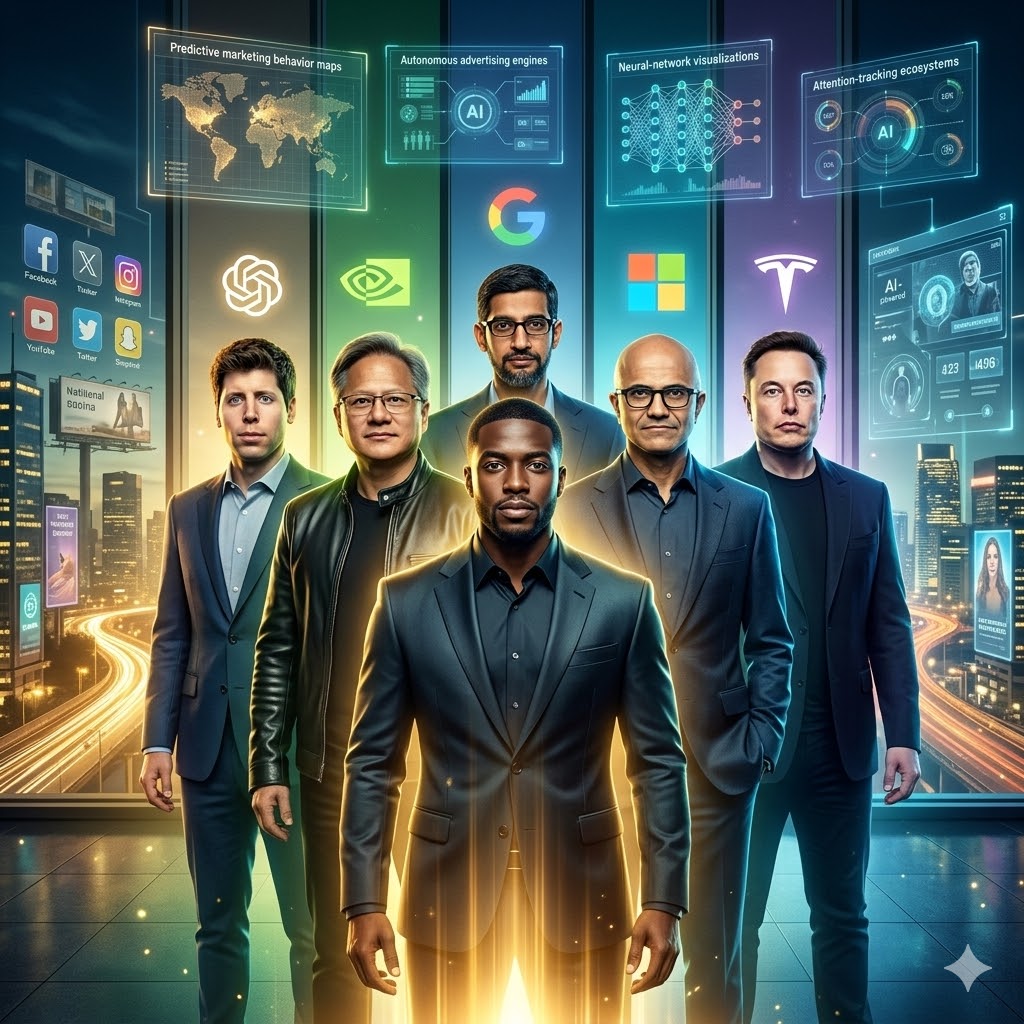
Five of the most powerful AI CEO voices on the planet — Sam Altman of OpenAI, Jensen Huang of Nvidia, Sundar Pichai of Google, Satya Nadella of Microsoft, and Elon Musk of xAI — all said something that should have stopped every marketer cold.
They did not talk about better chatbots or faster tools.
They did not predict a future that is still 10 years away.
They signaled a very specific shift that is already changing how marketing must operate right now in 2026.
And if you are still running the same content playbook from 2023, this article will show you exactly why that strategy is quietly dying — and what you need to build instead.
We strongly recommend that you check out our guide on how to take advantage of AI in today’s passive income economy.
Table of Contents
Why the AI CEO Marketing Shift Is the Biggest Signal of 2026
Here is what made this moment so unusual.
Sam Altman, Jensen Huang, Sundar Pichai, Satya Nadella, and Elon Musk all come from different companies, serve different audiences, and build different things.
But in the last 90 days, every single one of them stopped talking about AI models and started talking about something else entirely.
They started talking about systems, infrastructure, and agents.
That change in language is not a coincidence — it is a signal.
And for marketers, that signal means one thing: you are no longer just creating content for humans to find and read.
You are now competing to become the source that AI agents pull from, trust, cite, and recommend when someone asks a question.
Most marketing teams are still not aware this shift is already happening at scale.
The audience for your content has quietly changed, and the optimization game has completely changed with it.
The ROI Data That Should Make Every Marketer Pay Attention
Before breaking down what each AI CEO said, it is worth looking at what the data is already showing.
A 2025 performance analysis tracking companies that implemented GEO (Generative Engine Optimization) and AEO (Answer Engine Optimization) produced numbers that were hard to believe at first glance.
In 2024, companies that tried GEO strategies saw a negative 28% ROI.
One year later in 2025, that same strategy flipped to a positive 144% ROI.
Same approach, same core strategy — completely different results just 12 months apart.
And based on the acceleration happening across every major AI platform right now, that number is expected to climb even further throughout 2026.
That kind of performance swing does not happen by accident.
It happens when a new system starts to reward the early adopters who understood the rules before everyone else did.
What Sam Altman Said That Most Marketers Still Do Not Understand
Intelligence Becoming a Utility — And Why That Changes Everything for Marketers
Sam Altman published a blog post in early 2025 titled “The Gentle Singularity” and it contained a phrase that should be read carefully by every person who works in marketing.
He wrote that 2025 brought the arrival of agents that can do real cognitive work, that 2026 will likely bring systems capable of generating novel insights, and that 2027 may see AI operating physically in the real world through robotics.
But at BlackRock’s Infrastructure Summit in March 2026, Altman went even further with his description of where AI is heading.
He described future AI systems as being capable of running autonomous projects lasting weeks at a time, operating with full organizational context and without human hand-holding on every step.
Then he said something that reframes everything about where the AI CEO marketing shift is really pointing.
He said: “We see a future where intelligence is a utility like electricity or water, and people buy it on demand to do whatever they want.”
Think about what that actually means.
You do not think about who built the power grid when you flip on a light switch in your kitchen.
You just use it without a second thought.
Altman is saying AI is heading to that same invisible layer of everyday life — and when it gets there, agents will be running autonomously for weeks at a time, completing research tasks, building shortlists, and making purchasing recommendations.
And those agents will pull their data from somewhere.
The question is whether they pull it from you or from your competitor.
Jensen Huang Said AI Has Already Become Infrastructure — Not a Trend
A Trillion-Dollar Chip Backlog That Tells You Exactly How Serious This Is
Jensen Huang, CEO of Nvidia, is not someone who speaks in vague forecasts.
He builds the physical hardware that makes the entire AI economy run, and when he spoke at GTC 2026, his words had a weight that should have registered across every marketing department in the world.
He said: “AI is no longer a single breakthrough application. It is essential infrastructure. Every company will use it, every nation will build it.”
He also described what he called the inference inflection point — the moment when AI shifted from being trained on data to actually doing productive work in the real world.
That moment, according to Huang, has already arrived.
And to understand just how serious the demand picture is right now, Nvidia is currently sitting on a trillion-dollar chip backlog running through 2027.
Demand doubled in just 12 months.
That is not a trend with a ceiling somewhere in the distance.
That is a full takeover already underway.
For marketers, the translation is direct.
When the CEO of the company that physically powers the AI economy tells you that AI has moved from training to doing, he is telling you that the audience consuming your content has fundamentally changed.
AI agents are now the first readers.
What Sundar Pichai Confirmed About the Death of Traditional Search Rankings
Google Is Becoming an Agent Orchestrator — And SEO Must Follow
No one has more direct insight into where search is heading than Sundar Pichai, and in April 2026, he confirmed what many marketers had been suspecting for months.
In a conversation on the Cheeky Pint Podcast with John Collison and Elad Gil, Sundar described Google Search evolving into what he called an “agent orchestrator” — a system that completes complex tasks autonomously.
He used the example of planning a five-day trip to Rome for under 1,200 euros as the type of task this new system is designed to handle without sending the user to ten different web pages.
He also confirmed that Google and Gemini will overlap in certain ways and profoundly diverge in others, signaling that the search experience people have used for 20 years is being fundamentally redesigned from the inside out.
Google committed somewhere between 75 and 100 billion dollars in capital expenditure for 2026, and Sundar described the company as being supply-constrained simply because demand is hitting every surface area at once.
Gemini 2.0 Pro reached 750 million monthly active users, which Sundar described as the fastest adoption of any model in Google’s history.
Here is what this means for the AI CEO marketing shift in real terms for SEO professionals.
The question is no longer “Does my page rank for the keyword?”
The real question now is: “Does the AI agent select my content when it is completing a task for someone?”
That is a completely different optimization problem, and most current SEO strategies were not built to solve it.
Data from 2024 surveys showed that roughly 30% of people already use AI platforms like ChatGPT to answer their questions instead of traditional Google searches.
Nearly a third of the search population has already shifted their behavior, and the graph is still climbing.
Satya Nadella’s “Models to Systems” Warning Was Quietly the Clearest of All
The Difference Between an AI Tool and an AI System — And Why It Matters for Your Team
In December 2025, Microsoft CEO Satya Nadella published a blog post that contained what may be the clearest single sentence anyone has written about where the AI CEO marketing shift is actually pointing.
He wrote: “We will evolve from models to systems when it comes to deploying AI for real-world impact.”
That sentence is deceptively simple.
A model is your marketing team opening ChatGPT on Monday morning, writing a blog post, and calling it AI-powered content creation.
A system is where that content gets published, tracked for AI citations, and where that citation data feeds directly back into the next piece of content produced — automatically and continuously.
Most marketing teams right now are doing the first thing and telling themselves it is the second.
At Davos 2026, Nadella said something in a conversation with Larry Fink that deserves to be pinned on the wall of every marketing department in any country.
He said: “If AI is just a carnival for tech companies, then it is a bubble. If it can spread to all industries like electricity and create real surplus, then it is a transformation.”
He then described AI agents at Microsoft Ignite 2025 not as tools or features, but as teammates.
In April 2026, Microsoft launched an internal initiative called Code Red — an emergency-level push in response to real competitive pressure from OpenAI and Google.
You do not launch an emergency initiative unless the threat is real and the stakes are high.
These are internal fire drills happening at the largest technology companies in the world.
What Elon Musk’s Aggressive Predictions Actually Mean for Marketing Teams
Even at Half Speed, the Direction Is Unmistakable
Elon Musk’s timelines are aggressive, and it is fair to factor that in when reading his predictions.
But even if you cut every one of his forecasts in half, the direction they point in is impossible to ignore.
In late 2025, Musk told xAI staff internally that the company could reach artificial general intelligence by 2026.
He announced a project called Macrohard — an AI agent system designed to handle anything a white-collar worker can do on a computer — developed in collaboration with Tesla’s digital Optimus project.
In a widely shared clip from February 2026, Musk predicted that programming as a profession could effectively vanish by the end of the year, as AI would increasingly generate binary code directly from human language input.
In March 2026, after losing nine of the 11 original co-founders of xAI, he publicly acknowledged the company was not built correctly the first time and is being rebuilt from the foundation up.
For marketers, the translation of all this is straightforward and significant.
Entire job categories are being rebuilt as agent-driven platforms.
If white-collar workflows are being automated at that level, then the audience consuming marketing content is shifting in the same direction.
You are increasingly writing content not for a manager who opens your article after lunch, but for an AI agent that is doing that manager’s research on their behalf.
The Pattern All Five AI CEOs Are Pointing To — And the 3 Marketing Changes That Follow
When you step back and look at all five leaders together, the same message is coming from five completely different angles.
Sam Altman says intelligence becomes a utility.
Jensen Huang says AI has become infrastructure.
Sundar Pichai says search becomes an agent orchestrator.
Satya Nadella says models must evolve into systems.
Elon Musk says entire professions become agent-driven platforms.
Five different people, five different companies, one transition.
The era of isolated AI models is ending, and the era of AI systems and autonomous agents is the operating reality of 2026.
So what does this actually mean for how you do your work every day?
Three things change fundamentally.
Change One — Your Content’s Audience Has Already Shifted
Most marketers are still writing as if the end reader is a human who clicked a link, skimmed the page, and made a decision.
That assumption is breaking down fast.
In 2022, a buyer would Google “best CRM for small businesses,” click five articles, and read through them on their own.
In 2025 and 2026, that same buyer asks ChatGPT or Perplexity the same question, and an agent reads those articles for them and delivers a summary.
The human never sees your page.
The agent does.
Consider this: a VP of Marketing types into ChatGPT — “find me the best B2B SaaS marketing agencies under 500 employees.”
The agent does not return links.
It builds a curated shortlist.
The brands that appear on that list are the ones the agent could find, read, and trust.
The ones that did not structure their content for that kind of machine-level extraction are invisible.
Data from NP Digital’s internal tracking shows that AI platforms currently drive less than 1% of total site traffic — but they are generating 9.7% of B2B revenue and 11.4% of B2C revenue.
That gap between volume and value is the most important number in marketing right now.
It is the highest-converting traffic channel many experienced marketers have ever seen.
Change Two — The Metrics You Are Tracking Right Now Are the Wrong Ones
Rankings and click-through rates are lagging indicators in the agent era.
They tell you how you performed in a world that is already changing around you.
What matters in 2026 is whether your content is being cited and actively recommended by AI systems when someone asks a relevant question in your industry.
Citation frequency and agent retrieval rate are the metrics that will define marketing authority through the rest of this year and well beyond.
The problem is that most analytics dashboards right now are not measuring these numbers at all.
You can check your AI visibility for free using a tool like Ubersuggest at ubersuggest.com, which shows which pages of your site are being pulled into AI-generated answers and which are completely invisible to the systems making recommendations.
NP Digital has tracked cases where layering AEO strategies on top of existing SEO work led to AI platforms like ChatGPT accounting for roughly 5.8% of a brand’s total online revenue.
That number is climbing as more people shift their search behavior toward AI platforms.
Change Three — Your Competitive Moat Is Being Rebuilt From Scratch
For years, the moat in digital marketing was straightforward: publish more content, rank higher, capture more traffic, and outspend competitors on paid distribution.
In the agent era, that moat is being replaced entirely.
The new moat is becoming the source that AI assistants trust, pull from, and recommend by default when answering questions in your space.
You do not build that kind of authority with a clever prompt or a new AI subscription.
You build it with a content and data architecture that is structured, authoritative, and machine-readable at consistent scale.
3 Practical Actions You Can Take This Week Based on the AI CEO Marketing Shift
Action One — Build for Citation, Not Just Ranking
The structure of your content needs to change immediately.
Structured data markup, clear source attribution, and direct answers to specific questions placed prominently at the top — these are the signals AI agents evaluate when deciding which source to pull from.
A beautifully written long-form post that buries its key insight in paragraph 14 will not get cited.
A piece that leads with a clear, well-sourced direct answer and layers supporting depth beneath it is far more likely to surface in AI-generated responses.
Start tracking how often your content is cited in AI answers using tools like Ubersuggest or Semrush’s AI Overviews tracker — not just where it ranks on Google.
Citations are the new KPI.
Action Two — Own the Research Layer Across All Platforms, Not Just Google
When you add up all platforms — Google, YouTube, TikTok, ChatGPT, Perplexity, Claude by Anthropic, Reddit, and others — the total daily volume of searches across the entire internet exceeds 50 billion queries per day.
Google accounts for roughly 13.7 billion of those.
That means over 70% of search is happening somewhere Google does not control.
If your brand exists only as a ranked URL on Google and nowhere else in those environments, you are invisible to a growing share of the research that actually drives purchasing decisions.
Your brand needs structured, authoritative presence across all of those surfaces — not just one.
Action Three — Build Content Systems, Not Just Content Tactics
This is the through-line that runs through every single CEO we just covered.
Satya Nadella said it most directly: models to systems.
A system means your content strategy feeds production, production gets measured for agent retrieval and citation frequency, and that measurement feeds automatically back into the next cycle of your strategy.
Tools like AnswerThePublic can help you build that loop by surfacing the questions people and agents are already asking in your niche — giving your content pipeline a continuous input of real demand data.
That kind of compounding system is the competitive moat that will separate the winners from the rest through the end of 2026 and into 2027.
You do not have to build it all at once.
Start with one step.
Because small, well-placed moves made today are worth more than large moves made 18 months from now, after your competitors have already connected the dots that five AI CEOs laid out clearly in plain sight.
We strongly recommend that you check out our guide on how to take advantage of AI in today’s passive income economy.