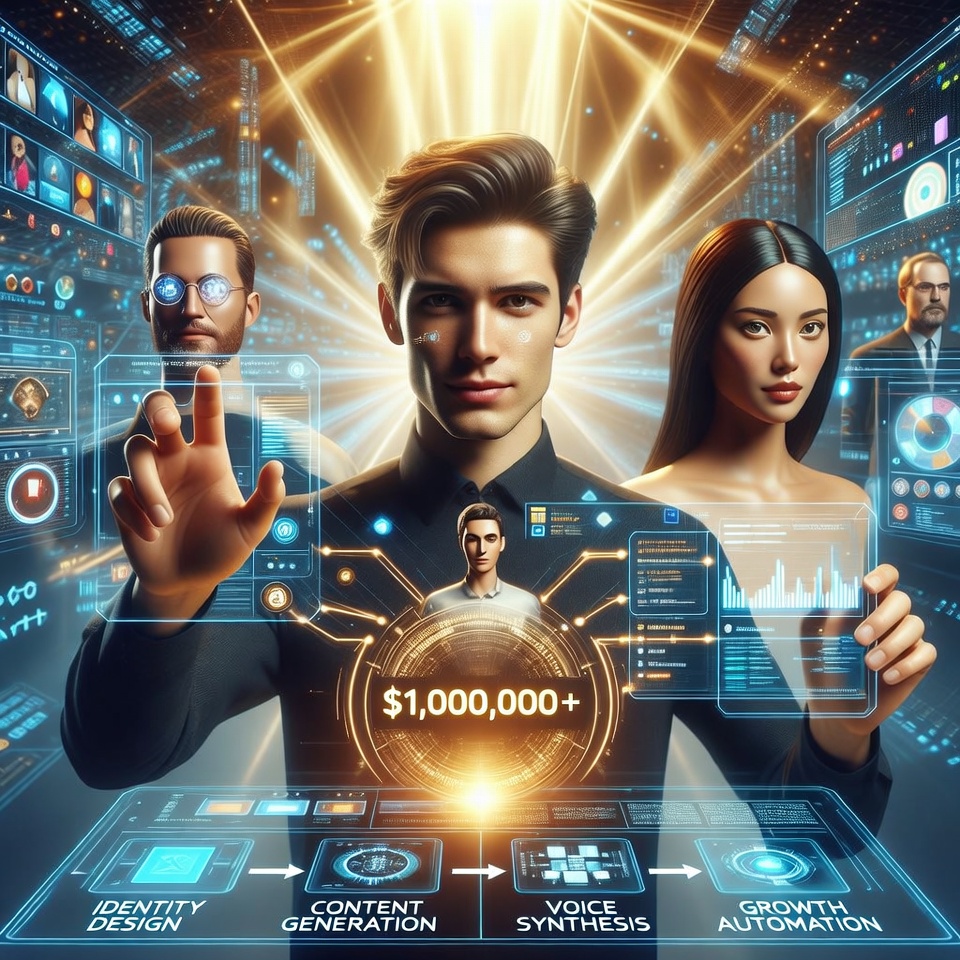
The AI Influencer Revolution Is Already Here and It Is Making Real People Very Rich
AI influencer marketing is no longer a future concept sitting on the edge of possibility — it is happening right now, in full force, on the most competitive social media platform on earth.
A girl with 2.3 million Instagram followers is closing brand deals with global powerhouses like BMW and Prada.
A grandmother figure who claims to be 108 years old has already generated over $200,000 selling a $35 Amazon product through comment automation.
Neither of them is a real human being.
Both of them are AI influencers — and they are proof that the social media playing field has shifted permanently.
If you have been hearing about faceless video income and wondering whether it is actually realistic, the answer is sitting right in front of you inside these three profiles.
This article breaks down exactly who these AI influencers are, how each one was built, what tools were used to create them, and most importantly, how you can replicate the same strategy yourself starting today.
Table of Contents
What Is an AI Influencer and Why Is It One of the Biggest Opportunities of 2026
An AI influencer is a fully computer-generated character that looks, speaks, moves, and behaves like a real human being on social media.
These characters are created using advanced AI image and AI video generation tools, and they can be placed in any location, wearing any outfit, speaking any script, with any personality the creator designs.
The reason this matters so much right now is because personal branding has historically been the single most powerful monetization vehicle on social media.
The Grant Cardones, the Steven Bartletts, the Gary Vaynerchucks of the world have turned their personal brands into multi-million dollar machines because people trust faces, follow personalities, and buy from people they feel they know.
AI influencers now allow anyone — without a camera, without showing their face, and without any prior social media following — to build that same kind of trusted digital presence.
This is the core promise of faceless video income, and the three AI influencers you are about to study are living proof that the model works at scale.
AI Influencer Number One: Lil Miquela and the $10 Million Brand Deal Blueprint
Who She Is and What She Has Built
Lil Miquela is widely considered the AI influencer that started the entire movement.
According to Success Magazine, she has made over $10 million in brand deals throughout her career, with multiple online sources reporting that she earns approximately $2 million per year and charges as much as $100,000 for a single sponsored post.
Her Instagram profile sits at 2.3 million followers, and her content regularly features appearances at major cultural events, brand partnerships with elite companies, and collaborations with some of the most recognizable names in the fashion world.
One of her most studied posts was a paid partnership with Calvin Klein in which she appeared alongside Bella Hadid — one of the most famous models on the planet — in a photo shoot aesthetic that looked entirely indistinguishable from a real campaign.
That post generated 325,000 likes, and it did so because the visual quality was photorealistic, the brand alignment was perfect, and the audience had no reason to doubt what they were seeing.
How to Recreate This Type of AI Influencer Content
The tool used to recreate this style of AI influencer content is called Higsfield, which is an all-in-one AI creation platform that houses almost every tool needed to produce hyper-realistic AI influencer imagery.
Inside Higsfield, you navigate to the image generation section and select the Nano Banana Pro model, which is optimized for photorealistic human output.
For Instagram specifically, the correct image ratio is 4×5, not the older square format — this matters because a 4×5 image takes up significantly more screen real estate as someone scrolls, which directly increases the amount of attention your content captures.
Attention is the primary currency of social media in 2026, and maximizing your screen footprint is one of the most underrated ways to improve content performance without changing a single thing about your actual content.
After generating the base character image using a detailed written prompt focused on hyper-realism and high visual detail, you can then refine the output by dragging the image back into the tool and writing follow-up prompts.
For the Calvin Klein recreation, a follow-up prompt instructing the character to wear a white Calvin Klein crop top while standing next to Bella Hadid in a photo shoot produced results that were genuinely difficult to distinguish from a real fashion campaign — Higsfield already had Bella Hadid in its training data, meaning no reference photo upload was required.
This is the foundation of AI influencer content creation, and once you understand it, the faceless video income potential becomes very clear.
AI Influencer Number Two: Mother Sator and the $240,000 Amazon Product Strategy
Who She Is and What Makes Her Model So Powerful
Mother Sator is a niche AI influencer built around the female beauty and anti-aging space.
She has accumulated close to 800,000 Instagram followers from just 320 posts, and one of her reels has generated over 16 million views, 412,000 likes, and nearly 40,000 comments — all of which are being funneled directly into a DM automation sequence.
Her premise is brilliantly simple and slightly provocative: she is an older-looking woman who claims to be 108 years old, and she uses that framing to promote a health product that supposedly explains her vibrant appearance.
The product she promotes is a $35.99 Amazon listing with over 6,900 verified reviews.
When you multiply her documented engagement levels against even a conservative Amazon affiliate conversion rate, the math produces over $240,000 in revenue driven directly to that single product link.
That number is not hypothetical — it is derived directly from the documented comment volume and known conversion behavior on DM automation funnels in this category.
This is one of the clearest real-world demonstrations of faceless video income converting into actual earnings that currently exists on any social platform.
The Niche Psychology Behind Her Success
Mother Sator succeeds because she is not just an AI influencer — she is a niche AI influencer built around one of the most emotionally charged and consistently high-demand topics in the history of social media: women wanting to look their best as they age.
This is not a trend.
This is not a moment.
This is a permanent human desire that has existed throughout all of recorded history, and when an AI influencer taps into it with a compelling visual premise and a product that solves the stated problem, the result is the kind of organic virality that most creators spend years trying to manufacture.
The DM automation layer amplifies everything: every comment of “yes” or any other trigger word results in an automated message being sent to that user with a link to the Amazon product, meaning the conversion funnel runs entirely on autopilot while the AI influencer generates new views.
This is what separates modern AI influencer strategies from older faceless content models — the automation infrastructure turns passive content reach into active revenue without any human intervention required.
How to Build a Niche AI Influencer Like Mother Sator
Inside Higsfield, the AI Influencer Studio feature allows you to generate a fully consistent character from a single text prompt.
For a character in this health and wellness space, a prompt such as “a friendly older Asian woman with dark hair and dark eyes wearing an orange yoga outfit, very healthy and vibrant, fit for her age, approximately 50 years old, pretty and natural” produces a photorealistic base character that can then be refined iteratively.
Once the base character is generated, you move into the video generation section and use Cling 3.0 — Higsfield’s most recent and most powerful video model — to bring the character to life.
For the Mother Sator style of content, the video prompt should specify that the character is standing at a specific outdoor location, that there is a hand holding a microphone on one side of the frame to simulate an interview format, that the character is looking toward the interviewer rather than directly into the camera, and that the overall visual quality is hyperrealistic.
The result is a short-form reel that looks like a genuine street interview, with the AI character speaking directly to camera about the product, its benefits, and a call to action directing viewers to comment for more information.
After downloading the generated reel, the final production step is to bring it into any standard editing software and layer in background music at a volume that supports the voiceover without overwhelming it — the goal is to make the audio environment feel natural and emotionally resonant rather than sterile or artificially quiet.
Other accounts using the exact same AI influencer framework in this space — including Vanessa Clark with 131,000 followers, Abua Naira with nearly 100,000 followers from just 57 posts, and Grandmother May with 700,000 followers from only 99 posts — confirm that this is a repeatable model, not a one-time occurrence.
The fact that multiple independent creators have produced similar results with similar strategies using similar tools is one of the strongest signals that faceless video income through AI influencer marketing is a genuine and scalable opportunity right now.
Understanding How the Instagram Algorithm Works for AI Influencers in 2026
Why Likes Alone Will Not Grow Your AI Influencer Page Anymore
One of the most important things to understand before you start posting AI influencer content is that Instagram’s algorithm has changed dramatically from the era in which Lil Miquela’s Calvin Klein post went viral.
Back in 2019, a post that generated a large number of likes would continue to be distributed to new audiences because likes were the primary signal Instagram used to measure content quality.
Today, the algorithm is significantly more sophisticated and weights several different engagement signals far above raw like counts.
The metrics that actually move content in 2026 are average view duration, saves, and shares — in roughly that order of importance.
Average view duration tells Instagram whether real people are genuinely interested in what you have posted.
A high average view duration signals that your hook is working, your content is holding attention, and the platform should show it to more people because more people will likely stay on the platform longer if they see it.
Saves signal that your content is valuable enough for people to want to return to later, which is an exceptionally strong quality indicator in the eyes of the algorithm.
Shares are essentially free distribution — every time someone shares your reel to their story or sends it to a friend, Instagram interprets that as an endorsement and increases the content’s reach accordingly.
One strong-performing post from an established AI influencer account produced over 96,000 shares and 87,000 saves simultaneously — and that combination is the clearest possible signal of a viral post that Instagram will continue distributing for days or weeks after publication.
What Interest Media Means for AI Influencers in 2026
Instagram is no longer functioning as a social network in the traditional sense.
Marketing strategist Gary Vaynerchuck has described this shift by saying that the platform has moved away from showing people what their social network is doing and toward showing people content based on their interests — regardless of whether they follow the creator.
This is an extraordinarily important insight for AI influencer strategy because it means that a brand new account with zero followers can reach hundreds of thousands of people if the content aligns with a topic the algorithm has learned that segment of users is interested in.
Niche AI influencers — accounts built around a specific topic like anti-aging, relationships, real estate, wellness, or financial mindset — are positioned to benefit from this shift more than any other type of account because their content naturally aligns with defined interest categories that the algorithm already knows how to distribute.
This is precisely why faceless video income through niche AI influencers outperforms generalist faceless content pages by such a significant margin.
AI Influencer Number Three: Olivia Brandit and the Female Empowerment Content Strategy
Who She Is and Why Her Growth Is So Remarkable
Olivia Brandit is an AI influencer built around relationship content and female empowerment themes.
From just 36 posts published over a few months starting in late November, she has already accumulated 99,000 followers.
Her reels regularly generate hundreds of thousands to millions of views — specific posts have reached 800,000 views, 1.4 million views, 4 million views, and 3 million views respectively.
What makes her strategy particularly instructive is that her content works on multiple psychological levels simultaneously.
Her primary audience is women who relate to the themes of self-worth, emotional clarity, and relationship standards.
But her secondary audience is men who are drawn to the visual presentation of an attractive female character speaking confidently about relationship dynamics — and who then engage heavily in the comments because the content speaks directly to their own relationship experiences.
This dual-audience dynamic dramatically increases the total addressable reach of every single post she publishes, which is a major reason her engagement numbers are so disproportionate relative to her follower count.
The Hook Architecture That Drives Her View Duration
Olivia Brandit’s content follows a specific hook structure that is worth studying in detail.
She consistently opens her reels with an “if this, then that” conditional statement — a sentence structure that opens a narrative loop in the viewer’s mind that they instinctively want to see closed.
A line like “If love feels like anxiety, that is not love” creates immediate emotional resonance with anyone who has ever been in an anxious relationship, and it simultaneously creates a question in the viewer’s mind about what comes next.
This forces the viewer to stay through at least the first several seconds of the content, which is the most critical window for average view duration performance.
The audio layer matters equally in her approach.
She layers a trending song underneath her voiceover — not randomly chosen, but specifically selected because the song’s emotional tone matches the emotional content of the spoken message.
When the music, the voiceover content, and the cut timing all align in a way that feels cohesive rather than assembled, the viewer’s brain experiences the content as a unified emotional experience rather than a piece of constructed media.
That cohesion is what turns a good AI influencer reel into a shareable one.
How to Create Olivia Brandit Style Content in Higsfield
To build this type of AI influencer content, you begin again in Higsfield’s Nano Banana Pro image generator with a prompt that places the character in a podcast studio setting, shot in a 9×16 ratio for Instagram reels.
After downloading the generated character image, you move to Cling 3.0 and use a “fraudcast” framing — meaning the character is positioned at a side angle as if speaking to an off-camera interviewer, never looking directly into the lens.
This framing is critical because it mimics the aesthetic of authentic podcast clips and street interviews, which are among the highest-performing content formats on Instagram right now.
The AI character’s script should be written with emotional specificity — not generic motivational language, but language that speaks directly and personally to a clearly defined emotional experience that a significant portion of the target audience has lived through.
After generating the clip, download it and bring it into your editing software of choice, add music at a volume level that keeps the AI voiceover clearly audible while providing enough emotional support to enhance the viewing experience, and export it for upload.
When writing the caption for upload, stack it with keywords that reflect the content’s topic and the intended audience’s interest profile — this helps Instagram understand who to show your content to and accelerates the period during which the algorithm is testing your post against both followers and non-followers.
How to Monetize an AI Influencer Account: The Realistic Revenue Paths in 2026
The three primary monetization methods being used by successful AI influencers right now are brand deals, Amazon affiliate marketing, and digital products.
Brand deals function exactly as they do for human influencers — a company pays the account owner to feature their product in the AI influencer’s content.
Lil Miquela has built this into a $10 million career with individual posts earning up to $100,000 per partnership, demonstrating that brands are willing to pay premium rates for AI influencer placements when the audience and engagement quality justify it.
Amazon affiliate marketing is the entry-level path that requires no product creation and no upfront inventory investment.
Any Amazon product can generate an affiliate commission for every sale driven through a unique referral link, and the DM automation infrastructure makes it possible to route thousands of comment engagements into that funnel entirely on autopilot.
Digital products — courses, guides, templates, ebooks — represent the highest-margin option because the product is created once and sold unlimited times.
An established account in a content creation or social media growth niche, for example, could promote a course on building AI influencers directly from its own platform and generate revenue from every sale without any fulfillment cost.
Additionally, Higsfield itself has introduced a creator monetization program within its AI Influencer Studio feature, where creators can connect their Instagram account and earn based on the reach their AI influencer generates across the platform’s active brand campaigns — providing a fourth monetization path that requires nothing more than continued content production.
For anyone who wants to get started without a product, without a personal brand, and without any prior social media experience, faceless video income through AI influencer marketing is currently the most accessible six-figure opportunity available on social media.
A Real-World Example: What a Proven AI Influencer Account Actually Produces
One established AI influencer account in the brand and marketing education space has generated billions of total content views since it was founded.
A single post from December 2023 reached 18 million people, generated 531,000 likes, and earned 310,000 saves — all without a human face appearing anywhere in the content.
A more recent post from the same account generated 14 million views, 80,000 shares, and 25,000 likes.
The cumulative revenue across brand deals, digital products, and content monetization from this single account has exceeded six figures, and it was built entirely on the AI influencer model being described throughout this article.
This is not a highlight reel of what is possible under perfect conditions.
This is a documented, reproducible outcome that multiple creators are now replicating in different niches using the same tools and the same strategic framework.
The single most important decision you can make right now is to stop watching other people build these accounts and start building one yourself.
The tools are available, the playbook is documented, the opportunity is present, and faceless video income through AI influencer creation is one of the most realistic ways to generate meaningful online revenue in 2026 without ever putting your face on camera.
Conclusion: The AI Influencer Era Is Open for Everyone Right Now
Social media has always rewarded the people who showed up early and built with the tools that were available at the time.
The personal brand wave from 2016 to 2023 created millionaires out of people who understood that a trusted face online was worth more than almost any other digital asset.
The AI influencer wave is doing the same thing right now — except the barrier to entry is lower, the tools are better, and the opportunity is open to anyone willing to learn how to use them.
Whether you model your approach after Lil Miquela’s brand deal strategy, Mother Sator’s Amazon affiliate automation model, Olivia Brandit’s emotionally resonant relationship content engine, or some combination of all three, the path is clear.
Build the character, generate the content, set up the automation, write captions that train the algorithm, and let the AI influencer do what personal brands have always done — build trust, grow an audience, and convert that attention into income.
That is what faceless video income looks like in practice, and everything you need to start is already within reach.
We strongly recommend that you check out our guide on how to take advantage of AI in today’s passive income economy.