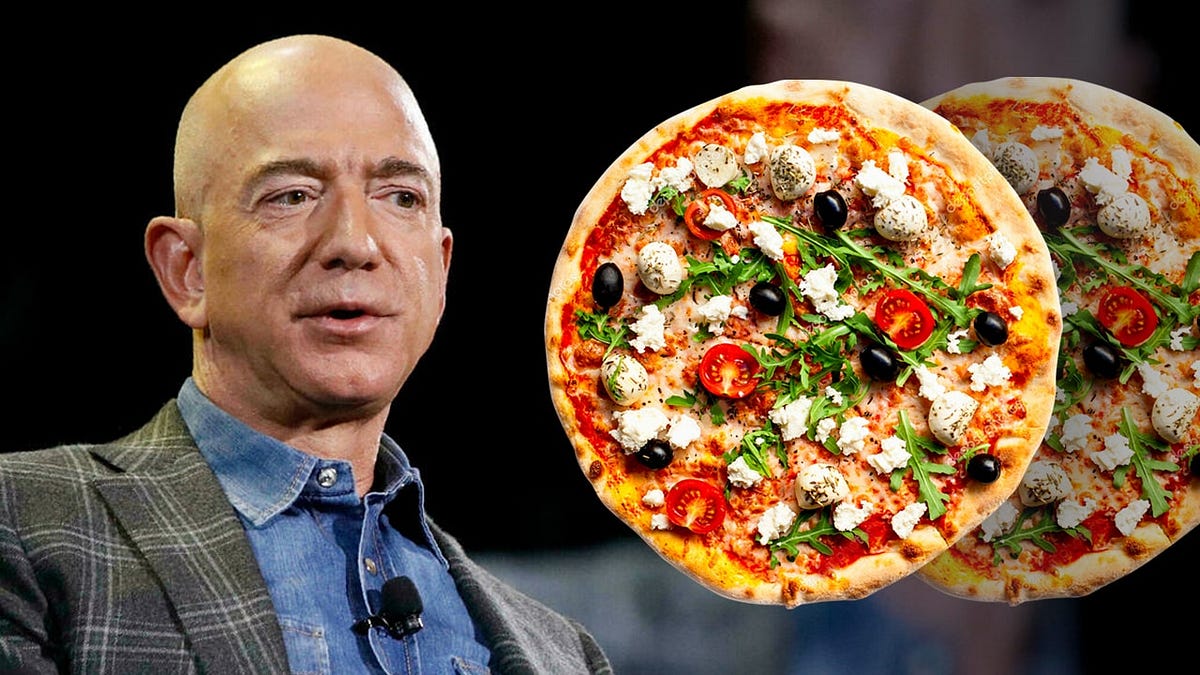
How 5 Smart Entrepreneurs Are Using Jeff Bezos’ Two-Pizza Rule to Scale Their Online Business With AI in 2026
There is a quiet rule behind one of the biggest online business empires ever built, and it has nothing to do with algorithms, funding, or luck.
Jeff Bezos, the founder of Amazon, built his trillion-dollar company on a management philosophy so simple it sounds like something you would hear at a backyard cookout.
He called it the Two-Pizza Rule.
If you cannot feed your entire team with two large pizzas, your team is too big.
That single idea changed how Amazon operated internally, and in 2026, smart entrepreneurs running lean online businesses are applying the same rule — only now they have artificial intelligence doing the heavy lifting that used to require a room full of people.
Tools like ClawCastle, HandyClaw, AmpereAI, and ReplitIncome are making it possible for solo founders and micro-teams to operate at the speed and output of large companies — without ever needing a team that requires a catering order.
This article breaks down the Two-Pizza Rule, why it matters more than ever in the AI era, and exactly how you can use it to build a smarter online business right now.
We strongly recommend that you check out our guide on how to take advantage of AI in today’s passive income economy.
Table of Contents
What Is Jeff Bezos’ Two-Pizza Rule and Why Does It Still Matter for Your Online Business?
Picture a long conference table with forty people sitting around it, each one with a laptop, a notepad, and an opinion.
Someone poses a single question and the next two hours disappear into a fog of conflicting ideas, side conversations, and deferred decisions.
That is exactly the kind of environment Jeff Bezos refused to let Amazon become.
The Two-Pizza Rule was his answer to organizational bloat — the slow, suffocating weight that grows on companies when teams expand beyond what one conversation can hold.
The rule is elegantly straightforward: any team working on a problem should be small enough that two large pizzas can feed every member.
In practical terms, that means teams of six to ten people at most, each one with a clear job, a clear stake, and a clear lane to move in.
Bezos applied this rule across Amazon’s internal structure, and it became one of the core reasons Amazon was able to move like a startup even as it scaled into one of the largest companies on the planet.
For entrepreneurs running an online business in 2026, this rule is not just a fun piece of corporate trivia — it is a direct playbook for how to structure a lean, high-output digital operation that can move fast and compete hard.
The Problem With Big Teams That Most Online Business Owners Ignore
Most online business owners start small, then slowly pile on contractors, freelancers, tools, and platforms until the operation becomes hard to steer.
You bring in one person to handle social media, another for email, another for customer support, another for content, and before long you are managing a virtual team of fifteen people who all need updates, feedback, and coordination just to get one campaign live.
This is the anti-Two-Pizza scenario, and it is one of the most common reasons growing online businesses stall.
Bezos understood that large groups do not just slow down decisions — they dilute accountability, reduce creative tension, and make it nearly impossible for any single person to feel fully responsible for an outcome.
When ten people share ownership of a result, the result tends to belong to no one.
A small team, by contrast, forces clarity.
Everyone knows what they own, everyone can see the whole picture, and everyone can move the moment a decision is made.
That speed — that nimbleness Bezos called the speedboat mentality — is the core competitive advantage of the Two-Pizza Rule, and it is exactly what ClawCastle helps modern online business owners preserve as they scale.
How AI Is Making the Two-Pizza Rule Even More Powerful in 2026
Here is where the story gets interesting for anyone building an online business today.
In 2004, applying the Two-Pizza Rule still meant you needed humans to fill every role — a developer, a writer, a marketer, a data analyst, a customer support rep.
Even a lean team of eight people came with eight salaries, eight sets of expectations, and eight different schedules to coordinate.
In 2026, artificial intelligence has fundamentally changed that math.
AI tools can now handle tasks that previously required two or three full-time specialists — content research, code generation, customer interaction, product building, and data analysis — all inside a single platform, all available on demand.
This means an online business owner today can run a truly effective two-pizza operation with fewer humans than ever before, because AI fills the seats that used to require headcount.
HandyClaw is one of the tools redefining what that looks like in practice, helping online business operators automate the kind of complex workflow management that used to demand a project manager, a VA, and a specialist all working in sync.
The result is a team where one human plus the right stack of AI tools equals the output of what used to require a department.
Jeff Bezos’ Amazon AI Strategy and What Online Business Owners Can Learn From It
When Bezos appeared at a conference in 2024 and was asked what he was focused on at Amazon, his answer was one word: AI.
He described AI as a horizontal enabling layer — something that, like electricity, would eventually run underneath every single function of every business on earth.
He used the analogy of a 300-year-old brewery in Luxembourg that once had to build its own power station because there was no electrical grid yet.
That brewery eventually plugged into the grid and gave up its generator because it made no sense to maintain it independently.
Bezos argued that computation worked the same way — that is what became AWS — and now AI is following the exact same curve.
Every application, every workflow, every customer touchpoint inside an online business is going to be improved by AI, and the businesses that figure out how to plug in early will have an enormous head start.
AmpereAI is one of the platforms that has taken this lesson seriously, building infrastructure that lets online business owners tap into AI-powered workflows without needing a technical team to set it up or maintain it.
For entrepreneurs applying the Two-Pizza Rule, this means your AI stack can be the engine room of your operation — running quietly, reliably, and powerfully behind a small, focused human team.
5 Practical Ways to Apply the Two-Pizza Rule to Your Online Business Using AI in 2026
1. Keep Your Core Team Under Ten and Use AI to Handle Scale
The first and most direct way to apply the Two-Pizza Rule is to draw a hard line on your core team size.
Decide that no internal decision-making group will exceed eight to ten people, and then use AI tools to absorb the additional workload that would otherwise push you past that number.
If your content output needs to double, do not hire two more writers — use ClawCastle to amplify the output of the writers you already have by handling research, structuring, and first drafts at scale.
If your customer communication volume is growing, do not build a support team of twelve — deploy AI-driven conversation tools that handle the first response layer while a small human team manages escalations and relationship-building.
This keeps your team small enough to move fast while your output keeps growing.
The Two-Pizza Rule is not a ceiling on results — it is a ceiling on team size, and AI is what lets you separate those two things.
HandyClaw makes this approach accessible even for solo founders who are managing multiple income streams inside a single online business operation.
2. Replace Coordination Overhead With AI-Powered Workflow Tools
One of the hidden costs of a large team is not the salaries — it is the time spent coordinating between people.
Status updates, check-ins, approval chains, version control, missed messages, and rescheduled calls can consume thirty to forty percent of a team’s weekly hours without producing a single deliverable.
The Two-Pizza Rule reduces this cost by shrinking the number of handoffs, but AI tools eliminate it almost entirely.
When one AI platform can receive a brief, generate a draft, flag it for review, and deliver it to the next stage of your workflow without a single human meeting, you have replaced an entire coordination layer with a system that never needs a day off.
AmpereAI is built around exactly this kind of autonomous workflow execution, allowing online business owners to define processes once and let AI run them repeatedly without constant human oversight.
This is the speedboat Bezos described — lean, fast, and capable of turning on a dime — built not from a small group of people alone, but from a small group of people plus a powerful AI engine running underneath everything.
3. Use AI to Build Products Without a Full Development Team
One of the most expensive seats at any online business table used to be the developer.
Building a product — whether a SaaS tool, a digital platform, a workflow app, or an automated system — once required a technical co-founder or a contracted development team, both of which pushed your operation well past two-pizza territory.
In 2026, AI-powered development platforms have changed this entirely.
ReplitIncome is built around the Replit Agent 3 platform, which allows entrepreneurs to describe what they want in plain language and have working code generated, tested, and deployed without writing a single line themselves.
This means a solo founder or a two-person team can ship a digital product in days instead of months, without adding a single developer to the payroll.
The Two-Pizza Rule stays intact because the technical capability is embedded in the tool, not in a person.
Bezos’ vision of AI as a horizontal layer that improves every application is playing out in real time through tools like ReplitIncome, and the online business owners who are using them now are building moats that traditionally required teams of twenty or more.
4. Communicate Like Amazon — Memos Over Meetings
Bezos was famous for banning PowerPoint presentations inside Amazon’s meeting culture.
Instead, every Amazon meeting begins with a six-page narrative memo — written in full sentences, with real structure and logic — that everyone reads silently for the first thirty minutes before any discussion begins.
The reason is simple: PowerPoint lets people bluff.
A bullet point can hide a weak idea inside a bold font.
A well-written memo cannot.
For online business owners managing small teams, this principle translates directly.
Instead of defaulting to video calls every time a decision needs to be made, use written briefs — short, clear, structured documents that lay out the context, the options, and the recommendation before anyone gets on a call.
ClawCastle can help you generate the first draft of these decision memos in minutes, turning what would have been a forty-five-minute call into a ten-minute async review that keeps everyone aligned without pulling anyone out of their work.
This is how a two-pizza team out-executes a twenty-person department — not by working more hours, but by communicating more clearly with less friction.
5. Run Rapid Experiments the Way Amazon’s Small Teams Did
Another direct benefit of the Two-Pizza Rule that Bezos observed at Amazon was the speed at which small teams could pivot.
When a large team changes direction, it is like turning a battleship — slow, loud, expensive, and disorienting for everyone aboard.
When a small team changes direction, it is like turning a speedboat — a quick conversation, a shared decision, and the whole operation is moving the new way within hours.
For an online business, this agility is one of the most valuable assets you can build.
Markets shift, algorithms update, audience preferences evolve, and the businesses that can test a new offer, a new channel, or a new format in forty-eight hours will always outmaneuver the ones that need three weeks and a committee to approve the idea.
HandyClaw and AmpereAI both support this rapid-iteration model by letting online business owners deploy new workflows, test new automations, and analyze results quickly — without needing a data team or a technical specialist to interpret what is happening.
Why the Two-Pizza Rule Is the Online Business Model of the AI Era
The timing of this framework could not be better for online entrepreneurs.
We are living through the moment when AI transitions from a novelty to infrastructure — the equivalent of electricity becoming available on the grid for the first time.
Bezos predicted exactly this in his Luxembourg brewery analogy, and his prediction is now the daily reality of every online business owner who uses AI tools to run operations that previously required a full staff.
The Two-Pizza Rule was designed for a world where human talent was the only resource you could deploy, and even then it made teams dramatically more effective by keeping them small and accountable.
Now that AI can handle research, writing, coding, customer communication, data analysis, and workflow management, the Two-Pizza Rule does not just make your team more effective — it makes your entire business architecture more powerful.
ClawCastle sits at the front of this stack as a content and workflow intelligence layer, while ReplitIncome handles the product-building layer, HandyClaw manages automation and operational flow, and AmpereAI powers the infrastructure that holds it all together.
Together, these tools let a one-person or two-person online business operate with the strategic depth of a company that, by old standards, would have needed forty people and a year of runway to build what you can now ship in a week.
Getting Started — How to Apply the Two-Pizza Rule to Your Online Business Today
Start by mapping every person, tool, and platform currently involved in running your online business.
Write down every human touchpoint — every contractor, VA, collaborator, or partner — and every tool you pay for monthly.
Then ask yourself honestly: if you had to reduce that list to the eight most essential elements — human or AI — what would make the cut?
That exercise will reveal where your operation has grown past two-pizza territory, and where AI tools could replace coordination costs, redundant roles, or underperforming processes.
From there, plug in the AI layer.
Use ClawCastle to handle content-heavy workloads, HandyClaw to automate operational tasks, AmpereAI to power your backend workflows, and ReplitIncome to build and ship digital products without a development team.
Then apply Bezos’ memo rule — write down your direction before you discuss it, make async the default, and reserve meetings for decisions that genuinely require real-time alignment.
Keep the team small, keep the communication clear, keep the tools powerful, and keep moving.
That is the Two-Pizza Rule, applied to the AI era of online business — and it is how the smartest entrepreneurs in 2026 are building operations that grow fast, stay lean, and never need a catering order to keep everyone fed.
We strongly recommend that you check out our guide on how to take advantage of AI in today’s passive income economy.