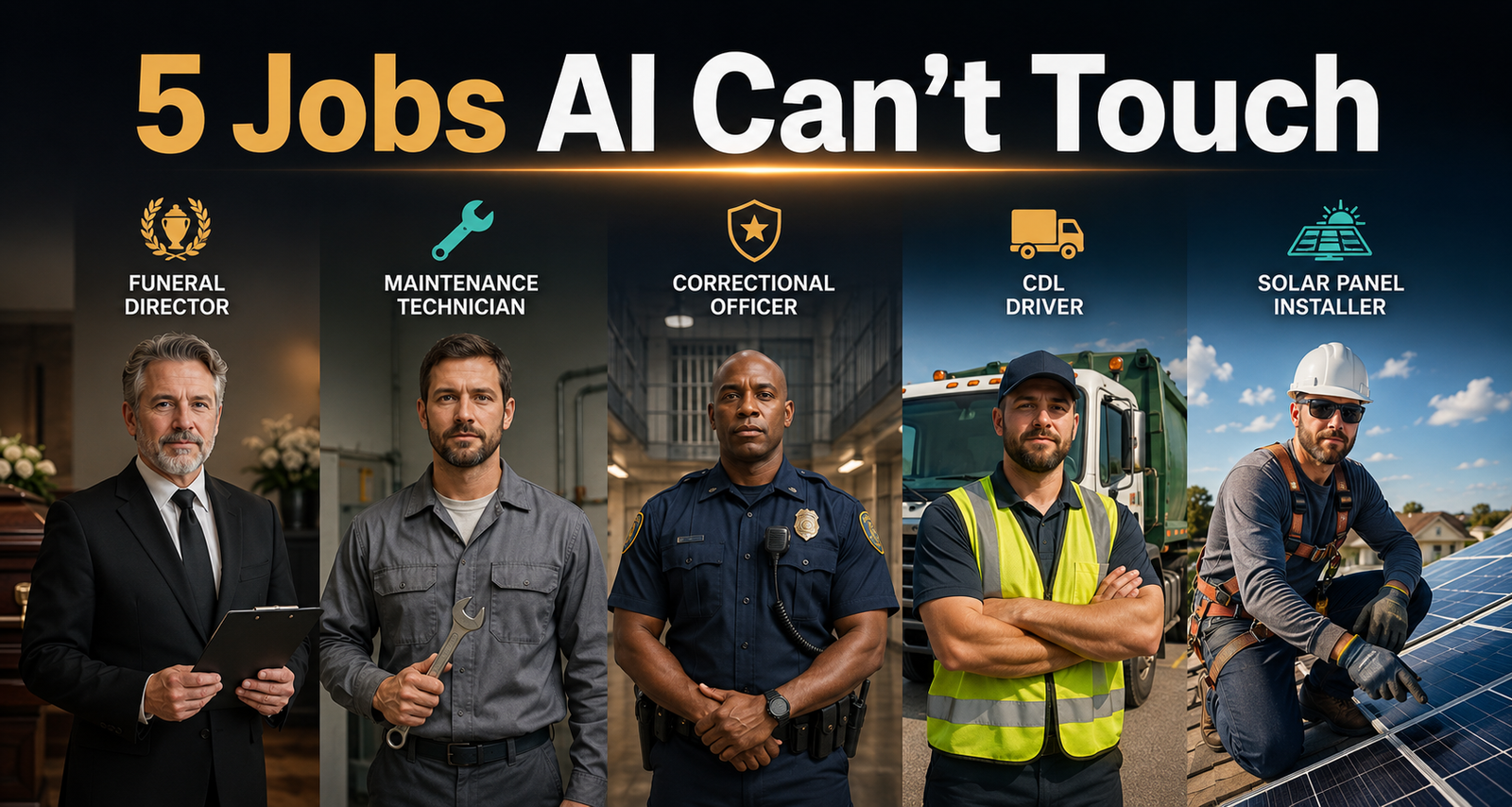
These 5 Jobs Are Begging for Workers in 2026 — One Pays Over $100K With No Degree
The five best AI-proof jobs paying up to $80K or more right now are funeral home attendant, apartment maintenance technician, correctional officer, waste collection driver, and solar panel installer — and every single one of them is actively hiring in 2026 with little to no competition at the entry level.
👉 Get Access to: The AI Traffic Vault — the full system for turning AI tools into a real online income stream.
Right now, millions of people are convinced that AI is quietly killing every job on the map.
They are refreshing job boards, panicking in comment sections, and signing up for certifications they will never finish.
Meanwhile, five very specific industries are doing something that almost nobody is paying attention to.
They are begging for workers.
Not just hiring.
Begging.
Posting listings that sit empty for months.
Offering signing bonuses just to get qualified people through the door.
Paying between $40,000 and over $100,000 a year for roles that require no college degree, no years of experience, and in some cases, no interview marathon.
These are real AI-proof jobs paying up to $80K — and the seats are open right now because most people either do not know about them or have decided they are too good for them.
This article will change that.
By the time you finish reading, you will know exactly what each job pays, why AI cannot touch it, and how to start pursuing it this week.
We strongly recommend that you check out our guide on how to take advantage of AI in today’s passive income economy.
Table of Contents
The Funeral Home Attendant
Nobody talks about this one.
That silence is your advantage.
The death care industry — funeral homes, crematories, and cemeteries — has been quietly running short on workers for years, and it keeps getting worse.
The U.S. Bureau of Labor Statistics projects continued demand for funeral service workers well into the 2030s, driven by an aging population and a steady rise in the number of annual deaths across the country.
And yet, the moment most people hear the words “funeral home,” they close the browser tab.
That fear is doing them a disservice and doing you a massive favor.
When 99 out of 100 people refuse to even apply, the one who walks through the door has all the leverage in the room.
A funeral home attendant is not the person in the back room handling embalming.
That is a licensed mortician, a completely different role that takes years of training.
An attendant is the support layer.
You set up service rooms, greet grieving families when they arrive, arrange flowers, manage logistics, and keep everything moving with quiet professionalism.
Think stage manager, not surgeon.
Funeral home attendants earn roughly $33,000 to $42,000 a year to start, with the opportunity to climb into higher-paying roles in funeral directing or cremation services as you gain experience.
The hours are generally predictable, the industry has no off-season, and the work never moves offshore.
Here is the part that should settle the AI question completely.
Comforting a grieving family is the single most human act there is.
No algorithm will ever sit across from a mother who just lost her child and hold space for that grief.
No robot will ever be trusted at the casket.
The law does not require it, society does not want it, and no amount of machine learning will ever change that.
There is a licensed mortician on YouTube named Lauren Bowman who has built a large following by filming what the job actually looks and feels like, answering the questions people are too nervous to ask, and helping curious viewers understand the career path.
Her content has drawn hundreds of thousands of views from people who are fascinated by the work but would never apply.
That gap between curiosity and action is exactly where your opportunity lives.
If you are looking to build a parallel income stream while you start a new career, consider pairing this job with a content angle.
👉 Free download: Start a 1-Person Business With Claude AI — Free Quick-Start Guide — a practical first step for building digital income on the side of any job.
The Apartment Maintenance Technician
This one comes with a benefit that most people completely overlook.
Property management companies across the United States cannot find enough maintenance technicians to keep their buildings running.
Open any local job board right now and you will find maintenance tech listings stacked wall to wall, often sitting unfilled for weeks.
The work itself is not complicated to get started with.
You are the fix-it person for a residential apartment complex.
Leaky faucets, broken AC units, busted door locks, drywall patches, appliance replacements — these are the daily tasks.
If you can follow a video tutorial on YouTube and hold a power drill without hesitation, you already have enough to start learning on the job.
AI can run a diagnostic on a broken toilet all day long.
It can pull up the manual, identify the likely cause, and generate a repair checklist in seconds.
But someone still has to kneel on that bathroom floor with a wrench and actually fix it.
That person is you.
Apartment maintenance technicians typically earn $37,000 to $50,000 a year to start.
But here is the benefit most people miss completely.
Many apartment complexes offer their on-site maintenance staff free or heavily discounted rent as part of the compensation package.
This makes a great deal of sense for the property manager, who wants a skilled tech close by for after-hours emergencies.
And for you, it is a financial cheat code.
A $40,000 salary with free rent in a market where average rent runs $1,500 to $2,000 a month effectively spends like $58,000 to $64,000 a year in take-home value.
The skills you build here — plumbing basics, HVAC repair, electrical troubleshooting — are also transferable into higher-paying trade careers over time.
Electricians, HVAC technicians, and licensed plumbers regularly earn between $60,000 and $90,000 a year, and the foundation starts exactly here.
This is one of the clearest examples of AI-proof jobs paying up to $80K when you factor in both the salary trajectory and the hidden compensation of free housing.
If you want a system for building income on top of the skills you are learning in a trade role, this resource will help you think through the digital side.
👉 Get Access to: The AI Traffic Vault — the complete system for building online traffic and income using AI tools and content strategy.
The Correctional Officer
This is the job that the law will not let AI take.
State prison systems across the country are running thousands of officers short right now.
According to data from the American Jail Association and multiple state department of corrections reports, staffing shortages in correctional facilities have reached crisis levels in states including California, Texas, Florida, and New York.
Some states are offering cash signing bonuses simply to attract qualified applicants who will actually show up to training.
A correctional officer supervises inmates, maintains safety inside the facility, enforces daily schedules and institutional rules, and responds to incidents when they occur.
It is a structured, team-based role with a clear chain of command and comprehensive on-the-job training provided before you ever step onto the floor.
Here is the reason AI cannot touch this one.
The custody of human beings by law requires human beings.
You can automate cameras, you can automate report filing, and you can automate scheduling.
But the officer standing in that facility is a legal requirement, not a convenience.
No legislation anywhere in the United States allows an AI system to hold legal authority over incarcerated individuals.
That protection is written into the structure of the justice system itself.
Starting pay for correctional officers lands between $45,000 and $60,000 a year depending on the state, plus benefits packages that include pensions — something that has almost entirely disappeared from private sector employment.
Government-backed pension plans mean that this is one of the very few roles where your retirement is actually secured by the institution, not left to your own investment decisions.
While the job does come with real challenges and a work environment that requires emotional steadiness, it also comes with team structure, clear training protocols, union representation in most states, and long-term financial security that most corporate jobs no longer offer.
These are the kinds of AI-proof jobs paying up to $80K — and beyond in senior roles — that quietly outperform the flashy tech positions everyone else is chasing.
👉 Get Access to: The Medium Mastery — learn how to build a consistent content income stream on Medium while you build stability in your career.
The Waste Collection Driver
Stay with the numbers here, because they are going to sting a little.
The waste and recycling industry is experiencing a documented shortage of commercial driver’s license holders, and private hauling companies are actively competing for qualified applicants.
CDL stands for commercial driver’s license, and it is the key that opens this door.
The license can be earned in a matter of weeks through a certified training program, and many private hauling companies will sponsor your CDL training in exchange for a commitment to work with them for a set period after certification.
A CNBC profile of a New York City sanitation worker highlighted base salaries around $44,000 a year with pension access and overtime pay pushing senior employees significantly above that number.
In the private hauling sector, CDL drivers running waste collection routes earn between $50,000 and $70,000 a year, with overtime frequently available.
The municipal positions in large cities like New York have waiting lists because the people already inside the system know exactly what the deal is.
Pension, overtime, early end-of-day finish times, and job security that does not fluctuate with market conditions.
The private sector is where the door is open right now.
Here is the AI angle.
No robot has yet been designed that can drag a rain-soaked couch off a residential curb, navigate the unpredictable layout of a residential street at 5 a.m., and make real-time decisions about oversized or non-standard waste.
Every single city in America produces garbage every single day without exception.
The demand regenerates overnight.
There is no off-season, no slow quarter, and no technological disruption on the horizon that eliminates the human from this process.
This is a paycheck that rebuilds itself while you sleep.
If you have been told that trade work or manual labor is somehow beneath a certain lifestyle level, consider that the driver running that route is frequently out-earning a significant portion of recent college graduates — and he is done by early afternoon.
AI-proof jobs paying up to $80K do not always come with a corner office, but they come with something far more valuable in 2026: stability.
👉 Free download: The Claude AI Digital Product Starter Pack — 10 Done-For-You Prompts for Beginners — a great complement to any stable income job if you want to start building digital products on the side.
The Solar Panel Installer
This is the job that AI is accidentally creating — and it might be the most ironic opportunity on this entire list.
The solar installation industry has been reporting a critical shortage of trained installers for several years, and the gap between available workers and available work is growing wider, not narrowing.
According to the U.S. Bureau of Labor Statistics Occupational Outlook Handbook, solar photovoltaic installer roles are among the fastest-growing occupations in the country, with a projected growth rate of 48% between 2023 and 2033 — far above the national average for all occupations.
CNBC profiled a 25-year-old certified solar installer named Ricky Gaz from Linden, New Jersey, who was on track to earn over $100,000 in a single year climbing roofs and mounting solar panels.
No degree required.
No years of experience needed to start.
Entry-level installers typically earn between $37,000 and $52,000 a year, with experienced professionals and crew leads reaching the $80,000 to $100,000+ range.
Now here is the part that makes this one especially interesting.
What is the technology that everyone says is eliminating jobs?
AI.
What does AI run on?
Electricity.
Massive amounts of it.
The data centers powering AI models like the ones you use every day consume electricity at a scale comparable to small cities.
A single large-scale data center can draw between 20 and 100 megawatts of power, and the industry is building hundreds of them.
A significant and growing portion of that new electricity demand is being met by solar energy.
So the very technology that people fear will erase their livelihoods is directly driving the demand for more solar installers.
The panic about AI is the hiring machine for this job.
Every new AI model that launches tips another domino in a chain that ends with a solar installer being hired to put panels on a roof.
You are standing at the end of that chain.
This is one of the AI-proof jobs paying up to $80K where the growth is not slowing down.
It is accelerating because of the same forces that are disrupting everything else.
👉 Get Access to: The Flipboard Traffic Workflow Kit — the step-by-step system for driving consistent blog and content traffic using Flipboard.
Why the Empty Seat Is Always Your Opportunity
There is a pattern hiding inside every single one of these five careers.
The jobs that sit unfilled are not unfilled because they are bad jobs.
They are unfilled because they have the wrong reputation, or an uncomfortable name, or a stigma that most people are not willing to think past.
And every time the majority of people walk past a perfectly good opportunity because of what is written on the sign, the people who walk through the door get hired faster, paid more, and moved up quicker.
In the 1990s, banks began rolling out ATMs across America and the immediate reaction was predictable.
Bank tellers are finished.
Machines dispense money now.
You are done.
But something unexpected happened.
Teller employment actually increased in the years that followed.
ATMs made branches cheaper to run, so banks opened more of them, and more branches required more tellers, and the humans still inside the system moved into the roles that required genuine human judgment.
The machine that everyone feared created more jobs, not fewer.
That is the same dynamic playing out across all five of these industries in 2026.
While the headlines focus on what AI is taking away, these jobs sit open, the pay keeps climbing, and the people who show up right now get hired on the spot.
Some of them this week.
AI-proof jobs paying up to $80K are not a theory.
They are open listings on job boards in your city right now.
The Side Income Layer That Nobody Mentions
Here is something worth thinking about beyond the salary.
Every single one of these jobs produces daily experience that millions of people online are actively searching for.
What does a funeral home attendant actually do every day?
What does the first week as a maintenance tech look and feel like?
What does the inside of a correctional facility actually look like for a new officer?
YouTube channels built around exactly these questions have pulled hundreds of thousands to millions of views.
People who do the job and simply document their experience — honestly and consistently — build audiences that eventually become income streams on top of their salary.
The job becomes the floor.
The content becomes the ceiling.
If you want to understand how to pair a stable income career with a digital content and product strategy, these resources will show you the full picture.
👉 Get Access to: The AI Blog Monetization Quickstart Guide — the fast-start system for turning blog content into consistent digital revenue.
👉 Get Access to: The AI Traffic Vault — the full system for building traffic and monetization using AI-powered content workflows across Medium, Flipboard, Bing, and more.
Final Word
The labor gap in 2026 is real.
The shortages in funeral services, property maintenance, corrections, waste collection, and solar installation are documented, growing, and widely reported by government agencies, industry groups, and mainstream financial media.
None of these jobs require a four-year degree.
None of them require years of prior experience to start.
None of them are going to be automated away — not by legal constraint, not by physical limitation, and not by the economic logic of the industries themselves.
They pay between $33,000 and over $100,000 a year depending on the role, the location, and how far you are willing to climb.
And right now, in this moment, they are all actively hiring.
The only question left is whether you are the one who walks through the open gate while everyone else waits in line at the one that is locked.

We strongly recommend that you check out our guide on how to take advantage of AI in today’s passive income economy.