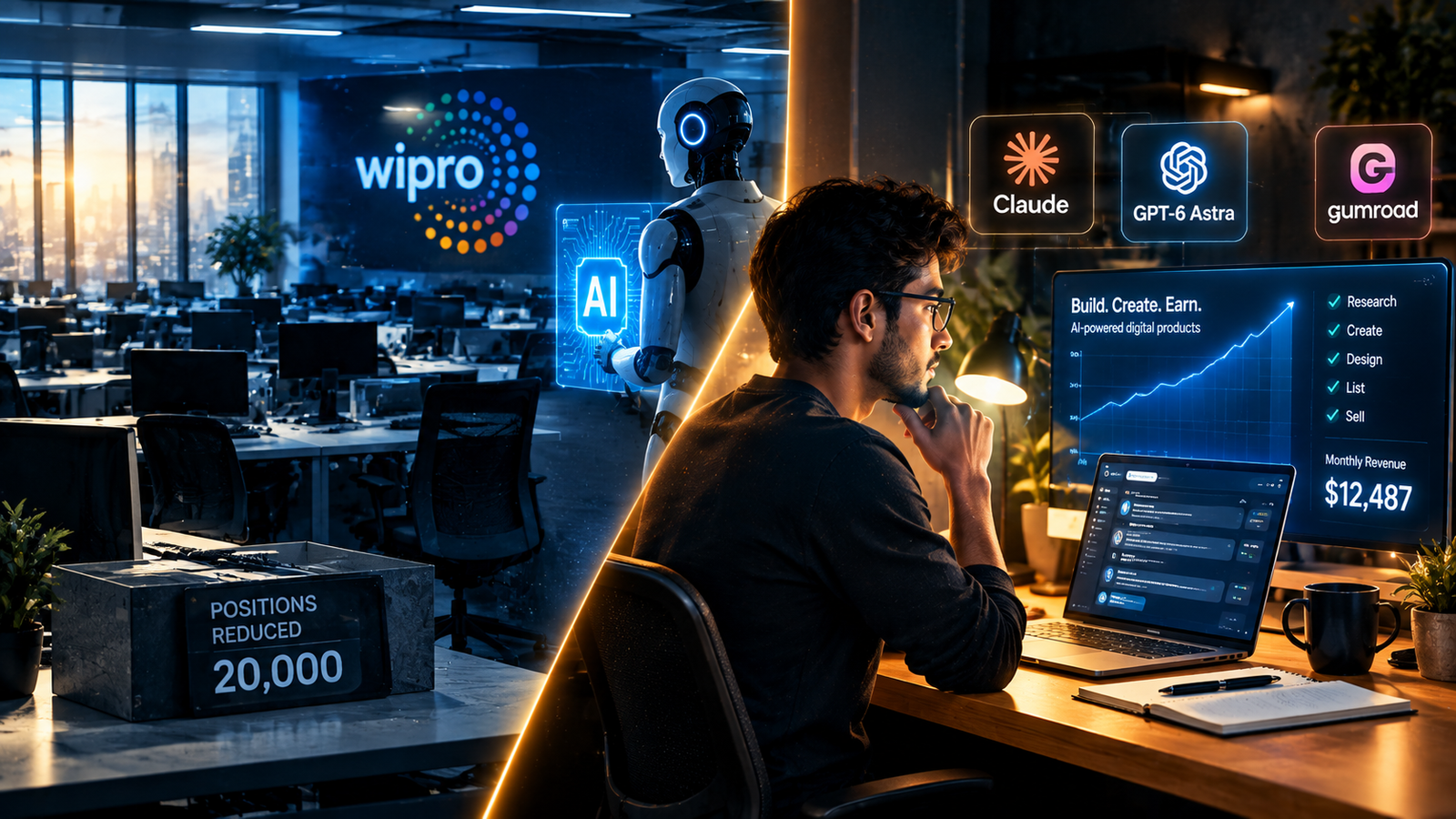
AI Is Coming for 20,000 IT Jobs — What Happens to the $100K+ Careers Next?
AI is replacing jobs in the tech industry faster than most workers ever thought possible, and the numbers coming out of India’s biggest IT firms in 2026 make it impossible to ignore.
Wipro, one of the largest IT services companies in the world, has publicly confirmed through its CTO that the company has deployed enough AI agents to perform the work of 20,000 full-time employees.
That is not a forecast.
That is not a pilot program.
That is a done deal — and it is already reshaping how one of the world’s biggest tech workforces operates.
👉 Start a 1-Person Business With Claude AI — Free Quick-Start Guide
Table of Contents
What Wipro Just Did — And Why It Changes Everything
Wipro is not a startup making bold claims to attract investor attention.
It is one of India’s “Big Three” IT services giants, sitting alongside Tata Consultancy Services (TCS) and Infosys, collectively employing hundreds of thousands of software engineers, project managers, QA testers, and support professionals across the globe.
When Wipro’s Chief Technology Officer steps in front of the industry and says the company has deployed AI agents equivalent to a workforce of 20,000 people, the whole tech sector needs to sit up and pay attention.
According to reporting from the Economic Times and multiple tech industry publications, Wipro confirmed in 2026 that AI is now performing approximately 10% of the total work their human workforce previously handled.
That 10% figure might sound modest at first glance, but consider the context.
Wipro employs around 230,000 people globally.
Ten percent of that workforce represents a staggering volume of real, billable, revenue-generating work — now being handled not by human employees drawing salaries and benefits, but by AI systems running continuously at a fraction of the cost.
The company is not stopping there.
Wipro has publicly committed to shifting toward a human-AI workflow model, which means the human role in software delivery is no longer about writing code or managing tickets from scratch.
It is now about supervising, auditing, and improving AI agents that do the heavy lifting.
This is not the future of IT work.
This is the present, and it is already running at full speed.
TCS Said It First — Nobody Listened
Here is what makes the Wipro story even more striking.
Tata Consultancy Services, which is the single largest IT services firm operating out of India and one of the biggest in the entire world by revenue, made almost the exact same declaration earlier in 2026.
TCS leadership stated plainly that the company had significantly slowed down human hiring because AI agents were absorbing the work that would have gone to new employees.
In practical terms, TCS did not say they were simply experimenting with AI.
They said human hiring pipelines were being redirected because AI was doing the job.
For millions of young engineering graduates across India and the broader developing world who have historically looked to companies like TCS and Wipro as the gateway to a stable, well-paying technical career, this shift is nothing short of devastating.
AI replacing jobs in the tech industry is no longer a theoretical risk that career advisors mention politely in webinars.
It is corporate policy at companies that collectively employ nearly a million people.
And the global implications stretch far beyond India.
IT services companies like Wipro and TCS serve clients in North America, Europe, and Asia, meaning their AI-powered delivery model affects the hiring decisions of companies worldwide.
When the cost of delivering software goes down because AI agents replace human labor, clients begin to expect that same efficiency from every vendor.
The pressure cascades through the entire industry.
👉 Get Access to: The AI Blog Monetization Quickstart Guide
The Real Replacement Is Not What You Think
Here is where the conversation about AI replacing jobs in the tech industry needs to get more honest, because the picture is more nuanced than the headline suggests.
You are probably not going to walk into the office tomorrow and find a robot sitting at your desk.
What is far more likely is that the person who gets hired instead of you — or promoted ahead of you, or brought in to consult above you — will be someone who knows exactly how to deploy, manage, and improve AI agents at scale.
The replacement is not AI versus human.
The replacement is AI-competent humans versus everyone else.
This is a critical distinction that most mainstream coverage of this story completely misses.
Wipro and TCS are not simply turning the lights off on human workers.
They are fundamentally restructuring what a productive worker looks like, and the bar has shifted in a way that leaves two groups dangerously exposed.
The first group is experienced professionals who have deep domain knowledge but have not yet built genuine hands-on fluency with AI tools like Claude, ChatGPT, or GitHub Copilot.
They know how the business works inside and out, but they cannot deploy the technology that is now central to how the business gets done.
The second group is younger workers who are comfortable with AI tools as a consumer product but lack the real-world business experience to understand which problems are actually worth solving.
They can prompt a model.
They cannot define the workflow, catch the errors the model makes, or build the feedback loop that makes the system genuinely better over time.
The professionals who are genuinely valuable in 2026 sit squarely between these two groups.
They have experience.
They have reputation.
They understand how businesses actually function at an operational level.
And they are actively learning how to deploy AI agents to solve the specific problems they already know exist.
👉 Get Access to: Start a 1-Person Business With Claude AI
70% of Job Listings Now Include AI — What That Actually Means
The data on AI replacing jobs in the tech industry is not limited to Wipro’s headline announcement.
A significant and accelerating shift is visible in the hiring market itself.
Recent analysis of job postings across major platforms, including LinkedIn and Indeed, shows that approximately 70% of new job listings now reference AI tools, AI workflows, or AI-adjacent skills somewhere in the description.
This is not confined to technical roles.
Marketing managers are being asked to use AI content tools.
Financial analysts are expected to work with AI-assisted forecasting software.
Customer support leads are being hired specifically to manage AI-powered ticketing systems.
Project managers are overseeing hybrid teams where some team members are human and some are automated agents running inside platforms like Claude’s Model Context Protocol or Microsoft Copilot.
The message from employers could not be more direct.
If you are not fluent in AI tools, you are not the candidate they are building for.
And fluency here does not mean having used ChatGPT to rewrite your resume.
It means understanding how to set up an AI agent, define its task parameters, audit its output, catch its mistakes, correct the workflow, and build the kind of improving feedback loop that makes the system more accurate and more useful over time.
That specific skill — the ability to manage an AI flywheel rather than just prompt a chatbot — is the new baseline for competitive employment.
👉 Free Download: The Claude AI Digital Product Starter Pack — 10 Done-For-You Prompts for Beginners
The Flywheel That Separates Winners From Everyone Else
Let us talk about what deploying AI agents actually looks like in practice, because there is a significant gap between what people imagine it to be and what it really requires.
Imagine you are running a Google Ads campaign for a client.
You connect the client’s performance data, their CRM history from a platform like HubSpot, and their previous campaign structure all into Claude through a connected workflow.
You ask Claude to duplicate a winning campaign and build out a new one targeting a different audience segment.
The first time you run that workflow, the output will have gaps.
The agent will make assumptions that do not match the client’s business reality.
It will miss nuances in the data that an experienced marketer would catch immediately.
Here is what separates the people who will win in this environment from the ones who will get left behind.
The winners do not give up when the first output is imperfect.
They audit the gaps, correct the workflow, add more context, and run it again.
They build a system that improves with every iteration, getting tighter and more accurate each time, until the AI is producing work that is genuinely close to what an expert would deliver manually — in a fraction of the time.
This is the flywheel concept, and it is the single most important operational skill for anyone navigating AI replacing jobs in the tech industry.
It is not about using AI as a search engine or a brainstorming buddy.
It is about building a self-improving system where each cycle of human review and agent refinement makes the next output better.
The people who master this flywheel approach are not going to be replaced by AI.
They are going to be the ones deploying it — and charging premium rates for the results it produces.
👉 Get Access to: The AI Traffic Vault
The Problem Nobody Is Talking About — Context Switching
There is a challenge sitting at the center of the AI-powered work model that almost nobody in the mainstream tech media is discussing honestly, and it is one of the most real friction points for people building these kinds of AI workflows.
It is called context switching.
When you are running AI agents across multiple projects simultaneously — which is exactly what the most productive professionals in 2026 are doing — you are constantly moving your attention from one task to another in rapid succession.
You have Claude running a research task in one window.
You are taking a client call on another screen.
You are reviewing a piece of content the agent produced while also responding to email.
You are jumping between a financial model, a content workflow, and a customer support system — all of which have AI components running in the background.
The human brain is genuinely not wired for this kind of rapid-fire task switching at the level that AI-augmented work now demands.
Cognitive science research, including studies published by the American Psychological Association, consistently shows that task-switching carries a measurable mental cost — what researchers call “switch costs” — that reduces accuracy and slows down decision-making even for high-performing individuals.
The average person needs around 15 minutes to reach a genuine flow state on a complex cognitive task.
If you are switching between AI agent outputs every five minutes, you may never reach that flow state at all.
This is not a small inconvenience.
It is a fundamental challenge in the architecture of AI-powered work that the most effective professionals are only just beginning to develop strategies for.
Some are building time-blocked schedules where AI agents are left to run for longer stretches while the human goes completely offline — exercising, making coffee, stepping away entirely — before returning to review and refine the output.
Others are using project management tools like Notion AI or Linear to create structured handoff points that make re-entering a project faster and less cognitively draining.
The point is this: mastering AI tools is only half the challenge of surviving and thriving as AI replacing jobs in the tech industry continues to accelerate.
The other half is mastering your own attention — building personal systems that let you move between human responsibilities and AI oversight without losing the quality of either.
👉 Get Access to: The Medium Mastery
What Skills Actually Keep You Employable — and Profitable — in 2026
Given everything happening at Wipro, TCS, and across the broader IT services sector, the practical question every working professional needs to answer is clear.
What do I actually need to learn, build, and do to stay on the right side of AI replacing jobs in the tech industry?
The answer is not a single skill.
It is a cluster of connected capabilities that together make you genuinely difficult to replace — not by an AI, and not by someone who only knows how to use AI on a surface level.
The first is workflow architecture.
This means understanding how to map out a business process, identify the specific steps where an AI agent can take on work, and design the handoff points where human judgment still adds irreplaceable value.
Tools like Claude’s Model Context Protocol, Zapier AI, and Make (formerly Integromat) are the infrastructure layer for this kind of work.
The second is agent auditing.
This is the ability to review AI output not just for surface-level accuracy, but for logical consistency, factual reliability, and fitness for the specific business context it was created for.
This requires domain knowledge.
You cannot audit the output of a financial AI agent if you do not understand finance.
You cannot catch the errors in an AI-generated legal summary if you have never worked in a legal environment.
Domain expertise is not obsolete — it is what makes your AI oversight valuable.
The third is iterative refinement.
This is the flywheel skill discussed earlier.
The ability to take flawed AI output, diagnose why it failed, improve the prompt or the workflow, and run the system again with better results is what separates AI users from AI operators.
AI operators are the professionals the market will pay a premium for.
The fourth is communication and client management.
As AI handles more of the execution layer in professional services, the humans in the room become responsible for translating between what the client actually needs and what the AI system can realistically deliver.
This is a relationship skill, not a technical one, and it is increasingly rare precisely because so much professional energy has gone into building technical skills over the past decade.
👉 Get Access to: The Flipboard Traffic Workflow Kit
Manufacturing Is Growing While IT Contracts — What That Tells Us
It would be incomplete to look at AI replacing jobs in the tech industry without acknowledging the broader economic picture that is shifting at the same time.
While IT services are shedding human headcount at companies like Wipro and TCS, the manufacturing sector — particularly in the United States — is experiencing a significant resurgence.
Investment in domestic manufacturing infrastructure, driven by policy initiatives like the CHIPS and Science Act and reshoring trends across industries from semiconductor production to clean energy hardware, is creating a new wave of jobs that AI cannot easily displace.
These are physical, location-specific roles in production, quality control, logistics, and skilled trades.
They require human hands, human presence, and human judgment in three-dimensional, real-world environments that current AI systems are still very far from being able to replicate.
This does not mean the answer to AI displacement is to abandon the digital economy and go build things with your hands — though there is genuine and growing demand for exactly those skills.
What it does mean is that the economic story of 2026 is not simply “AI is taking all the jobs.”
It is more accurately: “AI is restructuring which jobs exist, which ones pay well, and which human skills are now the scarce resource.”
For people building businesses and careers at the intersection of AI and digital products, the restructuring is an opportunity as much as it is a threat.
The window to position yourself as someone who understands how to deploy AI at a professional level is still open.
It is narrowing.
But it is still open.
👉 Get Access to: The AI Blog Monetization Quickstart Guide
The Honest Reality for Solo Operators and Digital Entrepreneurs
If you are a solo operator, a freelancer, a content creator, or a one-person digital business owner, the news from Wipro and TCS is not just a story about someone else’s job market.
It is a direct signal about the competitive environment you are operating in right now.
When enterprise companies are deploying AI agents at the scale of 20,000 human workers, the competitive baseline for what a single professional can produce has changed forever.
This is both terrifying and genuinely exciting.
Terrifying because the output ceiling for what one AI-augmented person can produce is now higher than anything a solo operator could have realistically competed with five years ago.
Exciting because that ceiling applies to you too.
If you are a solo content creator who understands how to use Claude to research, outline, draft, and refine long-form content while you focus your human attention on strategy and distribution — you are not competing with ten-person teams anymore.
You might actually be outcompeting them.
If you are a freelance marketer who has connected client data into an AI workflow and built a flywheel that produces better campaign optimization every week — you are delivering enterprise-level results from a home office.
AI replacing jobs in the tech industry is the threat vector for people who are standing still.
For people who are actively building AI-powered workflows into everything they do, it is the biggest competitive advantage the solo operator world has ever seen.
👉 Start a 1-Person Business With Claude AI — Free Quick-Start Guide
Where Do You Start If You Are Behind?
The single most common question from people who see what is happening at Wipro and TCS and want to get ahead of it is: where do I actually start?
Not with a course.
Not with a certification.
Not by reading a hundred articles about AI trends.
You start by picking one real workflow in your actual work or business and rebuilding it with an AI agent at the center.
If you write content, build a Claude-powered research and outlining workflow.
If you run ads, connect your campaign data to an AI tool and let it suggest optimizations you then review and implement.
If you do client work of any kind, identify the most repetitive deliverable in your service and build an AI system that handles the first draft while you focus on refinement and client communication.
The goal is not perfection on the first try.
The goal is to build your first flywheel — your first self-improving loop of AI output, human review, and system refinement — and then repeat that process across every part of your work until AI is embedded in how you operate at a fundamental level.
This is not optional for people who want to stay competitive as AI replacing jobs in the tech industry continues to accelerate through 2026 and beyond.
It is the new baseline.
And the people who start building that baseline now are going to find themselves in an extraordinarily strong position two years from now, when the gap between those who built AI-powered workflows and those who did not will be impossible to close.
👉 Get Access to: The Flipboard Traffic Workflow Kit
Conclusion — The $100K Career Is Not Dead. But It Is Being Redesigned.
The story of Wipro deploying AI agents equivalent to 20,000 employees is not a cautionary tale about the end of work.
It is a clear, data-backed signal that the definition of a valuable professional is being rewritten in real time, and the rewrite is happening faster than most career advisors are willing to admit.
AI replacing jobs in the tech industry is not a wave that is coming.
It is already here.
It has already restructured hiring pipelines at TCS and Wipro.
It has already changed what 70% of job listings expect from candidates.
It has already created a divide between professionals who are building AI-powered workflows and those who are waiting to see how things develop.
The $100K career is not disappearing.
It is migrating to the people who understand how to deploy AI agents, manage the context-switching demands of AI-augmented work, and build the kind of self-improving systems that make their output irreplaceable.
Those people are going to thrive.
The question you need to answer honestly is whether you are one of them yet — and if not, what you are going to do about it starting today.
👉 Get Access to: The Full Package — Start a 1-Person Business With Claude AI

We strongly recommend that you check out our guide on how to take advantage of AI in today’s passive income economy.