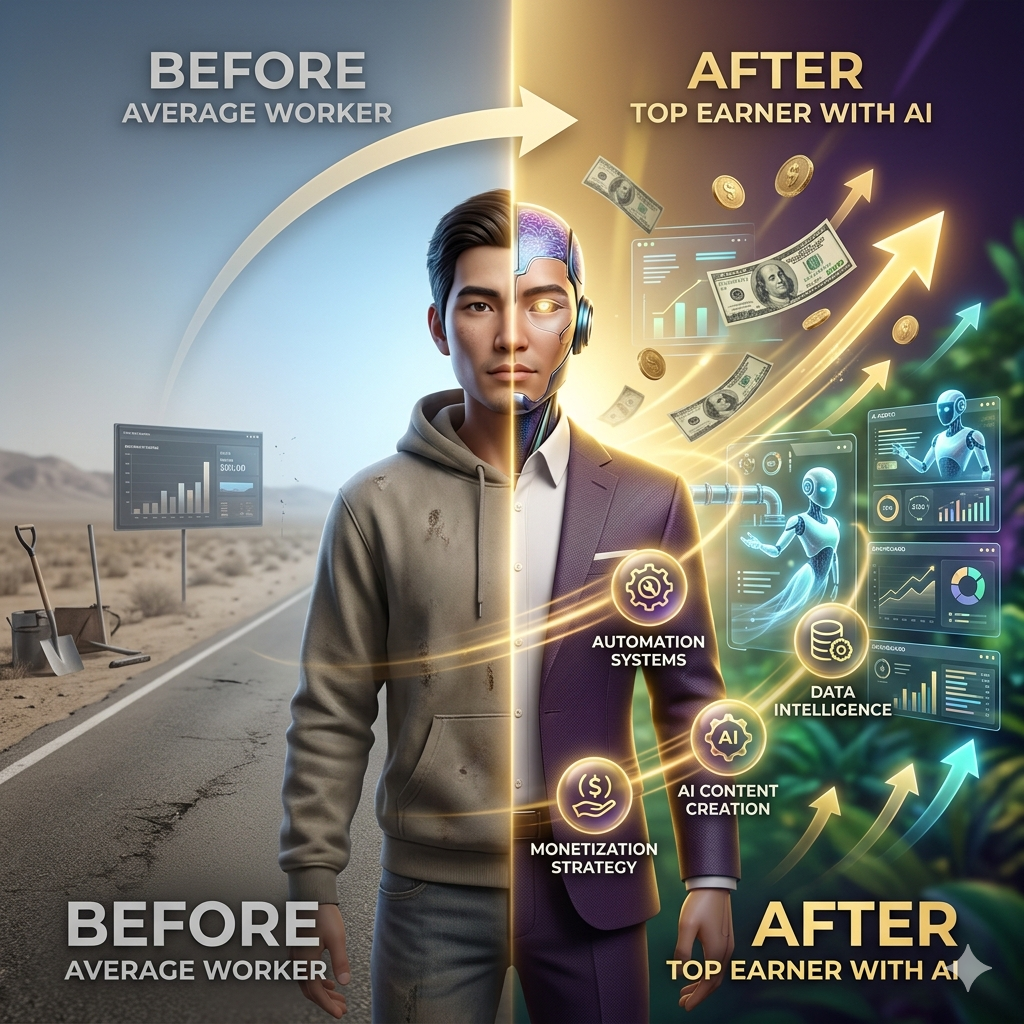
How 4 Powerful AI Skills Will Make You Irreplaceable at Work in 2026
Knowing how to use AI skills is no longer something that sets you apart from the crowd in 2026 — it is now the bare minimum that every employer, client, and competitor expects from anyone who calls themselves a professional.
Saying you know how to use AI today is a lot like putting “proficient in Microsoft Word” on your resume back in 2005 — it tells people almost nothing meaningful about your real capabilities.
The professionals who are pulling ahead right now are not just the ones who use AI the most — they are the ones who have built specific, strategic AI skills on top of the basics that most people never bother to develop.
This article breaks down exactly four of those AI skills in clear, practical language so you can start applying them immediately whether you work in content creation, consulting, marketing, data analysis, or any other field.
Tools like ProfitAgent are already being used by smart professionals to automate workflows and accelerate results, and understanding the skills behind that kind of leverage is exactly what this article is about.
We strongly recommend that you check out our guide on how to take advantage of AI in today’s passive income economy.
Table of Contents
Skill Number 1 — The Cockpit Rule: Knowing When to Use AI and When to Step Back
The first and most important of all AI skills you need to develop in 2026 is what is best described as the cockpit rule, and it is a mental model for deciding when to hand a task entirely to AI, when to work alongside it, and when to put it away and do the work yourself.
Think about how a pilot operates an aircraft and the logic becomes immediately clear — at cruising altitude on a clear day with no turbulence in sight, the pilot turns on autopilot and lets the system do its job without interruption.
During takeoff and landing, where there are far more variables, unpredictable forces, and higher stakes, the pilot and the automated systems work in close collaboration together rather than one replacing the other.
And in an emergency, when the instruments fail or conditions become too extreme for any automated system to handle, the pilot takes full manual control because no machine can replace human judgment in that moment.
This exact same logic applies to how you should be deploying your AI skills across every task in your professional life every single day.
Autopilot mode is when you hand the task over to AI with clear instructions and trust the output with minimal review — the AI handles it, you spot-check it, and you move on without wasting time on unnecessary back-and-forth.
Collaboration mode is where you and AI iterate together across multiple rounds until the output genuinely meets your standard — neither you working alone nor the AI working alone could have produced that result at the same level of quality.
Manual mode is when you do the work entirely yourself because the AI either cannot do it well enough or the risk of getting it wrong is simply too high to delegate — and recognizing this clearly is one of the most underrated AI skills anyone can build.
A useful framework for deciding which mode to choose comes from Professor Ethan Mollick of the Wharton School of Business, who developed what he calls the agentic cost-benefit framework, and it comes down to three specific factors that are worth understanding deeply.
The first factor is human baseline time — how long would this specific task take you to do entirely on your own without any AI assistance at all?
The second factor is probability of success — how likely is the AI tool you are using to get this particular type of task right on its first or second attempt given the domain involved?
The third factor is AI process time — how long will it realistically take you to write the prompt, wait for the output, review it, fix errors, and arrive at a usable result?
Here is a practical example to make this concrete: if you have a messy spreadsheet that needs restructuring for a client presentation, the human baseline might be two full hours of tedious manual formatting work, the AI’s probability of success is high because structured data manipulation is exactly what modern AI tools excel at, and the AI process time might be fifteen minutes to upload the file, write a clear prompt, and do a quick spot-check — making autopilot mode the obvious choice.
Now contrast that with a scenario where you are preparing a high-stakes client pitch that requires knowledge of the client’s specific risk tolerance, your organization’s internal priorities, and industry dynamics that only someone inside the room would know — in that case, collaboration mode is the right call because AI can handle the research and the draft, but it cannot replace the strategic direction that only a human expert can provide.
And if your boss sends an urgent message questioning your team’s approach on a sensitive project, and you already know the full backstory, the internal politics, and the right tone to take — the human baseline is three minutes, while the AI process time would be thirty minutes just to explain all the context you already have in your head, making manual mode the clear winner.
Using AutoClaw as part of your daily workflow helps you apply this kind of thinking at scale, because it is built to handle the autopilot tasks efficiently so you can focus your real cognitive energy on the work that actually needs you.
Skill Number 2 — Build the Rails: Designing AI-First Workflows That Run Without You
The second of the four AI skills that will define professional success in 2026 is what can be called building the rails, and it is the ability to design structured workflows that allow AI to do the heavy lifting consistently and reliably once the system is in place.
Think of a high-speed bullet train — laying the tracks requires enormous effort, significant planning, and a lot of patience upfront, but once those rails are in place, the train glides along at over 300 kilometers per hour with almost no friction and very little ongoing maintenance.
The same principle applies to how the most effective AI users operate today — they invest time upfront in designing the workflow, and then the AI just runs along those rails delivering consistent output without requiring constant supervision or rework.
A clear example of this in practice: using a single catch-all prompt to handle both subject lines and body content in email newsletters produces decent results, but creating a separate, purpose-built prompt optimized specifically for subject line generation consistently produces measurably better click-through rates because the instructions are more focused and specific.
Andrew Ng, one of the most respected voices in the AI field, found that using a single prompt to generate and run code gave a success rate of around 48 percent, but when a workflow was designed to write the code, run it, identify errors, and troubleshoot them using the same model in sequence, the success rate jumped to 95 percent — same model, completely different result, all because of the process design.
A Harvard and Boston Consulting Group study that tested 758 professional consultants found that the highest performers fell into two clear groups — centaurs, who divided tasks between themselves and AI with intentional handoff points, and cyborgs, who integrated AI into every single step of their process — while the group that used AI without any structured process at all performed 19 percentage points worse than both.
The variable that determined performance was not which AI tool they were using — it was the quality of the process they had built around it, which is a distinction that most people miss entirely when they talk about AI skills.
To start building your own AI-first workflows, begin by identifying a recurring deliverable you produce regularly — a weekly report, a content brief, a client proposal — and break it down into its individual component steps.
Then apply the cost-benefit framework from skill number one to each step — labeling each as autopilot, collaboration, or manual — and prioritize redesigning the autopilot steps first because that is where you get the biggest return for the least amount of effort invested.
AISystem is designed exactly for this kind of workflow thinking — giving professionals a structured environment where they can delegate, automate, and iterate with precision rather than just throwing prompts at a chatbot and hoping for the best.
Skill Number 3 — The Storytelling Mode: Turning AI-Generated Information Into Something People Actually Care About
The third of the four AI skills that matter most in 2026 is storytelling, and it is the one that AI itself is least equipped to replace because it requires something no model can generate on its own — meaning.
AI companies understand this better than almost anyone, which is why they have been aggressively hiring heads of content, narrative strategists, and professional storytellers even as they automate enormous portions of other knowledge work roles across every industry.
Information itself has become a commodity in the age of AI — anyone can generate a well-researched summary, a detailed list, or a comprehensive analysis in seconds — which means the real competitive advantage now belongs to the person who can take that information and transform it into something that moves people to think differently, feel something, or take action.
A manager in a room full of competing budget proposals who chooses to tell a story about how her project will create impact for an entire region and make her leadership look good will consistently win over the manager who presents a stronger spreadsheet with no narrative wrapper — because humans make decisions based on stories, not data alone.
Two frameworks are worth mastering here if you want to develop this AI skill at a professional level, and both of them have been used successfully in management consulting for decades.
The first is the ABT framework — And, But, Therefore — developed by scientist and filmmaker Randy Olsen, which structures any update, proposal, or explanation as: here is where we are AND what is happening, BUT here is the problem or conflict, THEREFORE here is the action or resolution — and it works because the but creates tension that makes people lean in, and the therefore satisfies that tension with a clear next step.
The second is the SCQA framework used by McKinsey, Bain, and BCG — Situation, Complication, Question, Answer — which works on the same principle of introducing a conflict and then resolving it, because conflict is the engine of every story that has ever held a human audience’s attention across any culture or era.
To see how much difference this actually makes, consider two versions of the same story: version one says that a hero was given a dangerous object and after a long journey he destroyed it — factually accurate, completely forgettable.
Version two says that the hero was the only one capable of resisting the corruption of that object, but the journey nearly destroyed him, and by the time he reached the point of no return, the object had already won, and it was only through the obsession of an unlikely adversary that the object was accidentally destroyed — same facts, completely different emotional impact, and a story that has been retold for generations.
When you combine ProfitAgent with a genuine storytelling skill, you are not just producing content faster — you are producing content that connects, converts, and builds an audience that keeps coming back.
Skill Number 4 — Manual Override: Protecting Your Critical Thinking in a World Full of AI Shortcuts
The fourth and final AI skill on this list is one that most people overlook entirely because it sounds counterintuitive — it is the skill of intentionally choosing not to use AI for certain tasks so that your own cognitive abilities do not weaken from disuse.
A weightlifting belt helps you move heavier loads, but if you wear it for every single rep across every single session, the stabilizer muscles in your core gradually weaken, and after a year you are only strong when the belt is on — take it off and your body cannot support the same weight it once handled with ease.
The same atrophy happens in the human brain when AI handles too much of the cognitive work that your thinking was previously responsible for carrying.
Researchers at McGill University found physical changes in the brains of drivers who relied heavily on GPS navigation — specifically a reduced ability to navigate independently when the GPS was unavailable — demonstrating that the brain genuinely rewires itself around tools it depends on.
A joint study from Microsoft and Carnegie Mellon University found that knowledge workers who over-relied on AI gradually stopped performing the cognitive steps that define genuine expertise — questioning assumptions, cross-checking sources, and carefully weighing trade-offs — which left them significantly less prepared for edge cases and unexpected situations.
And a study of 2,760 radiological decisions found that clinicians who used AI as their first opinion frequently anchored onto that answer and stopped looking for contradicting evidence, while those who formed their own opinion first and used AI as a second check maintained a much higher level of diagnostic accuracy across the board.
Professor Ethan Mollick’s practical recommendation for developing this AI skill is straightforward and immediately actionable: think first, prompt second — which means for any analytical task, you spend a few minutes forming your own position or hypothesis before you open any AI tool and ask for its interpretation.
The second habit is to interrogate the output rather than accept it — when AI gives you an answer, ask yourself how you would verify it independently, what the strongest counterargument would be, and what assumptions the answer is resting on that may or may not hold in your specific situation.
AutoClaw is a tool that supports this kind of disciplined thinking rather than replacing it — giving you the efficiency gains of AI automation without encouraging the passive consumption that leads to cognitive atrophy over time.
The concern that AI is making professionals dumber is not entirely without basis, but the more accurate framing is that AI changes habits, and habits are entirely within your control to shape deliberately.
An MIT study found that students who used AI without any structured guidance scored 17 percent worse on follow-up assessments, but a World Bank study found that six weeks of structured AI-assisted tutoring produced learning gains equivalent to two full years of traditional schooling — same technology, opposite outcomes, entirely determined by how intentionally it was used.
AISystem gives you the structure to use AI intentionally, which is the difference between building better AI skills and slowly outsourcing your own expertise to a tool that does not have your best interests at stake.
Final Thoughts — The 4 AI Skills That Will Decide Who Thrives in 2026 and Beyond
The gap between professionals who are thriving with AI and those who are being replaced by it is not a gap in which AI tool they are using — it is a gap in the quality of the AI skills they have built around how they use it.
The cockpit rule gives you a decision-making framework for when to delegate, collaborate, or override — so you are never wasting time on the wrong mode for any given task.
Building the rails turns your AI usage from a series of one-off prompts into a structured, repeatable system that produces consistent results at a fraction of the effort over time.
The storytelling mode ensures that the information AI helps you generate actually lands with the people who need to act on it, rather than disappearing into the noise of a world drowning in AI-produced content.
And the manual override habit keeps your own cognitive abilities sharp so that AI remains a tool that amplifies your expertise rather than a crutch that quietly erodes it.
ProfitAgent brings all of these AI skills together in a practical environment where you can start applying them immediately, and the professionals who are integrating tools like AutoClaw and AISystem into well-designed workflows are already seeing results that most AI users will not catch up to anytime soon.
The AI is not going anywhere — the only question worth asking now is whether you are building the skills to direct it or slowly becoming a passenger inside a system that someone else designed.
We strongly recommend that you check out our guide on how to take advantage of AI in today’s passive income economy.