9 Boring Businesses That Could Generate Up to $1,200 a Day
The most profitable boring business ideas that make money are usually the ones nobody is competing for, and that includes mobile notary work, parking lot striping, laundry delivery, appliance removal, dustless blasting, mat cleaning, pressure washing, gutter guard installs, and remote house cleaning, each of which can realistically bring in up to $1,200 a day with modest startup costs and steady local demand.
Most people chase the exciting stuff.
They want the app, the course, the personal brand, the thing that looks good on a screenshot.
But some of the best boring business ideas that make money are hiding in plain sight, doing unglamorous work that almost nobody wants to do themselves.
There is no content strategy involved.
There is no audience to build.
There is just a real problem, a fair price, and a customer who is relieved someone finally showed up to handle it.
Below are nine of these low-drama, high-demand businesses, broken down so you can see exactly how the math works.
We strongly recommend that you check out our guide on how to take advantage of AI in today’s passive income economy.
Table of Contents
1. Mobile Notary Services
Mobile notary work means traveling to homes, hospitals, and offices to notarize documents like real estate closings, loan paperwork, and legal forms.
The notary and loan-signing industry has grown steadily as remote closings and refinancing activity have increased demand for signing agents who can meet clients wherever they are.
Signing agents are often paid a flat fee per appointment by title companies and loan officers, and rates commonly range from roughly $75 to $200 depending on the complexity of the signing and the location.
This works because notarization is legally required for many transactions, and people are willing to pay extra for someone to come to them instead of taking time off to visit an office.
Startup costs are relatively low, often under $500 once you account for state commissioning, an errors-and-omissions policy, a notary stamp, and a signing agent course.
If you complete even six to eight signings in a day at an average rate, you can land in the neighborhood of $1,200 for that day’s work.
Most agents find work through signing platforms such as Snapdocs or NotaryDash, which connect independent notaries with title companies that need appointments filled.
If you are detail-oriented and comfortable driving around your city, this is one of the more accessible boring business ideas that make money without requiring a storefront or employees.
👉 Get Access to: The AI Traffic Vault
2. Parking Lot Striping
Parking lot striping means repainting the lines, arrows, and accessibility markings that keep a parking lot organized and compliant with ADA requirements.
This service sits inside the broader pavement maintenance industry, which is worth tens of billions of dollars nationally when you include sealcoating, patching, and line work.
Local striping contractors typically charge anywhere from a few hundred to a couple thousand dollars per lot, depending on size, and clients include shopping centers, medical offices, schools, and warehouses.
The reason this keeps working is simple: paint fades in the sun, and most municipalities require lots to be restriped on a regular cycle to stay compliant.
You can get into this with a few thousand dollars for a striping machine, stencils, and durable line paint, which is a modest investment relative to what a single job can pay.
Landing even one larger commercial lot in a day can put you close to that $1,200 mark, and a full week of consistent bookings adds up quickly.
Many operators build relationships with pavement maintenance and sealcoating companies, since those businesses frequently subcontract out the striping portion of larger jobs.
Because striping disrupts parking, most of the work happens on weekends or after business hours, so it suits people who don’t mind an unconventional schedule.
👉 Free download: Start a 1-Person Business With Claude AI — Free Quick-Start Guide
3. Laundry Pickup and Delivery
Laundry pickup and delivery is exactly what it sounds like: you collect a customer’s dirty laundry, have it washed and folded, and return it fresh, usually within a day or two.
The professional laundry services industry in the United States is valued in the billions and continues to expand as more people look for ways to offload household chores.
Platforms like Poplin and SudShare connect independent operators with customers who want their laundry handled, and many operators run these routes entirely from their phone.
This works because laundry is a chore almost everyone dislikes, and people will happily pay a per-pound rate to have it disappear from their weekend.
Startup costs can stay under $500 if you’re using your own washer, dryer, and vehicle, with the main investment going toward bags, labels, and basic route software.
Charging in the range of a couple dollars per pound, a modest weekly volume can generate roughly $1,200 across a few days of pickups and folding.
A practical way to find early customers is partnering with local laundromats or offering wash-and-fold add-ons that laundromats don’t currently provide themselves.
Route optimization matters here, so batching pickups by neighborhood keeps drive time down and profit per hour up.
4. Appliance Removal and Recycling
Appliance removal and recycling means hauling away old refrigerators, washers, and ovens, then either scrapping them for materials or reselling working units.
This niche sits inside the broader appliance and metal recycling sector, which handles a significant volume of discarded appliances every year as people upgrade or move.
National junk removal brands like 1-800-GOT-JUNK operate in this space at scale, but plenty of room exists for local operators who specialize specifically in appliances.
The demand comes from landlords, movers, and homeowners who need something gone quickly and don’t want to figure out disposal logistics themselves.
You can start with under $1,000 if you already own a truck or trailer, adding straps, a dolly, and basic safety gear for handling heavy appliances.
Charging roughly $100 to $150 per haul, completing eight to ten pickups in a day can put you at or near that $1,200 daily figure.
Sorting out copper wiring and other scrap metal separately before dropping items at a scrapyard can add meaningful extra income on top of the haul fee itself.
Building a few repeat relationships with furniture stores or property managers who regularly need old units removed can turn this into steady, recurring work.
👉 Get Access to: The AI Traffic Vault
5. Dustless Blasting
Dustless blasting uses a mix of water and abrasive media to strip paint, rust, and grime from surfaces like driveways, boats, vehicles, and industrial equipment.
It’s part of the surface restoration and blasting industry, which spans manufacturing, marine, automotive, and construction applications.
Operators in this space commonly charge anywhere from $500 to $2,000 per job depending on the surface area and the extent of the paint or rust removal needed.
The appeal for customers is that it’s faster, cleaner, and less damaging to the underlying surface than traditional dry sandblasting.
The catch is a higher barrier to entry, since equipment like a trailer, compressor, and blast pot can run in the range of $10,000 to $15,000 to get started.
Once that equipment is in place, two mid-sized jobs in a single day can put you at or above $1,200, with profit margins that can climb past 50 percent if you’re doing the labor yourself.
A strong way to generate leads is reaching out directly to auto restoration shops, painters, and general contractors who need blasting done but don’t want to own the equipment.
Because the before-and-after results are so visually dramatic, this is a business where a simple Instagram page can do a lot of the marketing work for you.
6. Commercial Mat Cleaning
Commercial mat cleaning involves picking up, deep-cleaning, and returning the heavy rubber floor mats used by restaurants, gyms, and office buildings on a recurring schedule.
This falls under the broader commercial cleaning sector, and while national uniform and facility services companies like Cintas dominate the enterprise end of mat rental, plenty of small operators still compete on price and service in local markets.
The reason this business keeps working is that dirty entrance mats are both a slip hazard and a bad first impression, and most businesses are required or strongly incentivized to keep them clean.
Startup costs can stay in the range of $1,000 to $2,000 for a commercial extractor, detergent, and a dedicated drying space.
Charging roughly $20 to $25 per mat on a weekly or monthly contract, a modest client base of restaurants and offices can generate around $1,200 a week in recurring revenue.
Offering a free demo cleaning to a handful of local businesses is often enough to start building a client list, especially when paired with simple before-and-after photos.
Bundling in extras like mop head swaps or entry mat rentals can increase revenue per client without adding much additional work.
Because this is recurring, contract-based work, it tends to be one of the more predictable boring business ideas that make money on this list.
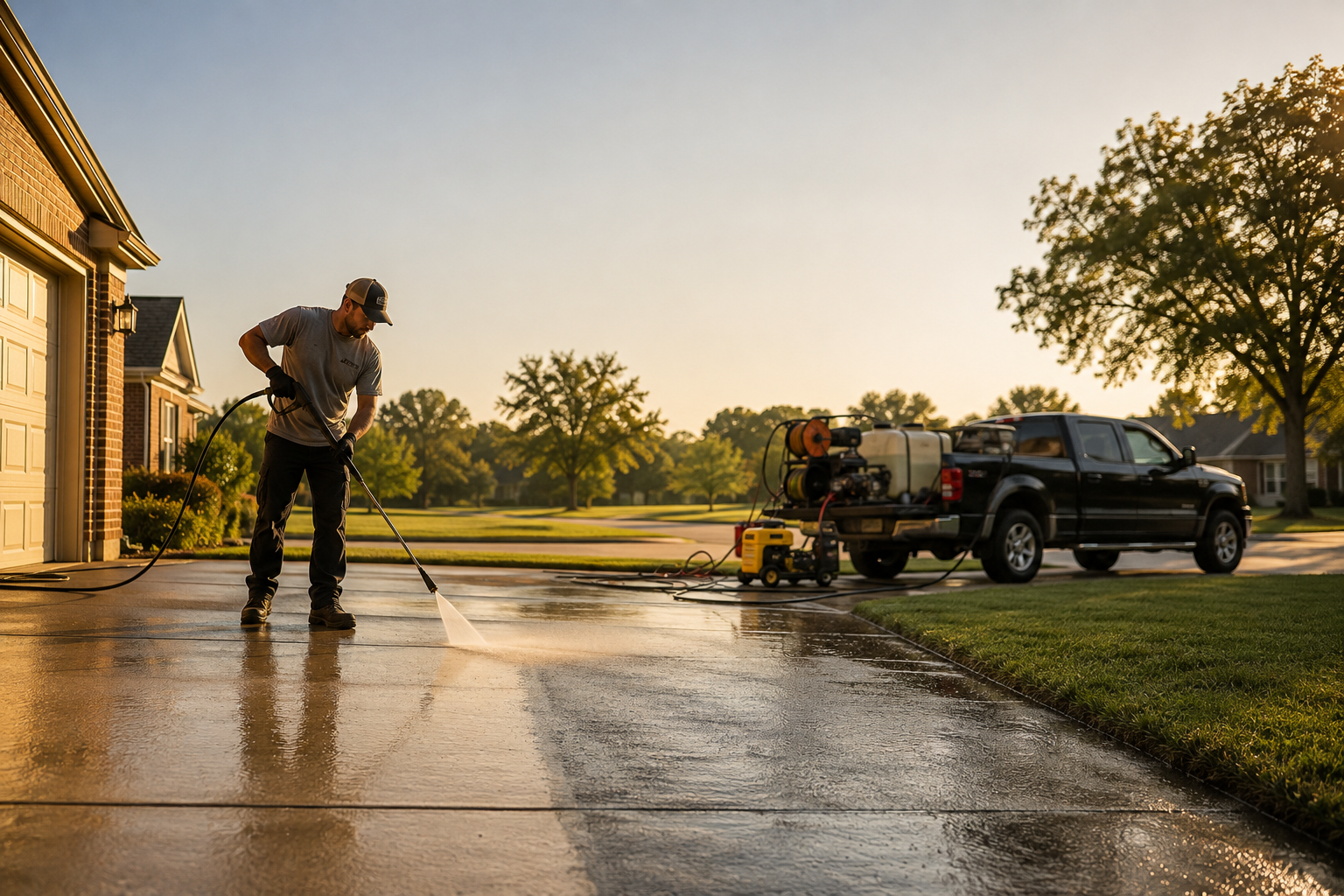
7. Pressure Washing Driveways
Pressure washing focused specifically on driveways, sidewalks, and patios means blasting away dirt, mildew, and algae buildup to restore concrete to a like-new appearance.
This sits inside the exterior cleaning industry, which also includes house washing, roof cleaning, and deck restoration.
Local pressure washing operators typically charge $150 to $400 for a standard residential driveway or patio job, depending on size and condition.
The appeal is almost entirely visual, since clean concrete makes a noticeable difference to curb appeal, and homeowners are usually willing to pay for that instant improvement.
You can start with a consumer-grade pressure washer for a few hundred dollars, which makes this one of the lowest-cost entries on this entire list.
Completing four to five jobs in a day at an average rate can put you close to that $1,200 daily figure.
A practical way to find clients is going door-to-door in higher-income neighborhoods with simple before-and-after photos, or offering a discounted first job in exchange for referrals.
Upselling add-ons like window cleaning or gutter cleaning on the same visit can meaningfully increase the value of each stop without adding a separate trip.
👉 Free download: The Claude AI Digital Product Starter Pack — 10 Done-For-You Prompts for Beginners
8. Rain Gutter Guard Installation
Gutter guard installation means fitting mesh or aluminum covers over existing gutters to keep leaves and debris from clogging them, which helps prevent water damage to the roof and foundation.
National brands like LeafFilter and LeafGuard dominate a large share of the market and often work with independent installers or refer overflow leads to local contractors.
This works because most homeowners don’t want to get on a ladder themselves, and clogged gutters can lead to expensive water damage if left unaddressed for too long.
Startup costs are relatively low, often under $1,000 for a quality ladder, basic drill set, and initial guard inventory.
Pricing commonly runs a few dollars per linear foot, and on an average-sized home with 150 to 200 feet of gutter, a single job can approach or exceed $1,200.
Because gutters typically need cleaning before guards go on, many installers start with a cleaning visit, which also creates a natural opportunity to pitch the guard upgrade.
Bundling this with an annual gutter cleaning plan or a roof inspection referral can turn a one-time install into an ongoing customer relationship.
For anyone comfortable on a ladder, this remains one of the more straightforward boring business ideas that make money with a clear, repeatable pricing structure.
9. Remote House Cleaning
Remote house cleaning means running a cleaning business without doing the cleaning yourself, instead matching independent cleaners with clients and taking a percentage of each job.
Residential cleaning is a multi-billion dollar industry in the United States, and unlike many service categories, no single company controls a dominant share of the market nationally.
Chicago-based King of Maids is a well-known example of this model operating at scale, matching independent cleaning contractors with residential clients across the metro area.
This works because you’re not the one cleaning, hiring employees, or buying equipment, which means the business can be run almost entirely from a laptop once systems are in place.
A first-time deep clean commonly runs around $250 to $300, and a meaningful percentage of first-time customers convert into recurring weekly, biweekly, or monthly clients over time.
Landing even a handful of first-time cleans in a week, combined with recurring bookings from past clients, can build toward a consistent $1,200-a-day equivalent in monthly revenue as the client base grows.
A common way to get started is posting in local Facebook groups and Nextdoor offering free quotes, while sourcing cleaners through job boards and pairing them with incoming leads.
Because it functions more like a lightweight matching platform than a traditional service business, this is often considered the most scalable of the boring business ideas that make money covered here.
👉 Get Access to: The Medium Mastery
The Real Pattern Behind These Businesses
None of these nine businesses are exciting, and that’s exactly the point.
They solve a problem someone genuinely doesn’t want to deal with, they charge a fair price for showing up and doing the work well, and they rely on demand that already exists instead of demand you have to create from scratch.
Startup costs across this list range from a few hundred dollars for pressure washing up to several thousand for dustless blasting, which means there’s an entry point for almost any budget.
What they share is a low reliance on content, personal branding, or audience-building, which makes them a solid option for anyone who would rather build something quiet and dependable than chase trends.
If your interest leans more toward building an online, content-driven business instead of a local service business, that same principle of solving a real problem still applies.
Writing and selling digital products around AI tools and online income strategies works the same way: find a specific problem, solve it clearly, and price it fairly.
👉 Get Access to: The AI Traffic Vault
👉 Free download: Start a 1-Person Business With Claude AI — Free Quick-Start Guide
Whichever direction you choose, the businesses that tend to last are rarely the flashiest ones, and often the most boring boring business ideas that make money end up being the most reliable.
We strongly recommend that you check out our guide on how to take advantage of AI in today’s passive income economy.