How One Solo Builder Used AI Tools to Launch a SaaS Product, Get 1,000 Users, and Break Free From the 9-to-5
How I Built a 350-Paid-User SaaS App With Cursor and Made $30K Working Solo
Building apps with Cursor AI to generate passive income is no longer a fantasy reserved for Silicon Valley engineers with computer science degrees and massive development teams.
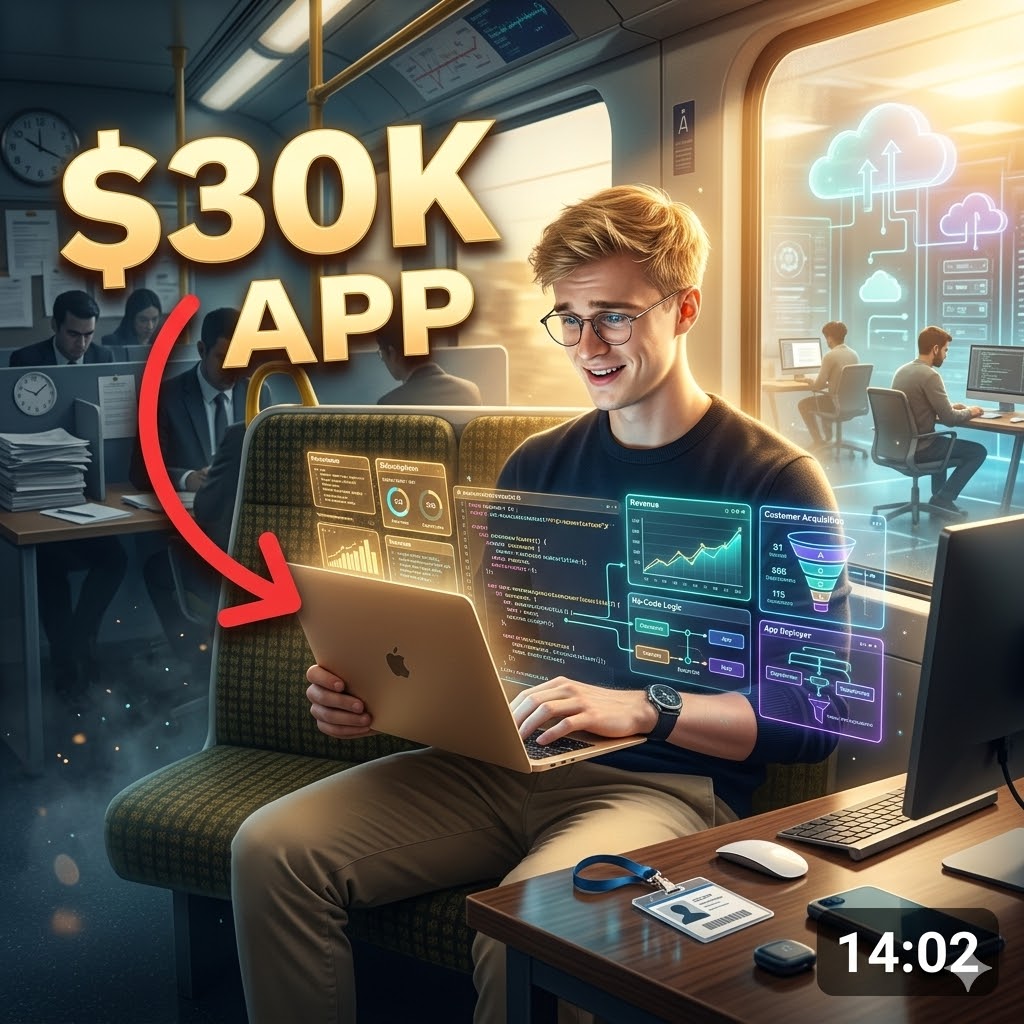
A regular guy — commuting to work every single morning just like millions of other people — decided one day to open his laptop on the train and start building something.
No co-founder.
No investors.
No team.
Just a clear idea, a few powerful AI tools, and the discipline to keep going even when nobody was watching.
Seven months later, that app had crossed $30,000 in revenue, attracted over 1,000 registered users, and converted more than 350 of them into paying customers.
The day he quit his job, he was sitting in an office he no longer wanted to be in, working a schedule someone else had designed for him, earning a salary that could never match the freedom he had already tasted.
This is not a rags-to-riches fairy tale.
This is a practical, step-by-step story about what happens when someone with domain knowledge, a real problem to solve, and the right tools decides to stop waiting for the perfect moment.
We strongly recommend that you check out our guide on how to take advantage of AI in today’s passive income economy.
Table of Contents
The Man Behind the App: A Background Built on Hustle, Not Code
Polus was 18 years old when he first realized the traditional path was not going to work for him.
He needed money to get through college, and the only job available to him at the time was door-to-door sales.
One afternoon, he knocked on the wrong door and a man grabbed him and held a knife to his throat.
That moment ended his sales career immediately and launched something far more important — a desperate, hungry, relentless search for a better way to earn a living.
He tried web design, copywriting, sales funnels, and anything else that could put money in his pocket without putting him in danger.
He became what the entrepreneurship world calls a generalist — someone who knows a little about a lot, can adapt quickly, and figures things out by doing rather than studying.
When he entered university, he studied computer game development, but he openly admits that he was terrible at writing code.
He was a visual thinker, someone who saw the end product clearly in his mind but could not translate that vision into lines of syntax that a computer would obey.
For years, that limitation felt like a ceiling he could not break through.
Then AI came along and removed the ceiling entirely.
The Idea That Changed Everything
Polus spent years trying different business models, chasing income streams that always seemed to fall just short of the freedom he was looking for.
He was working in the creator economy space, focused on connecting brands with content creators, and he kept running into the same frustrating problem over and over again.
There was no clean, reliable way for startups to find and connect with the right influencers for their products.
The existing solutions were either too expensive, too complicated, or simply not designed with small and medium-sized businesses in mind.
So he started building a database himself — manually at first, as a personal resource — and then he had a thought that changed everything.
What if he turned this database into a proper software product that other people could pay to access?
What if he built a SaaS platform that matched startups with influencers, automating the connection that was currently happening through spreadsheets and cold emails?
He called it Creator Hunter, and he started building it with the only tools available to someone who could not write code from scratch.
The Exact Tech Stack He Used to Build Creator Hunter
Step One — Perplexity for the Game Plan
Before writing a single prompt or touching a design tool, Polus turned to Perplexity AI to map out his entire build process.
Perplexity is a research-driven AI tool that pulls from current documentation and real-time web sources to give detailed, accurate, step-by-step guidance.
He told it exactly what he wanted to build, told it he was not a developer, and asked it to walk him through everything from the beginning.
Perplexity responded with a long, structured document covering every step of the build — the tools to use, the order to implement them, the dependencies to install, and the errors to watch out for.
He kept that document open throughout the entire development process and referred back to it every time he hit a wall.
Step Two — Bolt for the Functional MVP
Once he had his roadmap, Polus opened Bolt — an AI-powered development tool that lets you describe what you want in plain English and generates working frontend code almost instantly.
He took the guidance from Perplexity and started implementing it in Bolt one step at a time, focusing on the core features first.
He built the dashboard, set up the basic navigation, and designed the core user flows — all through prompts, not code.
When errors appeared, he copied them directly and threw them back into the AI, which fixed them and moved forward.
By the end of this phase, he had a clean, functional MVP with a real interface and working features — built entirely through conversation with an AI tool.
Step Three — Cursor for Production-Ready Code
This is where building apps with Cursor AI to generate passive income becomes a full professional operation.
After downloading his project from Bolt, Polus imported it directly into Cursor — an AI-powered code editor that understands your codebase deeply and can make complex changes through natural language instructions.
Inside Cursor, he connected his backend using Supabase, which is a free, open-source database platform that handles data storage and real-time functionality.
He also integrated Clerk, a user authentication service that handles sign-ups, logins, and account management without requiring any custom security code.
Cursor wrote all the scripts needed to connect these services together, handled the integration errors, and helped Polus dial in the security of the application through targeted prompts.
By the end of this stage, he had a fully functioning SaaS product with authenticated users, a live database, and a backend that could scale.
Step Four — Framer for the Landing Page
For the public-facing website, Polus used Framer, a no-code design and website builder known for its polished templates and fast customization.
He picked a free template he liked, chose a clean font, updated the colors and button styles, and focused 80 percent of his time on the hero section — the part of the page that visitors see first before they scroll.
His hero section communicated exactly what Creator Hunter did, who it was for, what problem it solved, and what the user should do next — all within the first few seconds of landing on the page.
He kept the rest of the design simple and clean, because his goal was to ship fast, not to build the most beautiful website on the internet.
How He Marketed the App and Went From Zero to $30K
Building in Public on X (Twitter)
Polus did not have an advertising budget.
He did not hire a marketing agency or run paid campaigns on Google or Meta.
He opened his X (formerly Twitter) account and started talking about what he was building, how he was building it, and what was happening in real time.
This strategy — known as building in public — works because it creates a community of people who are invested in your journey before your product even launches.
His most successful post reached close to 500,000 impressions, not because it was perfectly crafted or professionally produced, but because it tapped directly into a debate that was already dominating the AI and tech space at the time.
The question everyone was asking was whether AI coding tools were actually good enough to build a real, full SaaS product — and his post answered that question with a live demo and a genuine, unfiltered reaction.
He had found an angle that connected his product to the conversation that was already happening, and the internet rewarded him for it.
The Launch Night That Validated Everything
For months before launch, Polus had been building the product in near silence, with no guarantee that anyone would pay for it.
He launched Creator Hunter, sat down for dinner with his girlfriend, and pulled out his phone to check the dashboard.
Sales were coming in one after another.
He stayed on that screen watching the notifications roll in, counting 20 to 30 sales in a single evening.
That night did not just generate revenue — it confirmed that the problem he had built a solution for was real, that people were willing to pay for it, and that the months of work on his morning commute had not been wasted.
The Lessons That Matter Most for Anyone Wanting to Build With AI
Your Domain Knowledge Is Your Biggest Asset
When people talk about using Cursor AI to build and monetize apps fast, they usually focus on the tools — the prompts, the tech stack, the launch strategy.
But Polus points to something more foundational than any of that.
The reason Creator Hunter worked was not because Bolt is a great tool or because Cursor AI writes clean code.
It worked because Polus had spent years in the creator economy, understood the pain of matching startups with influencers, and knew exactly what a useful solution would look like.
His domain knowledge gave him the idea, shaped every feature decision, and made his marketing authentic because he was talking about a problem he had lived.
If you have spent years working in an industry and you keep running into the same frustrating problems, you already have a business idea sitting inside that frustration.
Ship Scrappy, Then Polish
One of the most important things Polus learned through this process is that waiting for your product to be perfect before launching is the fastest way to stay stuck forever.
He launched Creator Hunter when it was functional, not when it was flawless.
He built the landing page in Framer using a free template, not a custom-designed brand identity.
He posted on X with raw, unfiltered updates — not polished marketing copy written by a professional agency.
The scrappiness was not a weakness — it was the strategy.
Building apps with Cursor AI to generate passive income is not about creating something that looks like it came from a $10 million startup.
It is about building something that solves a real problem fast enough to test whether people actually want it before you spend months perfecting something nobody will use.
Marketing Is Joining the Conversation, Not Starting One
The mistake most solo builders make when they launch is that they announce their product and then wait for the world to pay attention.
Polus did something different.
He found the conversations that were already happening in his space, identified the debates and trends his product was directly relevant to, and inserted his story into those conversations with genuine evidence and results.
The 500,000-impression post did not succeed because of great writing.
It succeeded because it answered the question that thousands of people were already asking at that exact moment in time.
What His Life Looks Like Now
Polus quit his job on December 24th and has been working on Creator Hunter full time ever since.
He travels more, works more hours than he ever did in his 9-to-5, and feels none of the exhaustion that used to define his working week.
He was building the MVP while traveling to China, New York, and France — watching revenue notifications arrive while exploring cities on the other side of the world.
That experience — earning while moving, building while living — is the specific kind of freedom that no salary can replicate.
His costs are minimal: Vercel for hosting (free tier), Supabase for the database (free tier), and a small API cost for data scraping.
His margins are around 90 percent.
For every dollar that comes in, he keeps nearly all of it.
Final Thought: The Window Is Open Right Now
The story of Creator Hunter is not about Polus being exceptional.
It is about what becomes possible when someone with real knowledge of a real problem decides to use building apps with Cursor AI to generate passive income as the vehicle to solve it.
The tools exist.
The distribution channels exist.
The paying customers exist.
The only thing standing between where you are right now and a product that earns while you sleep is the decision to start prompting and stop waiting.
You probably already have the idea.
You probably already have the domain knowledge.
The only question is whether you are going to act on it this weekend — or keep watching other people like Polus do it first.
We strongly recommend that you check out our guide on how to take advantage of AI in today’s passive income economy.