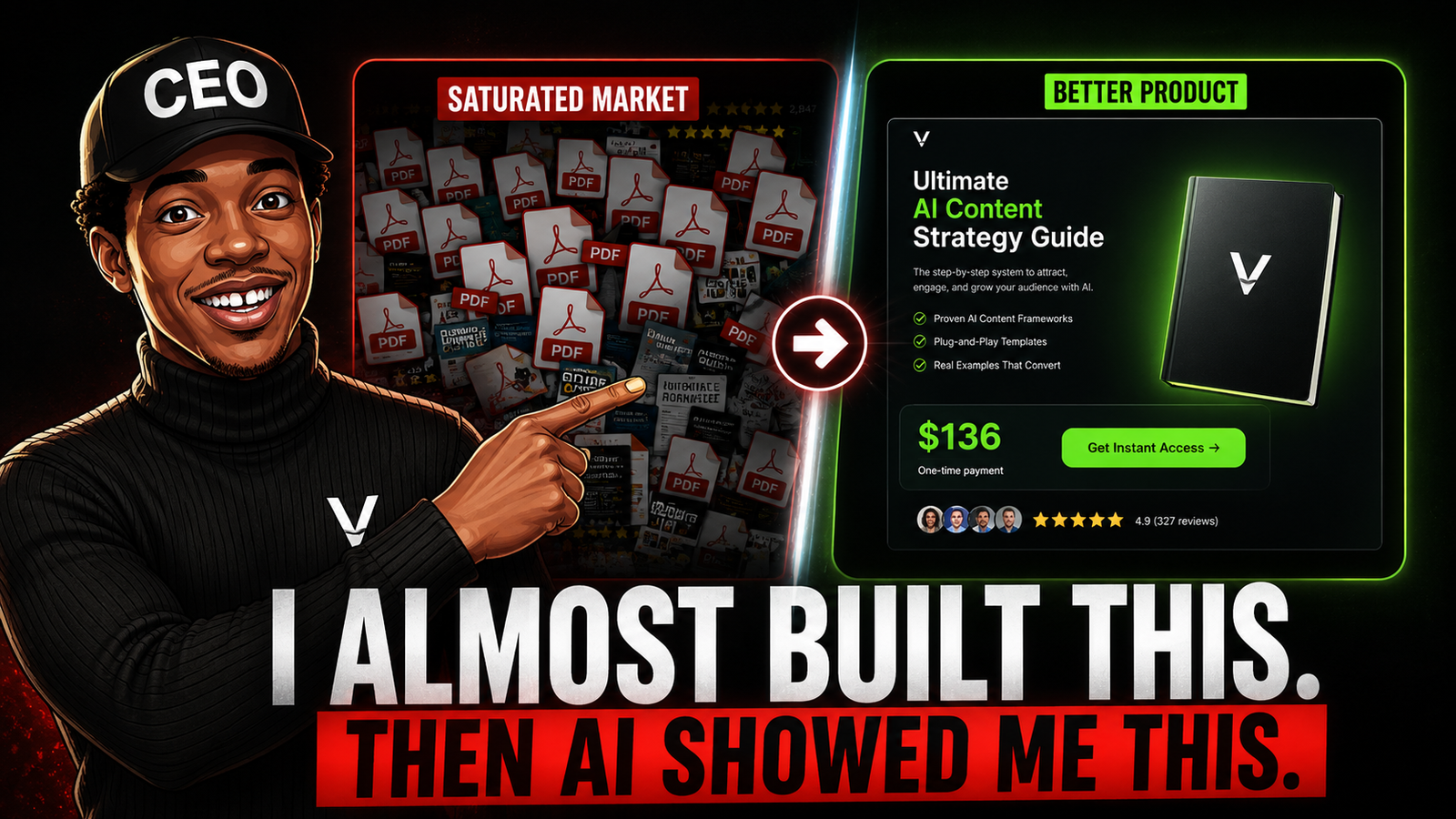
The most common reason digital products fail is not poor quality, wrong platform, or bad marketing. It is that the product was built without first confirming that anyone was actively looking for it. The creator had an idea that felt good, built it, listed it, and then discovered through the silence of no sales that the market did not share their enthusiasm.
This article documents the complete three-tool AI validation framework that catches that mistake before it costs weeks of wasted effort — and demonstrates the framework using a real product idea that failed the validation test and the pivot direction that passed it and went on to generate real sales.
Step 1 — The Product Idea That Almost Got Built
The product idea being evaluated is an AI Productivity Tips Collection — a bundle of tips and advice for people who want to use AI tools more effectively in their daily work and business. On the surface this idea has obvious appeal. The topic is popular, the potential audience is large, and there is no question that interest in AI tools is high.
But surface appeal and market demand are not the same thing. And the validation framework is designed to separate the two with data rather than intuition.
The AI Productivity Tips Collection has three structural problems that validation will reveal. The audience is too vague — anyone who uses AI tools is not a specific buyer, it is a demographic. The pain point is not urgent — wanting to use AI tools more effectively is an aspiration rather than an acute problem that buyers are actively spending money to solve. And the free content competition is overwhelming — the internet is saturated with AI productivity tips from major publications, YouTube channels, newsletters, and social media accounts, all available for free.
These problems are not visible from the inside of the idea. They require external validation tools to surface them. That is exactly what the next three steps do.
Step 2 — The Claude AI Demand Signal Test
The Claude AI demand signal test uses a structured validation prompt to evaluate a product idea against five specific market demand signals. The prompt is designed to produce actionable analysis rather than generic encouragement.
Here is the complete validation prompt to use in Claude AI:
You are a digital product market research expert with deep knowledge of what makes simple digital products sell to cold online audiences. I want you to evaluate a digital product idea for me using five specific demand signals. The product idea is stated here. Evaluate this idea against the following five signals and give me a clear assessment of each one.
Signal 1 — Audience Specificity: Is the target audience clearly defined and specific enough that a real buyer would immediately recognize themselves in the product description? Rate this signal as Strong, Weak, or Critical Problem and explain why.
Signal 2 — Pain Point Urgency: Does this product solve a specific painful problem the target audience is actively trying to solve right now, or does it provide general information that is nice to have but not urgently needed? Rate this signal as Strong, Weak, or Critical Problem and explain why.
Signal 3 — Free Content Competition: Is the core value of this product readily available for free online in a format that a potential buyer could easily find without paying? Rate this signal as Low Competition, Moderate Competition, or Critical Problem and explain why.
Signal 4 — Transformation Clarity: Can a potential buyer clearly picture how their situation will be meaningfully different after using this product compared to before? Rate this signal as Clear, Unclear, or Critical Problem and explain why.
Signal 5 — Buyer Intent Alignment: Is the type of person who would search for this topic in a buying mindset or an information-seeking mindset where they expect free content? Rate this signal as Buyer Intent, Mixed Intent, or Information Seeker and explain why.
After evaluating all five signals, give me an overall Validation Score from 1 to 10 where 10 means build this product immediately and 1 means abandon this idea entirely. Then give me one specific recommendation for either how to fix the critical problems identified or what product direction would score significantly higher for the same target audience.
When this prompt is applied to the AI Productivity Tips Collection, Claude identifies critical problems on Signals 1, 2, 3, and 5 — audience specificity, pain point urgency, free content competition, and buyer intent alignment all flag as problematic. The overall validation score lands low. And the recommendation points toward a more specific, more urgent, more buyer-intent-aligned direction — helping a specific type of person solve a specific problem using Claude AI.
Step 3 — The Bing AI Search Validation Check
The Bing AI search validation check uses Microsoft Bing AI’s citation behavior as a real-time indicator of topic saturation and buyer intent.
When Bing AI generates an answer to a search query, it selects three to five source pages to cite as references. The identity of those sources reveals the competitive landscape for content on that topic.
For the AI Productivity Tips Collection direction, a Bing AI search for the core problem the product addresses returns citations that are entirely from major free publications — major tech outlets, established newsletters, and high-authority blogs. This citation landscape confirms that the free content competition flagged by Claude is not theoretical — it is real, current, and dominant.
For the pivot direction — how to start a one-person business with Claude AI — the Bing AI citation landscape is meaningfully different. The sources cited are more specific, less dominated by major publications with enormous domain authority, and include content from smaller specialized creators. This creates a realistic opportunity for a focused product page or blog post to enter the citation pool and attract traffic that a paid product can convert.
The Bing AI check adds a second independent confirmation of the same conclusion Claude reached — the broad topic is saturated, the specific niche has opportunity.
Step 4 — The Flipboard Engagement Test
The Flipboard engagement test uses Flipboard’s magazine search and content engagement data as a third independent demand signal.
Flipboard organizes content by topic into magazines that readers actively follow. The number of existing magazines on a topic and their follower counts reveal both the competitive landscape and the level of genuine reader engagement with that content area.
For the broad AI productivity tips topic, a Flipboard search reveals a high number of existing magazines with established follower bases — confirming saturation and making it difficult for a new creator to establish topic authority.
For the one-person business with Claude AI direction, the Flipboard search reveals fewer existing magazines and more open space for a new creator to become the dominant magazine in that specific topic area. Combined with engagement data showing real reader interest in AI business content, this Flipboard signal adds a third confirmation that the pivot direction has genuine market demand.
Three independent tools — Claude AI, Bing AI, and Flipboard — have now evaluated the same two product directions and reached the same conclusion independently. That convergence is the strongest possible signal the framework can produce.
Step 5 — The Buyer Intent Score and the Pivot
The buyer intent scoring prompt synthesizes all three validation signals into one final comparative score using Claude AI as the synthesis tool.
The scoring prompt asks Claude to evaluate the summary results from all three validation tests and produce a final Buyer Intent Score from 1 to 10 for both the original idea and the pivot direction, along with a clear build or do not build recommendation for each.
The AI Productivity Tips Collection scores below 4 out of 10 — a clear do not build recommendation. The one-person business with Claude AI direction scores above 7 out of 10 — a clear build recommendation with specific guidance on the product format that would serve this audience best.
That validated pivot direction became the Start a 1-Person Business With Claude AI product at adegbenga.gumroad.com/l/ewfjmv and the accompanying Free Quick-Start Guide at adegbenga.gumroad.com/l/rfqby — which generated 92 downloads and $40.79 in voluntary pay-what-you-want revenue in its first 21 days, with 4 paid sales of the $17 guide generating an additional $68.
The market confirmed what the validation framework predicted. The framework works because it asks the market what it wants before the builder decides what to make. That sequencing — validate first, build second — is the only structural difference between a digital product that sells and one that sits.
Watch The Video Here
The Complete Validation Framework Summary
Any product idea can be evaluated using these three free tools in under one hour by following this sequence.
Start with the Claude AI demand signal test using the complete prompt provided in Step 2. Note which of the five signals flag as Weak or Critical Problem. If three or more signals flag as critical, the idea needs significant modification before moving forward.
Run the Bing AI search validation check on the core problem the product addresses. Evaluate whether the citation landscape is dominated by free major publications or whether there is space for specific focused content. A saturated citation landscape is a red flag for a paid product competing in that space.
Test the Flipboard engagement signal by searching the topic in Flipboard and assessing the number of existing magazines and their follower engagement. A saturated magazine landscape confirms the Bing AI finding. An open landscape with real engagement signals genuine opportunity.
Finally run the buyer intent scoring prompt in Claude to synthesize all three signals into a clear final score and recommendation. A score above 7 with a build recommendation from Claude after reviewing all three validation summaries is a strong signal to proceed. A score below 4 is a clear signal to modify the direction significantly or abandon it entirely.
This framework costs nothing to run. It takes under one hour. And it is the difference between building a product the market wants and building a product the creator likes — which are two very different things.

We strongly recommend that you check out our guide on how to take advantage of AI in today’s passive income economy.