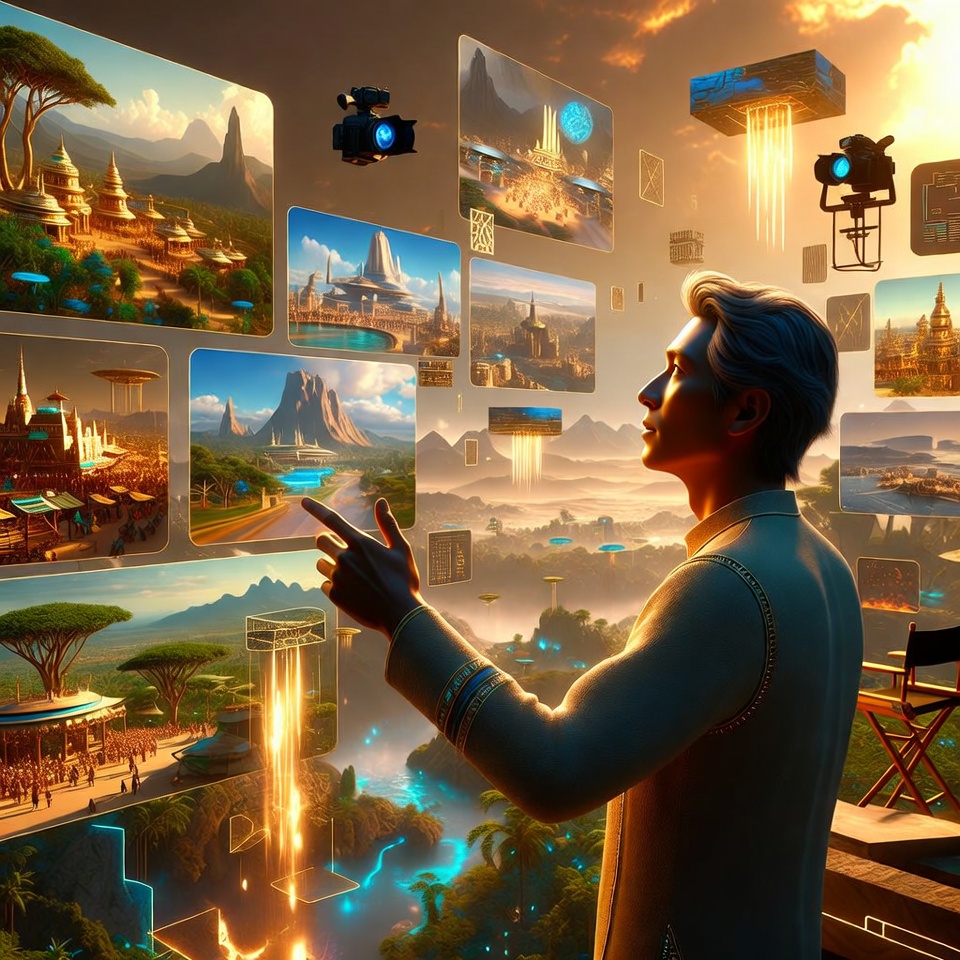
The Question That Has Haunted Filmmakers for Generations
Filmmakers across Africa and the global diaspora have carried a burning question for decades — one so big, so loaded with pain, pride, and possibility that mainstream cinema never dared to fully answer it.
What if Africa was never colonized?
What if the Malian Empire had continued its intellectual expansion outward across the globe?
What if the Kingdom of Kongo had developed its maritime trade routes into a global economic force that rivaled Europe?
What if Great Zimbabwe had grown into an architectural and cultural civilization that shaped modern urban design?
What if Timbuktu had remained the undisputed center of the world’s knowledge, scholarship, and scientific discovery?
For far too long, these questions lived only in the pages of academic texts, in whispered conversations at family tables, and in the imaginations of faceless video income content creators who dared to dream beyond the camera.
In 2026, something has changed — and the shift is seismic.
Artificial intelligence has handed filmmakers a tool so powerful and so democratizing that the alternate history of Africa is no longer hypothetical.
It is being visualized, scripted, animated, and released to global audiences at a pace that no Hollywood studio gatekeeper can slow down.
Table of Contents
Why AI Is the Most Important Storytelling Tool for African Filmmakers in History
Hollywood Never Told This Story — And Here Is Why That Matters
For over a century, the global film industry operated under a single, deeply biased creative monopoly.
Filmmakers who wanted to tell African stories on a cinematic scale needed budgets that reached into the tens of millions of dollars.
They needed studios that believed African narratives would sell tickets outside of Africa.
They needed access to production pipelines — post-production houses, visual effects studios, distribution networks — that were entirely concentrated in Los Angeles, London, and Paris.
The result was a story vacuum that stretched across generations.
Africa’s pre-colonial civilizations, rich with architectural marvels, military innovation, spiritual complexity, and economic sophistication, were either ignored completely or reduced to crude background settings in films where European characters played the heroes.
Director Damien Hauser, the Swiss-Kenyan filmmaker behind the critically acclaimed Memory of Princess Mumbi, put it plainly at the Venice Film Festival: “Till now, it was always Hollywood telling the stories of the whole world.”
He made that film, which imagines a retro-futuristic Africa, almost entirely with AI — and he admitted he could not have done it any other way.
That statement contains the full weight of what is happening to African cinema in 2026.
Filmmakers no longer need Hollywood’s permission, budget, or belief in the commercial viability of their vision.
They need AI — and a story worth telling.
The Rise of African AI Filmmaking in 2026 Is Not a Trend — It Is a Revolution
The African AI International Film Festival, which held its landmark 2026 edition in January of this year, was more than a celebration of short films and experimental work.
It was a declaration.
Filmmakers from Lagos to Dakar, from Nairobi to Kigali, gathered to demonstrate that AI is not just a Western technological luxury being exported into Africa.
It is a tool that African creators are using to reclaim their own narrative power.
The festival’s founder, Sandra Adeyeye Bello, described the event as a “celebration of our diversity, innovation, shared humanity, and the culture that binds us across oceans.”
That language is important because it signals something that goes far beyond technical filmmaking.
For the first time in history, filmmakers on the African continent can visualize a Kingdom of Benin that never fell to British cannons, a Songhai Empire that never collapsed under Moroccan invasion, and a Zulu nation that never bent to colonial redrawing of land borders — all without needing a single dime from a foreign studio.
This is the revolution that AI is enabling in 2026 — and it is only just beginning.
What “What If Africa Was Never Colonized?” Actually Looks Like on Screen
The Visual Language of an Uncolonized Continent
Imagine the screen fills slowly from the top down, like sunrise over the Sahel.
The first image you see is not a dusty village or a war-torn landscape, which is what decades of biased cinema have trained the Western eye to expect when Africa appears on screen.
Instead, you see a skyline of towering stone spires, smooth and pale in the early morning light, rising from the plains of what would have been called Zimbabwe — except in this world, no one called it Zimbabwe because there was no colonial renaming.
The city is called Madzimbabwe.
Its walls are built in dry-stone architecture so precise that not a single piece of mortar holds them together, yet they have stood for three centuries and show no sign of crumbling.
The streets below pulse with color — rich indigo textiles imported from the coast, brass ornaments caught in shafts of morning light, and the sound of a language spoken with the confidence of a people who have never been told that their tongue is inferior.
This is the visual language that AI is now allowing filmmakers to build frame by frame, scene by scene, without needing a $20 million visual effects budget.
Senegalese filmmaker Hussein Dembel Sow described creating over 7,000 AI-generated images as part of a single film project — essentially building a living storyboard that captured the visual identity of a world rooted in African mythology, spirituality, and pre-colonial historical reality.
That level of world-building, previously impossible for independent filmmakers without a major studio behind them, is now available to any creator with a vision, an AI tool subscription, and the creative ambition to use it.
The Civilizations That Alternate History Filmmakers Are Bringing Back to Life
The stories that are emerging from Africa’s new wave of AI-powered filmmakers are not random.
They are deeply researched, historically anchored, and built around civilizations that genuinely existed in their full sophistication before European colonial forces dismantled them.
Filmmakers are focusing on the Mali Empire, which at its peak in the 14th century was the wealthiest empire on earth, with Mansa Musa presiding over resources so vast that his pilgrimage to Mecca caused inflation across the entire Mediterranean economy.
They are exploring the Songhai Empire, which governed a vast stretch of West Africa with a sophisticated legal system, civil administration, and one of the earliest examples of a professional standing army in the world.
They are rebuilding the Kingdom of Aksum, the East African civilization that minted its own coins, built towering obelisks, and conducted international trade with the Roman Empire, Persia, and India as an equal, not a subordinate.
And they are imagining what would have happened had the transatlantic slave trade never occurred — how those civilizations might have developed their own industrial revolutions, their own technological breakthroughs, their own global cultural exports.
These are the stories that are now being turned into films, short series, and AI-generated cinematic content by filmmakers who use tools like Google’s Veo 2, Runway, ElevenLabs, CapCut, and Midjourney to build entire worlds from scratch.
How Ordinary Creators Are Joining the Movement — And Earning From It
You Do Not Have to Be a Filmmaker With a Festival Budget to Tell This Story
Here is where the conversation shifts from inspiration to opportunity.
The movement around African alternate history storytelling is not limited to festival directors and award-winning filmmakers with access to cutting-edge production pipelines.
It is wide open — and it is profitable.
In 2026, the creator economy is valued at over $127 billion globally, and faceless video creation is one of the fastest-growing segments within it.
Faceless channels now make up 38% of all new creator monetization ventures, with top performers earning $80,000 or more per month while never once showing their face on camera.
What that means for the alternate history storytelling niche is extraordinary.
A creator who builds a YouTube channel exploring what African civilizations would have looked like without colonization — using AI-generated visuals, voiceover narration, historically grounded scripts, and cinematic editing — is sitting inside one of the most emotionally resonant and algorithmically powerful content niches on the internet right now.
This is where a tool like faceless video income becomes genuinely relevant to the conversation.
The Faceless Video Income Formulator, created by Jim Daniels, is a web-based AI software system that takes any content idea — including a concept as rich and complex as African alternate history filmmaking — and generates the scripts, titles, video descriptions, thumbnail prompts, and SEO optimization you need to turn that idea into a published YouTube video that drives affiliate traffic and passive income.
You paste a concept or a URL, and the system builds the content structure for you from the ground up.
No on-camera presence required.
No Hollywood budget needed.
No prior video production experience necessary.
Just a story worth telling, and a system built to help you tell it profitably.
The Connection Between Alternate History Content and Affiliate Income in 2026
Filmmakers who approach this space with a monetization mindset — not just a creative one — are discovering that alternate history African content sits at the intersection of several high-engagement content signals simultaneously.
It is educational.
It is emotionally charged.
It is visually spectacular when produced with AI tools.
It is deeply shareable across communities that are actively hungry for this kind of representation.
And it connects naturally with affiliate products that serve content creators, AI tool users, and online income builders — the exact audience that faceless video income was designed for.
The data behind this opportunity is not speculative.
Long-form faceless channels in educational and historical niches consistently generate higher RPM rates than entertainment-only channels because their audiences skew toward adults with purchasing power and a genuine interest in the products and services that creators recommend.
When filmmakers build channels in this space and embed affiliate links for AI tools, video production software, or digital products like the faceless video income system, they are layering a monetization engine on top of content that already has organic emotional and cultural traction.
That combination — purpose-driven storytelling plus systematic affiliate monetization — is exactly what separates the creators who build sustainable income in this space from those who create great content but never turn it into a business.
The Tools African Filmmakers Are Using to Build This World in 2026
AI Has Eliminated the Budget Barrier That Silenced African Storytellers for 100 Years
Let us be specific about what the tools are and how filmmakers are using them, because the gap between knowing that AI exists and knowing how to deploy it for cinematic alternate history storytelling is still very real.
For image generation and visual world-building, filmmakers are using tools like Midjourney and Adobe Firefly to create historically detailed environments — palace interiors, market squares, warrior formations, and architectural skylines — that reflect authentic African design aesthetics rather than the generic fantasy settings that Western AI training data tends to produce by default.
This requires deliberate, culturally specific prompting — a skill that filmmakers in this space are rapidly developing as a core creative competency.
For video generation and scene animation, tools like Google’s Veo 2, Runway Gen-3, and Kling AI are allowing filmmakers to turn static images into moving scenes with cinematic camera work.
A still image of a Malian marketplace can become a five-second pan shot that feels like something out of a $10 million production — and filmmakers are stringing dozens of these clips together to create full short films.
For narration and voiceover, ElevenLabs remains the gold standard for AI voice generation, offering deep, authoritative voices that suit historical documentary-style content and cinematic narration with equally compelling results.
For scripting and content structuring, the faceless video income system provides exactly the kind of structured workflow that filmmakers transitioning from pure creative work to monetized content creation need.
It bridges the gap between having a powerful story concept and turning that concept into a publishable, SEO-optimized video that actually reaches the audience it deserves.
From Timbuktu to YouTube — How the Distribution Game Has Changed for Filmmakers
One of the most significant structural shifts in how filmmakers reach audiences in 2026 is the role that YouTube has taken on as a primary distribution platform for African cinema.
Industry analysis published at the start of 2026 confirmed that African filmmakers are increasingly embracing YouTube as a distribution channel for mid-level budget films, recognizing that streaming services have pulled back on local investments while YouTube continues to reward consistent, high-quality content regardless of where its creator is based.
This is a profound opportunity for filmmakers who are building alternate history content because YouTube’s algorithm actively rewards content that generates strong watch-time, emotional engagement, and community discussion — all of which African alternate history content produces in abundance.
A 20-minute video exploring what the Benin Kingdom’s diplomatic relationships with Europe might have looked like in an uncolonized world will hold a viewer’s attention far longer than the average YouTube video because it is simultaneously educational, visual, and emotionally resonant.
High watch-time translates directly into higher CPM rates, stronger algorithmic promotion, and faster channel growth.
When filmmakers build these channels systematically — using tools like faceless video income to maintain a consistent content production rhythm — the result is a channel that grows steadily, earns from multiple revenue streams, and builds a loyal audience that keeps coming back for more.
That is not just filmmaking.
That is a business.
The Cultural Weight of This Moment — Why 2026 Is the Year This Story Gets Told
What Happens When Filmmakers Reclaim Their Own Narrative
There is something that happens to a culture when it sees itself accurately represented on screen for the first time.
It is not simply entertainment.
It is a recalibration of how a people understand their own worth, their own history, and their own potential future.
For African audiences globally — in Lagos and London, in Accra and Atlanta, in Johannesburg and Jacksonville — seeing an alternate history Africa depicted with the visual grandeur it deserves on screen in 2026 carries a weight that no historical drama about European courts or American struggles can replicate.
It says: your ancestors built empires.
Your ancestors mastered astronomy, metallurgy, architecture, governance, and trade on a continental scale.
Your history did not begin with colonization and it does not end with its aftermath.
Filmmakers who tell these stories are not just making content.
They are performing an act of cultural restoration that has been delayed for five centuries.
The AI tools available in 2026 mean that this restoration does not have to wait for a Netflix commissioning editor or a Sundance committee to greenlight it.
It can begin today, with a creator anywhere in the world, a well-crafted prompt, and the determination to see it through.
The Creator Who Tells This Story First Builds the Largest Audience
There is also a first-mover advantage in this space that is still wide open in 2026, and filmmakers with the vision to recognize it are the ones who will build the largest, most loyal audiences over the next three to five years.
The alternate history African storytelling niche on YouTube remains dramatically underserved relative to the size of its potential global audience.
Hundreds of millions of people across the African diaspora — in the Americas, Europe, the Caribbean, and across the continent itself — are actively searching for this content and finding very little of it that meets the cinematic and intellectual standards they are looking for.
The creator who steps into that gap consistently, with content that is visually stunning, historically grounded, and emotionally resonant, will build an audience loyalty that no algorithm change can easily erode.
And when that audience is built on content powered by the kind of systematic production workflow that faceless video income provides — with consistent video output, strong SEO structure, and affiliate monetization baked into every upload — the income potential scales in direct proportion to the audience growth.
Filmmakers in 2026 are sitting at a unique intersection of cultural urgency, technological democratization, and monetization opportunity that may not present itself at this scale again.
The question is simply whether they will recognize it and act.
Building Your Own AI-Powered Alternate History Film Channel — A Practical 2026 Framework
What the First 90 Days Look Like for a Filmmaker Starting This Journey
Start with the question — not the tools.
The most important thing any filmmaker entering this space can do in the first week is define the specific historical question they want to answer with their content.
“What if Africa was never colonized?” is a masterclass in a broad, emotionally powerful framing — but the content that performs best on YouTube narrows that question to a specific civilization, a specific historical moment, or a specific counterfactual scenario.
What if Mansa Musa had established permanent trade routes to the Americas before Columbus arrived?
What if the Zulu military technology had developed in parallel with European industrialization instead of being dismantled by it?
What if the Songhai Empire had survived the 1591 Moroccan invasion and gone on to establish a continental federation?
Each of these questions is a series waiting to be born.
Each one carries enough historical depth to sustain dozens of video episodes.
Each one speaks directly to an audience that is hungry, engaged, and growing.
The next step is building the production system.
This is where filmmakers who combine creative vision with the structured workflow provided by faceless video income gain a decisive advantage over creators who are working without a system.
The Faceless Video Income Formulator handles the script structure, the SEO optimization, the video title strategy, and the thumbnail prompting — freeing the filmmaker to focus their energy on the historical research, the AI visual world-building, and the narrative depth that makes the content genuinely compelling rather than generic.
In the first 30 days, a filmmaker using this workflow can realistically publish 8 to 12 well-structured videos.
In the first 90 days, with consistent posting and systematic keyword targeting, that channel can begin generating organic search traffic and building the subscriber base that unlocks YouTube monetization.
By the six-month mark, with affiliate links embedded across the video descriptions and community tab, the channel becomes a multi-stream income asset — earning from ad revenue, affiliate commissions, and potentially digital product sales, all built on content that carries genuine cultural weight and meaning.
The Bigger Picture — African Storytelling, AI, and the Future of Global Cinema
What the World Gains When African Filmmakers Tell African Stories
The impact of this movement extends far beyond the African diaspora.
When filmmakers with authentic cultural knowledge and personal connection to African history are empowered to tell these stories at a cinematic level, global cinema gains access to narratives, aesthetics, and emotional textures that it has never encountered before.
This is not just good for African audiences — it is good for storytelling itself.
The most commercially successful films of the past decade have succeeded precisely because they introduced global audiences to stories and worlds they had never seen before.
When African alternate history narratives, visualized with AI-powered cinematic quality by filmmakers who understand the history from the inside, begin reaching those same global audiences through YouTube, streaming, and festival distribution, the ripple effects on culture, commerce, and creative inspiration will be felt across the entire industry.
Damien Hauser said it plainly: “Once people are able to tell their own stories, there will be so many crazy stories, new stories, new perspectives.”
He was talking about African filmmakers.
He was talking about exactly this moment.
The tools are here.
The stories are real.
The audience is waiting.
This Is Your Moment — Whether You Are a Filmmaker, Creator, or Both
You do not need to choose between being an artist and building an income in 2026.
Filmmakers who are stepping into the African alternate history space with AI tools are discovering that the two can coexist and amplify each other in ways that were simply not possible before this technological moment arrived.
If you are a creator with a deep connection to African history and a desire to tell these stories in a way that reaches a global audience, the AI tools are ready for you.
If you are a digital entrepreneur who recognizes the extraordinary content opportunity that this niche represents, the monetization system is ready for you.
And if you are both — a filmmaker who wants to build something that is simultaneously meaningful and profitable — then the combination of AI creative tools and a structured system like faceless video income is the most powerful starting point available to you right now.
The world has been waiting five centuries for this story to be told properly.
In 2026, with AI in the hands of filmmakers who have lived this history, that wait is finally over.
The continent is ready to tell its own story.
The tools are ready to build its visual world.
And the audience — hundreds of millions strong, spread across every continent — is ready to watch.
We strongly recommend that you check out our guide on how to take advantage of AI in today’s passive income economy.