The Flipboard Content Strategy
Most people who try Flipboard for traffic give up within two weeks. Not because the platform does not work — it does, consistently, for accounts that understand how it operates — but because they use it the wrong way and never see the results that are sitting right there waiting for anyone who gets the approach correct.
This article covers the complete Flipboard content strategy — every element, in the exact order it needs to be implemented, with the real data behind it. If you have already read the Video 2 article covering what Flipboard is and why it works, this is where the practical execution begins.
👉Get Access to: The AI Blog Monetization Quickstart Guide to learn how to turn skills like this into a content business in 2026.
Table of Contents
The Magazine Structure That Makes Everything Else Work
The single most important structural decision on Flipboard is how you name and organize your magazines. Most beginners create one magazine, name it after their blog or personal brand, and post their own content into it. That approach fails for two reasons — a single magazine limits distribution to one topic feed, and a brand-named magazine is invisible to readers searching Flipboard by topic.
The structure that produces consistent traffic uses a minimum of five active magazines, each named after a specific searchable topic that the target audience is already looking for inside Flipboard. Not five variations of the same topic — five genuinely different angles that all map back to the same core audience.
For a channel in the AI tools and digital products space, the core magazine set looks something like this. AI Tools for Beginners. Make Money Online With AI. Free Traffic Without Paid Ads. Digital Products and Passive Income. Claude AI Tips and Tutorials. Every one of those names is a phrase a real reader would type into the Flipboard search bar. Every one maps to a different distribution feed within the platform.
Five magazines means five separate topic feeds available for content distribution simultaneously. A piece of content added to the AI Tools for Beginners magazine reaches everyone following the AI tools topic. The same or related content added to the Free Traffic Without Paid Ads magazine reaches a completely different segment of readers following that topic. The audience reach multiplies with every well-named magazine added to the structure.
The magazine description field is one of the most underused elements on the platform. Flipboard indexes these descriptions for internal search, which means a well-written keyword-rich description increases the discoverability of the magazine itself — not just the content inside it. Write a two-sentence description for each magazine that includes the exact keywords a target reader would use to find content on that topic.
The Posting Cadence That Builds Consistent Traffic
The daily posting target for this strategy is 20 to 30 total flips across all active magazines. At five to ten seconds per flip using the Flipboard browser extension, that is five to ten minutes of active work per day. Manageable even on the busiest days.
The content split across those 20 to 30 daily flips is 80 percent external curated content and 20 percent original content. That means for every 30 flips in a day, 24 of them are high-quality articles from other authoritative sources in the niche, and 6 of them are original blog posts, product pages, or videos.
The 80-20 split is what trains the Flipboard algorithm to treat the account as a quality content curator rather than a self-promotional spam feed. The platform actively rewards accounts that function as editorial destinations — places where readers come not just for one creator’s content but for the best of the web on a given topic. Original content placed within a high-quality curated magazine reaches far more readers than the same content posted in isolation.
The weekly rhythm that sustains this without burnout is consistent Monday through Friday activity at the full 20 to 30 flip volume, and reduced weekend activity of 10 to 15 flips — curated content only on weekends, no original posts unless something is time-sensitive. This keeps the account signaling activity to the algorithm every day of the week without requiring full production effort seven days a week.
👉 Get Access to: Start a 1-Person Business With Claude AI for a more detailed walkthrough of the full system.
The Two-Step Flip Method and US Timing Windows
The two-step flip method is the most underused tactic on Flipboard and the one that produces the clearest measurable traffic increase for accounts that implement it correctly.
Most people flip a piece of content once into one magazine and leave it there. The two-step approach flips the same content twice, into two different magazines, separated by a four to six hour gap.
Step one — flip the content into the broadest most active magazine in the account. For an AI and make-money-online account, this is the magazine with the highest follower count or the one mapped to the widest topic feed. This first flip gets the content into the broadest distribution window and in front of the existing audience.
Step two — four to six hours later, flip the same content again into the most niche-specific magazine relevant to that article’s topic. So a post that went into AI Tools for Beginners at 9am gets flipped into Claude AI Tips and Tutorials at 2pm. Two audiences, two topic feeds, two distribution windows, from one piece of content.
The four to six hour gap aligns with Flipboard’s internal content freshness cycle. The platform refreshes its topic feed recommendations approximately every four to six hours, meaning the second flip hits a fresh distribution window rather than competing with the first flip for the same reader attention slots.
The US audience timing windows matter even for accounts operating from outside the United States, because the majority of Flipboard’s active readership is US-based. The three highest engagement windows on Flipboard are 7am to 9am US Eastern — morning browsing before work — 12pm to 1pm US Eastern — lunchtime reading — and 8pm to 10pm US Eastern — evening wind-down. Original content flips should land inside one of these three windows every time. Curated content can go out at any hour, but original posts hitting outside these windows consistently underperform the same content posted during them.
👉Get Access to: The AI Blog Monetization Quickstart Guide to learn how to turn skills like this into a content business in 2026.
What the Before and After Data Actually Shows
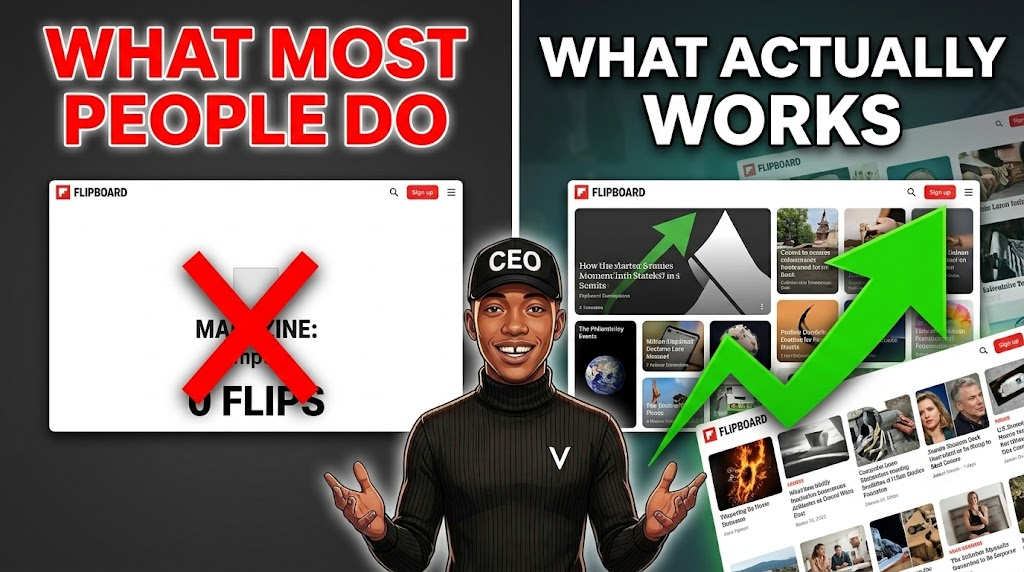
The traffic difference between using Flipboard as a self-promotion feed versus using the full strategy described in this article is not subtle. It is visible within the first 30 days and significant within 60.
Before implementing the five-magazine structure, the 80-20 curation ratio, and the two-step timing method — referral traffic from Flipboard for a real account in this niche was effectively zero. A handful of clicks per week at best, with no consistency and no growth trend.
After 60 days of consistent implementation — a rising and holding base traffic floor from Flipboard referrals, magazine follower counts growing weekly without additional promotional effort, and original content reaching new audiences every week through the compounding effect of an established curator account.
The compounding dynamic is the most important long-term outcome. Every new original article added to a magazine that already has followers gets distributed to those followers immediately on publication. The audience built in month one works for the content published in month three. This is fundamentally different from a social media platform where yesterday’s post is effectively dead by tomorrow.
The realistic timeline from a brand new Flipboard account to a consistent daily referral traffic floor using this strategy is 30 to 60 days. Not viral. Not passive from day one. But consistent, compound, and fully within reach for anyone who implements it correctly and shows up every day.
👉 Get Access to: Start a 1-Person Business With Claude AI for a more detailed walkthrough of the full system.
The Content Type That Gets the Most Clicks
Appearing in a Flipboard topic feed and getting clicked are two separate challenges. The magazine structure and posting strategy solve the first one. The content format solves the second.
On Flipboard, the clickable surface area of any piece of content is three elements — the thumbnail image, the headline, and the first line of the article description. Everything else happens after the click. These three elements need to work together to create an immediate, specific reason to stop scrolling and read.
The highest-performing headline formulas in the AI and make-money-online niche on Flipboard follow three patterns. A specific outcome with a timeframe — How to Build a Digital Product That Sells in Under 24 Hours Using Claude AI. A contrast or contradiction — Why Google Traffic Gets Harder Every Year While This Platform Gets Easier. A direct insider claim with a real number — The Flipboard Strategy That Sent 3,000 Visitors to My Blog Last Month.
Specific numbers outperform vague language consistently. “3,000 visitors” beats “thousands of visitors” every time. “24 hours” beats “quickly” every time. Specificity signals that the content comes from real experience rather than general advice, which is exactly what a Flipboard reader in the make-money-online space is looking for.
The first line of the article description should directly answer the implicit question that the headline raised. If the headline promises a 24-hour digital product build, the first line should confirm that promise with a specific detail — what was built, what tool was used, what the result was. That confirmation is what converts a curious headline scan into a click.
👉 You can also watch the video here
What Comes Next
Traffic from Flipboard is powerful and compound. But Flipboard is not the only place where content discovery is being fundamentally rewritten right now. Microsoft Bing AI is changing where people find content across the entire web — and almost nobody in the make-money-online space has positioned themselves for what that shift means for free traffic.
That is exactly what the next video in this series covers. And if the Flipboard strategy in this video made sense, the Bing AI opportunity is going to make the same kind of sense — with a different platform, a different mechanism, and an even earlier competitive window.
Visit wealthytent.com for the full written guides that accompany every video in this series. And grab the Free AI Business Monetization Roadmap for Beginners from the description link — it documents the complete system in one starting document.
👉Get Access to: The AI Blog Monetization Quickstart Guide to learn how to turn skills like this into a content business in 2026.
We strongly recommend that you check out our guide on how to take advantage of AI in today’s passive income economy.