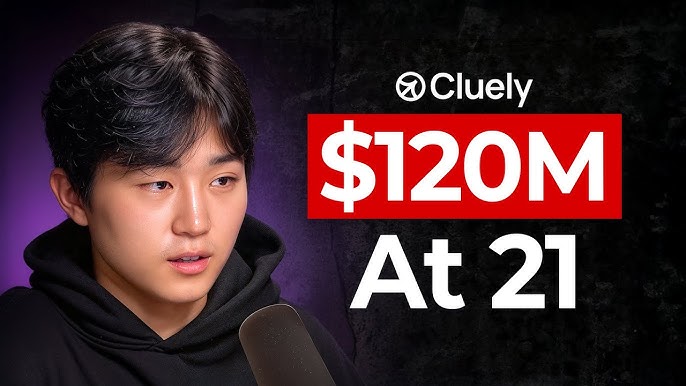
How Getting Kicked Out of Harvard and Columbia Helped This 21-Year-Old Build a $120 Million AI Startup
The Harvard dropout who builds a $120 million company before turning 22 is not supposed to exist, yet that is exactly what Roy Lee did, and the way he did it rewrites everything most people think they know about building a successful business in 2026.
Roy Lee did not graduate from a top university.
He did not follow a conventional path into tech.
He did not wait until the idea was perfect, the product was polished, or the timing felt safe.
He got kicked out of Harvard before he ever attended a single class, then enrolled at Columbia and got kicked out again after publicly recording himself using his own AI software to cheat on an Amazon job interview, and then posting the video online for the world to see.
What followed was $5 million raised in 24 hours, a company valuation of $120 million, and a product called Cluey that is now reshaping how people think about real-time artificial intelligence assistance in every area of life.
If you are building something with AI tools right now, or if you are looking for ways to generate serious online income in 2026, then what Roy Lee figured out is worth studying very carefully because the principles are transferable, repeatable, and grounded in something much more practical than luck.
Tools like ClawCastle are already helping builders and marketers step into this kind of AI-powered opportunity without needing a computer science degree or an Ivy League network.
We strongly recommend that you check out our guide on how to take advantage of AI in today’s passive income economy.
Table of Contents
The Harvard Dropout Story That Actually Begins Before Harvard
Roy Lee’s story did not start with the expelled-from-Columbia headline, even though that is the moment most people know him for.
It started much earlier, when he was flipping sneakers in middle school, running Amazon FBA stores, and later managing a six-figure tutoring business in high school, all before most of his peers had their first part-time job.
What makes this even more remarkable is that for a full year during high school, while his mother was severely ill and unable to run the family’s tutoring academy, Roy stepped in and quietly managed the entire operation himself at around 15 years old.
He took her calls, responded to clients through her phone, coordinated tutors, and kept the revenue flowing for a business bringing in somewhere between $100,000 and $200,000 per year, without a single client knowing that the person managing everything was a teenager.
This is not a story about genius or luck.
It is a story about someone who learned very early that the gap between what people think they can do and what they actually can do is almost entirely invented.
When Harvard rescinded his admission over an unreported school suspension, rather than treating it as a catastrophic failure, Roy treated it as a signal from the universe to go build something.
He spent the next year locked in his room learning to code, experimenting with business ideas, and searching for the one product that would actually work.
For anyone going through that same early grind right now, HandyClaw gives builders a practical entry point into the AI tools market without needing to already be a developer or a founder with a track record.
What Cluey Actually Does and Why It Changes Everything
Cluey is best described as a transparent pane of glass that sits over everything else on your computer screen.
It watches what you are doing, listens to your conversations, and rather than waiting for you to ask it a question the way you would with a regular chatbot, it predicts what information you are going to need and surfaces it in real time before you even have to ask.
If you are on a Zoom call with someone you have never met, Cluey immediately pulls up a full profile of everything that person has ever done online, their career history, their content, their professional background, and presents it to you as if you had spent hours researching them beforehand.
If someone in that meeting mentions a company name or a technical term you have never heard of, Cluey silently pulls the definition and relevant context and places it in front of you so that your end of the conversation never breaks stride.
For sales teams, call center workers, consultants, and business professionals, this is not a minor convenience.
It is a fundamental shift in how much a single person can know and communicate in a high-stakes conversation without any preparation time.
The engineering challenge Roy and his team solved was not finding a smarter AI model, it was figuring out how to stitch together audio, screen data, and contextual information into a format that the model could actually reason over intelligently, a process called context stitching that turns images and audio into optimized text tokens the model can act on instantly.
AmpereAI is building in a similar direction for founders and developers who want to deploy AI systems that go beyond simple chatbot interfaces and actually integrate with real workflows in meaningful ways.
The Columbia Expulsion That Launched a $120 Million Company
When Roy arrived at Columbia, he had one goal: find a co-founder and get out as fast as possible.
He approached roughly 50 students before one of them, a computer science major named Neil, agreed to team up with him.
Together they built several projects that went nowhere, including an AI date matcher, an AI note-taker, and various other small experiments, before landing on something called Interview Coder.
Interview Coder was a translucent overlay that could read what was on your screen and give you real-time solutions to coding problems while you were sitting inside a technical job interview.
The second it gained a small amount of traction, Roy did the thing that most people would never dare to do.
He used it live during an actual Amazon internship interview, recorded the entire process, successfully passed through every stage of the interview using the tool, and then posted the video publicly on the internet.
An Amazon executive saw the video, contacted Columbia, and threatened to stop recruiting from the university unless Roy was expelled.
Columbia complied.
Roy had already anticipated this outcome.
He kept posting every development on Twitter as the disciplinary hearings unfolded, and by the time the expulsion was finalized, venture capitalists across Silicon Valley had already seen enough to act.
He raised $5 million in 24 hours.
For anyone who wants to understand how this kind of attention-to-income pipeline works and how to build one of their own, ReplitIncome offers a practical system for generating income through AI-driven platforms and no-code tools that make it possible to go from idea to product without a technical background.
Why Short Form Content Is the Biggest Business Opportunity of 2026
One of the most counterintuitive things Roy Lee teaches through his example is the claim that artificial intelligence is not actually the biggest business opportunity of this generation.
He believes it is short form content.
His argument is that the ability to pick up a phone, speak for ten seconds, and reach 100 million people is a distribution shift so profound that most businesses have not even begun to adapt to it.
The companies that are growing the fastest right now, including Cluey itself, are not growing because their underlying technology is dramatically superior to everything else on the market.
They are growing because they have figured out how to command attention quickly, turn that attention into a cultural moment, and funnel it toward a product that already has value.
This is why Roy insists that the head of marketing at any serious company should have at least 100,000 followers before they are even considered for the role, not because follower count is a vanity metric, but because reaching that number means you have personally cracked some version of the algorithm and understand how virality actually works from the inside.
ClawCastle is a resource that connects this kind of growth thinking to AI tools that can be built, deployed, and marketed by people who understand short form distribution but want to add real software products to their income model.
The Viral Strategy Behind a $2 Million Party and a Full Anime Series
Most companies spend their marketing budgets on ads, sponsored content, and influencer deals.
Roy Lee is planning to spend $2 million on a single rave for every software engineer in the Bay Area.
The logic is not irrational when you understand the framework underneath it.
Roy believes the strongest marketing move a company can make is to engineer a cultural moment so memorable that everyone who experiences it associates the brand with something they genuinely loved.
A tech company throwing the first major rave for engineers creates exactly that kind of lasting impression, and the documentation of the event, shared across social platforms by every attendee and creator in the room, becomes its own self-sustaining distribution channel.
Beyond that, Cluey is also funding a full 12-episode anime series, estimated at $3 to $5 million, in which the main character uses Cluey to navigate school, work, and life after being transported into a new world.
This is not gimmickry.
This is brand storytelling at a scale and cultural depth that most venture-backed startups have never attempted, and it speaks directly to the Gen Z and anime-native audiences who will make up the next wave of serious software users.
HandyClaw offers a more accessible entry point for founders and content creators who want to build income around AI tools without needing to spend millions on brand awareness campaigns first.
The Winner’s Effect and Why Your First Win Matters More Than Anything
Roy Lee has a framework he calls the winner’s effect, and it is one of the most practically useful ideas in the entire conversation he has had publicly about building companies and building a life.
The winner’s effect is simple: when you win at one thing, it gives you the confidence, the momentum, and the identity shift needed to win at the next thing.
It is not about talent.
It is not about intelligence.
It is about finding the first win, no matter how small it seems, and letting it compound.
Roy traces his entire business trajectory back to the moment Interview Coder got its first thousand likes on a post.
That single data point told him the idea had viral potential, which changed how he approached every decision that followed.
He did not need a mentor to tell him what to do next.
He did not need a business school education or a roadmap.
He needed confirmation that something he built could actually connect with people, and once he had it, he went all in.
AmpereAI is built for the kind of person who is still searching for that first win in the AI space, offering tools and infrastructure to help builders ship real products faster so the feedback loop can begin.
How to Make $10,000 a Month in 2026 Using AI and Short Form
The advice Roy Lee gives for someone who wants to reach $10,000 a month online in 2026 is refreshingly specific and low on gatekeeping.
He says to go to a no-code builder like Lovable, type in an idea for a simple AI-powered app, and build a working prototype in under 20 minutes.
The idea does not need to be revolutionary.
It just needs to be inherently interesting or shareable enough that someone who sees it would instinctively want to pass it along.
From there, you make a TikTok account, you make an Instagram account, and you start posting about it.
If it does not take off immediately, you spend a few hundred dollars reaching out to a micro-influencer to create a single video about the product.
You repeat this process until something lands, and according to Roy, if the core concept is genuinely viral, this rarely takes more than two weeks.
The second major opportunity he identifies is in AI automation services for small and medium businesses, particularly business owners who have never once used a tool like ChatGPT and have no idea that their customer outreach, email follow-ups, or appointment scheduling could be handled automatically for almost nothing.
ReplitIncome gives people the system to start delivering exactly this kind of value to local and online businesses, using AI platforms like Replit to build and deploy simple automations that business owners will pay real money for every single month.
The Brain Chip, Artificial Super Intelligence, and Where Everything Is Heading
Roy Lee believes that the final form factor of artificial intelligence is a brain chip, and he believes this not as a distant science fiction concept but as an inevitable destination that everything he is building right now is pointing toward.
The argument is sequential: the company that becomes the default way people interact with AI on their computers will be best positioned to build the hardware that becomes the default way people interact with AI in the physical world.
Cluey, in his view, is the software layer that earns the right to become that hardware layer.
He expects artificial super intelligence, defined as an AI capable of improving itself faster and better than humans can, to arrive before 2030.
When that happens, the companies that will matter are the ones that already own the relationship between the user and the AI interface, not the ones that built the underlying model.
This is why he would turn down a $1 billion acquisition offer from Mark Zuckerberg without hesitation.
The vision is larger than any exit, and the moment you take the money and hand over the mission, you become a supporting character in someone else’s story.
ClawCastle continues to be one of the most useful starting points for anyone who wants to position themselves on the right side of this AI transition before the window closes.
Conclusion
What Roy Lee’s story teaches is not that you need to get expelled from two Ivy League universities to build something worth $120 million, even though that is a memorable way to start.
It teaches that the rules most people follow are not laws of nature.
They are social agreements that the majority has never thought to question.
The Harvard dropout who records himself cheating on an Amazon interview and posts it publicly is not being reckless.
He is being strategic in a language that most people around him do not yet speak.
If you are building in the AI space right now, the combination of real software value and short form distribution is the most powerful pairing available to anyone at any budget level.
You do not need millions to begin.
You need an idea that is honest, a product that is useful, and the willingness to put it in front of people before it feels completely ready.
HandyClaw, AmpereAI, ReplitIncome, and ClawCastle each represent a different entry point into the kind of AI-powered income stack that is working right now in 2026, and none of them require you to blow up your academic career to get started.
We strongly recommend that you check out our guide on how to take advantage of AI in today’s passive income economy.