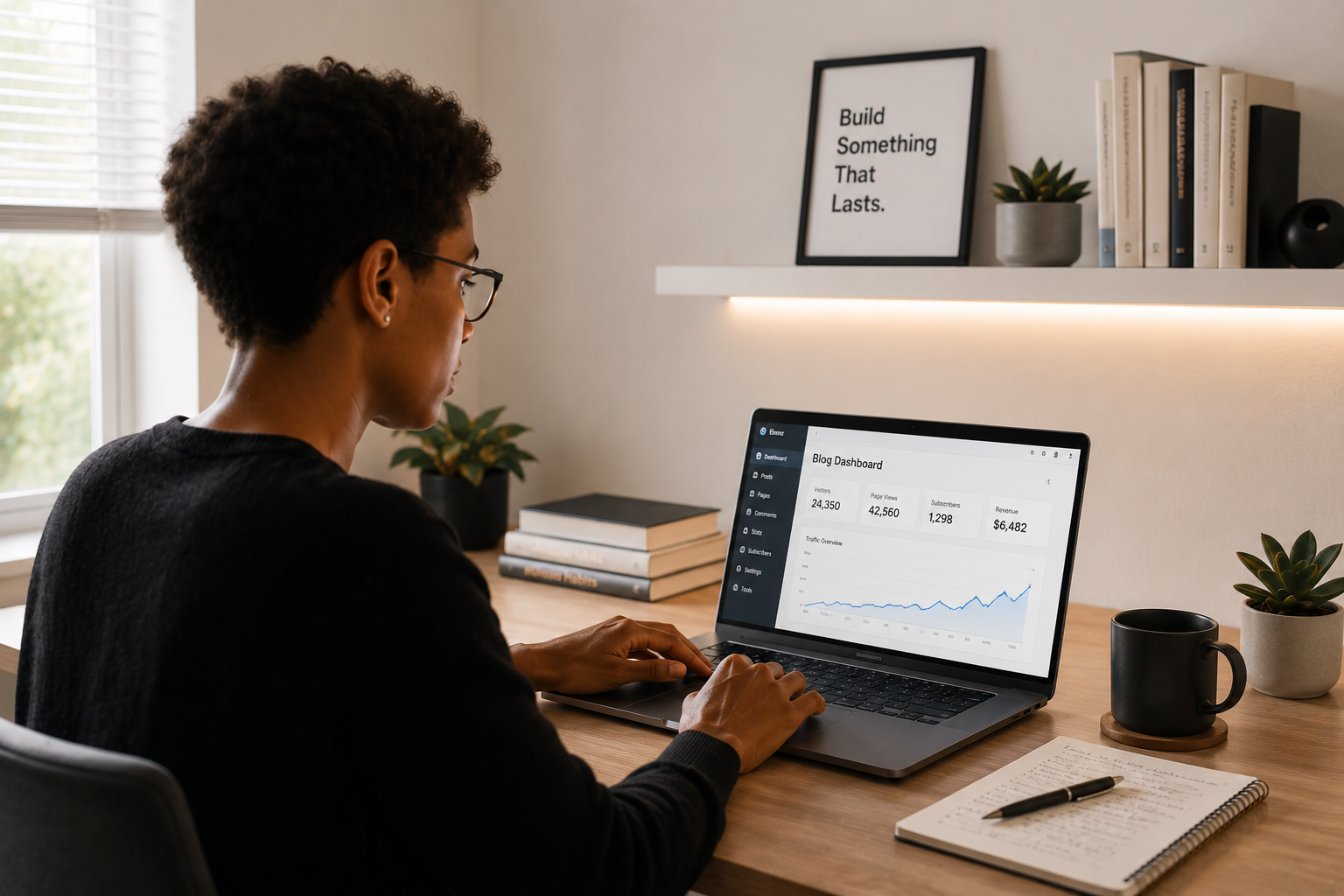
I Tested 5 Blog Traffic Methods in 2026 — Here’s the One That Made Me $10K/Month
Starting a money-making blog in 2026 is one of the most realistic paths to building a $10,000-per-month online business, and the strategy is more straightforward than most people think.
You pick a profitable niche, build a self-hosted blog, drive traffic from the right platforms, and layer in multiple income streams that compound over time.
This is not a fantasy.
It is a real, working system that thousands of solo content creators are using right now.
And in this article, you will see exactly how I would do it — step by step — if I were starting from zero today.
👉 Get Access to: The AI Blog Monetization Quickstart Guide — the fast-track guide that maps out exactly how to monetize a blog with AI tools and smart traffic systems.
The honest truth is that most people who start a blog in 2026 will quit before they ever see results.
Not because blogging does not work.
But because they start with the wrong foundation, target the wrong traffic source, and have no clear monetization plan tied to real numbers.
That is the gap this article fills.
Whether you are starting completely from scratch or restarting a blog that never gained traction, this plan is designed to walk you from setup to $10K/month in a structured, phase-by-phase approach that actually makes sense for 2026.
👉 Get Access to: The Flipboard Traffic Workflow Kit — the exact Flipboard traffic workflow that drives consistent daily readers to your blog without relying on Google.
The Foundation You Must Build Before Anything Else
Before you write a single blog post, you need to set up the right foundation.
This is where most new bloggers waste months of their lives — obsessing over logos, color palettes, and font choices instead of building something that actually earns money.
Here is what the foundation of a money-making blog actually looks like.
First, you need a self-hosted website.
This means you own your blog outright — not a free Blogger account, not a Medium account, not a Substack newsletter.
Your own domain, your own hosting, your own platform.
WordPress.org is the most widely used self-hosted blogging platform in the world, and it remains the gold standard for bloggers who want full control over their SEO, their design, and their monetization.
Hosting providers like Bluehost, Siteground, and Cloudways offer reliable, affordable options that get you live in under an hour.
Second, you need a clean, simple design.
A blog that looks professional does not have to look complicated.
Think of a minimal white background, one or two accent colors, readable fonts like Inter or Lora, and a layout that puts your content front and center.
Third, you need a clear niche.
A niche is not just a topic.
It is the intersection of what your audience searches for, what brands want to advertise in, and what digital products you can eventually sell.
High-earning blog niches in 2026 include personal finance, AI tools and income strategies, remote work and online jobs, home decor and interior design, food and recipes, parenting, and travel.
Fourth, you need an email list set up from day one.
Most new bloggers skip this step and regret it deeply.
Your email list is the only audience you truly own — it is not subject to algorithm changes, platform shutdowns, or social media trends.
ConvertKit (now rebranded as Kit) and MailerLite are both beginner-friendly email platforms that offer free plans with solid automation features.
Set up a simple lead magnet — a free checklist, PDF, or mini guide — and embed it on your blog from the very first week.
Choosing the Right Niche for Maximum Earning Potential
The niche you choose will either accelerate or slow down your path to $10K/month, and this decision matters more in 2026 than it ever did before.
Google has become increasingly difficult to rank on as a new blog, especially in competitive niches.
But the right niche on the right traffic platform can still get you to $10K/month without a single first-page Google ranking.
The niches that perform best for visual traffic platforms like Pinterest and Flipboard in 2026 are home decor, food and recipes, seasonal lifestyle content, wellness and beauty, AI tools and income strategies, and personal finance.
These are topics that people search for emotionally.
They want inspiration, solutions, and ideas — and they click on content that looks visually compelling and promises a clear result.
If you are drawn to the AI and online income space, that is an incredibly strong niche in 2026.
The audience is hungry, the affiliate commissions are high, and there are multiple digital products you can create and sell from day one.
👉 Get Access to: The AI Traffic Vault — the complete 90-page system covering Medium, Flipboard, Bing/Copilot AI search, Claude AI content workflows, and monetization strategies for content creators building in the AI niche.
If you are unsure which niche to pick, ask yourself these three questions.
What topic could I write about every single week for the next two years?
What does my audience search for online before they go to bed at night?
Is there a product — affiliate, display ad, or digital — that this audience will pay for?
When all three answers point in the same direction, you have found your niche.
Content Strategy: What to Write and How to Write It
Once your blog is set up and your niche is locked in, the next step is building a content library that attracts readers and earns money on repeat.
Here is where most new bloggers make a critical mistake.
They write content for Google.
They chase high-volume keywords with the hope of ranking on page one and getting a flood of organic search traffic.
But for a brand new blog in 2026, that strategy almost never works.
Google’s ranking algorithm heavily favors established domains with strong backlink profiles, years of content history, and high domain authority.
A brand new blog going up against Forbes, NerdWallet, or Business Insider for a competitive keyword is like entering a marathon without ever having run a mile.
Instead, the smart content strategy for a new blog in 2026 is to focus on Pinterest and Flipboard traffic first, build domain authority in the background, and gradually introduce SEO-optimized content as your blog grows.
Every single blog post you publish should be built around one core question that your audience is already asking.
Make the title of each post a direct promise — a clear answer, a list of steps, or a specific number.
Titles like “7 AI Side Hustles That Made Me $500 This Month” or “The 5-Step Pinterest Strategy That Brought 15,000 Visitors to My New Blog” outperform vague titles every single time.
Aim for posts that are 1,500 to 2,500 words long, broken up into scannable H2 and H3 sections, written at a Grade 5 reading level, and packed with actionable steps rather than fluffy advice.
👉 Free download: Start a 1-Person Business With Claude AI — Free Quick-Start Guide — grab this free guide to learn how to use Claude AI to write better blog content, faster, without sounding like a robot.
Write three to five posts per week for the first three months.
This is the content volume that builds momentum and gives Pinterest and Flipboard enough material to distribute.
The Traffic Strategy That Actually Works in 2026
Traffic is the lifeblood of a money-making blog, and choosing the right traffic platform is one of the most important decisions a new blogger will make.
Here is the strategy that makes the most sense for a blog starting from scratch in 2026.
Pinterest First
Pinterest is a visual search engine with over 500 million monthly active users, and unlike Google, it does not care how old your domain is or how many backlinks you have.
What determines success on Pinterest is purely visual — how your pin looks, whether your title creates curiosity, and whether the content on the other end of the link delivers on the promise.
For every blog post you publish, create three to five Pinterest pins using Canva.
Canva offers a free plan with hundreds of pin templates that are already sized at the correct 1000 x 1500 pixel ratio.
Create one base design, duplicate it four times, and make small visual variations — different background colors, different fonts, slightly different headline wording.
Upload each pin to Pinterest with a keyword-rich title and a natural, engaging description that sounds like a curious reader recommending the article rather than the author self-promoting.
Schedule your pins at least five days apart using Pinterest’s built-in scheduler or a tool like Tailwind.
Check your Pinterest analytics after 30 days to see which pins are getting the most clicks and impressions.
Double down on those designs and topics by creating more pins around them.
Flipboard as a Secondary Traffic Engine
Flipboard is a content curation platform that is massively underused by bloggers in 2026, and that underuse is exactly what makes it powerful.
When you flip your blog posts into relevant Flipboard magazines, your content gets surfaced to readers who are already browsing topics in your niche.
The key rule with Flipboard is balance.
Flip your own articles no more than two times per post.
Spend the majority of your Flipboard time — roughly 30 to 50 flips per day — curating excellent content from other creators in your niche.
This positions you as a trusted curator, which increases your Flipboard follower count and expands the reach of your own content over time.
👉 Get Access to: The Flipboard Traffic Workflow Kit — the complete Flipboard strategy that walks you through exactly how to set up your magazines, balance your flips, and drive consistent daily traffic to your blog.
Medium as a Long-Term Traffic Amplifier
Medium is a third platform worth adding to your traffic strategy, particularly if your niche overlaps with AI, business, personal development, or remote work.
Publishing condensed versions of your blog posts on Medium — with a canonical link back to your original post — gives your content a second life on a platform with millions of built-in readers.
One blogger using a focused Medium strategy saw their traffic grow from 300 to 15,000 daily views in just three months.
That kind of growth is possible when you publish consistently, write for Medium’s most active publications, and optimize your headlines for emotional engagement.
👉 Get Access to: The Medium Mastery — the deep-dive guide to turning Medium into a reliable traffic source for your blog, even if you are starting with zero followers.
The 4 Income Streams That Build a $10K/Month Blog Business
Traffic alone does not pay the bills.
The way a blog earns money is by converting that traffic into income through multiple layered streams that grow as your audience grows.
Here are the four income streams I would build from day one if I were starting a new blog in 2026.
Display Advertising
Display ads are one of the most passive income streams available to bloggers.
Once you have ads running on your blog, every single page view generates a small amount of revenue — whether the reader buys anything or not.
The two most respected ad networks for bloggers in 2026 are Mediavine and Raptive (formerly AdThrive).
Mediavine requires a minimum of 50,000 sessions per month to apply for their full program, but they also offer Journey by Mediavine, which accepts blogs with as few as 10,000 monthly sessions.
This is a realistic milestone to target by month nine or ten of consistent content creation and traffic building.
Affiliate Marketing
Affiliate marketing is the practice of recommending products and services inside your blog posts and earning a commission when a reader makes a purchase through your link.
In 2026, the most accessible affiliate program for new bloggers is the Amazon Associates Program, which allows you to earn commissions on virtually any product sold on Amazon.
Beyond Amazon, niche-specific affiliate programs often pay significantly higher commissions.
In the AI and online income niche, programs from tools like ConvertKit, Jasper, Tailwind, Canva, and various SaaS platforms pay recurring monthly commissions that can compound quickly.
Add affiliate links naturally inside your blog posts — not as a separate “resources” section at the bottom, but woven into the content itself at the exact moment the reader needs that tool or recommendation.
Digital Products
Selling your own digital products is the fastest path to $10K/month because you keep 100% of the revenue and the product costs nothing to reproduce.
Digital products for bloggers can include ebooks, PDF guides, templates, printables, prompt packs, courses, and workshops.
The key is to create a product that solves a specific, urgent problem for your audience — and price it at a point that matches the value delivered.
👉 Get Access to: The AI Traffic Vault — a 90-page digital product covering the complete traffic and monetization system for AI-era bloggers who want to grow fast without relying on Google.
👉 Get Access to: The AI Blog Monetization Quickstart Guide — a focused guide for bloggers who want to launch their first monetization system quickly using AI-powered content and smart product placement.
Sponsored Content
Sponsored blog posts are a fourth income stream that becomes available once your blog has an established audience and a consistent traffic base.
Brands in your niche will pay anywhere from $150 to $2,000 per sponsored post depending on your traffic volume, niche relevance, and domain authority.
Start pitching brands directly through their website contact pages or affiliate program managers once your blog reaches 10,000 monthly sessions.
The 12-Month Roadmap to $10K/Month
Here is how the year breaks down in realistic, manageable phases.
Months 1 Through 3 — Setup and Foundation
Register your domain, set up your WordPress.org blog, choose a clean theme, and install essential plugins like Rank Math for SEO, WP Rocket for speed, and Akismet for spam protection.
Set up your email marketing account on Kit or MailerLite and create one simple lead magnet to start building your list.
Publish three to five blog posts per week.
Set up your Pinterest business account and create three to five pins per post.
Set up your Flipboard account and start curating content in your niche immediately.
Months 4 Through 6 — Content and Traffic Growth
Continue publishing at your established pace and expand your Pinterest strategy.
Analyze your Pinterest analytics at the end of each month — look for which pins and topics drive the most clicks and double down on those.
Launch your first digital product — even a small $27 PDF guide on your area of expertise gets your monetization system activated.
Begin adding affiliate links to every relevant post.
Months 7 Through 9 — Monetization Acceleration
By now, you should be seeing consistent daily traffic from Pinterest and Flipboard.
Apply for Journey by Mediavine if you have hit 10,000 monthly sessions.
Increase your digital product offerings and begin promoting them through your email list.
Start cross-publishing your best content to Medium to amplify reach.
👉 Get Access to: The Medium Mastery — everything you need to use Medium as a consistent secondary traffic source that feeds readers directly back to your blog.
Months 10 Through 12 — Scaling to $10K/Month
By the end of month twelve, your goal is to have all four income streams producing revenue simultaneously — display ads running, affiliate commissions coming in monthly, digital product sales from your email list and blog traffic, and your first sponsored post deals closing.
A blog earning $3,000 per month from display ads, $2,000 from affiliates, $4,000 from digital product sales, and $1,000 from a single sponsored post hits exactly $10,000 per month.
That is not a fantasy.
It is a math equation — and the variable you control is how consistently and strategically you execute the plan.
The AI Advantage: How to Use Claude AI to Blog Faster in 2026
One of the biggest differences between bloggers who hit $10K/month and those who plateau at $500 is content output speed.
In 2026, the bloggers winning are the ones using AI tools strategically to research, outline, draft, and repurpose content without sacrificing quality or their personal voice.
Claude AI is one of the most powerful writing tools available for bloggers right now.
Unlike ChatGPT-generated content that often reads as flat, generic, and obviously machine-written, Claude produces output that sounds more human, more nuanced, and more aligned with your natural voice when prompted correctly.
The right workflow is to use Claude AI to generate outlines, expand bullet points, suggest headline variations, and repurpose long-form posts into email newsletters and social captions.
You still bring your personal experience, your real examples, and your editorial judgment — Claude just handles the heavy lifting that used to take hours.
👉 Free download: The Claude AI Digital Product Starter Pack — 10 Done-For-You Prompts for Beginners — grab ten ready-to-use Claude AI prompts that help you write better blog posts, create digital products, and build your content system faster.
👉 Get Access to: Start a 1-Person Business With Claude AI — the complete guide to building a one-person online business using Claude AI as your content engine, strategist, and product creation partner.
What Most Bloggers Get Wrong (And How to Avoid the Same Mistakes)
Before wrapping up, there are three critical mistakes worth naming because they are the ones that derail the most promising blogs before they ever reach their potential.
Mistake one is spending too long in the setup phase.
Your blog does not need to be perfect before you publish.
A simple, clean WordPress site with a free theme like Kadence or Astra is more than enough to start.
Get it live, get content up, and refine the design as you go.
Mistake two is trying to rank on Google too soon.
As a new blog in 2026, your domain authority is essentially zero.
Spending your first six months writing content optimized for competitive Google keywords is like trying to win a Formula 1 race on a bicycle.
Focus on Pinterest and Flipboard first, build your audience and domain authority, and then layer in SEO-targeted content after month six.
Mistake three is building traffic without building an email list.
Traffic is rented.
Algorithms change, platforms disappear, and social media reach gets throttled.
Your email list is the only audience that is truly yours — and every blogger who has hit $10K/month consistently will tell you that their email list was the single most important asset they ever built.
👉 Get Access to: The AI Blog Monetization Quickstart Guide — your shortcut to building a monetized blog system using AI tools and traffic strategies that work in 2026.
Your First Steps Start Today
A $10K/month blog is not built in a single weekend.
But it is built — reliably, repeatedly — by people who start with a solid foundation, commit to a consistent content schedule, drive traffic from the right platforms, and layer in income streams that grow with their audience.
The plan in this article is the exact system I would follow if I were starting a brand new blog from zero in 2026.
Every element of it is real, tested, and built around how content and traffic actually work on the internet right now.
Your job is to pick a niche, set up your blog this week, and commit to the next twelve months with the same energy you would give any serious business.
Because that is exactly what this is — a business.
And like any business, the ones that win are the ones that start.
👉 Get Access to: The Flipboard Traffic Workflow Kit — the proven Flipboard system for driving daily readers to your blog without paying for ads or chasing Google rankings.
We strongly recommend that you check out our guide on how to take advantage of AI in today’s passive income economy.