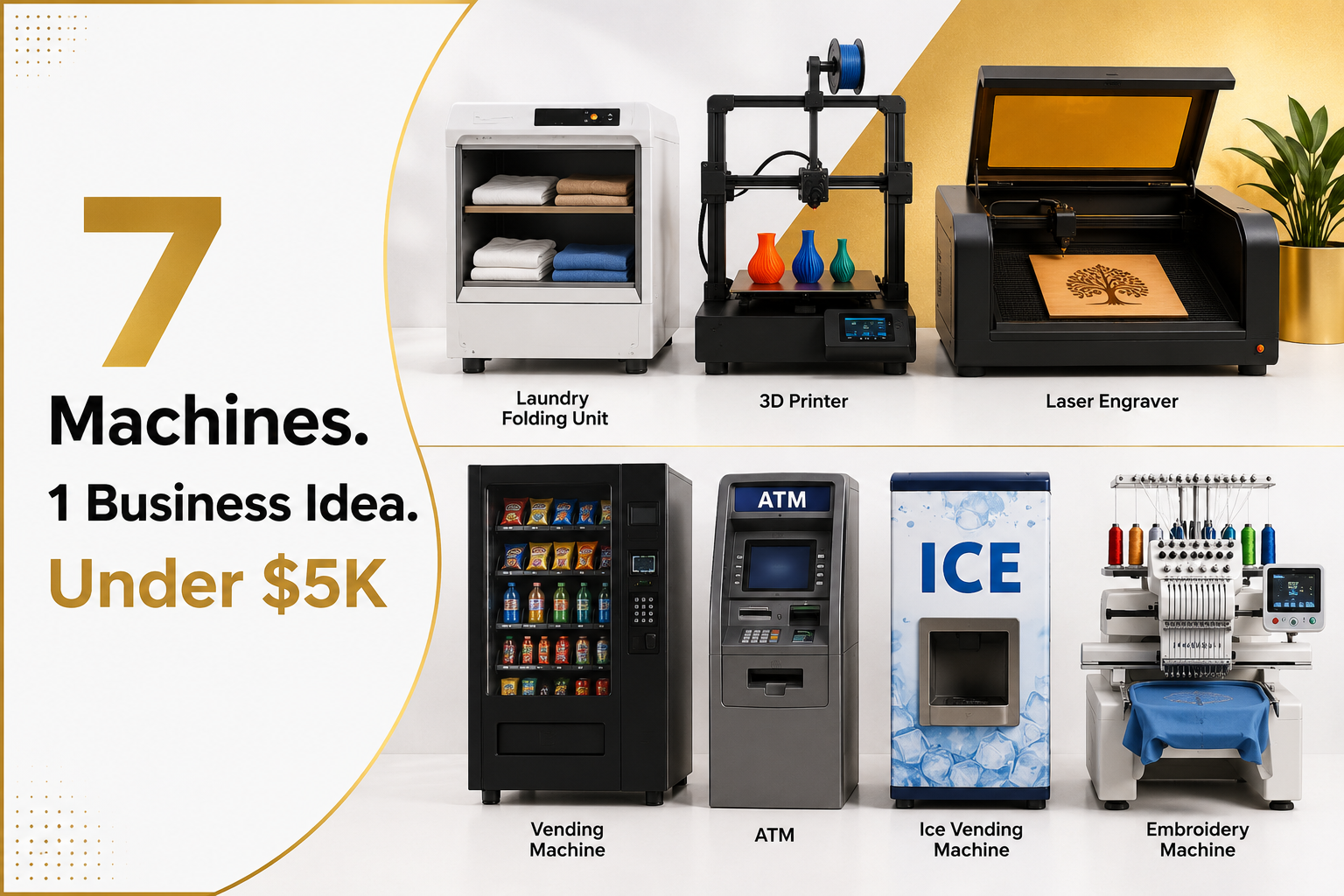
7 Physical Business Machines Quietly Making People $6K to $33K Every Month
A machine-based business is one of the fastest ways to start earning real income with a small upfront investment in 2026.
While everyone is chasing complicated online funnels and digital schemes that take months to gain traction, regular people are buying physical machines, setting them up, and generating thousands of dollars in monthly profit almost immediately.
These are not glamorous businesses.
They are not going viral on social media or being featured in Forbes.
But they are quietly building serious wealth for the people who are smart enough to take action on them.
This article breaks down seven real machines you can buy today, most of them for well under $5,000, that have already helped everyday people build income-generating assets they are proud of.
👉 Free download: Start a 1-Person Business With Claude AI — Free Quick-Start Guide
Table of Contents
Why Machine-Based Businesses Are Having a Huge Moment in 2026
Most new entrepreneurs spend years trying to figure out how to make money online before they even earn their first dollar.
They build websites, create content, run ads, launch courses, and burn through thousands of dollars before seeing any real results.
Machine-based businesses flip that model completely on its head.
You buy the machine, you find a location or a customer base, and the machine does the heavy lifting while you collect the income.
The learning curve is low, the setup time is short, and in many cases, the machine pays for itself within the first few months of operation.
It is the kind of simple, tangible business model that does not require you to be a tech wizard, a social media guru, or a startup founder with venture capital backing.
What it does require is a willingness to invest a small amount of money upfront and the patience to build something real over time.
👉 Get Access to: The AI Traffic Vault
Machine 1 — The Laundry Folding Machine
The laundry folding machine is one of the most underrated tools you can pair with a service-based business right now.
The concept sounds almost too simple to be profitable.
You take in other people’s dirty laundry, wash it, dry it, fold it perfectly using an automated folding machine, and deliver it back to them clean and neat.
But the numbers behind this model are genuinely impressive.
A platform called Poplin, formerly known as SudShare, works essentially like Uber but for laundry services.
Top earners on the Poplin platform are reportedly pulling in over $6,000 a month, which works out to around $72,000 a year for doing something most people consider a household chore.
One documented example involves a woman who started doing laundry through Poplin part-time, earned over $46,000 in a single year, and eventually used those earnings to open her own laundromat that now generates up to $24,000 per month in revenue.
A quality laundry folding machine, the kind that neatly folds garments automatically, can be purchased for a few hundred to a few thousand dollars depending on the model and capacity you choose.
If you already own a washer and dryer, your startup cost is minimal.
You pair the automation of the folding machine with the customer demand already flowing through a platform like Poplin, and you have a real, scalable business model that most entrepreneurs never think to consider.
The machine handles the labor.
The platform handles the customers.
You handle the pickups, the deliveries, and the banking.
👉 Get Access to: The AI Blog Monetization Quickstart Guide
Machine 2 — The 3D Printing Machine
The 3D printing machine for small business use is one of the most exciting opportunities in the physical products space right now, and the barrier to entry is shockingly low.
A beginner-level 3D printer capable of producing sellable products can be purchased for as little as $200 to $400.
Jacob Heightman, a 10-year-old entrepreneur, reportedly purchased his first 3D printing machine for around $300 and used it to produce and sell 3D-printed toys priced at $20 to $45 each, earning $1,700 in early revenue before he had even reached middle school.
That alone proves the machine is accessible to anyone with basic curiosity and a willingness to learn.
But the real ceiling of what is possible with a 3D printing machine was demonstrated by a 17-year-old high school student named Michael Sadderly, who learned 3D printing in a classroom setting and turned that knowledge into a niche online store selling custom Croc shoe attachments.
His store reportedly generated $250,000 in sales in one year and was on track to exceed $300,000, pulling in over $20,000 per month in revenue.
The key to making a 3D printing machine work as a real business is not just printing random items.
It is finding a passionate, loyal niche audience that buys the same category of product repeatedly and is willing to pay a premium for customization and novelty.
Whether you are targeting pet lovers, gamers, home decorators, or sneaker enthusiasts, the 3D printing machine gives you the power to create unique products at a very low cost per unit and sell them at margins that most product businesses would envy.
Platforms like Etsy, Shopify, and even local craft fairs give you immediate access to buyers without needing to spend a fortune on marketing.
Machine 3 — The Laser Engraving Machine
The laser engraving machine for custom products is one of the highest-margin physical business machines available to entrepreneurs today.
It works by using a focused beam of light to etch designs, names, logos, and patterns onto surfaces like wood, metal, glass, leather, and acrylic.
The result is a personalized, premium-looking product that customers are willing to pay serious money for.
John and Mark, the founders of a DIY crafting business called MakerFlow, built their entire company around a laser engraving machine.
They specialize in creating custom-engraved tumblers and other personalized items, and in one notable product drop, they reportedly sold 30,000 custom tumblers in under 10 minutes, generating $210,000 in a single sales event.
That is not a fluke.
That is the power of combining a machine that produces personalized products with a built-up audience of loyal buyers who are ready to purchase the moment something new drops.
Laser engraving machines suitable for a small home or studio business typically start around $300 to $500 for entry-level models and can scale up to $2,000 to $4,000 for professional-grade equipment that handles larger volumes and more complex materials.
The demand for customized keychains, cups, jewelry, wedding gifts, corporate awards, and branded merchandise is not going anywhere.
In fact, the personalization economy continues to grow every year as consumers increasingly prefer products that feel made specifically for them.
A laser engraving machine puts you in a position to serve that demand directly and profitably.
Machine 4 — The Vending Machine
The vending machine business is not a new idea, but it is one that continues to produce impressive results for entrepreneurs who approach it with the right strategy in 2026.
The concept is simple.
You buy a machine, you place it in a high-traffic location, you stock it with products people want, and you collect the income it generates around the clock without you needing to be physically present.
One well-documented vending machine entrepreneur in California reportedly operates 57 vending machines that together generate approximately $30,000 per month in income.
His smart approach involves pairing one snack machine with one beverage machine at every location so that each time he restocks or services a site, he is efficiently maintaining two machines at once.
This doubles the revenue per site visit and makes the entire operation far more time-efficient as it scales.
A single good-quality commercial vending machine can be purchased new for around $3,000 to $5,000 or found used in functional condition for significantly less.
Location scouting is the skill that separates average vending machine operators from highly profitable ones.
High-traffic areas like office buildings, gyms, hospitals, apartment complexes, laundromats, and school campuses tend to produce the most consistent and predictable revenue.
The more deliberately you choose your placement, the faster the machine pays for itself and starts generating pure profit.
YouTubers like Jamie Ibanez have built entire personal brands and additional income streams around teaching vending machine business strategies, proving that once you master the model, the knowledge itself becomes an asset you can monetize separately.
Machine 5 — The ATM Machine
The ATM machine business is one of the most overlooked machine-based income models available to regular entrepreneurs, and the profit margins are genuinely surprising.
Unlike a vending machine that requires you to source, purchase, and replenish inventory, an ATM machine earns money simply by being available in the right location and charging a convenience fee each time someone uses it to withdraw cash.
Paul Alex, a former police officer turned entrepreneur, publicly documented his journey of buying ATMs for approximately $2,100 each and building an ATM business that reportedly generated $12 million in revenue over three years.
He has shared the details of his business model openly on social media, providing a real-world blueprint for what is possible when you deploy multiple machines in well-chosen locations.
The typical surcharge fee per transaction on an independently owned ATM ranges from $2.50 to $3.50 per withdrawal.
In a location with steady foot traffic, like a bar, a convenience store, a gas station, or an event venue, a single machine can process hundreds of transactions per month with almost no intervention required from the owner.
The startup cost for a single ATM machine sits around $2,000 to $3,000 for a new unit, putting it well within the under-$5K startup range that makes this list compelling.
Profitability scales quickly once you begin deploying additional machines and building relationships with location owners who benefit from offering cash access to their customers.
👉 Get Access to: The AI Traffic Vault
Machine 6 — The Ice and Water Vending Machine
The ice and water vending machine is a specialized category of vending business that many entrepreneurs overlook entirely because it sounds too boring to be profitable.
But the numbers tell a very different story.
Steve Slaggle, a documented case study in the ice vending machine space, reportedly generated $33,000 in a single year from just two ice vending machines, spending approximately two hours per week maintaining and monitoring them.
That works out to an average of $2,000 to $3,000 per month in profit from a two-machine setup that required minimal daily attention.
Ice vending machines are large, durable, freestanding units that produce and dispense bagged ice and purified water on demand without any employee involvement.
They can be purchased new for approximately $25,000 to $40,000 for a full commercial unit, but smaller or refurbished units can be found in the $5,000 to $15,000 range depending on the capacity and configuration you need.
While this puts some ice vending machines slightly above the $5K threshold, they are included here because the profit potential and the low time investment make them worth considering as a business to work toward or finance.
Location is the defining factor in this business.
Ice vending machines perform exceptionally well near marinas, boat ramps, fishing spots, campgrounds, beachside parking areas, and rural convenience store locations where commercial ice supply is limited but customer demand is consistent and predictable.
Machine 7 — Textile and Clothing Creation Machines
The category of textile and clothing creation machines for small business use covers a wide range of equipment, each capable of producing sellable products that people genuinely love to buy.
This is not about competing with fast fashion brands.
It is about using specialized machines to create handcrafted, customized, or niche-specific items that command a premium price and attract loyal repeat buyers.
A sewing machine, available for as little as $100 to $200 for a reliable beginner model, is what launched one 27-year-old entrepreneur into a six-figure annual income by creating and selling silk scarves featuring architectural landmarks viewed from above.
Her products are visually distinctive, emotionally resonant, and positioned at a price point that reflects the craftsmanship behind them.
An embroidery machine, with beginner models starting around $300, helped a 21-year-old entrepreneur launch an Etsy shop that reportedly generated $1 million in its first year of operation.
She did it by combining her machine output with organic social media content that showed the products being made in real time, turning the creation process itself into marketing that drove buyers directly to her shop.
A tufting machine, used to create handmade rugs, powered a six-figure income for the creator behind Happy Rugs, a business built by Meline, whose handcrafted textile products resonated strongly with home decor buyers looking for something unique and artisan-made.
A circular sock knitting machine, the kind that automates the production of custom socks, can reportedly help a focused entrepreneur generate between $50,000 and $150,000 per year selling custom, novelty, and niche-themed socks at retail prices of around $10 per pair with a production cost of roughly $2 per pair.
Each of these textile machines gives you the ability to create a product that is deeply personal, highly giftable, and positioned in a market that is hungry for handmade alternatives to mass-produced goods.
👉 Get Access to: The Medium Mastery
The Hidden Business Layer Most Machine Owners Are Missing
Here is something that the most successful machine-based business owners in 2026 understand that most beginners overlook completely.
Once you figure out how to make money with a machine, the knowledge itself becomes a second business.
The California entrepreneur running 57 vending machines does not just earn from his machines.
He earns from coaching and teaching other people how to build their own vending machine businesses.
Paul Alex, who built his ATM business into a multi-million-dollar operation, has used social media to document and teach the exact process he followed, turning his expertise into an audience and his audience into another revenue stream.
This model of earning from the machine first and then earning from teaching the machine second is one of the most powerful financial strategies available to solo entrepreneurs today.
If you are thinking about starting a machine-based business and you also want to understand how to use AI tools and content creation to document and monetize your journey, the resources below are specifically designed to help you do exactly that.
👉 Get Access to: The Flipboard Traffic Workflow Kit
👉 Get Access to: Start a 1-Person Business With Claude AI
How to Pick the Right Machine for Your Budget and Lifestyle
Choosing the right machine-based business comes down to three things — your available budget, your available time, and the type of work you actually enjoy doing.
If you have under $500 to start and you enjoy creative work, a 3D printing machine or a beginner embroidery machine is your best entry point.
If you have $1,000 to $3,000 and you prefer a more hands-off passive model, a single vending machine or ATM in a well-chosen location is a strong first move.
If you have $3,000 to $5,000 and you want to build a service business with a real brand, a laser engraving machine paired with an e-commerce storefront gives you significant upside.
If you already have a washer and dryer at home and want to start earning money this week, a laundry folding machine combined with a Poplin account could have you processing your first order within days.
Every machine on this list has produced documented, real-world results for real people who started with small budgets and zero prior industry experience.
The machine you choose matters far less than the commitment you bring to understanding your customer, placing yourself in front of demand, and showing up consistently to build the business one week at a time.
Final Thoughts — The Machine Is Just the Beginning
A machine-based business is one of the most reliable, low-drama paths to building real income from a small initial investment in 2026.
The machines themselves are not magic.
They are tools.
What makes them powerful is the system you build around them — the customers you serve, the locations you choose, the platforms you use to market your services, and the knowledge you accumulate as you grow.
The seven machines covered in this article — the laundry folding machine, the 3D printer, the laser engraver, the vending machine, the ATM machine, the ice vending machine, and textile creation machines — each represent a proven, accessible path to building income that does not depend on algorithms, viral content, or convincing investors to fund your idea.
They depend on you buying a machine, learning how to operate it well, and serving customers who are already looking for what you offer.
That is a business model as old as commerce itself.
And in 2026, it is still working beautifully for the people willing to execute it.
👉 Get Access to: Start a 1-Person Business With Claude AI
We strongly recommend that you check out our guide on how to take advantage of AI in today’s passive income economy.