
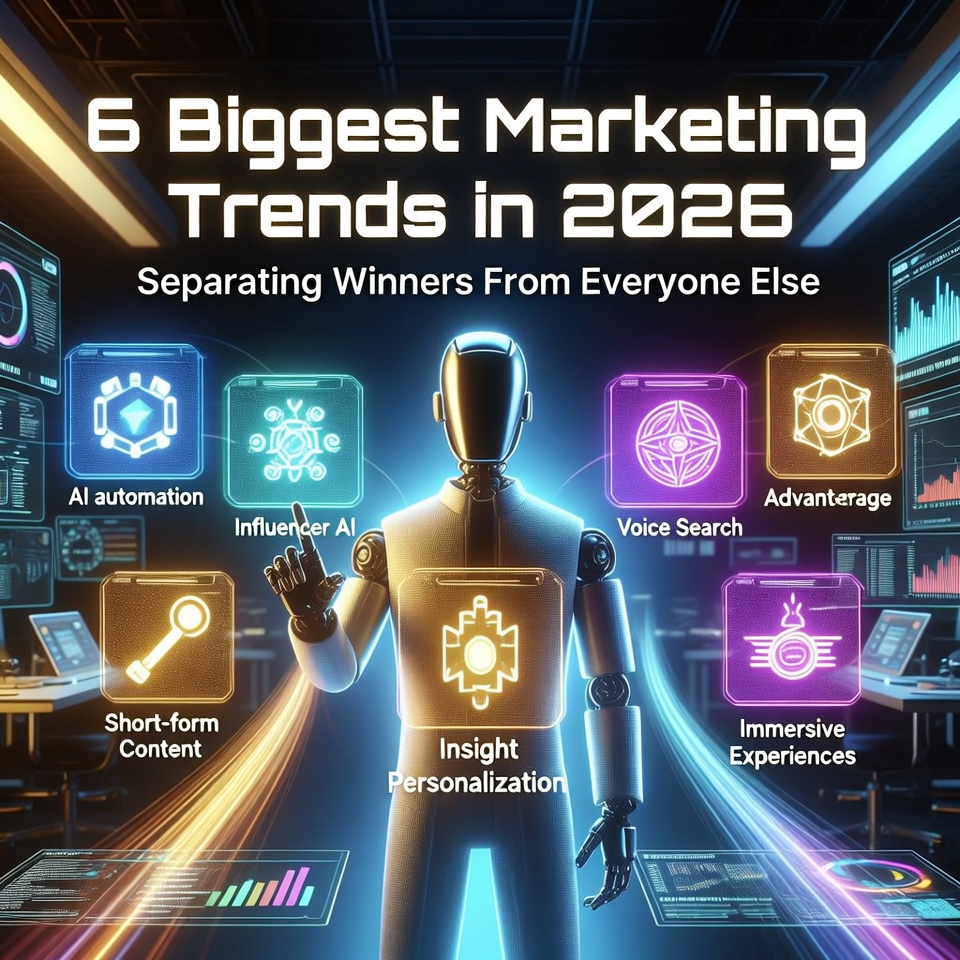
The Rules of Marketing Have Completely Changed
The marketing trends defining 2026 are not just shifting the playing field, they are flipping the entire board, and the brands that refuse to look up from their old playbooks are the ones quietly bleeding audience trust, conversion rates, and relevance right now.
A year ago, the conversation was about learning AI tools, experimenting faster, and getting ahead of the curve before the wave hit.
Well, the wave has hit, and almost everyone is riding it now.
That is exactly the problem.
In 2025, using AI to speed up your content creation felt like a competitive advantage.
In 2026, it is the baseline, the floor, not the ceiling, and if you are still treating the tools themselves as the strategy, you are already working harder for diminishing results.
What HubSpot’s 2026 State of Marketing Report reveals, drawing on real data from real marketers across industries and team sizes, is something far more nuanced and far more actionable than most brands are currently responding to.
Tools like flipitai are already helping creators and marketers adapt to this new landscape by building smarter content systems that do not just move fast, but move with purpose and clarity.
The six major marketing trends outlined in this piece are not predictions, they are patterns already in motion, already separating the brands building momentum from the ones generating noise.
So let us walk through every single one of them, look at what the data actually says, understand what really changed, and talk about how to adjust without burning your team out in the process.
Table of Contents
Trend 1: Your AI Output Is Only as Good as the Human Judgment Behind It
The Problem With Everyone Using the Same Tools
Here is a quick experiment worth trying the next time you are scrolling through LinkedIn.
Count how many seconds it takes you to spot a post that was clearly written entirely by AI, complete with the flawless grammar, the suspiciously structured list of bullet points, the emoji headers, and that signature opener that starts with something like “here’s what no one tells you.”
Most people can identify one in under three seconds, and that speed of recognition is a direct signal of a much deeper marketing trend that is now defining how audiences engage with content.
According to HubSpot’s 2026 report, 52% of marketers now say that AI has made content easier to create but less effective overall.
On top of that, 53% of marketers say they are actively struggling to differentiate in oversaturated feeds.
This is the paradox that defines the first and most critical of all current marketing trends, which is that the same tools meant to give you an edge have become the very thing making you invisible.
Last year, the question was how to start using AI.
This year, the question every serious brand must be asking is how to stop sounding like it.
Because when every brand has access to the same models, the same prompts, and the same outputs, the only thing that creates differentiation is the judgment, taste, and perspective of the human behind the content.
The tools handle execution, but your brand voice is what gets remembered, and tools like flipitai are built specifically to help you encode that voice into your workflow so your content does not just come out faster, it comes out sounding unmistakably like you.
How to Stay Ahead on This Marketing Trend
Before a single word of copy is ever generated, the strategic work needs to happen first, which means building out your brand tone guidelines, documenting your specific point of view, and feeding that context into your tools so the output reflects your identity rather than the default voice of a generic assistant.
Then apply what experienced content strategists call the human edit rule, which means reading every sentence you are about to publish and asking yourself whether a forgettable LinkedIn influencer account could have posted it without changing a single word.
If the answer is yes, that sentence needs to go.
Finally, build a prompt library inside tools like flipitai so that every time you find a prompt combination that actually sounds like your brand, you save it, refine it, and reuse it rather than starting from scratch every single session.
Trend 2: Brand Clarity Is Not a Nice-to-Have, It Is a Revenue Variable
When No One Knows What You Sell, No One Buys It
Here is a scenario that should feel uncomfortably familiar to a lot of marketing teams right now.
A visitor lands on a company homepage, reads the headline, scans the subheading, and five seconds later closes the tab because they still have no clear idea what the company actually does, who it is for, or why they should care.
That is not a design problem, it is a messaging problem, and it is costing those brands real money every single day.
The HubSpot report reveals that more than half of all marketers agree that expressing a clear brand taste and point of view is now essential for AI tools to function effectively.
Yet, and this is the part that is genuinely difficult to explain, 40% of marketing teams have still not clearly defined their brand’s unique value proposition.
That means nearly half of all teams are pouring AI tools, budget, and creative energy into a system that has no clear foundation to build on, which is one of the most damaging marketing trends happening silently across industries right now.
Think about a brand you would recognize from a screenshot alone, no logo, no name, just a tone, a color, a way of saying things, and a personality that makes the brand immediately distinct.
Duolingo is one of the clearest examples of this in action.
Their brand point of view is documented so tightly, and their guidelines are so specific, that every touchpoint including their website copy, their social posts, their in-app moments, and even their push notifications all carry the same unmistakable personality.
If the copy does not sound like the owl, it does not go live.
That level of clarity is not an accident, it is a system, and it is the kind of system that flipitai helps content teams build and maintain so the brand voice stays consistent no matter how many pieces of content are being produced at once.
How to Stay Ahead on This Marketing Trend
Run what is known as the five-second test by showing your homepage to someone who has never seen your brand before and asking them to tell you exactly what you do and exactly who it is for.
If they cannot answer both questions within five seconds, the copy is not clear enough, and no amount of AI output is going to fix that problem until the messaging itself is refined.
Every channel touchpoint, from your social media bio to your email footer to your ad headlines, should answer the same core question in the same consistent way, because repetition is what builds recognition in a world where audiences are moving faster than ever.
And instead of asking whether your brand feels right, start measuring which specific headlines are actually driving sign-ups, which phrases are converting, and which messages are bringing in qualified leads, then build more of those using flipitai to scale what is already working.
Trend 3: More Content Is Not the Answer When Intent Has Left the Room
Output Is Up, But Impact Has Stalled
Open your content calendar right now and look at the last thirty days of posts.
Ask yourself honestly how many of those posts could have been quietly deleted without a single person noticing, and if the answer is most of them, then you are experiencing one of the most quietly destructive marketing trends currently running through social media strategies everywhere.
According to the HubSpot report, 83% of marketers say that AI has dramatically increased the expectation to publish more content than ever before.
At the same time, creating content that actually drives engagement remains the single biggest challenge across marketing teams globally.
Output is going up and impact is not, which means the volume itself has become the problem.
AI removed the friction from content creation, and with that friction went the natural filter that used to stop weak, purposeless ideas from ever going live.
What gets published now often gets published simply because it is easy to produce, not because it has anything meaningful to say.
Using a platform like flipitai changes that equation by giving creators the structure to plan content with a clear purpose rather than filling a calendar for the sake of filling a calendar.
How to Stay Ahead on This Marketing Trend
Replace the question “what should we post?” with “why are we posting this?” and if the only honest answer is because it is Tuesday or because the calendar has a gap, delete the draft before it ever goes live.
Set a quality standard for every single piece of content by requiring it to do at least one of three things, which means it must either teach your audience something genuinely useful, entertain them in a way that reflects your brand personality, or challenge a belief they already hold in a way that makes them think differently.
If a piece of content does none of those three things, it is not content, it is noise, and publishing it is actively training your audience to scroll past everything you post, including the pieces that actually matter.
Finally, stop optimizing purely for reach and start tracking resonance, because one genuine reply from a qualified lead is worth exponentially more than a thousand views from an audience that has already learned to ignore you.
Trend 4: Discovery Gets You Seen But Depth Is What Builds Trust
Short Form Opens the Door, But Long Form Keeps People Inside
Think about the last brand or creator you came to genuinely trust online.
That trust almost certainly did not come from a single fifteen-second clip, a one-liner post, or a trending audio that made you laugh once before you kept scrolling.
Trust is built through repetition, depth, and consistent proof delivered over time, and one of the most important marketing trends in 2026 is the growing gap between brands that understand this distinction and brands that are still treating discovery as the destination.
HubSpot’s data shows that short form content continues to drive the strongest initial returns in terms of reach and new audience exposure.
At the same time, long-form content saw one of the biggest year-over-year performance lifts in the entire report, which tells a very clear story about what is actually compounding into audience loyalty right now.
Morning Brew is one of the most often-cited examples of this strategy executed perfectly at scale.
Short form was never their destination, it was the on-ramp, the entry point that moved new readers toward their email newsletter, which is the owned channel where the real trust, the real habit, and the real revenue were built.
Short form gets you discovered, long-form builds credibility and expertise, and owned channels like email newsletters and long-form written content turn attention into a consistent weekly habit that no algorithm can take away from you.
Tools like flipitai are especially useful here because they help creators repurpose and extend their content across multiple formats, ensuring that a single idea can live at both the discovery level and the depth level without requiring your team to create everything from scratch.
How to Stay Ahead on This Marketing Trend
Commit to owning at least one depth channel, whether that is a podcast, a long-form written series, or an email newsletter, because you need one place where you can consistently deliver real value without being at the mercy of an algorithm that changes its priorities every quarter.
Use short form content exclusively for reach and attention, not explanation, and immediately point that traffic toward your depth channel so that every new viewer or reader has a clear next step that moves them closer to your owned audience.
Then close the loop with a simple, consistent email format that takes people from your social feed to your inbox, because that transition from casual viewer to weekly reader is the move that turns fleeting attention into lasting loyalty, and that loyalty is the only marketing asset that truly compounds over time.
Trend 5: Search Has Changed and Your Website Visitor Has Already Made Up Their Mind
AI Summaries Are Where Decisions Begin Now
When was the last time you typed something into a search engine, received an AI-generated summary at the top of the page, got the exact answer you needed, and then clicked absolutely nothing?
If that experience feels familiar, then you already understand one of the most structurally significant marketing trends reshaping how content gets discovered, evaluated, and acted on in 2026.
HubSpot’s report reveals that nearly half of all marketers now say traditional search traffic is declining as a direct result of AI-powered answers.
However, and this is the critical nuance that most brands are completely missing, the same report shows that traffic arriving from AI tools carries significantly higher purchase intent than traditional search traffic ever did.
This is not traffic disappearing, it is traffic getting filtered, and the visitors who do make it to your website in this environment are not browsing casually, they are deciding.
They have already compared options inside an AI chat, they have formed an opinion from a creator’s long-form content, they have read a community recommendation, and by the time they land on your site, the research phase is behind them.
Platforms like flipitai help brands create content that is structured to be cited, summarized, and referenced inside AI-generated answers, which means your brand starts showing up at the very moment a potential buyer is forming their opinion, long before they ever perform a traditional search.
How to Stay Ahead on This Marketing Trend
Optimize for where research actually happens today, which means social platforms, online communities, creator content, AI chat tools, and direct recommendations, because that is where your next customer is forming their opinion about your brand whether or not your content is part of that conversation.
Lead with the answer in every piece of content you create, because AI tools reward clarity and so do humans, and skipping the long preamble in favor of immediate, specific, genuinely useful information is exactly how your content gets cited, trusted, and eventually acted on.
Assume that every visitor arriving at your website has already done their homework, and design your pages accordingly by putting your pricing, your demo button, and your clearest value statement front and center rather than making a decision-ready buyer hunt through paragraphs of marketing copy to find what they came for.
Trend 6: The Brands Winning Right Now Are Learning Faster, Not Planning Longer
Agility Has Replaced the Perfect Strategy
Every marketing team has been in this meeting at some point, the one where a campaign launched three weeks ago is clearly underperforming, but the monthly review cycle has not arrived yet, so no one has official permission to change anything, and by the time approval comes through, the moment has passed entirely.
That delay, between seeing a problem and being able to act on it, is costing brands far more than any individual course correction ever would, and it represents one of the most operationally important marketing trends in the entire HubSpot report.
The teams consistently performing at the top of their categories are not smarter than everyone else.
They are simply faster.
They analyze performance weekly, sometimes daily, and they update live campaigns within hours of identifying what is and is not working.
This is the foundation of what HubSpot calls the loop marketing playbook, which is a system built on the understanding that in a market moving this fast, the goal is not perfect planning, it is launching, learning, fixing, and repeating on a cycle that is tight enough to stay responsive to what is actually happening in real time.
Tools like flipitai are designed to support exactly this kind of adaptive marketing operation by centralizing your content data, your performance signals, and your publishing workflow so that insights from one channel can be applied across others within the same week rather than the same quarter.
How to Stay Ahead on This Marketing Trend
Stop chasing performance data across ten different tabs and invest in building a centralized hub where your email results, social analytics, and website behavior all live in one place, because the time you save connecting the dots is time you can spend acting on what you find.
Shorten your feedback cycles dramatically by committing to weekly performance reviews at minimum and building in a specific protocol for applying what you learn in one channel to your strategy in another, so that a subject line that outperforms on Tuesday becomes the inspiration for your ad copy on Wednesday rather than a footnote in next month’s report.
Before you launch anything new, take thirty minutes to identify the smallest possible improvement you could make to whatever is already running, because small, deliberate changes to live campaigns compound far faster than starting from scratch, and in 2026, the teams winning the most ground are the ones who have learned to optimize while they are moving rather than waiting until they have stopped.
Conclusion: The Difference Between Keeping Up and Actually Evolving
The six marketing trends covered here are not theoretical shifts on the horizon.
They are active changes already separating the brands building real momentum from the ones generating impressive output with rapidly declining results.
AI removed the barriers to content creation, which means the brands that win from this point forward are the ones with the clearest voice, the sharpest positioning, the deepest content, the most adaptive systems, and the discipline to publish with intent rather than volume.
A year from now, the question worth asking yourself is whether your marketing will look like more posts, more tools, and more effort chasing diminishing returns, or whether it will look like a clear system with compounding momentum that kept working even on the days when you were not pushing.
That is the real difference between keeping up and actually evolving.
And whether you are a solo creator or a scaling brand, tools like flipitai exist specifically to help you build the kind of systems that do not just respond to marketing trends but stay ahead of them, turning strategy into consistent, repeatable, and measurable results that grow without burning you out.
Start building smarter now, because the window between those who adapt early and those who catch up late is widening by the day.
We strongly recommend that you check out our guide on how to take advantage of AI in today’s passive income economy.