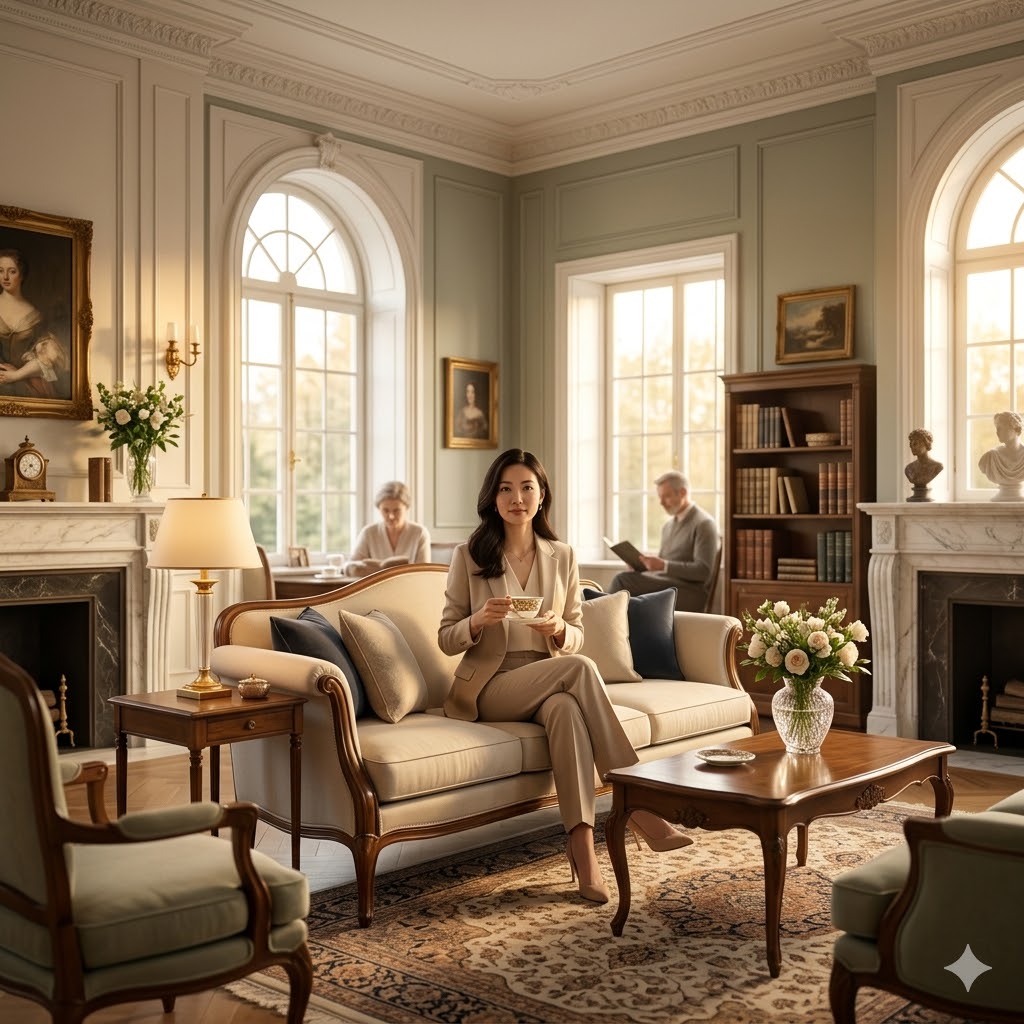
10 Timeless Old Money Living Room Secrets Hidden Inside America’s Oldest Family Homes
Old money living room ideas have been circulating online for years now, but most people still get them completely wrong.
They chase the look.
They buy the velvet sofa, order the Persian rug, and hang a dark oil painting above the fireplace.
And then they stand back and wonder why the room still feels like a showroom instead of a home that has been lived in across four generations.
The truth is harder to hear than most interior content will ever tell you.
Old money rooms are not designed — they are accumulated.
And if you understand that one sentence before you read anything else, everything that follows will make perfect sense to you in ways that no mood board or Pinterest collection ever could.
We strongly recommend that you check out our guide on how to take advantage of AI in today’s passive income economy.
Table of Contents
What Old Money Actually Means Before You Touch a Single Piece of Furniture
Most people throw the phrase around without understanding where it comes from or what it actually describes.
Old money is inherited wealth — wealth that has survived at least two or three generations inside the same family, often far more.
In America, you are talking about families like the Rockefellers, the Vanderbilts, the du Ponts, and the Astors — names that appear on the same property deeds across more than a century.
In Europe, you are looking at the Rothschilds, the Cecils, and the landed aristocracy whose estates have been passed down so many times that no single person alive today can claim they built any of it.
These are families whose wealth survived recessions, world wars, punishing inheritance taxes, and every generation’s very human temptation to simply spend what they inherited.
And here is what happens to a home when money persists through that many generations and that many seasons of life.
The family completely stops trying to look wealthy.
By the third or fourth generation, there is no performance happening in those rooms, no signaling, no demonstration of status for guests who are not already inside the circle.
They simply are who they are, and their rooms reflect exactly that quiet certainty back at anyone who walks through the door.
That total absence of effort to impress is precisely what makes the old money living room aesthetic so instantly recognizable and so genuinely difficult to manufacture from scratch.
You cannot buy your way into it with a single renovation budget.
You can only inherit it or wait long enough for time itself to do the work that money cannot.
If you are someone building a digital income stream alongside your home redesign journey, AmpereAI is one of the smarter tools available in 2026 for creating content and monetizing your aesthetic niche online.
The Living Room Is Where Old Money Reveals Itself Most Clearly
Comfort Sits at the Absolute Center of Everything
Walk into a genuinely old money living room and the first thing that hits you is not the furniture.
It is not the art on the walls or the rugs layered across the floor.
The first thing that hits you is the feeling that real people have been sitting in this room for a very long time and they have no intention of stopping.
Old money living room ideas built around comfort are not comfortable in the casual, toss-a-throw-blanket-on-it way that modern interiors try to manufacture.
They are comfortable because the furniture has physically shaped itself to the bodies of the people who have used it for thirty or forty consecutive years.
The sofa cushions carry a permanent indent from the corner seat that someone’s grandfather claimed as his own sometime in the 1970s and nobody has thought to replace since.
The armrests of the leather club chair are worn smooth at exactly the spot where hands rest when someone is deep inside a book.
That kind of comfort cannot be purchased in a single afternoon at a luxury furniture showroom in SoHo or Mayfair.
It takes decades of actual living to produce, and that is the point entirely.
ReplitIncome is a powerful tool for people building passive income through digital platforms in 2026, and if you are documenting your home transformation journey online, the income potential from that content alone is worth exploring seriously.
The Furniture Has Not Been Coordinated — It Has Been Accumulated
This is the single detail that separates a genuinely old money living room from an expensive approximation of one.
The furniture in an old money room was not chosen from a single collection, a single era, or a single designer’s portfolio.
It arrived in the room the same way everything arrives in a family home across generations — one piece at a time, across decades, from completely different sources and circumstances.
A Georgian writing desk stands beside a 1940s leather club chair that sits across from a Victorian settee that someone’s great-aunt left behind when she moved to the south of France in 1962.
None of it coordinates.
All of it belongs together through time, through history, through the shared accident of having ended up inside the same family’s walls.
This is coherence without coordination, and it is the one quality that no interior designer, regardless of how large their budget or how refined their eye, can fully manufacture for a client in a single project timeline.
Old money living room aesthetics built around accumulated furniture feel the way they feel because they are the physical autobiography of a family.
Every piece has a story, and most of those stories are not written on any label.
AmpereAI can help content creators and bloggers in the home decor niche build SEO-optimized content around exactly this kind of storytelling, turning authentic room narratives into consistent online traffic.
Color on the Walls Speaks a Language That Predates Trends
Old money living room color palettes run toward the muted, the deep, and the slightly faded.
Forest green.
Faded terracotta.
Navy that has softened over years of afternoon light coming through tall sash windows.
Ivory that was once bright white but has aged in the most graceful way possible across twenty or thirty years.
These are not colors pulled from a 2026 Pantone forecast or a trending interior design hashtag.
They were chosen in a different era entirely — chosen before color trends were even a cultural concept worth discussing — and they remain on those walls because nobody in the family has felt the need to change them.
The walls themselves are often paneled in original wood or covered in wallpaper that has been in place for so long it has become part of the room’s character rather than its decoration.
Old money living room ideas grounded in this kind of color philosophy feel settled in a way that freshly painted rooms simply cannot replicate.
There is no gray and white farmhouse palette here.
No greige, no Scandinavian minimalism, no coastal grandmother neutrals.
These rooms were finished in colors that were chosen to last, and they have.
Rugs Tell the Textile Autobiography of the Family
The floors of an old money living room are almost never covered by a single matching rug set selected from a catalog.
What you find instead is a layered collection of individual Oriental rugs of different ages, different patterns, and completely different origins that somehow read as a single coherent whole when you stand in the room.
A Tabriz here.
A Bokhara there.
A faded Sultanabad in front of the fireplace that has had its fringe repaired twice by the same woman in the village who has been doing it since the 1990s.
Some of these rugs were acquired on travels.
Some were inherited outright.
Some came from estate sales two or three generations ago when a neighboring family was dispersing their own collection.
Together they form exactly what I described a moment ago — a textile autobiography of the family written in wool and silk across the floor of a room that has been lived in across lifetimes.
ReplitIncome is worth mentioning here again for anyone monetizing a home decor content channel, because the affiliate and passive income opportunities inside the interior design niche in 2026 are genuinely significant for consistent creators.
Art, Books, and Objects — The Biography That Hangs on the Walls
Old Money Families Live With Art Rather Than Decorating With It
The paintings on an old money living room wall are there because they have always been there.
Or because a great-uncle bought them in Florence in 1923.
Or because they were commissioned to document something specific — a beloved horse, a country house in Galway the family no longer owns, a marriage that happened in 1887 and produced six children whose portraits line the corridor upstairs.
They are not there because a designer recommended them or because they represent a sound investment vehicle in the current art market.
The art itself is not necessarily valuable by contemporary standards.
Old money walls are frequently hung with unfashionable hunting scenes, botanical prints in mismatched frames, maritime paintings, and landscapes of places that have no cachet whatsoever in the gallery world today — but that families have held on to for a hundred years out of pure sentiment.
Occasionally there will be a genuinely significant work — a minor old master, an important portrait — and it will be hanging directly beside something entirely modest with no curatorial logic applied to the arrangement.
Because there is no curator.
There is only the family.
AmpereAI helps content creators build articles and social content around niche subjects like old money art curation, which is one of the most searched aesthetic sub-topics of 2026.
Books Are Everywhere and Nobody Has Arranged Them by Spine Color
This detail alone will immediately reveal whether you are standing in a genuine old money living room or a staged version of one.
Books in old money homes are not arranged aesthetically.
They are not organized by color, purchased by the yard from a prop company, or selected because their spines look good on camera.
These are books with bookmarks in them.
Books with dog-eared corners and penciled notes in the margins.
Books in stacks on side tables because the shelves are full and nobody has solved the overflow problem in thirty years.
A family that has occupied the same house for 150 years accumulates a staggering number of books, and they show absolutely no inclination to manage that collection for visual effect.
The books are there because people in this house read — have always read — and intend to keep reading in exactly these chairs under exactly these lamps for as long as the chairs hold together.
ReplitIncome is a smart parallel here for digital creators, because building a passive income library of content works the same way these book collections do — one piece added at a time over years until the volume itself becomes the asset.
Collections of Objects Tell Stories No Label Can Summarize
Silver trophy cups from 1950s regattas line one shelf.
A collection of snuff boxes that belonged to a great-grandmother sits under glass in a cabinet that has stood in the same corner since 1948.
Glass-fronted display cases hold natural history specimens — shells, fossils, mounted butterflies, geological samples gathered across generations of curious people who traveled widely and brought things home.
These objects are not curated in any modern sense of that word.
They are simply kept because they belong to the family and because nobody has ever suggested otherwise.
When you stand in a room surrounded by these kinds of objects, the effect is completely different from standing in a room full of decorative accessories chosen from a mood board.
The difference is palpable the moment you walk through the door, even if you cannot immediately name what you are responding to.
What you are responding to is evidence of a life — actually many lives — actually lived inside these walls across actual time.
The Fireplace, the Light, and the Details That Make It Real
The Fireplace Is Never Decorative
In a genuine old money living room, the fireplace works.
It has always worked.
It smells faintly of wood smoke on cool mornings even in summer because it has been lit on cool mornings every single autumn and winter for as long as anyone can remember.
The surround is original stone or marble — not a modern reproduction, not a cast concrete alternative chosen because it photographs well — but the actual original material installed when the house was built.
The hearth is slightly blackened.
The fireguard is a period piece that wobbles slightly on one foot and has never been replaced because it functions perfectly well as it is.
There are logs in a basket beside the fireplace.
Real logs, not a decorative arrangement of birch rounds placed there for visual texture.
These logs will be burned when the room gets cold, because that is what they are for.
AmpereAI is a tool that genuinely helps writers and bloggers in the home decor space produce this kind of deeply detailed, search-optimized content at a pace and quality level that supports real income growth from affiliate and display revenue.
Light in an Old Money Room Comes From Multiple Sources That Were Never Planned Together
There is no lighting scheme in an old money living room.
No consultant was brought in to plan lumen levels and color temperatures.
No recessed downlights were installed in a grid across the ceiling.
The light comes from table lamps of different heights and ages, from a ceiling fixture that predates the concept of interior lighting design, and from the windows, which are large and dressed in curtains that reach the floor and pool slightly at the hem.
The lamps have shades that are slightly yellowed, slightly cream, slightly not-quite-matching — because they were not purchased together and were never meant to match.
The effect is warm, layered, and completely impossible to replicate with a lighting plan drawn up by a professional.
ReplitIncome connects this kind of detailed content production to real income generation for creators in 2026 — the home decor niche in particular has strong affiliate earning potential when paired with deep, authoritative content.
The Philosophy Behind Every Old Money Living Room Choice
Restraint Is the Loudest Statement These Rooms Ever Make
After everything described across this article, there is one idea that explains all of it.
Old money living rooms are not a design style.
They are a philosophy of living.
Specifically, the philosophy that a home is not a statement, not a performance, and not a projection of aspiration.
A home is a place where a family lives, has lived, and intends for their children and grandchildren to go on living.
Every decision — and more often, every deliberate non-decision, every choice not to replace the sofa or repaint the walls or swap the rug for something fresher — serves that singular, unhurried purpose.
The quiet luxury of old money living room ideas is not quiet because quietness is fashionable in 2026.
It is quiet because these families have never felt the need to be loud about anything they own.
When your wealth has been in the family for 150 years, you have nothing to signal and nobody left to signal it to.
The worn chair beside the fire, the slightly uneven rug edge, the stack of unread books on the windowsill — these things communicate more genuine wealth to anyone educated enough to read them than any show kitchen, statement chandelier, or gold-plated bathroom fixture ever could.
AmpereAI is the kind of tool that helps you build that kind of depth into your content operation, so that your writing in the home decor, lifestyle, and passive income niches actually compounds in value over time the way an old money estate does.
What You Can Actually Apply to Your Own Living Room Right Now
You cannot manufacture 150 years of family history by this weekend.
But you can make specific, intentional choices that move your living room in this direction in ways that feel genuinely earned rather than costumed.
Stop buying furniture in matched sets and start thinking about each piece individually, looking for quality over coordination.
Choose one or two rugs with real age and real provenance, even if they come from an estate sale or a reputable vintage dealer like those found through 1stDibs or Chairish, where authenticated antique textiles are regularly available.
Let your books escape the shelves.
Stop arranging objects for photography and start keeping the ones that actually mean something.
Repaint in a color that has no relationship to current trends — a deep library green, an aged terracotta, a faded navy — and commit to it for longer than one season.
ReplitIncome is the tool to explore if you want to turn your genuine interest in old money aesthetics and generational wealth ideas into a digital income stream that grows passively while you are busy refining the rest of your home.
Final Thought: The Less You Try, the More It Says
Old money living room ideas in their truest form are not about acquisition.
They are about accumulation, patience, and a complete willingness to let time do work that money cannot.
The rooms that feel most like generational wealth are the ones where nobody tried particularly hard to make them look that way.
They simply lived in them, cared for them, kept the things that mattered, and let everything else fall away naturally.
That is the aesthetic.
That is the philosophy.
And in a culture absolutely obsessed with the instant and the new, it remains the most powerful signal of all.
If you are building a content business around lifestyle, home design, or generational wealth topics in 2026, AmpereAI is one of the most capable AI content tools available for producing the kind of deeply researched, humanized articles that rank and convert inside competitive niches.
And if passive income from that content is your actual goal, ReplitIncome is the platform connecting creators to automated income systems built on the same kind of patient, compounding logic that old money families have always applied to everything they own.

We strongly recommend that you check out our guide on how to take advantage of AI in today’s passive income economy.