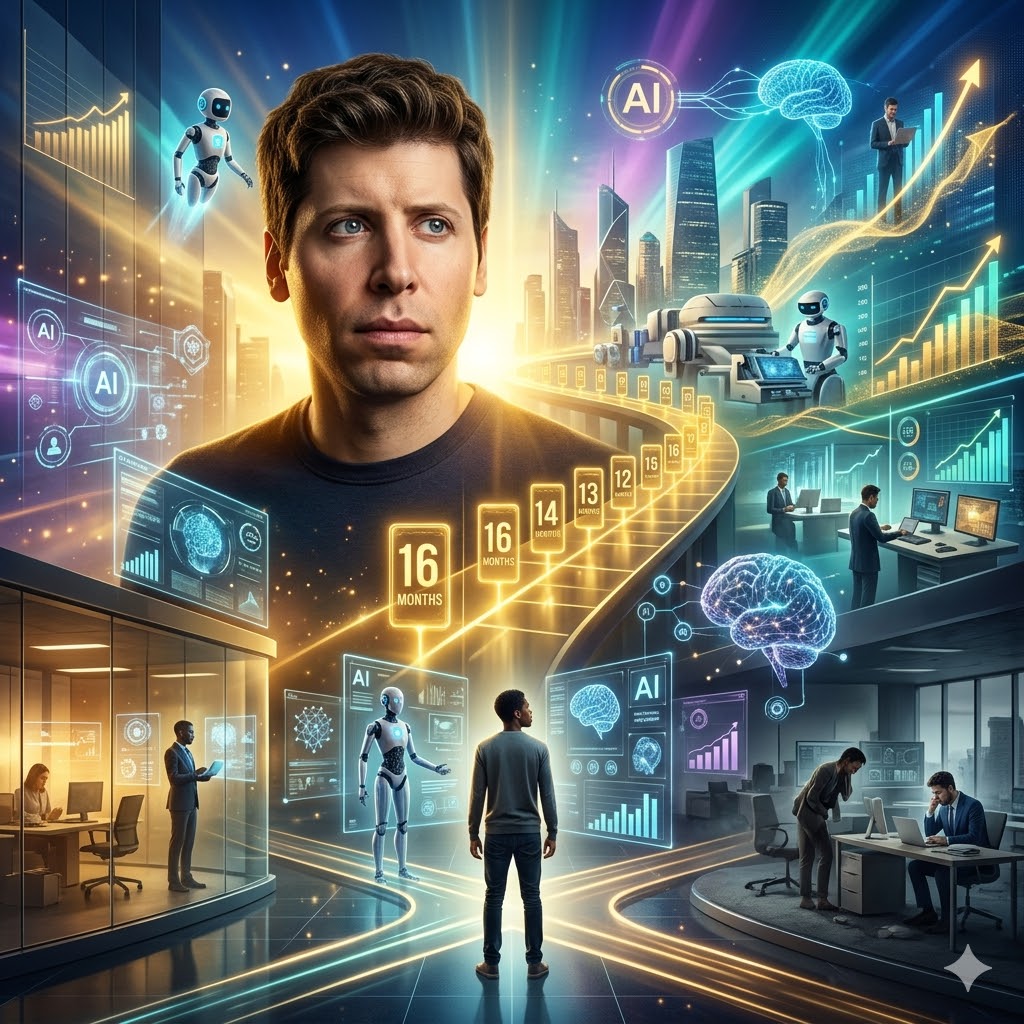
Sam Altman’s 2026 Warning: Why the Next 16 Months Will Separate AI Winners From Losers Forever
The Clock Is Already Ticking
Sam Altman, the CEO of OpenAI, has been saying something that most people are not taking seriously enough, and the window he keeps pointing to is closing faster than anyone is ready for.
Right now, in 2026, the gap between companies that understand where artificial intelligence is headed and those that are still treating it like a productivity tool is wider than it has ever been.
Sam Altman sat down with Vinod Khosla, one of Silicon Valley’s most respected venture capitalists and the founder of Khosla Ventures, for a wide-ranging conversation that covered the future of AI, the fate of the Fortune 500, job disruption, and whether AI will concentrate wealth or spread it more equally across the world.
What came out of that conversation was not a polished press release or a feel-good investor pitch.
It was a raw, honest look at how fast things are moving and why the next sixteen to eighteen months represent a turning point that will separate the companies, workers, and economies that survive from those that do not.
This article breaks down the biggest takeaways from that conversation, translates what they mean for regular people and businesses, and explains why Sam Altman’s timeline is something every entrepreneur, investor, and working professional in 2026 should be paying close attention to.
We strongly recommend that you check out our guide on how to take advantage of AI in today’s passive income economy.
Table of Contents
From Zero to One Was the Shock, But the Real Disruption Is Happening Right Now
When ChatGPT launched in late 2022, most people were caught completely off guard.
There was no major AI assistant one day and then suddenly there was something that could write essays, answer complex questions, and hold a conversation, and the world stopped for a moment to take it all in.
Sam Altman described that moment as the “zero to one” shock, the kind of system disruption that rewires how people think about what is possible.
He compares that early version of ChatGPT to a score of one on a capability scale that goes from zero to one hundred, and he says we are now sitting somewhere around ten.
Here is what makes his warning in 2026 so significant: he believes we will go from ten to one hundred in the next eighteen months, and yet most people will not feel the full weight of that leap the same way they felt that first moment.
The reason is psychological, not technical.
People have already accepted that AGI is coming.
The conversation has moved from “Is this real?” to “Okay, now what do I do with it?” and that shift in mindset means the next massive leap in capability will feel more like an upgrade than a revolution, even though the actual impact will be far larger than anything that has come before it.
The Fortune 500 Is Facing Its Fastest Demise in History and Sam Altman Agrees
Why Custom AI Software Threatens the Entire SaaS Industry
Vinod Khosla made a bold prediction during the conversation, stating that we will see a faster collapse of the Fortune 500 in the 2030s than at any point in modern history.
Sam Altman’s response was not dismissive.
He agreed that his instinct pointed in the same direction, particularly when it comes to software companies.
The logic is straightforward.
Right now, businesses pay large SaaS companies for software products because building custom software is expensive, time-consuming, and requires skilled engineering teams that most companies cannot afford to maintain at scale.
But if AI agents can generate custom software on demand, the entire reason those SaaS giants exist starts to disappear.
Instead of paying for a subscription to a customer relationship management tool or a complex enterprise resource planning platform, a business could simply describe what it needs, and an AI system builds it instantly, for free or at minimal cost.
Sam Altman specifically flagged this as a shift that feels closer than most people realize, and he noted that large Fortune 500 companies managing complex supply chains are particularly vulnerable to this kind of disruption, though he acknowledged that physical-world changes tend to take longer than software-world changes.
The window he is pointing to, from now through the end of 2026 and into the early 2030s, is the period where companies either figure this out or start falling behind permanently.
The 10 to 100 Capability Leap and What It Means for the Next 16 Months
Why This Leap Will Feel Quiet But Hit Harder Than Anything Before
Sam Altman said something during his conversation with Vinod Khosla that sounds almost contradictory at first.
He believes the jump in AI capability that is coming in the next eighteen months will be astonishing in technical terms, but it will not feel as wild or shocking as the moment ChatGPT first appeared.
The reason is that the shock of novelty is gone.
When ChatGPT launched, nobody saw it coming, and the zero-to-one transition hit the world without warning.
The jump from ten to one hundred that Sam Altman is now predicting for this eighteen-month window is expected, and expected progress, no matter how remarkable, does not produce the same emotional jolt that a total surprise does.
But here is why businesses and workers need to pay attention anyway.
The fact that a leap feels expected does not mean it will be painless.
If AI models jump dramatically in capability over the next sixteen months, the companies that have been quietly building workflows and systems around AI will suddenly have a serious competitive advantage over those that have been waiting to see how things unfold.
The gap that is quietly forming right now between AI-first companies and AI-resistant companies will become very loud, very fast.
AI Scientists Doing AI Research — The Feedback Loop That Could Change Everything
How AI Accelerating Its Own Development Creates an Entirely New Timeline
One of the most striking moments in the conversation between Sam Altman and Vinod Khosla came when they discussed the possibility of AI systems doing most of the research that leads to future AI breakthroughs.
Sam Altman described this not as a sudden flip where AI takes over science overnight, but as a gradual and messy process where the line between human-led and AI-led research starts to blur.
Imagine a researcher at OpenAI who is already using AI tools to generate code.
Today that might mean the AI is helping write ten or twenty percent of their pull requests on GitHub.
Over time that percentage climbs, then the AI starts testing new model architectures on its own, and then it begins generating and testing its own hypotheses.
The researcher still feels like they are in control, still feels like they are doing the work, but they are now producing ten times the output they were capable of before.
Sam Altman’s point is that whether you call that “AI-assisted research” or “AI doing the research” is almost a philosophical question, but the net effect is the same: scientific progress accelerates far beyond what any human team could achieve alone.
And this acceleration is not limited to software.
If AI is helping design better data centers, develop faster chips, and optimize the entire infrastructure supply chain of the AI industry itself, then the rate of progress compounds in a way that most people’s mental models are simply not built to anticipate.
The Jobs Already on the Chopping Block Right Now
Coding, Customer Support, and Sales Are the First Dominoes
When Vinod Khosla pressed Sam Altman to name the specific jobs and industries facing the most immediate disruption, the OpenAI CEO was direct.
He said that in the short term, the AI software engineer will be the single most disruptive force hitting enterprises right now.
Companies are investing heavily in AI coding tools, and the output is measurable.
Teams that have gotten good at working with AI coding assistants are already significantly outperforming teams that have not.
Beyond software development, Sam Altman pointed to customer support and outbound sales as two functions that are already being handled entirely by AI inside some companies today.
These are not theoretical projections about what might happen in 2030.
These are live deployments happening right now in 2026, where businesses have removed entire human teams from customer-facing roles and replaced them with AI agents.
He acknowledged that the visibility of these changes is lower than the visibility of AI in coding, because code ships into products that people can see, while AI handling a support ticket is invisible to most observers.
But make no mistake: the disruption is already here, and the pace is picking up with every quarter that passes.
Will AI Make the World More Equal or Just Make the Rich Richer?
Sam Altman’s Case for Technology as a Force for Broad Global Benefit
Perhaps the most important and most debated part of the conversation between Sam Altman and Vinod Khosla was the question of wealth distribution.
If AI eventually does most of the work that humans currently do, who benefits?
Does the value flow upward to the small circle of people who own the AI systems, the compute infrastructure, and the data pipelines?
Or does it spread outward in the way that previous technological revolutions eventually spread, lifting billions of people out of poverty over time?
Sam Altman made his position clear: he believes AI will ultimately be a force for equality rather than further concentration of wealth, and he pointed to ChatGPT as early evidence.
He noted that ChatGPT is now one of the five biggest websites in the world by traffic, with hundreds of millions of people accessing it, many of them for free.
His vision is one where, eventually, billions of people will have access to a free AGI-level assistant that can provide world-class medical advice, education, software development, and problem-solving to anyone with a smartphone connection.
He used the analogy of what happens when a company uses AI to discover a cure for cancer: the inventors should get rich, but the cure itself should be cheap enough for the whole world to use.
Or when AI makes nuclear fusion commercially viable: the companies involved will profit, but the result will be electricity so cheap it transforms the global economy for everyone, not just the wealthy.
He acknowledged that compute access could become a dangerous bottleneck if left unchecked, imagining a world where massive amounts of capital flood into compute resources and make them scarce and expensive.
His proposed solution is simple: build more compute, lower the cost, and distribute access as widely as possible.
What This All Means for You in 2026 and Beyond
The conversation between Sam Altman and Vinod Khosla was not designed to frighten people, but it carries a message that every person paying attention to the economy in 2026 needs to sit with.
The zero-to-one moment that surprised the world with the arrival of ChatGPT will not happen again.
The next shock is coming through quiet, relentless progress, through AI models that are ten times more capable arriving before most businesses have figured out how to use the ones they already have, through Fortune 500 companies losing their reason to exist, through job categories disappearing not all at once but function by function, and through a small window of time, the next sixteen months, where the decisions that companies, entrepreneurs, and workers make right now will define where they stand for the rest of this decade.
Sam Altman is not predicting the end of the world.
He is predicting a new one.
And the people who thrive in it will be the ones who stopped waiting for another zero-to-one shock and started adapting to the fact that we are already at ten and climbing hard toward one hundred.
The clock on that window is already running.
We strongly recommend that you check out our guide on how to take advantage of AI in today’s passive income economy.