How a 23-Year-Old Built a $10,000/Month Business Working 5 Hours a Week
A washer and dryer rental business is a low-cost side business where you rent out used appliances to renters month-to-month, often starting with $0 upfront by testing demand on Facebook Marketplace before ever buying a machine.
This exact model helped a 23-year-old entrepreneur reach roughly $10,000 in monthly recurring revenue while working just five to ten hours a week, with no employees and minimal overhead.
👉Free download : Start a 1-Person Business With Claude AI — Free Quick-Start Guide
Most people scroll past washers and dryers every single day without ever thinking twice about them.
They see them as boring appliances tucked away in a laundry room, not as a business opportunity.
But one young entrepreneur looked at those same ugly white machines and saw something completely different.
He saw a way to build a business that could start a profitable appliance rental business with literally zero dollars in the bank.
No warehouse, no staff, and no fancy equipment required.
Just a phone, a Facebook Marketplace account, and a willingness to test an idea before spending a single dollar on it.
That is exactly what he did, and within a few short months, he had built a business generating close to $10,000 a month.
This article breaks down exactly how he did it, step by step, using real tools, real platforms, and real numbers.
We strongly recommend that you check out our guide on how to take advantage of AI in today’s passive income economy.
Table of Contents
How the Idea Started With a Simple Test on Facebook Marketplace
Before he ever touched a washer or dryer, he was already experimenting on Facebook Marketplace.
He tried renting out a backyard game called nine square, the kind popular in family neighborhoods across Utah.
Then he moved on to paddle boards, listing them for rent directly through Facebook, with no paid ads involved.
He even tested ideas for things he did not own yet, like excavators, chainsaws, and luxury bathroom setups, just to see if people would respond.
He would take a real photo, sometimes even a screenshot, post it as a rental listing, and watch to see how many messages came in.
If nobody responded, he moved on to the next idea without losing any money.
If people did respond, that was his signal the idea had real demand behind it.
This testing habit is the foundation of how to start a profitable appliance rental business without wasting money on inventory nobody wants.
One day, almost by accident, he posted a washer and dryer set for rent at $50 a month.
He did not own the machines yet.
He simply wanted to see if anyone would respond to the listing.
Then he left for a previously booked cruise and lost phone service for several days.
The Business That Nearly Started Itself While He Was Away
When he returned from the cruise and reconnected to the internet, he found roughly 30 messages waiting for him.
All of them were people asking about the washer and dryer listing he had posted before he left.
Out of those 30 inquiries, three or four turned into serious, ready-to-rent customers.
That response rate told him everything he needed to know about demand.
One woman in Orem, Utah, asked if he could install the set the very next day.
So he drove to a local appliance retailer called RC Willey, a well-known Utah-based store similar to Home Depot for appliances, and bought his first washer and dryer set without any prior installation experience.
That first purchase alone cost him close to $1,000 for one set, and he ended up buying three sets that day, putting in roughly half of his personal savings at the time.
It was a bold move, but because he had already validated demand first, the risk was far lower than it looked on paper.
👉Get Access to : The AI Traffic Vault
Why Washers and Dryers Beat Every Other Rental Idea
Utah has extreme seasonal swings, with roughly six months of hot weather and six months of cold weather each year.
That seasonal pattern kills a lot of rental business ideas before they even get started.
A boat cannot be rented out in the middle of winter.
An off-road vehicle sits useless once the snow piles up.
But a washer and dryer sits inside someone’s home, and people need clean laundry every single week of the year, regardless of the season.
That single insight is why this niche outperformed every other rental idea he had tested before it.
It also explains why so many renters keep the machines for a year or longer instead of returning them after a few months.
Understanding this kind of year-round demand is critical if you want to start a profitable appliance rental business that actually lasts.
The First Installation Went Wrong, and That Turned Into a Lesson
His very first installation in Orem did not go smoothly.
The apartment’s dryer vent was completely clogged with lint, something he had never dealt with before.
The dryer he installed would not run properly because of built-in safety features designed to prevent lint-related fires.
He had to go buy vent-cleaning tools on the spot just to get the unit working for his very first paying customer.
That customer, by the way, is still paying him through Cash App on the 15th of every month years later.
Lesson learned the hard way: always check the dryer vent before assuming a machine is broken.
This is the kind of practical, on-the-ground knowledge that separates people who simply talk about business ideas from people who actually execute them.
👉Get Access to : The Medium Mastery
Scaling From One Set to Dozens Using Wholesale Suppliers
After those first few installs went well, he wanted a cheaper, more scalable way to source machines.
He called wholesale appliance suppliers across Utah and described himself simply as a property manager who needed a large volume of sets.
Multiple suppliers quoted him bulk pricing, and he ended up investing around $30,000 to secure dozens of washer and dryer sets at once.
In his first two months of operation, he installed close to 35 sets across paying customers.
At an average rental price between $60 and $85 a month per set, that put his monthly recurring revenue somewhere around $2,400 within just those first sixty days.
He also set up Stripe, the widely used online payment processor, so customers could be billed automatically instead of him chasing down cash payments every month.
That single decision to automate billing through Stripe freed up hours of his time every week.
It is a small operational detail, but it is exactly the kind of system that lets someone start a profitable appliance rental business without it turning into a second full-time job.
The Real Unlock: Used Machines Perform Just as Well as New Ones
Once his initial batch of new machines sold out, he ran a quiet experiment.
He listed an old, used washer and dryer set at the exact same $50 to $60 price point as his brand-new units.
The response was identical.
Renters did not care whether the machines were new or used, as long as they worked reliably.
That discovery completely changed his cost structure, because used sets could often be sourced for $0 to $200 instead of $1,000 per set.
He started specifically hunting for older Whirlpool direct-drive washers and dryers, models that were discontinued around 2013 due to new water and energy efficiency regulations.
These older units are known for lasting decades because their parts were mass-produced for roughly 30 years straight, meaning replacement parts are still cheap and widely available online.
Brands like Kenmore are also built on the same Whirlpool platform, so they hold up just as well in daily rental use.
Three Ways He Found Free or Nearly Free Washers and Dryers
The first method was simple: search Facebook Marketplace for terms like “free appliances” or “broken appliances.”
People moving or upgrading their homes post these listings constantly, and many machines only need one small repair to work again.
The second method involved partnering with local used-appliance stores, offering to handle their delivery routes in exchange for pulling old machines out of customers’ homes during pickups, machines that were often still fully functional.
The third method was building relationships with big-box store delivery drivers, who sometimes sell old appliances they would otherwise have to haul away, often for as little as $15 to $20 each.
Combining these three sourcing channels meant he rarely had to pay full retail price for inventory ever again.
This is one of the most overlooked parts of learning how to start a profitable appliance rental business: sourcing costs can be driven close to zero if you know exactly where to look.
👉Free download : The Claude AI Digital Product Starter Pack — 10 Done-For-You Prompts for Beginners
The Three-Step System Behind the Entire Business
He calls his method the Post, Rent, Buy process, and it works in a very specific order.
Step one is to post a listing, sometimes even using a real reference photo before owning the item, purely to test demand.
Step two is to rent it, meaning you only move forward once a real customer confirms they want it.
Step three is to buy it, using the customer’s confirmed interest to justify the purchase instead of guessing upfront.
This order matters because it removes almost all financial risk from starting the business.
You are never buying inventory on a hope; you are buying it because someone has already agreed to pay for it.
That single sequencing decision is the difference between a risky purchase and a validated one.
Delivery, Tools, and the Simple Setup Behind $10,000 a Month
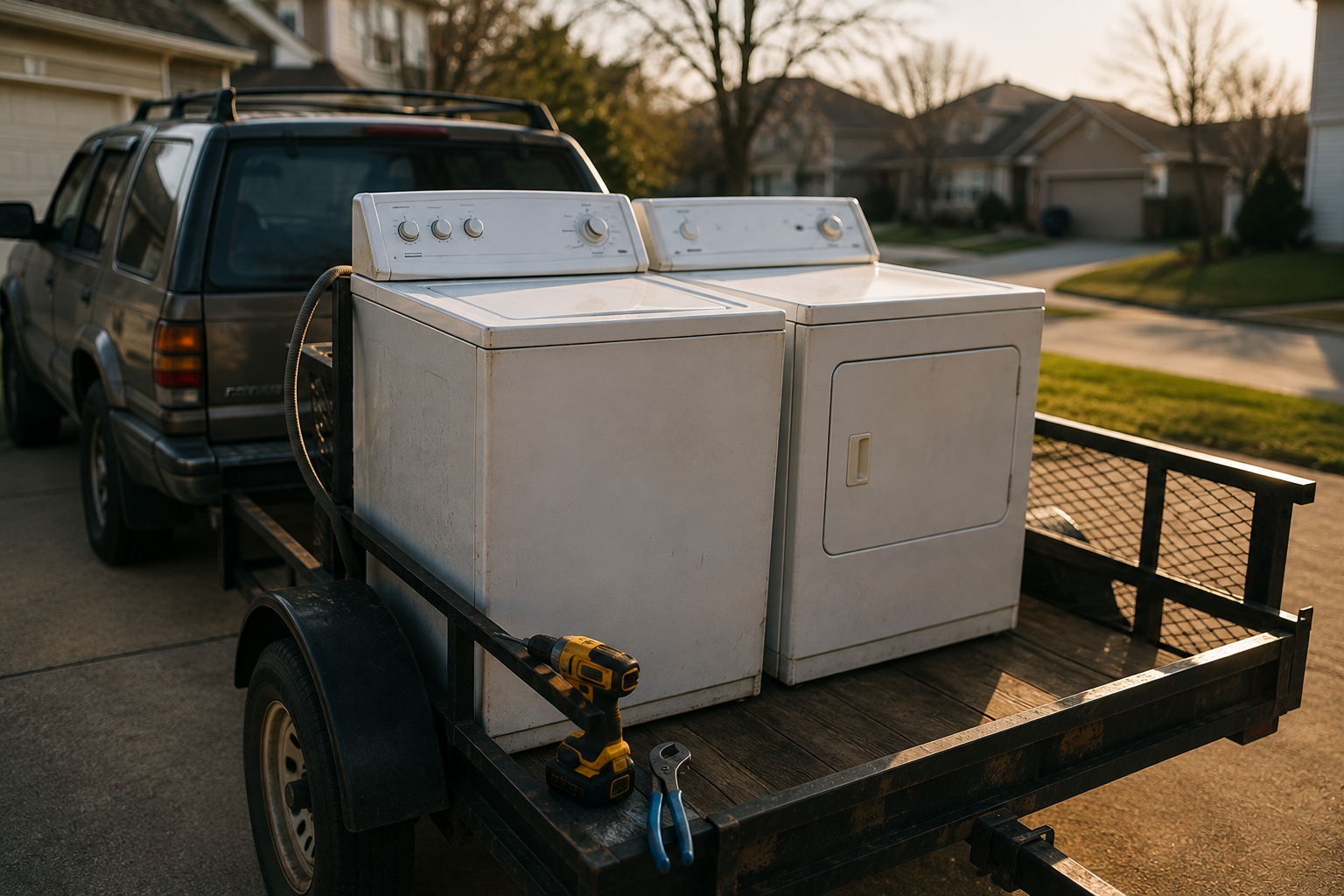
He runs deliveries using a Toyota Highlander with over 260,000 miles on it, paired with a small trailer roughly 10 feet long that fits about six machines at a time.
For anyone without a vehicle capable of towing, renting a truck from Home Depot for about $25 a day, or installing a trailer hitch through U-Haul for around $250, are both realistic starting points.
His toolkit is intentionally simple: a cordless drill, commonly a Ryobi model, and a pair of channel-lock pliers.
He also uses printed door hangers placed on apartment complexes that clearly do not include washers and dryers as part of the lease.
Hanging roughly 200 door hangers takes about 30 minutes and typically generates three to four leads from that single building alone.
He budgets around 5 cents per door hanger, meaning 10,000 of them cost roughly $500, a number he expects to help scale his revenue from $10,000 to $20,000 a month.
The Numbers That Make This Business Worth Studying
Out of roughly 170 total installs over about two years, only 50 customers ever canceled, putting monthly churn at around 1.5 percent, which is remarkably low for any subscription-style business.
Service calls average just five to eight per month across more than 100 active units, and many issues, like a clogged dryer vent, get resolved over the phone without an in-person visit.
Basic liability insurance for the entire operation runs about $700 a year, or roughly $60 a month.
With those numbers, the entire business runs on just five to ten hours of hands-on work per week.
That is the kind of margin and time freedom that makes people want to start a profitable appliance rental business in their own city.
👉Get Access to the full Package: Start a 1-Person Business With Claude AI
Why This Model Works in Almost Any City
This business does not require a massive metro area to succeed.
One operator scaled to more than 900 rental units and still only works two to three days a week.
Another tested the exact same model in Burley, Idaho, a town with only a few thousand residents, and still managed to rent out 25 sets with strong ongoing demand.
The common thread is simple: anywhere people live, laundry is a recurring need, and a month-to-month rental option solves a real, unavoidable problem.
Research even estimated there are roughly 15,000 independent mom-and-pop appliance shops across the country, many of which do not offer their own delivery service and are open to partnering with independent drivers.
That gap alone represents a separate income stream layered on top of the core rental business.
👉Get Access to : The AI Blog Monetization Quickstart Guide
Turning This Into Your Own Repeatable System
The appliance rental model proves something bigger than just one niche business idea.
It shows that low-risk, validate-first thinking can be applied to almost any local service business, not just washers and dryers.
If you want a repeatable system for testing, building, and scaling your own online income streams the same way, the Claude AI Digital Product Starter Pack and Medium Mastery guides walk through the exact frameworks for building digital products and content-driven income around AI tools.
The core lesson is the same one this appliance business proves: post first, validate demand, then invest.
That single mindset shift is often the real difference between people who start a profitable appliance rental business successfully and people who spend money before they ever confirm anyone wants what they are selling.
👉Get Access to : The AI Traffic Vault
👉Free download : Start a 1-Person Business With Claude AI — Free Quick-Start Guide

We strongly recommend that you check out our guide on how to take advantage of AI in today’s passive income economy.