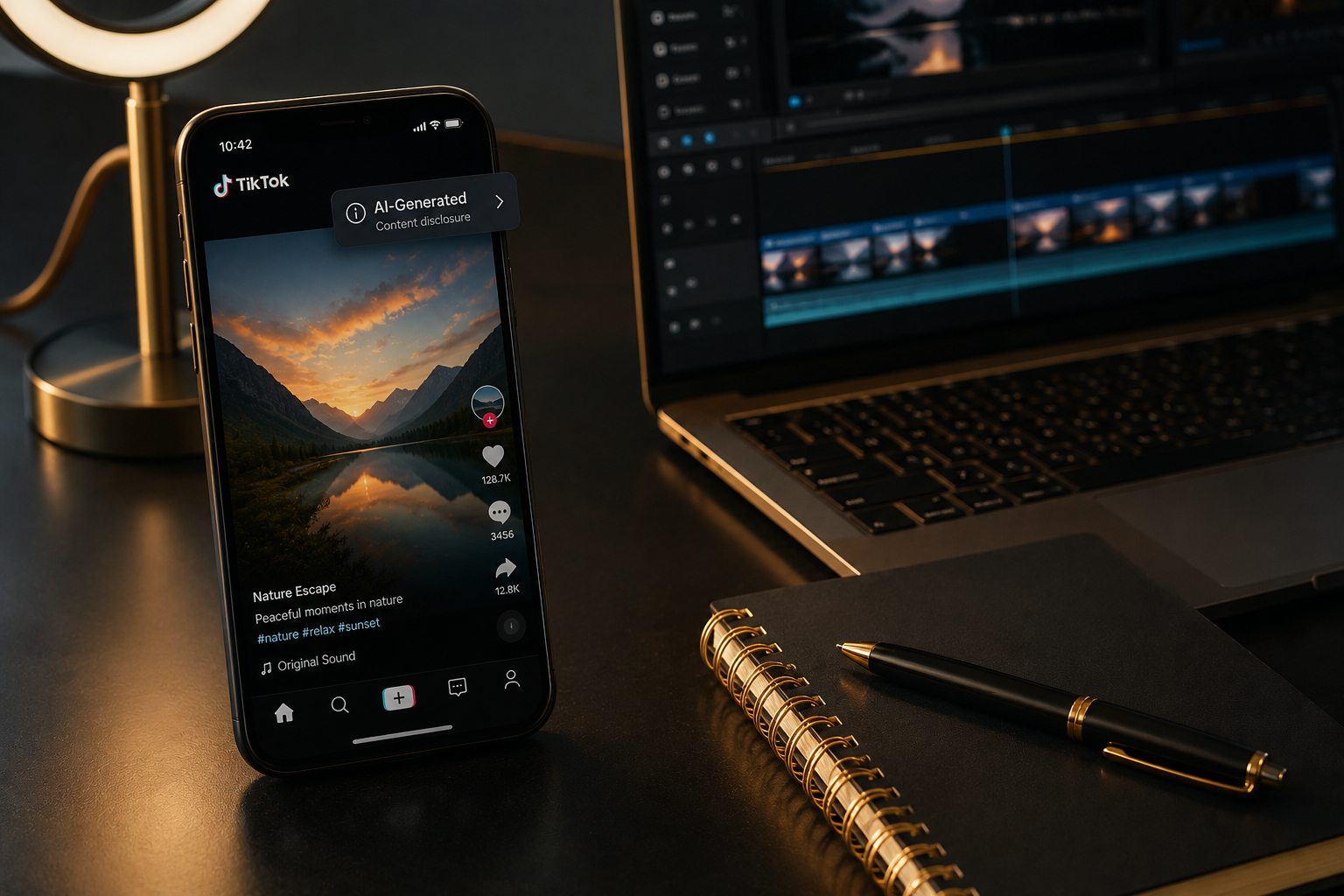
TikTok Just Banned This Type of Content in 2026 (And 3 Things You Must Do Next)
TikTok’s 2026 AI content disclosure rules now ban undisclosed AI-generated and deepfake videos that depict real people without their consent or without a visible label.
This means any video that uses artificial intelligence to make someone appear to say or do something they never actually did is no longer allowed unless it is clearly marked.
The change affects creators, brands, and agencies who use AI tools to build faceless channels, product demos, or influencer-style content.
Understanding these TikTok AI content disclosure rules now is the difference between a channel that keeps growing and one that quietly loses its reach.
We strongly recommend that you check out our guide on how to take advantage of AI in today’s passive income economy.
Table of Contents
What TikTok Actually Banned in 2026
TikTok did not ban AI content as a whole.
What changed is much narrower and much more specific than that.
TikTok’s updated Community Guidelines on synthetic and manipulated media now require explicit disclosure of AI-generated content across organic posts, branded content, and paid advertisements.
The platform also defines a deepfake as any AI-generated or AI-manipulated video, image, or audio that depicts a real person in a way they did not authorize.
So the “banned” content type is not AI editing tools, AI voiceovers, or AI-assisted video creation in general.
It is specifically content that fakes a real person’s likeness or voice without their permission and without a clear on-screen label.
This is the core of the new TikTok AI content disclosure rules that every brand and creator now has to work around.
If your channel uses AI avatars, AI voice tools, or AI-generated presenters, the rule still applies to you the moment a video could be mistaken for a real human speaking.
👉Free download: Start a 1-Person Business With Claude AI — Free Quick-Start Guide
Two Enforcement Categories You Should Know
TikTok’s policy splits enforcement into two clear buckets, and knowing which one applies to your content matters.
The first bucket is an absolute ban with zero exceptions, no matter how the content is labeled.
This includes political deepfakes of electoral candidates, where any synthetic media of that kind is prohibited outright.
The second bucket is conditional, meaning the content can stay up as long as it is properly labeled and disclosed.
Most creator content, including AI avatars, AI-voiced tutorials, and AI-generated product demos, falls into this second, more flexible category.
The key is that the label has to be visible on the video itself, not buried in the caption where viewers might miss it.
Getting this distinction right protects your channel from takedowns while still letting you use AI tools to scale your content output.
👉Free download: The Claude AI Digital Product Starter Pack — 10 Done-For-You Prompts for Beginners
Why TikTok Is Cracking Down Right Now
This crackdown did not happen in isolation, and there is a clear reason behind the timing.
TikTok’s US operations moved to an Oracle-led joint venture in January 2026, which changed how the platform is governed and secured in the United States.
With American investors and Oracle now overseeing US operations, there has been a stronger push toward brand-safe, advertiser-friendly content across the platform.
Regulatory pressure is also part of this story, and it did not start with TikTok.
The FTC’s increasing enforcement of influencer disclosure rules in the United States directly influenced TikTok’s decision to formalize these requirements rather than leave them as loose community guidelines.
Advertisers also want assurance that their paid content sits next to authentic, clearly labeled posts, not synthetic media that could damage trust in the platform.
For everyday users, the goal is simple: when someone can quickly tell whether a video is AI-generated, they can decide for themselves whether to trust what they see.
That transparency is now baked directly into TikTok’s algorithm, and it is reshaping the TikTok AI content disclosure rules for everyone who posts commercial or creator content in 2026.
What Counts as the Banned Content Type
TikTok’s definition of restricted AI content is broader than most creators expect, so it helps to see it laid out clearly.
Here are the content types that now require disclosure under the TikTok AI content disclosure rules, or risk removal if left unlabeled:
- AI-generated avatars or presenters that could pass as a real human on camera
- AI voice cloning used to narrate a video without disclosing the voice is synthetic
- Deepfake edits that place a real, named person’s face or voice into new footage
- AI-generated “endorsements” that make it look like someone recommends a product without consent
- Heavily AI-altered backgrounds or scenes that could mislead viewers into thinking footage is real
- AI-generated content designed to spread misinformation, which is prohibited outright regardless of labeling
TikTok’s synthetic media rules require disclosure not just for organic posts, but for branded content and paid advertisements too.
This means an agency running paid TikTok ads with an AI-generated spokesperson faces the exact same disclosure requirement as a solo creator posting for free.
👉Get Access to: The AI Blog Monetization Quickstart Guide
How to Label AI Content the Right Way
Labeling your content correctly is simpler than most creators assume once you understand the process.
TikTok gives every account built-in tools to disclose AI-generated material, and skipping this step is the fastest way to lose reach.
Step 1: Turn On the AI-Generated Content Toggle
After you finish editing your video, tap “Next” to reach the posting screen.
Look for the AI-generated content or synthetic media disclosure setting and switch it on before you publish.
This tells TikTok’s system directly that the video contains AI-created or AI-altered elements.
Step 2: Add a Visible On-Screen Label
Your disclosure cannot live only in the caption, because the label needs to appear on the video itself.
A simple text overlay that says “AI-generated” or “Made with AI” placed clearly on screen satisfies this requirement.
Step 3: Keep the Caption Consistent With the Video
Add the same disclosure language in your caption so the label matches across the whole post.
This consistency helps TikTok’s automated systems confirm the disclosure and reduces your chances of a manual review flag.
New Limits on Off-Platform Promotion
Alongside the AI disclosure rules, TikTok tightened how creators can send viewers outside the app.
These updated community guidelines restrict how creators can direct viewers to external platforms or websites, and they apply most heavily to livestreams.
Only accounts with at least 1,000 followers can host livestreams, and the account holder must be 16 or older, while receiving virtual gifts during a livestream requires the creator to be 18 or older.
For brands and creators building an audience through TikTok, this means external links, contact details, and mentions of other platforms need to follow the platform’s current disclosure and promotion rules rather than being dropped freely into a livestream.
If you’re building a personal brand around AI tools and digital products, this is exactly why owning your own audience matters.
👉Free download: Start a 1-Person Business With Claude AI — Free Quick-Start Guide
How TikTok Detects Violations
TikTok does not rely on human moderators alone to catch undisclosed AI content.
The platform’s synthetic media detection systems are built to flag videos automatically, then route serious cases to human review for a final decision.
Enforcement follows a tiered penalty structure, meaning first-time or minor disclosure issues are treated differently from repeated or harmful violations.
If a creator does not disclose properly or fails to appeal within 24 hours, the content becomes ineligible for the For You feed and loses significant reach.
Repeated violations can escalate from reduced distribution all the way to posting restrictions or a full account suspension.
This is why building the disclosure habit into your workflow from day one matters more than trying to fix flagged videos after the fact.
Will Disclosure Labels Hurt Your Reach?
This is the question every creator asks, and the honest answer is reassuring.
TikTok’s own compliance data suggests properly disclosed content performs just as well as similar undisclosed posts, and sometimes better.
The real reach penalty comes from skipping disclosure entirely, not from adding the label.
Content that stays compliant continues to pass campaign and pre-launch checks that require AI-generated content to be labeled, along with verified accounts and factual, provable claims.
Properly labeled content remains fully eligible for standard algorithmic distribution across the For You feed.
There is no hidden penalty for being upfront about using AI, and creators who build transparency into their workflow tend to build stronger long-term trust with their audience too.
What You Should Post Next: Action Checklist
Now that you understand the TikTok AI content disclosure rules, here is exactly what to check before your next upload.
- Review your last 10 to 15 videos and confirm any AI-generated or AI-voiced content has a visible on-screen label
- Turn on TikTok’s AI-generated content toggle for every future post that uses synthetic voice, avatars, or heavy AI editing
- Add matching disclosure language in your captions, not just the video overlay
- Audit any livestream plans against the current follower and age requirements before going live
- Keep AI content authentic in intent, meaning it enhances your real voice and expertise rather than replacing it entirely
- Document your disclosure process so your team or collaborators follow the same standard every time
If you’re using AI tools like Claude to plan, script, or scale your content output, the goal is the same: use AI to support your authentic voice, not to impersonate someone else’s.
👉 Get Access to the full package: Start a 1-Person Business With Claude AI
Frequently Asked Questions
Does this rule ban all AI-generated content on TikTok?
No, it only restricts AI content that depicts a real, identifiable person without their consent or without a visible disclosure label.
Can I still use AI voice tools for my videos?
Yes, as long as you disclose that the voice is AI-generated using TikTok’s built-in labeling tools.
Does labeling my content as AI-generated hurt my reach?
No, TikTok’s compliance data shows properly disclosed content performs on par with similar non-disclosed posts, while undisclosed content risks removal from the For You feed.
Do these rules apply outside the United States?
Enforcement varies by country, and brands operating globally should follow the most restrictive version of the guidelines to stay compliant everywhere they post.
Final Thoughts
TikTok’s 2026 AI content disclosure rules are not designed to punish creators who use AI tools responsibly.
They exist to protect real people from being impersonated and to keep the platform trustworthy for advertisers and viewers alike.
If you label your AI content clearly, keep your voice authentic, and stay inside the platform’s current promotion rules, there is no reason your reach should suffer.
The creators who adapt early to these TikTok AI content disclosure rules will be the ones still growing steadily while others scramble to catch up.
👉Free download: The Claude AI Digital Product Starter Pack — 10 Done-For-You Prompts for Beginners
👉Free download: Start a 1-Person Business With Claude AI — Free Quick-Start Guide
We strongly recommend that you check out our guide on how to take advantage of AI in today’s passive income economy.