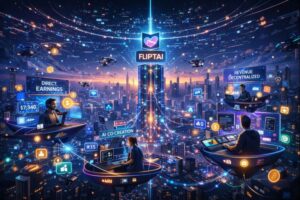
The Quiet Revolution Happening Inside the Creator Economy
UGC monetization is no longer a side benefit of content creation — it is the entire business model, and most creators have not yet realized it.
Picture a young woman sitting at a secondhand desk in a studio apartment, her phone propped up on a stack of textbooks, filming her fifth brand unboxing video this week — all for free.
She has warm lighting, a natural on-camera presence, and a genuine talent for making products feel desirable in under 60 seconds.
Brands keep sliding into her DMs, asking for “just one more clip,” and she keeps delivering, getting nothing but a repost and a thank-you emoji in return.
This scene is playing out across millions of phones and laptops every single day, and it is one of the most costly and least-discussed stories in the entire creator economy.
The shift from free content labor to paid content assets is real, it is picking up speed, and platforms like flipitai are building the infrastructure that makes the transition possible.
This article breaks down exactly what that shift looks like, why it matters deeply for your income, and how both creators and flippers can stop leaving money on the table starting today.
By the time you finish reading, you will see every piece of content you make as what it truly is — a business asset with a price tag worth collecting.
Table of Contents
How “Free Content” Became the Creator Economy’s Biggest Myth
The Editing Trap That Has Been Keeping Creators Broke
Let’s start with a scene that most working creators will recognize immediately and painfully.
A brand reaches out, asks for a 30-second product video, and offers “exposure” as the full payment — maybe a newsletter mention, maybe a repost, maybe nothing at all.
The creator says yes, spends three hours filming, two hours editing, an hour on revision notes, and finally uploads the finished clip with a cheerful caption and high hopes.
The brand takes that video, runs it as a paid ad, earns thousands in revenue from it, and the creator gets a follower count that barely moved and a message that says “great work, let’s do it again.”
This is the editing trap — and it is built entirely on the false promise that free creative work will somehow circle back as fame, opportunity, and eventual income.
UGC monetization flips this story on its head by treating every video, review, and testimonial as a licensable asset with a clear market value, not a favor being traded between strangers.
The creator economy is projected to reach USD 528 billion by 2030, and the overwhelming majority of that value is being built on the labor of people who are not yet receiving a fair share of it.
Understanding why that gap exists — and how to close it permanently — starts with recognizing that your content is not just self-expression anymore; it is intellectual property with a dollar figure attached.
What Brands Already Know That Most Creators Don’t
Brands have understood for years that raw, unpolished, authentic video content converts better than glossy studio advertising — sometimes by a factor of three or four times in measurable click-through and purchase rates.
They maintain entire teams whose job is to source, license, and amplify user-generated content because the return on investment is simply too strong to ignore.
When a real person films themselves using a skincare product in a bathroom mirror at 7 AM, it feels true — and that feeling of truth is worth an extraordinary amount of advertising spend.
Smart brands are not running those clips once and moving on; they are licensing the content, repurposing it across every digital channel, and paying for the right to use it on an ongoing basis.
UGC monetization is the mechanism that allows creators to step into this transaction as equal commercial participants rather than unpaid suppliers handing over assets out of goodwill.
Platforms designed around this exact model, like flipitai, are helping creators understand their market value, structure fair licensing terms, and connect with brands that are ready and willing to pay for quality content consistently.
The knowledge gap — the wide space between what major brands know about content value and what independent creators know — is precisely where enormous amounts of money are being lost every single day.
Closing that gap is not just about a bigger monthly income; it is about building a creative career with real staying power that does not burn itself out in two years on zero revenue.
The Rise of the Flipper: A New Player Nobody Saw Coming
Alongside the traditional on-camera creator, a brand new archetype has emerged inside the content economy — and this player is quietly building wealth without ever appearing on screen.
Imagine a person who does not create original content themselves but instead identifies undervalued UGC assets, enhances them using AI tools, and redistributes them at maximum commercial value to brands and agencies.
The flipper treats content the way a seasoned real estate investor treats property — sourcing it at the right price, adding meaningful value through curation and optimization, and licensing or reselling it at a premium.
This model is becoming one of the fastest-growing pathways to UGC monetization because it requires less personal brand-building and more systems thinking, which suits a completely different type of entrepreneur.
A flipper might source fifteen short-form videos from micro-creators in a specific niche, package them into a themed content bundle, and license that entire bundle to a brand for a flat fee or a long-term revenue share arrangement.
The dedicated flipper portal at flipitai is built specifically for this workflow, giving flippers the tools to source, tag, manage, and monetize UGC content assets at genuine scale.
This creates a healthy two-sided market where creators gain visibility and income they would never have found on their own, and flippers gain access to a steady pipeline of licensable content to build their entire business model around.
The system sustains itself because every participant in it benefits — and that mutual value exchange is the engine driving the most exciting new chapter in UGC monetization today.
Building a Real Income From Content You Already Make
Why Paid Reach Has Replaced Organic Growth as the Real Goal
Organic reach is not dead, but it is no longer the reliable, predictable growth engine it was five years ago — and most creators are still building their entire strategy as if nothing has changed since 2019.
Algorithms across every major platform have shifted toward pay-to-play models, meaning that even genuinely excellent content can sit invisible without the distribution muscle that either money or strategic partnerships provide.
The creators who are winning consistently in 2025 are not just making better content — they are pairing exceptional creative work with smart distribution through brand licensing, paid placement, and content syndication agreements.
UGC monetization is the bridge between making content and making real money from it, because it ensures the work you already produce gets compensated at every stage of its commercial journey.
Think of it this way: every time a brand runs your clip inside a paid ad campaign, you have effectively funded your own reach — your face and voice are in front of thousands of new people, the brand paid for the amplification, and you earned a licensing fee for the privilege.
Platforms like flipitai exist to help creators structure this model, protect their terms, and get connected with brands and flippers who are actively searching for quality UGC content to license right now.
The mental shift from chasing followers to building a content licensing portfolio is one of the single most important pivots any working creator can make in the current landscape.
It changes your entire relationship with the work — from an emotional hustle powered by the dopamine of likes to a strategic business powered by recurring, predictable income.
The Content Asset Stack: What a Monetizable Portfolio Actually Looks Like
A content asset stack is the collection of content pieces you own and can license, and building one intentionally is the practical foundation of every serious UGC monetization strategy that actually works.
Visualize a well-organized spreadsheet — rows and rows of video clips, product testimonials, lifestyle reviews, how-to guides, and reaction videos, each one carefully tagged by niche, format, platform compatibility, and current licensing status.
That spreadsheet is not just an archive gathering digital dust; it is a catalog, and every single item inside it is available for brands, agencies, and flippers to browse and pay for.
Short-form vertical videos are the hottest content asset class in the market right now, particularly those that follow the problem-solution-emotion arc and deliver their payoff within 30 to 45 seconds.
Brands will pay a meaningful premium for content that demonstrably converts, and authentic UGC consistently outperforms scripted studio advertising in 2025 performance data by substantial margins across categories.
UGC monetization through a well-organized content asset stack means you are never starting from zero when a brand inquiry arrives — you already have a searchable, licensable library they can shop from immediately.
Creators who set up their profile on flipitai can build and maintain exactly this kind of structured, monetizable content library within the platform, making discovery and deal-making faster and cleaner for every party involved.
The goal here is not to simply create more content volume but to make every piece of content you already produce work harder, smarter, and far longer on your behalf than it ever has before.
AI-Powered Optimization: The Secret Multiplier in Modern UGC Monetization
Artificial intelligence is not here to replace creators — it is the single most powerful tool available for making UGC monetization scale in ways that were genuinely unimaginable just three years ago.
Picture a creator who films one raw walkthrough video of a product and then uses AI optimization tools to generate five distinct platform versions from that single recording — a TikTok hook edit, an Instagram Reel, a YouTube Short, a Pinterest Pin, and a LinkedIn carousel.
Each version is precisely calibrated for the algorithm and audience behavior patterns of its specific platform, which means one piece of creative effort becomes five separate licensable assets in the same afternoon.
This kind of content multiplication is the central value proposition of AI-enhanced UGC monetization, and creators who have adopted this workflow are pulling dramatically ahead of those still editing every frame manually.
Captions, subtitles, background music selection, color grading, pacing, and even voice clarity can all be adjusted at scale with AI assistance, making every item in your portfolio more polished, more platform-ready, and more commercially valuable.
Flippers working through the flipitai portal are already using exactly this kind of AI-enhanced workflow to optimize sourced creator content before licensing it, effectively adding measurable value without proportionally increasing production time.
The creator economy in 2025 rewards efficiency as much as talent, and combining genuine creative skill with smart AI tooling is the competitive edge separating mid-level creators from the ones building real six-figure content businesses.
UGC monetization at scale is not just about having good content — it is about having optimized, organized, and strategically distributed content that generates income around the clock, whether you are filming that day or not.
Licensing vs. One-Time Payments: Why Recurring Revenue Changes the Entire Game
Most creators, when they first encounter the idea of UGC monetization, think in terms of one-time payments — a brand pays for a clip, the creator delivers it, both parties move on, and that transaction is closed forever.
But the creators building genuine, lasting wealth from their content are thinking in an entirely different framework — they are structuring licensing deals that allow a single creative moment to generate income repeatedly across time.
Licensing turns a single piece of content into an ongoing revenue stream, and it is the exact same business model that professional photographers, musicians, illustrators, and screenwriters have used to build sustainable careers for decades.
Imagine filming a 45-second product demonstration on a Tuesday afternoon and collecting a licensing fee every single time that clip runs as a paid ad over the next 18 months — that is what real recurring UGC monetization looks like in daily practice.
The difference in annual income between a creator who sells content as a one-time transaction and a creator who licenses it on usage terms is not a small gap — it is often the difference between a struggling side hustle and a thriving full-time creative business.
Platforms like flipitai are built around supporting this licensing model from the ground up, giving creators a clear framework to set terms, track content usage, and collect payments without needing a dedicated lawyer or business manager on retainer.
UGC monetization through licensing also compounds your negotiating leverage over time — every piece of data showing your content converts becomes a stronger argument for charging more the next time a brand wants access to your work.
This data-driven, asset-based approach to pricing your creative output is one of the most empowering habits a creator can build, and it starts the moment you decide to treat your content as a business rather than a social media diary.
The Flipper Economy: Building Real Wealth Without Ever Being on Camera
Not every person who wants to earn from the UGC economy needs to be a face on camera, and this is genuinely one of the most liberating and underappreciated truths in the modern creator landscape.
The flipper model opens a credible path to serious UGC monetization for people who are strategic, detail-oriented, and skilled at identifying undervalued creative work — regardless of whether a camera makes them comfortable.
Think of a flipper as a content entrepreneur operating behind the scenes: they identify micro-creators who have 1,500 followers but produce stunning, highly specific product content in a niche that brands desperately need to reach.
The flipper licenses or acquires those assets, enhances them with AI optimization tools, packages them into themed, brand-ready collections, and pitches the entire package to companies in that niche who need authentic content but lack the time or systems to source it themselves.
The brand gets polished, ready-to-deploy assets that feel genuinely real; the creator gets paid, credited, and discovered by a wider audience; and the flipper earns a healthy margin for the curation and optimization work they brought to the table.
The dedicated flipper interface at flipitai is engineered for exactly this workflow, consolidating creator discovery, asset management, AI enhancement, and licensing deal logistics into one focused and streamlined environment.
This three-way value exchange is the structural reason the flipper economy is scaling so quickly inside the broader UGC monetization landscape — it solves a genuine, painful problem for all three parties simultaneously and repeatedly.
In a content environment where raw clips are abundant but curated, on-brand, conversion-ready assets are genuinely scarce, the flipper who can consistently deliver the latter is building something with real and durable long-term commercial value.
From Traffic Recovery to Evergreen Income: The Long Game of UGC Monetization
One of the most overlooked and potentially most profitable dimensions of UGC monetization is traffic recovery — the practice of identifying and relicensing older content that is still actively performing long after its original publish date.
Imagine a product review video you filmed 16 months ago that still ranks on the first page of YouTube search results and continues to drive affiliate link clicks and viewer engagement every single week without any new effort from you.
That clip is not an old post — it is a living, performing asset, and a brand paying attention to performance data would pay a meaningful fee to license it for their paid campaigns, buying structured commercial distribution on top of the organic reach it already owns.
UGC monetization through traffic recovery means expanding your focus beyond new content to actively auditing your entire existing library for revenue opportunities that are already generating value and just need to be formally packaged.
AI-powered analytics tools available through platforms like flipitai can surface exactly which older pieces of content in your library are still pulling audience engagement, making it straightforward to pitch them to prospective licensing partners as time-tested, proven-performing assets.
The evergreen income model — where creative work you produced months or years ago continues generating licensing revenue without any additional production effort — is the fullest and most sustainable expression of UGC monetization done right.
Building this kind of compounding content portfolio requires genuine discipline, a system for organization, and the right platform infrastructure to support long-term asset management at scale.
Every piece of content you create today is making a quiet choice: it is either becoming a one-time transaction that earns once and disappears, or it is becoming a long-term income asset that earns for years — and the decision about which one it becomes is entirely in your hands.
Conclusion: The Shift Has Already Happened — The Only Question Is Whether You’re In It
The creator economy has already made its move from free editing to paid reach — the transition is not on the horizon, it has arrived, and the window for early-mover advantage is sitting wide open right now.
Creators who have built a clear understanding of UGC monetization are assembling licensing portfolios, attracting recurring brand revenue, and scaling their income without necessarily needing to grow their audience by a single additional follower.
Flippers who have stepped into the new content economy are building serious six-figure businesses from curated, AI-enhanced content assets that never required them to appear on camera or grow a personal brand at all.
The infrastructure supporting all of this — the platforms, the AI tools, the community-level market intelligence, and the brand-side appetite for authentic creator content — is more developed, more accessible, and more ready to work for you right now than at any point in history.
UGC monetization is not a complicated concept dressed up in industry jargon: it is simply the practice of being paid fairly and repeatedly for creative work that carries documented, demonstrable value in the real commercial marketplace.
If you are a creator who is ready to stop working for free and start building a content business with real, recurring, compounding income, the starting point is flipitai — a platform built specifically around this model, for creators who are serious about making their content work as hard as they do.
If you are a flipper who is ready to source, enhance, and monetize high-quality UGC content at genuine scale, your dedicated operational hub is at flipitai — built from the ground up to support the full flipper workflow from asset discovery all the way through to licensing and payment.
The shift is real, the tools are built, the brands are ready to open their budgets, and the only question left is a simple one — will you step into this moment with the strategy and the platform to make it fully count?
We strongly recommend that you check out our guide on how to take advantage of AI in today’s passive income economy.