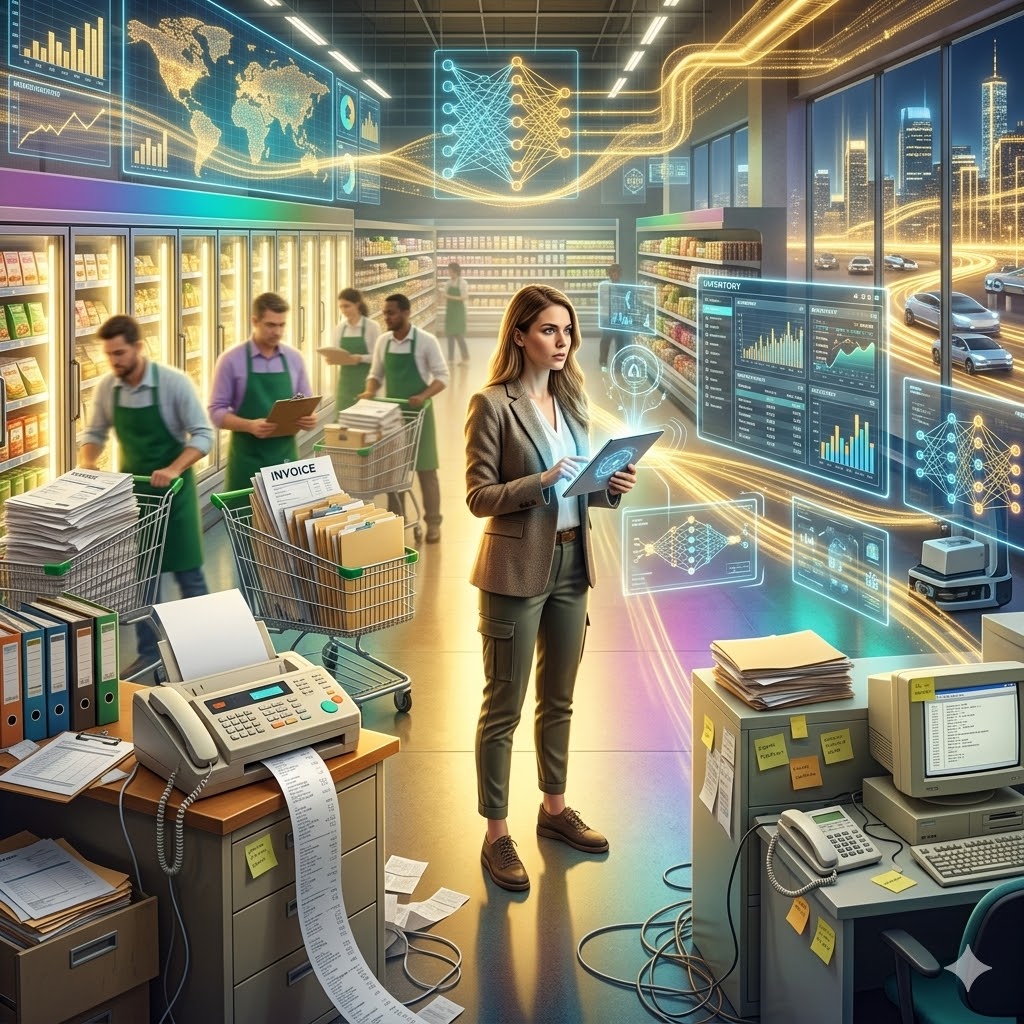
How One Startup Is Turning Clipboards and Fax Machines Into a Self-Driving Grocery Store
The Grocery Industry Nobody Talks About — And Why That’s About to Change
The $1.5 trillion grocery retail industry still runs on paper invoices, pencil-written orders, and fax machines in thousands of stores across America right now.
That is not a sentence about the 1990s.
That is what is happening today, in 2026, inside over 220,000 food and beverage retail locations spread across every corner of the United States.
Most people think about grocery stores as simple places — you walk in, grab your milk and eggs, and leave.
But behind those familiar aisles sits one of the most financially massive and technologically neglected industries on the planet.
It is bigger than the entire U.S. restaurant industry.
It is bigger than hotels.
It generates $1.5 trillion in overall processing volume every single year.
And for decades, the people running these stores have been managing that staggering volume with clipboards, stacks of paper catalogs, and phone calls to suppliers to order bananas.
We strongly recommend that you check out our guide on how to take advantage of AI in today’s passive income economy.
Table of Contents
A Family Legacy That Became a Billion-Dollar Problem Worth Solving
Brandon Crozier, co-founder and CEO of Vory, did not stumble onto this problem by accident.
He is third-generation grocery — his grandparents ran small stores in Oklahoma, his parents spent 40 years inside the food and beverage world, and his mother worked for major manufacturers including Mondelez International, the company that makes Oreo cookies, and Oscar Mayer, the iconic meat brand.
His father served as North American Director of Sales for Reynolds Consumer Products, the company behind the household grill foil you probably used at your last backyard barbecue.
His parents famously met and fell in love at the headquarters of Price Chopper, the upstate New York grocery chain, while both were pitching to grocery buyers in the same building.
Grocery was literally in Brandon’s blood before he ever thought about building a startup.
But the actual moment that sparked Vory came in 2020, when Brandon was visiting his parents in Minneapolis and they handed him a stack of invoices and paper catalogs from their grocery contacts.
He looked at the pile and assumed it was a relic from 20 years ago.
His parents told him it had come in from stores just the year before — 2019.
The SpaceX Moment That Changed Everything
Brandon brought that stack of papers to his Stanford friends and future co-founders, Rob Lor and Trey Doig.
Rob had worked at SpaceX, Lockheed Martin, and later built self-driving car technology at Lyft.
Trey had worked alongside Brandon at Google.
Together, they looked at that pile of grocery paperwork and had what Brandon now calls their defining moment of clarity.
Across the street from SpaceX’s Hawthorne, California headquarters, where engineers were relanding orbital rockets and planning missions to Mars, sat a grocery store where workers were counting inventory on a clipboard.
On the same planet.
In the same zip code.
One building was designing systems to terraform other planets, and the next building over was managing the food supply of an American community using a fax machine.
That contrast — feeding civilization on Earth using the same tools from 30 years ago — was the spark that sent Brandon, Rob, and Trey into Y Combinator with a stack of paper invoices slammed on the table as their pitch.
What Vory Actually Is — And Why the $1.5 Trillion Grocery Retail Industry Needs It Now
Vory is an all-in-one point-of-sale and agentic store management system built specifically for supermarkets and independent grocery retailers.
The platform covers five core pillars: point-of-sale, payment processing, inventory management, shopper marketing, and dynamic pricing.
Together, these five systems allow Vory to walk into a grocery store and, on average across its customer base, deliver a 20 to 25 percent lift in net sales, add seven to ten points in gross margin improvement, and repurpose labor away from manual tasks like printing shelf tags and re-entering data into back-office systems.
In plain language — stores that use Vory make significantly more money, waste less product, and run with less administrative chaos.
Since launching, Vory has processed over $500 million in payments and served more than one million shoppers in communities ranging from Staten Island in New York to Seattle in Washington.
That growth happened in just two years of full platform operation, following four years of intensive research, development, and product expansion.
The $1.5 trillion grocery retail industry that runs on outdated paper systems is exactly the customer this platform was designed to rescue.
Starting With a Wedge — The Inventory Ordering App That Got a Bear Hug
Vory did not launch with a full platform.
The team started narrow — a simple mobile app to help grocery stores reorder inventory from their wholesale suppliers without using paper, pencil, or fax machines.
Their first real customer conversations happened the hard way: walking into stores every day, studying the aisles, understanding what made each store unique, asking for the owner, and refusing to leave until someone sat down with them.
Their breakthrough came at The Market at Edgewood, a grocery store in Palo Alto not far from Stanford’s campus.
After showing up repeatedly, the owners finally agreed to explain their biggest pain points.
The core problem was inventory — a grocery store carries between 50,000 and 100,000 individual SKUs, ordering from hundreds and sometimes up to a thousand different wholesale suppliers, all managed on clipboards.
Forgetting to place an order meant empty shelves.
Ordering too much meant perfectly good broccoli going into the trash.
Brandon, Rob, and Trey went to their garage in East Palo Alto, stocked up on Red Bull and beef jerky, and built an app to solve this problem in 11 days.
When they came back and showed the dairy order clerk, Haime, how to scan barcodes and place a digital purchase order, he stopped mid-aisle, looked at the three founders, and said he had goosebumps.
He had never seen anything built specifically for him before.
He lifted Rob off the ground in a bear hug right there in the dairy aisle.
That moment told the Vory team everything they needed to know — there was a massive gap in the market, and the pain was real enough to produce that kind of visceral reaction.
Four Years of Research, Then a National Sales Machine
From that first bear hug, Vory scaled methodically — not by rushing, but by deeply understanding the complexity of the $1.5 trillion grocery retail industry that has decades of operational baggage baked in.
From 2020 to 2024, the team spent four years expanding their understanding of how grocery operates globally, visiting design partners in Western Colorado, studying stores in Amsterdam, and building a platform sophisticated enough to handle the regulatory complexity that comes with accepting government payment types like SNAP food stamps and WIC benefits.
By the time Vory launched its full end-to-end store management platform, the sales process had evolved from three founders knocking on five store doors a day, to a national field sales team of 15 representatives working across different U.S. geographies with individual quotas of approximately one million dollars per year.
The median sales cycle for a new Vory customer today is 18 to 21 days.
The median deployment cycle — getting the full platform live inside the store — is approximately 37 days.
Those are nearly consumer-level buying speeds for a product with enterprise-level complexity and stickiness.
The pitch that closes stores is not about features.
It is tied directly to the store’s profit and loss statement — sales lift, gross margin improvement, and labor repurposing — three levers that make the return on investment undeniable.
The Dairy Truck Crisis That Defined Vory’s Culture
Not everything went smoothly.
One of Vory’s defining early moments was a 5 a.m. phone call from Molly Stone’s Markets, a respected Bay Area grocery chain, reporting that a large Clover Dairy order placed through the Vory app had been dropped — the order never transmitted to the supplier.
If Molly Stone’s opened without dairy, the community impact was immediate: no milk for children’s cereal, no eggs for breakfast, and no foot traffic driven by the loss-leader products that bring shoppers into stores in the first place.
The Vory team did not apologize and move on.
They rented a refrigerated truck, drove to multiple locations including Whole Foods and big-box retailers, filled five shopping carts with milk, eggs, and cheese, loaded everything into the refrigerated truck, and delivered the complete order to Molly Stone’s just in time for the store to open its doors.
Molly Stone’s still tells that story today.
It is now enshrined inside Vory as a company principle: don’t mess with the dairy order — a reminder that they are critical infrastructure for communities, not just a software vendor.
That early willingness to show up and make things right, even at a painful cost, built the reputation that opened doors to hundreds of stores that followed.
AI Agents, Tariff Management, and the Self-Driving Grocery Store
The $1.5 trillion grocery retail industry is now sitting at a genuine technological inflection point, and Vory is positioning itself at the center of that transformation.
The platform currently runs three AI agents operating autonomously on behalf of each store.
The inventory agent automatically queues up replenishment orders and generates personalized offers to help shoppers increase their basket size during each visit.
The marketing agent creates targeted promotions based on purchasing patterns across the store’s one million-plus shopper touchpoints.
The pricing agent is perhaps the most powerful of the three — in an environment where tariffs and inflation are constantly pushing the cost of goods upward, Vory’s pricing agent automatically detects a price change from an incoming supplier invoice, pushes an updated price to the store’s electronic shelf labels, and ensures the customer pays the correct price at checkout — all in one automated step that previously required 12 separate manual actions inside the store.
Internally, Vory has also gone fully AI-native, with sales representatives using AI tools to write code, build custom store proposals, and close deals faster.
Development cycles that previously took a quarter are now completed in days.
Walmart, Amazon, and the $1.5 Trillion Race Nobody Is Watching
Here is what makes the moment especially urgent for the entire $1.5 trillion grocery retail industry facing digital transformation.
Walmart and Amazon — two of the most operationally sophisticated companies on the planet — are both betting enormous resources on the future of physical grocery right now.
In the past three months alone, Walmart has filed 50 retail AI patents aimed at transforming its Supercenter locations into stores of the future.
Amazon, which invented modern e-commerce, has declared that its next decade of growth is focused on physical grocery — it already owns Whole Foods, operates Amazon Fresh locations, has tested its Just Walk Out cashierless technology, and is now opening Costco-style warehouse club competitors beginning in Chicago.
Together, those two companies represent approximately 25 percent of the total U.S. grocery market.
The other 75 percent — over 200,000 independent and regional food and beverage retailers — have nobody building Walmart and Amazon-scale technology for them.
Vory is building precisely that.
The long-term vision is a self-driving grocery store: a store where the owner is freed from manual, valueless work, where AI agents handle pricing, inventory, and marketing automatically, where every dollar flowing in and out of the store is processed, tracked, and optimized in real time through a single system.
Gen Z is already driving this shift — recent consumer behavior reports show that younger shoppers are visiting physical grocery stores more frequently than millennials, using them as social spaces, hosting speed dating events inside them, and treating them as community third spaces in the way previous generations used coffee shops.
The grocery store of the future is not dying.
It is becoming the neighborhood living room — and Vory intends to be the operating system running underneath it.
$22 Million Series B and the Road to 3,000 Stores
Vory recently closed a $22 million Series B funding round led by Cherryrock Capital, a vote of confidence in both the team and the massive scale of the opportunity ahead.
The immediate goal is to reach $100 million in annual recurring revenue by getting 3,000 stores onto the full Vory platform — a milestone the team believes is achievable with their current product and go-to-market motion without requiring any major new product development.
The longer-term vision expands into financial services: helping stores access working capital to open new locations, add departments like coffee shops, pay their suppliers digitally, and eventually becoming the clearing house for trade across the entire global food supply chain.
Across 10 trillion dollars of grocery volume globally, the gap between where the industry operates today and where it could operate with modern technology is staggering.
The $1.5 trillion grocery retail industry stuck in outdated operational systems is not a niche problem.
It is the largest undigitized retail format on Earth, feeding civilization every single day, and it is finally — slowly, store by store — being dragged into the 21st century.
One bear hug at a time.

We strongly recommend that you check out our guide on how to take advantage of AI in today’s passive income economy.