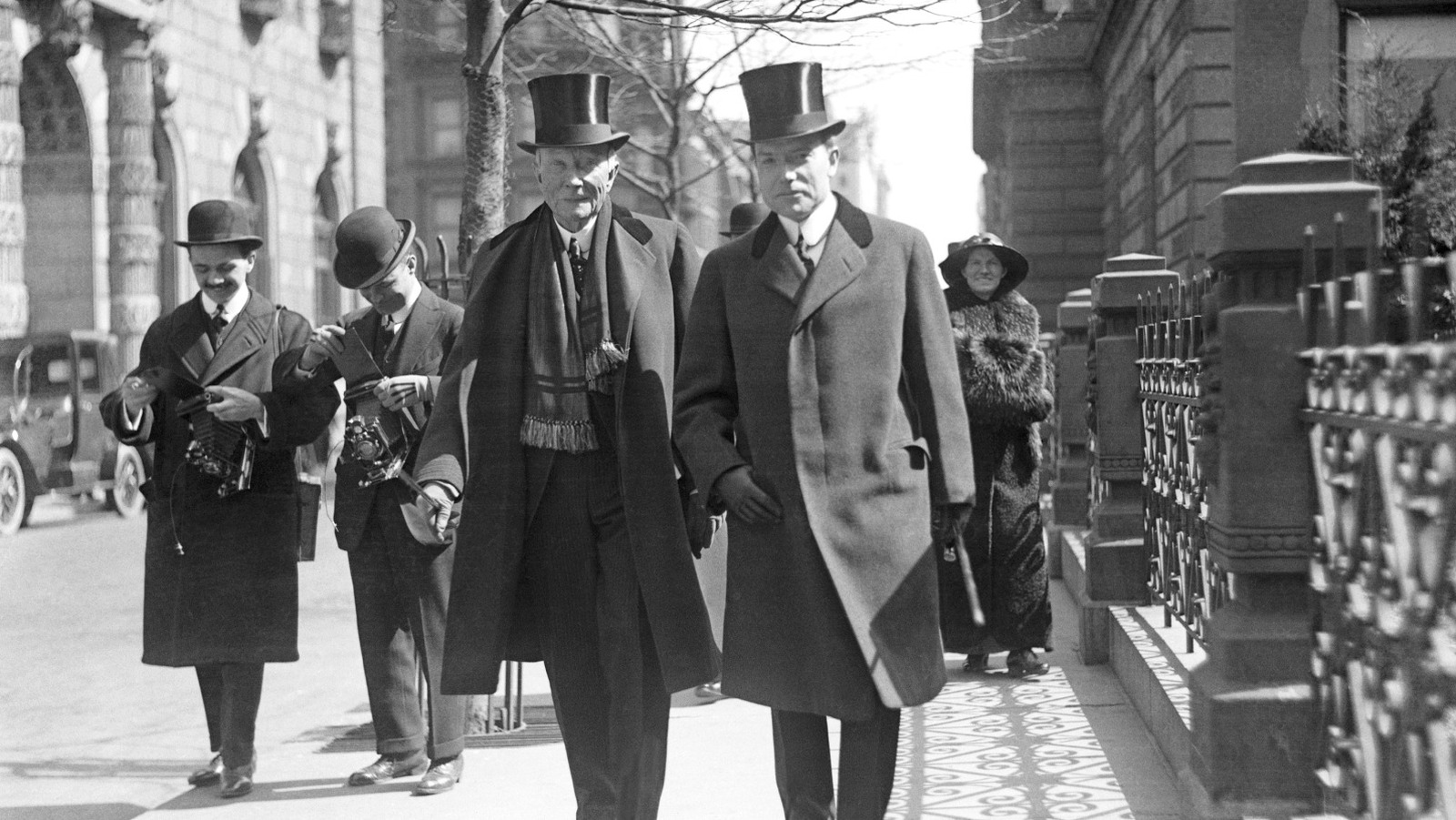
How Rockefeller Turned a $3.50 Paycheck Into the Biggest Fortune in History Using 7 Simple Money Rules
The money rules that built the largest personal fortune in human history did not start in a boardroom, a prestigious university, or a wealthy family estate.
They started at a small wooden desk in Cleveland, Ohio, where a 16-year-old boy was learning to read the financial bones of a business before most kids his age had ever held a real job.
That boy was John D. Rockefeller, and the wealth principles he discovered, refined, and executed with surgical precision became the same money rules that quietly separate the wealthy from everyone else in 2026.
If you have ever used a tool like ClawCastle to automate your workflow or HandyClaw to simplify your online income systems, then you already understand one of Rockefeller’s core beliefs: that leverage hidden inside a system is always worth more than raw effort applied on the surface.
This article walks you through the seven chapters of Rockefeller’s rise, and at every turning point, it reveals the exact money rule he used, why it worked then, and why it still works now.
We strongly recommend that you check out our guide on how to take advantage of AI in today’s passive income economy.
Table of Contents
Chapter 1: The Bookkeeper — Learn the Plumbing First
On September 26th, 1855, a 16-year-old boy with no connections, no college degree, and no family money walked the streets of Cleveland knocking on every business door he could find until someone said yes.
That someone ran a small commodities firm, and they offered him a job as a bookkeeper at $3.50 a week, which most teenagers would have treated as temporary embarrassment on the way to something better.
Rockefeller treated it like a masterclass in how money actually moves inside a real business.
He inspected every single line of every invoice that passed through that office, learning not just what things cost but why they cost that amount and where the business was silently bleeding money it had never noticed.
He built a mental model of business from the inside out, understanding the invisible architecture underneath the visible surface before he ever owned a single thing.
This is Rockefeller money rule number one: learn the plumbing before you touch the pipes.
The plumbing is the part of any business that nobody talks about at dinner parties — vendor contracts, shipping rates, cost structures, payment terms, and all the unglamorous detail work that determines whether a company actually makes money or just looks like it does.
Rockefeller was so grateful for that first job that he celebrated its anniversary every single year for the rest of his life, calling it Job Day, because he understood that the day he got that role was the day someone handed him a map to the inside of how wealth is actually built.
If you are using ReplitIncome to generate income through AI-powered tools or AmpereAI to accelerate your digital business, apply this same rule: go deeper into your own numbers than any competitor is willing to go, and you will always find leverage they cannot see.
Chapter 2: The Greatest Borrower — Move When the Window Opens
By 1863, Rockefeller was 23 years old and watching the oil boom in western Pennsylvania turn ordinary wildcatters into millionaires and back into paupers inside the same calendar year.
While everyone around him was racing to drill for oil and chase the discovery, Rockefeller made a decision that looked backwards to almost everyone watching: he went into refining, the boring, smelly, industrial middle step that sat between crude oil in the ground and kerosene in a lamp.
He positioned himself at the choke point of an entire industry, the place every barrel of oil had to pass through, and then he started borrowing aggressively to expand as fast as the opportunity allowed.
His partners panicked, told him he was overleveraged, and tried to force a company showdown that would push him out.
Rockefeller had secretly lined up outside financing before the meeting began, engineered the buyout himself, and woke up the next day as a 25-year-old who owned one of the largest refineries in the world.
This is Rockefeller money rule number two: opportunity has a clock, and the people who wait for certainty usually find the window already closed.
The biggest fortunes in history were not built by people who moved safely — they were built by people who moved with conviction before the market caught up to what they already saw.
Tools like ClawCastle exist precisely for this kind of decisive moment, giving you the infrastructure to move fast without building everything from scratch, because in a fast-moving market, your speed is your edge.
Chapter 3: The Edge Nobody Saw — Find the Choke Point in Your Industry
By his mid-twenties, Rockefeller had a good refinery, but good was never going to be enough, and he knew it.
While competitors obsessed over refining capacity, bigger facilities, and faster output, Rockefeller looked at the full picture of his cost structure and realized that transportation was costing him more than refining itself.
Every barrel of oil refined in Cleveland had to travel to market by rail, and the railroads were charging everyone the same posted rate of 60 cents per barrel, which felt fair on the surface but was quietly eating the profit margin of every refiner in the region.
Rockefeller built his refinery intentionally next to both a railroad and a river, giving himself a shipping alternative that was 50 percent cheaper than anything his competitors could access, and then negotiated a secret rate with the railroads that dropped his cost from 60 cents to 50 cents per barrel.
That 10-cent difference, invisible to the market, compounded into $50,000 per year in hidden profit — the equivalent of millions in today’s money — and he reinvested every dollar of it into the next layer of advantage.
Then he did something even more brilliant: he offered to ship his competitors’ oil through his network at rates better than they could negotiate alone, turning his private edge into a revenue stream and his rivals into paying customers.
This is Rockefeller money rule number three: the real money in any industry is not in the obvious product — it is in the system everyone else depends on but nobody controls.
In 2026, the choke points are data storage, computing infrastructure, and the distribution networks that carry AI outputs to market, and the builders using HandyClaw and AmpereAI to own those layers are the ones quietly compounding while the crowd chases the surface.
Chapter 4: The Cleveland Massacre — Argue From Numbers, Not Opinions
On February 17th, 1872, a 32-year-old John D. Rockefeller sat across from one of Cleveland’s largest oil refiners and slid a single piece of paper across the desk.
On that paper was a number, and the refiner who looked at it understood immediately that he could not compete, because Rockefeller had opened his own books and shown exactly how efficiently Standard Oil was operating — margins the refiner could not touch, cost structures he could not replicate, and credit relationships he could never access.
Over the next 28 days, Rockefeller repeated this process with every major refiner in Cleveland — 23 companies acquired in one month in what historians would later call the Cleveland Massacre.
Eighteen owners took cash and walked away. Five took stock in Standard Oil and became some of the wealthiest families in America because Rockefeller told them to hold on to every share they had.
This is Rockefeller money rule number four: stop trying to win negotiations with opinions and emotions — reveal the numbers that make the conclusion undeniable.
Data does not leave room for debate the way feelings do, and when you can show someone the gap between where they are and where you are with raw, verifiable numbers, you remove the negotiation entirely and replace it with a decision.
Whether you are closing a deal, asking for a raise, or pitching an investor, the frame that wins is always the one built on facts so clear that the other side has no logical path to disagreement.
Platforms like ReplitIncome help you build the kind of trackable, data-driven income systems that make your results visible and undeniable when it matters most.
Chapter 5: The Monopoly and the Mask — Discipline Is a Competitive Advantage
By 1879, Standard Oil controlled 90 percent of American oil refining, and Rockefeller was 39 years old — arguably the most powerful businessman on the planet.
And yet, from his very first $3.50 paycheck, he had donated 10 percent to his church, never touched alcohol, never gambled, attended church twice every Sunday for his entire life, raised his children on hand-me-down clothes, and carried a bag of dimes to hand out to strangers on the street.
The reason for this discipline was rooted in a childhood where nothing could be depended on — his father was a traveling con artist who ran two secret families and disappeared for months at a time, leaving Rockefeller with no stability, no models of reliability, and no one he could count on.
He chose to become the exact opposite of what he watched, building every habit and routine as a direct response to the chaos he had survived.
This is Rockefeller money rule number five: the person who controls themselves in every environment will eventually control the environment itself.
Business is chaos by nature — employees quit, markets shift, deals collapse, and most of what happens is completely outside your control, which means the only real leverage you have is the discipline you apply to the things that are inside your control.
Using ClawCastle to systematize your content output or HandyClaw to automate your affiliate income processes is itself an act of discipline — removing inconsistency from the parts of your business that do not require your daily attention.
Chapter 6: The Reinvention — Operators Build Businesses, Owners Build Freedom
At 58 years old, Rockefeller’s hair was gone from stress, his body was breaking down from decades of relentless pressure, and he walked away from daily management of Standard Oil entirely.
He started playing golf, spending time with his grandchildren, and handing operations to the people he had spent years building and training to run the machine without him.
Then in 1911, the Supreme Court ordered Standard Oil broken into 34 separate companies as punishment for the monopoly — and the ruling that was meant to destroy him made him richer.
The separate companies, freed from each other, were worth more on the open market than Standard Oil had been as a unified entity, and between 1911 and 1913, by doing literally nothing, Rockefeller’s net worth nearly doubled.
He spent the rest of his life giving money away — $540 million donated, roughly $15 billion in today’s dollars — funding the Rockefeller Foundation, the University of Chicago, and medical research that helped eradicate diseases like hookworm and yellow fever.
He died in 1937, two months before his 98th birthday.
This is Rockefeller money rule number six: make yourself replaceable in your current role so you can grow into your next one.
The employee who documents their process becomes promotable, the freelancer who builds a system stops trading time for money, and the business owner who develops a real team stops being the bottleneck and starts being the multiplier.
Tools like AmpereAI and ReplitIncome are built for exactly this kind of systemization — removing yourself from the daily execution so the business keeps growing whether you are in the room or not.
Chapter 7: The Real Playbook — Build the Machine That Buys the Next Machine
Most people think Rockefeller built one massive company and defended it.
What he actually built was a machine that made acquiring the next company easier than the last one — the first refinery was hard, the tenth was easier, and the twentieth was nearly inevitable, because every acquisition had already strengthened his credit relationships, deepened his operator bench, and sharpened the deal structures he used to close the next one.
By the time he had done it 23 times in a single month, the engine was running itself.
This is Rockefeller money rule number seven: build boring businesses that everyone needs, do it better than anyone else is willing to, and do it longer than anyone else is prepared to.
Oil refining in the 1800s was dirty, smelly, blue-collar, and unglamorous — no member of the elite would have been caught near it — and it made Rockefeller the richest human being who has ever lived.
In 2026, the equivalents are car washes, plumbing companies, laundromats, AI content pipelines, and automated affiliate systems — the things that do not make headlines but produce income through recession after recession because they serve needs that never go away.
The real secret is not finding a sexy opportunity — it is finding an essential one and staying with it longer than everyone around you is willing to endure.
If you are building that kind of income machine today, ClawCastle gives you the AI infrastructure to scale it, HandyClaw gives you the tools to automate it, AmpereAI gives you the computing power to accelerate it, and ReplitIncome gives you a proven income framework to monetize it.
Rockefeller did not become the richest man in history by doing something extraordinary.
He became the richest man in history by doing something essential, obsessively, with more precision and more patience than anyone else on earth — and that playbook is still available to anyone paying close enough attention to use it.

We strongly recommend that you check out our guide on how to take advantage of AI in today’s passive income economy.