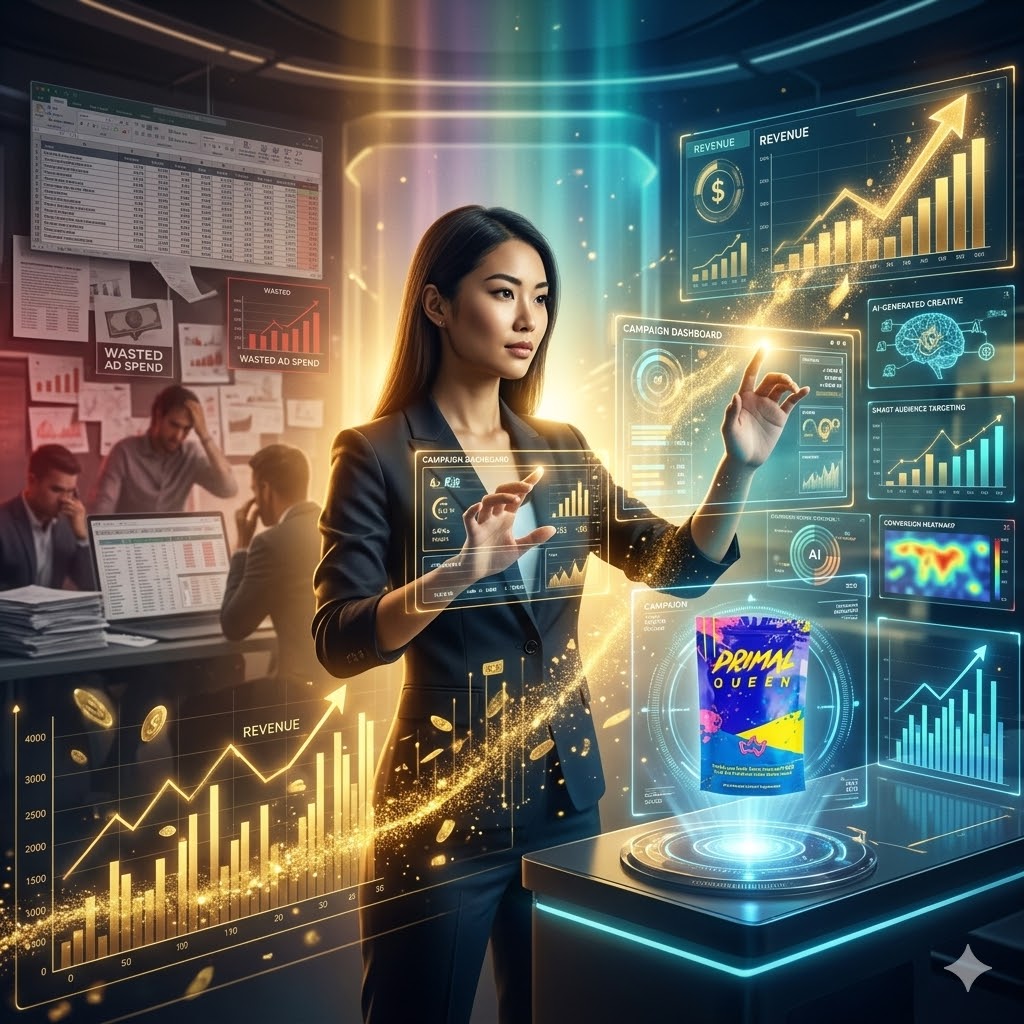
How a Health Brand Cracked the Code on Paid Traffic, AI-Powered Creatives, and Customer Retention in 2026
The $2M AI Ads Formula — Why Most Brands Miss It Every Single Time
Running high-converting AI ads that generate over two million dollars every single month is not a myth anymore.
A real brand is doing it right now, and the numbers have been verified by third-party analytics tools like SimilarWeb, which shows the brand pulling in over three million monthly website visitors consistently.
The brand in focus here is Primal Queen, a women’s supplement company that has disrupted the health and wellness space by combining sharp e-commerce fundamentals with the kind of creative volume and testing discipline that most online sellers never even attempt.
This is not a story about luck or a viral moment that faded after two weeks.
This is a breakdown of a repeatable, data-driven system built on products that work, landing pages that convert, offers that are hard to say no to, and an AI ad creative strategy that keeps the pipeline full every single day.
Every strategy covered in this article is the same kind of strategy used at Omnimedia, where brands collectively generate over one hundred million dollars in revenue using these same fundamentals.
If your e-commerce store has hit a ceiling and you cannot figure out why nothing is moving, this article is going to show you exactly where to look first.
If you are just starting out, this is the blueprint that gives you a clear picture of what a high-level e-commerce operation actually looks like from the inside.
You do not need to apply every single strategy covered here today, because even applying just one or two of these ideas to your business can move revenue in a direction you will notice quickly.
We strongly recommend that you check out our guide on how to take advantage of AI in today’s passive income economy.
Table of Contents
Start With the Product — Nothing Else Matters Without It
Why Primal Queen’s Product Strategy Is the Foundation of Their $2M Month
The first thing any serious e-commerce business needs to get right before spending a single dollar on AI ads for e-commerce growth is the product itself.
Primal Queen launched with a single flagship product, a beef organ supplement built specifically for women who struggle with energy and hormonal imbalance, and they made it good enough that customers came back for more without needing to be chased.
That original product gave them the trust and the data they needed to then expand their product line strategically into complementary offerings like the PQ7 weight loss support supplement, their Goddess Bites product focused on brain longevity and lean muscle, and their Marrow supplement designed to support joint health and mobility.
Notice that none of those new products do the same thing as the original flagship supplement, because the strategy was never to create duplicates.
The strategy was to create products that fill the gaps the first product does not cover, which means every new product in the line gives existing customers a new reason to spend more money without feeling upsold on something unnecessary.
This approach of building a complementary product ecosystem is one of the fastest ways to increase both your average order value and your customer lifetime value at the same time.
When you are relying on performance-based AI ads for e-commerce scale, your cost to acquire a customer goes up every year because ad platforms get more competitive, and the only buffer you have against rising acquisition costs is a higher lifetime value per customer.
A single-product brand that loses customers after one purchase is fighting an uphill battle that gets harder every quarter, while a brand with a thoughtful product ecosystem turns one transaction into a long-term customer relationship.
If your store only has one product right now, that is fine as a starting point, but you should already be thinking about what the next logical product is that your current customers would naturally want after buying from you the first time.
The lesson from Primal Queen is to expand with purpose, not just to have more SKUs on a shelf, but to build a product line that serves the same customer at multiple points in their health or lifestyle journey.
Landing Pages That Do the Heavy Lifting Before the Customer Even Thinks About Leaving
The Three Types of Pages Powering Primal Queen’s AI Ad Funnel
Once the product is solid, the next place where money is either made or lost is on the landing page, and Primal Queen runs a sophisticated three-part landing page strategy that most brands are not even close to replicating.
The first type of page they use is an optimized product detail page, which is clean, well-structured, and built to take a brand-new visitor who has never heard of the company and move them from skepticism to checkout through clear copy, strong visuals, and trust signals placed exactly where hesitation tends to spike.
The second type of page they lean on heavily, especially in recent campaigns tied to their best-performing AI ads for e-commerce conversions, is the quiz landing page, which works by engaging visitors in a personalized experience that makes the recommendation feel custom rather than generic, and this kind of interactive entry point is extremely effective for top-of-funnel traffic that does not yet know what they need.
The third type of page is the advertorial, which is a long-form editorial-style page that educates the reader about a category like beef organ supplements before ever asking them to buy anything, so that by the time they reach the product recommendation at the bottom, they already feel informed and ready to trust the brand.
One particularly clever element of their advertorial strategy is that they have become affiliates for competing beef organ supplement brands, meaning that even if a visitor clicks on a competitor’s link inside the page, Primal Queen still earns a commission, which effectively puts a financial floor under every piece of traffic that lands on that page no matter what decision the visitor makes.
This kind of layered approach to landing pages means that the brand is not dependent on a single page type to carry all the conversion weight, and each page is matched to the specific angle of the ad that sent the visitor there in the first place.
That message-to-page consistency is critical when running high volumes of optimized AI ads for digital marketing funnels, because a visitor who clicks on an ad about hormonal health and lands on a page about weight loss is going to leave immediately.
Every single ad needs to feel like a seamless continuation of the landing page it connects to, and that level of funnel coherence is one of the reasons Primal Queen converts traffic at the rate they do.
Spend time in the Meta Ads Library and click through to the pages their ads send traffic to, because the education you get from studying their live funnels in real time is worth more than most paid courses on e-commerce.
The Offer Architecture That Forces the Right Buying Decision
Why Subscription-Only Is Working and How They Make It Feel Like a Win for the Customer
The offer is where Primal Queen does something bold that most brands are too nervous to try, and it is one of the most important lessons buried inside their two-million-dollar monthly operation.
They have removed the option to buy their products as a one-time individual purchase on their website entirely, meaning that anyone who visits their store can only buy through an auto-ship subscription model, and that decision alone has transformed the shape of their revenue curve in a way that flat one-time purchases simply cannot match.
To make this subscription-only structure feel like a great deal rather than a restriction, they stack the offer with significant value, including thirty percent off for life, a free bamboo lid glass jar, a free on-the-go pill case, a free mystery gift, and free shipping, so the customer feels like they are winning even though the structure benefits the brand’s revenue predictability enormously.
They also layer in urgency by showing countdown timers on offers, like a thirteen-hour window on a specific deal, which creates a legitimate reason for the customer to act now rather than close the tab and forget about it.
Risk reversal is built directly into the checkout experience through a three hundred sixty-five day money-back guarantee and an easy online portal that allows customers to cancel, skip, or pause their subscription at any time, which removes the biggest emotional barrier most people have when committing to an auto-ship purchase for the first time.
They also build seasonal and occasion-based offers around moments that are genuinely relevant to their target audience of women, with their Mother’s Day bundle being a strong recent example that packaged a three-month auto-ship supply with a buy two get one free structure and layered in the same free gifts and shipping perks.
This kind of offer engineering tied to cultural moments in a customer’s year is something that the founder of Primal Queen has publicly credited as one of the most impactful breakthroughs in the brand’s growth, noting that sometimes the constraint is not the ad or the page but simply the offer itself.
Testing your offer with the same rigor you apply to your ad creative is one of the highest-leverage activities available to any e-commerce operator using performance-based AI ads for online business scaling.
Document what your current offer is converting at, swap in a new offer structure, measure it against the same traffic, and repeat the process until you have data that tells you exactly which offer architecture your specific customer responds to best.
The AI Ad Creative Engine That Keeps $2M Per Month Flowing
How Volume, Format Diversity, and AI Are Powering Primal Queen’s Paid Traffic Machine
This is the section where most brands fall furthest behind, because Primal Queen is not running a few dozen ads and hoping one of them works.
At the time of review, their Meta Ads Library showed over two thousand one hundred active ad creatives, which is a number that communicates something very clear about how seriously they take creative volume as a competitive advantage in their AI ads for e-commerce growth system.
Brands operating at this level of monthly revenue are typically testing no fewer than two hundred new creatives per week, which means creative production is not a monthly task or even a weekly sprint — it is a daily operational priority that runs in parallel with everything else in the business.
Their creative format mix includes static image ads, user-generated content style images, video ads, and AI-generated animation creatives where product ingredients are brought to life visually in a way that feels fresh and native to the feed, showing that they are actively following and testing emerging creative trends rather than recycling formats that worked two years ago.
They run ads through multiple Facebook Pages simultaneously, including pages set up to look like authoritative educational resources on topics like women’s hormonal health, which allows them to reach audiences in different mindsets and contexts rather than always leading with a direct brand pitch.
Their marketing angle diversity is equally impressive, with different ad sets targeting the GLP-1 weight loss conversation for their PQ7 product, hormonal support during specific times of the month for their beef organs product, and various other angles that speak to different pain points across the same broad target audience of health-conscious women.
On Google, their shopping listings stand out because they use bright pink backgrounds and include the actual supplement capsules alongside the packaging in the product image, which makes their listing visually distinct in a search results page where most competitors are using plain or muted product photography with nothing to differentiate them.
They also test multiple variations of their Google Shopping titles and images simultaneously, treating Google Shopping optimization with the same systematic testing discipline they apply to Meta creative, and this is an area that most e-commerce brands almost completely ignore even after they have been running ads for years.
If you want to understand what a fully operational AI ads for digital revenue scaling system looks like in the real world, spend an hour in the Primal Queen Meta Ads Library and study not just what the ads say but how the angle of each ad matches the page it connects to and the offer it leads into.
Customer Lifetime Value — The Metric That Makes Everything Else Possible
The Two Growth Levers Primal Queen Pulls to Keep Revenue Compounding Month After Month
Customer acquisition costs on Meta and Google are going up every year without exception, and the brands that will still be growing in three years are the ones that figured out how to extract more revenue from every customer they acquire rather than relying purely on finding new ones.
Primal Queen addresses this reality directly through two main levers, the first being the subscription-only purchase model already covered, which builds predictable recurring revenue into the foundation of the business rather than treating it as a nice bonus on top of one-time sales.
The second lever is the product line expansion strategy, which gives every existing customer multiple new products to discover and buy without requiring the brand to spend money acquiring a brand-new customer to generate that additional revenue.
Cross-selling to existing customers through a well-structured product ecosystem is one of the most cost-efficient growth activities available to any e-commerce brand, and it is the reason why expanding your product line strategically is not just a nice-to-have but a genuine scaling mechanism.
When you combine subscription retention with a product line that gives loyal customers new reasons to spend, the lifetime value of each customer climbs in a way that makes your cost-per-acquisition less painful and your paid media campaigns significantly more profitable over time.
Once these fundamentals are in place and performing at a baseline level, the shift is toward building optimization systems around each of them — structured processes for testing new ad creatives, new landing page variations, new offers, and new products, then measuring the results, cutting what fails, and scaling what works.
That optimization flywheel is what separates brands that peak at a certain revenue level and plateau from brands that keep compounding growth month after month because they have built systems that improve themselves over time rather than relying on one-time breakthroughs.
For anyone running a business right now and wondering why growth has stalled, the answer is almost always found in one of these five areas — product, landing pages, offer, ad creatives, or customer lifetime value — and the fastest way to find the constraint is to go through each one honestly and measure where performance drops off.
Building a business capable of generating two million dollars per month from AI ads for high-converting e-commerce funnels is not about doing one thing perfectly but about doing five things consistently and improving each one through data rather than guesswork.
The brands that figure that out in 2026 are the ones that will still be scaling in 2027 while everyone else is still searching for the one secret tactic that was never the real answer to begin with.
We strongly recommend that you check out our guide on how to take advantage of AI in today’s passive income economy.