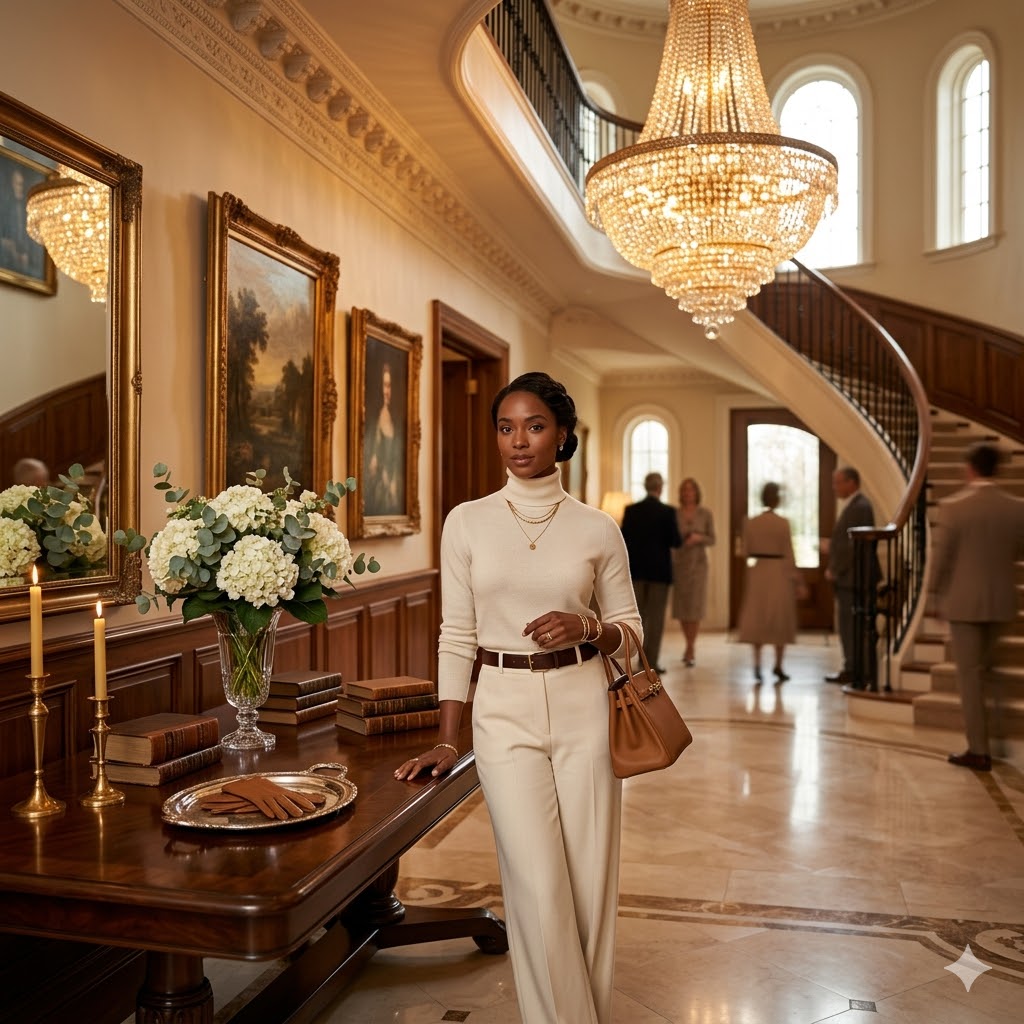
What the First 10 Seconds Inside an Old Money Home Tell You About 150 Years of Family History
Why a $200 Antique Side Table Screams Old Money Louder Than a $10,000 Chandelier
Walk through the front door of a home that carries old money entryway design principles and something hits you before you can name it.
It is not the size of the room.
It is not a dramatic light fixture hanging from the ceiling.
It is not marble floors or a gallery wall of expensive art prints perfectly arranged by a professional stylist.
It is something quieter than all of that — and yet it speaks louder than any of those things ever could.
This is the paradox at the heart of how generational wealth presents itself through interior design.
The families who have held wealth through three, four, sometimes six generations have stopped trying to show it.
And that complete absence of effort to impress is precisely what makes an old money entryway one of the most powerful first impressions a home can make in 2026.
Today, this article is going inside that entrance hall — the real one, not the staged version from a real estate listing.
We are going to look at what is actually there, what is deliberately absent, and why the combination of both tells a story that no interior designer can manufacture from scratch, regardless of budget.
We strongly recommend that you check out our guide on how to take advantage of AI in today’s passive income economy.
Table of Contents
What Old Money Actually Means Before We Talk About Decor
Before you can understand old money entryway design, you have to understand what old money actually is.
Old money is not simply having a lot of it.
Old money is inherited wealth — wealth that has survived two, three, or more generations inside the same family bloodline.
In America, families like the du Ponts of Delaware, whose fortune traces back to the early 1800s gunpowder trade, or the Astors, whose New York real estate wealth stretched across more than a century, are the textbook definition.
In the United Kingdom, the Cecil family — owners of Hatfield House in Hertfordshire since 1611 — represent a version of old money so deeply rooted it is inseparable from the physical architecture of the home itself.
These are families who stopped performing wealth several generations ago.
By the third or fourth generation, the house is simply where they live — not a symbol, not a brand, not a status signal.
And that is the critical detail that changes everything about how their entryways look and feel.
A home that has been lived in continuously by the same family for 120 years does not look designed.
It looks inhabited.
It looks like time itself decorated it — and in the truest sense, time did.
The Entrance Hall vs. The Foyer — A Distinction That Tells You Everything
Old Money Families Call It an Entrance Hall, Not a Foyer, and the Reason Matters
One of the first things you notice when you study old money entryway culture closely is the language used to describe the space.
These families call it an entrance hall.
Never a foyer.
The word foyer carries a theatrical association — a transitional lobby, a place to be seen before moving to the main event.
An entrance hall is something entirely different.
It is a working room.
It is a room where coats are hung on iron hooks screwed into wood that was painted dark green thirty years ago and never repainted.
It is where muddy boots sit on a stone floor that has been muddy before and will be muddy again.
It is where a wooden barometer, likely inherited from a grandfather, hangs on the wall because someone in this household genuinely reads it before stepping outside each morning.
The old money entryway is not staged for guests.
It is organized for the people who live here — and that difference is visible the moment you step inside.
The Architecture of an Old Money Entryway — What the Bones Tell You
Proportions, Ceiling Height, and the Materials That Cannot Be Rushed Into Existence
The structure of an old money entrance hall communicates before a single object inside it is even noticed.
Ceilings are high — not because height was chosen as a design feature, but because the house was built in an era when generous proportions were the architectural standard.
Think Georgian-style symmetry, Federal-period plasterwork cornicing, or the English country house tradition of wide, stone-flagged halls designed to receive guests arriving from long carriage journeys.
The floors are original.
That is the most important detail.
In a genuine old money entryway, the floor is either worn flagstone — the kind with a smooth, almost glassy surface that comes from 80 years of foot traffic — or original hardwood planks, wide and honey-colored, with a patina that no engineered wood floor can replicate.
The walls carry the weight of decades without apology.
Paint colors lean toward warm whites, deep stone, or aged cream — colors that were chosen in a different era and have simply never been swapped out for whatever shade Farrow & Ball designated as the color of the year.
The plasterwork on the ceiling, if present, is original and carries the small imperfections of handwork.
A crack that was repaired. A seam that was never quite invisible.
These are not flaws. They are the fingerprints of the house’s age.
What You See in an Old Money Entryway — Object by Object
The Oil Portrait That Nobody Would Buy at Auction Today
The first object your eye typically finds in a genuine old money entryway is a portrait.
Not a photographic print.
Not a contemporary art piece chosen because it adds drama to the space.
An oil portrait — dark-toned, painted in a style that belongs to another century entirely, in a gilded or carved wood frame that has been on this wall since before anyone currently living in the house was born.
The subject of the portrait is almost certainly a family member — an ancestor whose name the younger generation may not even know off the top of their head.
The painting is not here because it is beautiful or valuable.
It is here because it has always been here.
That distinction — between a thing being present because it was chosen and a thing being present because it belongs — is the single most important concept in understanding the old money entryway aesthetic.
The Side Table That Was Never Bought as a Side Table
Below the portrait, or to one side of the entrance, there is usually a side table.
Not a designer console table purchased to anchor the space.
An actual piece of period furniture — a narrow hall table from the Regency period, perhaps, or a Victorian side cabinet with legs that have been repaired at least once.
The corners are scuffed.
The top surface carries the ghost-ring marks of things set down on it without a coaster, decade after decade.
This table was not purchased for this spot.
It migrated here when the sitting room was rearranged in 1987 and it has never been moved since.
On its surface, you will typically find a silver or ceramic bowl — the kind used to hold keys, loose change, and small items from pockets.
That bowl is almost certainly old too. A christening gift, perhaps. An estate sale find from two generations back.
The Umbrella Stand and What It Signals About Real Living
The umbrella stand in an old money entryway is one of the most quietly significant details in the room.
It holds actual umbrellas — the kind used regularly in wet weather, not matching sets chosen for their aesthetics.
There may be four different umbrellas, none from the same era, none in particularly good condition.
A wooden walking stick or two lean alongside them.
Possibly a riding crop or a walking pole.
These are not decorative items.
They are tools used by people who go outside and come back in.
Their casual, imperfect arrangement is the visual equivalent of the family saying: people actually live here.
What Is Conspicuously Absent From an Old Money Entryway
No Statement Chandelier. No Accent Wall. No Designer Mirror.
The most instructive thing about the old money entryway is often not what it contains but what it refuses to include.
There is no statement chandelier chosen to create a dramatic focal point from a high ceiling.
No oversized gilded mirror centered on a wall to bounce light and signal luxury.
No gallery arrangement of carefully sourced prints, matted in wide white borders, hung with mathematical precision.
No sleek console table with sculptural legs purchased from a designer showroom and styled with a single architectural object and a vase of fresh blooms.
No color-matched accessories.
No visible effort at all.
The old money entryway does not look like it was designed — because it genuinely was not designed in the modern sense of that word.
It was accumulated over time by people who were simply living their lives inside this house.
The result is a room that feels authentic in a way that carefully designed spaces — even expensive, beautifully executed ones — simply cannot replicate.
The Scent and Light of an Old Money Entrance Hall
Why the Sensory Experience Matters as Much as What You See
The old money entryway does not just look different from a newly decorated home. It feels different — and much of that feeling comes from the senses beyond sight.
The light in these entrance halls is natural and slightly subdued.
Windows are original sash style, with single-pane glass that distorts light ever so slightly — a gentle waving of the view outside that you only notice if you look for it.
Light falls across the stone or hardwood floor in long rectangles that shift through the day.
There is no recessed LED lighting creating an even, shadowless wash across the space.
The shadows in an old money entryway are part of its character.
The scent is equally telling — a combination of beeswax polish on wooden furniture, the faint mineral note of stone flooring, old paper from books left on a hall table, and the outdoors tracked in on boots.
It is a deeply human smell.
It is the smell of a house that has been occupied continuously for a very long time.
No candle from Diptyque or Jo Malone replicates it, because it is not a smell anyone chose.
It is simply the smell of accumulated time.
How to Study the Old Money Entryway Aesthetic Without Faking It
The Difference Between Being Inspired by Generational Wealth and Simply Copying Its Surface
If you are drawn to old money entryway design — and in 2026, more people are than ever before — the most useful thing you can do is understand what you are actually responding to.
You are not responding to oil portraits specifically.
You are not responding to worn flagstone specifically.
You are responding to authenticity.
You are responding to a space that has no performance in it — a room that exists for the people in the house, not for the opinions of people passing through.
The principles that make an old money entryway so compelling are available to anyone willing to pursue them honestly.
Buy antique furniture because it is beautiful and interesting, not because it signals a look.
Choose colors that you love and live with them for years.
Stop replacing things the moment they show wear — let quality objects develop the patina that comes from actual use.
Display objects because they mean something to you, not because they match.
Hang art you inherited, found, or genuinely love — regardless of whether it coordinates with anything else.
These choices take time to accumulate into something that feels real.
That is not a design problem.
That is the point.
Real Homes That Embody the Old Money Entryway Tradition
Hatfield House, Chatsworth, and What Their Entrance Halls Actually Look Like
Some of the most studied examples of authentic old money entryway design in the English-speaking world are open to the public — which means you can walk through them and study them directly.
Hatfield House in Hertfordshire, England — home to the Cecil family since 1611 — has an entrance hall that dates to the Jacobean period.
Stone floors. Dark oak paneling. Portraits of ancestors going back four centuries.
The armor collection lining the hall was not purchased to decorate.
It was accumulated by a family whose history includes direct involvement in the courts of Elizabeth I and James I.
Chatsworth House in Derbyshire — seat of the Duke of Devonshire and home to the Cavendish family since 1549 — has an entrance that communicates the same principles at a grander scale.
Every object in those rooms is there because it belongs to the story of that house and that family.
No professional stylist assembled it for the current season.
In America, Biltmore Estate in Asheville, North Carolina — built by George Washington Vanderbilt II between 1889 and 1895 and still owned by the Vanderbilt family’s descendants — gives a similar window into how old money interiors accumulate meaning over time.
Walking through these entrance halls is the single best education in what the old money entryway aesthetic truly means at its core.
The First Impression That Generational Wealth Actually Makes
Why Less Always Says More When It Is Backed by Genuine Time
The deepest truth about the old money entryway is this:
The first impression it makes is not about money at all.
It is about time.
It is about a family that has been in the same place long enough for the floors to wear smooth, for the portraits to darken with age, for the umbrella stand to fill up with decades of practical accumulation.
That first impression — the one that makes visitors feel something they cannot immediately articulate — is the product of something no budget can purchase directly.
It is the product of continuity.
Of a family choosing, generation after generation, not to replace what still works, not to update what still belongs, not to perform what they have simply never needed to prove.
The worn edges of the hall table.
The barometer that still gets checked.
The coat hooks that hold real coats belonging to real people who live here.
These are the details that communicate old money entryway design more fluently than any decorator’s brief ever could.
The homes that feel like money are the ones built by people who stopped thinking about feeling like money at least three generations ago.
That is the first impression that truly screams generational wealth.
And it whispers.

We strongly recommend that you check out our guide on how to take advantage of AI in today’s passive income economy.