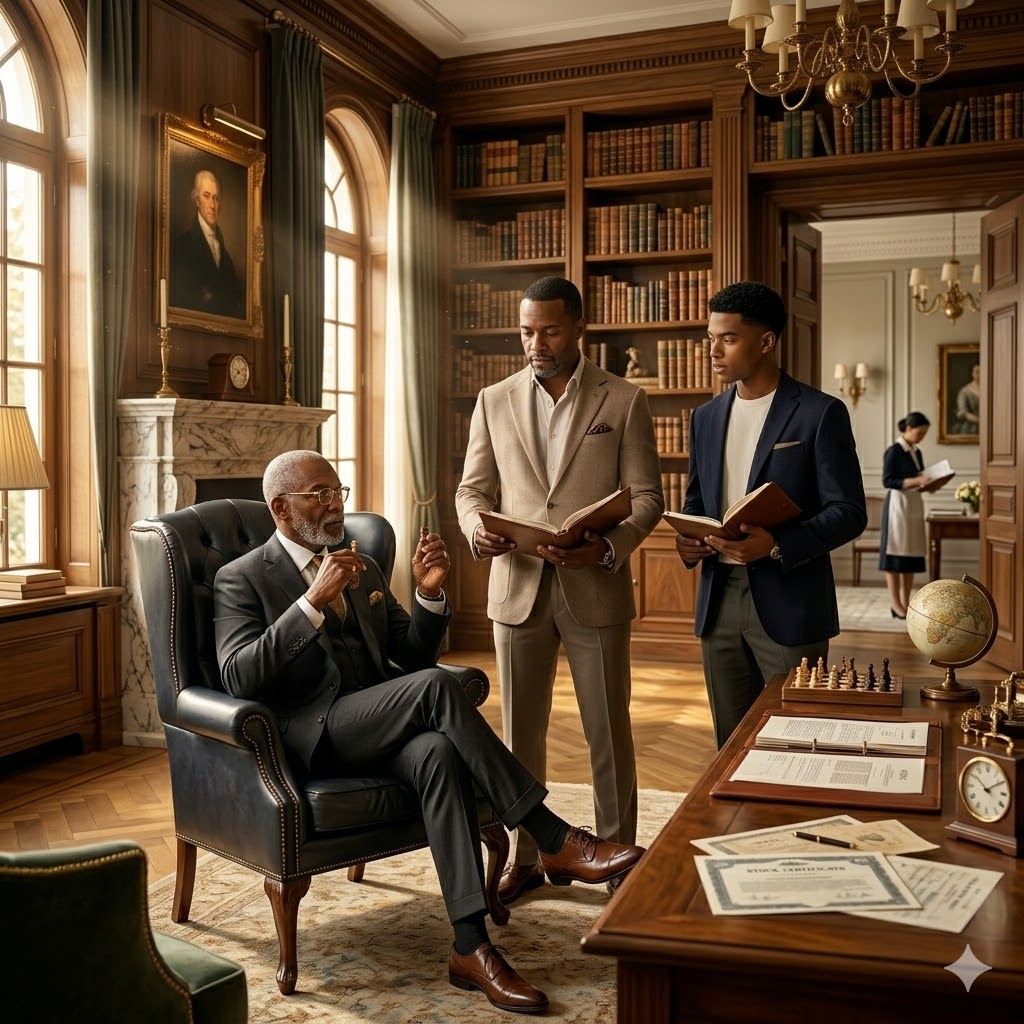
The 3-Generation Wealth Blueprint Old Money Families Have Quietly Used Since the 1800s
Why 90% of New Rich Go Broke in 3 Generations — And How Old Money Avoids It
Old money generational wealth building strategies are the quiet engine behind some of the most powerful family dynasties the world has ever seen.
While social media feeds in 2026 are flooded with overnight success stories, rented Lamborghinis, and loud displays of cash, the families who have truly held onto wealth for over a century are doing something completely different.
They are not trending on TikTok.
They are not launching meme coins or chasing viral investment tips from strangers on the internet.
They are sitting in boardrooms, trust offices, and private libraries, making slow, deliberate, and deeply calculated decisions that will still be paying off when their grandchildren’s grandchildren are alive.
This is the world of old money — and it looks nothing like what most people imagine wealth to be.
The Rockefellers, the du Ponts, the Mellons, the Vanderbilts — these are real American families whose fortunes have outlasted entire economic cycles, world wars, and market crashes.
Their blueprint is not locked away in some secret vault.
It is hiding in plain sight, built on a set of principles that are timeless, repeatable, and surprisingly available to anyone willing to adopt the mindset behind them.
This article breaks down the exact framework that old money families have used to grow and protect wealth across three full generations — and what you can learn from it starting today.
We strongly recommend that you check out our guide on how to take advantage of AI in today’s passive income economy.
Table of Contents
What Old Money Actually Means in 2026
Old money generational wealth building strategies start with understanding what old money actually is, because most people get this wrong from the very beginning.
Old money does not simply mean being rich.
It means being part of a family where wealth has been carefully passed from one generation to the next, sometimes across centuries, without being squandered, divided into nothing, or lost to poor decisions.
Unlike new money — which is often made quickly through a hot business idea, a viral product, or a fortunate investment — old money is rooted in heritage, discipline, and a deeply embedded culture of financial responsibility.
Families like the Rothschilds in Europe or the Phipps family in America did not maintain their status by spending lavishly or chasing every new opportunity.
They maintained it by doing less, not more — by resisting impulse, saying no to spectacle, and treating every financial decision as something that needed to survive the test of a hundred years, not just a single quarter.
In 2026, as inflation concerns, crypto volatility, and AI-disrupted industries reshape the financial landscape, the principles behind old money are more relevant than ever.
The noise has gotten louder, but the strategy for lasting wealth has not changed.
Old money generational wealth building strategies remain the same quiet, patient, and disciplined system they have always been — and that is exactly why they continue to work.
The Mindset That Separates Old Money From Everyone Else
Long-Term Thinking Is the Foundation
The single most defining characteristic of old money families is how far into the future they think when making decisions today.
Old money generational wealth building strategies are built on a time horizon that most modern investors cannot even mentally process.
Where a new money entrepreneur might ask, “What will this return in 12 months?” — an old money patriarch asks, “Will this still be valuable in 50 years?”
That one shift in perspective changes everything about how decisions are made.
It changes which industries they invest in, which properties they buy, which schools they send their children to, and even which family relationships they choose to nurture and protect.
Old money families are not interested in the fastest lane.
They are interested in the lane that does not end.
This is not an accident or a personality quirk — it is a deliberately cultivated mindset that is passed down through generations like a family heirloom, embedded into children before they are old enough to understand compound interest.
Patience as a Financial Discipline
Patience in old money circles is not passive waiting — it is an active, practiced, and deeply valued financial discipline.
Old money generational wealth building strategies rely on patience the way a master craftsman relies on precision — without it, the entire structure falls apart.
These families do not panic sell when the stock market drops.
They do not move their real estate holdings because of a bad quarter.
They do not abandon a 20-year investment strategy because a financial pundit on cable television is predicting doom.
They hold.
They wait.
They let time do what time does best — which is reward those who are disciplined enough to stay the course while everyone else is running in circles.
Warren Buffett, whose name is synonymous with patient investing, has often said that the stock market is a device for transferring money from the impatient to the patient — and old money families have understood this truth for centuries before Buffett ever put it into words.
Discretion as a Wealth Protection Tool
One of the most underappreciated old money generational wealth building strategies is the practice of intentional, deliberate discretion.
Old money families do not broadcast their net worth.
They do not post their vacation homes on Instagram.
They do not give interviews about their investment portfolios to financial magazines.
This is not because they are ashamed of their wealth — it is because they understand something most people do not: visibility creates vulnerability.
The more publicly visible your wealth, the more you attract lawsuits, scammers, gold diggers, government scrutiny, and social pressure to spend money you should be saving.
Old money families protect their wealth partly by protecting their privacy.
They drive understated vehicles — a well-kept classic rather than a flashy new supercar.
They wear quality that does not announce itself through logos.
Their homes are grand but tucked away from public view, behind gates, trees, and long private driveways that the public never sees.
Discretion is not modesty — it is strategy.
The 3-Generation Blueprint — How Old Money Builds and Transfers Wealth
Generation One — The Builder
Every old money dynasty begins with a builder — someone who creates significant wealth through a business, profession, or strategic investment, then makes the critical decision to protect it rather than consume it.
Old money generational wealth building strategies in the first generation are all about foundation — building assets that are not dependent on the founder’s continued presence to generate value.
The Rockefeller fortune began with John D. Rockefeller Sr., who built Standard Oil into one of the largest companies in American history, but more importantly, he structured his wealth in ways that would outlive him by over a century.
He established the Rockefeller Foundation in 1913, set up family trusts, and worked with legal advisors to create frameworks that would protect and distribute his fortune long after he was gone.
The lesson from the first generation is not to be the richest person in the room — it is to build the structures that make sure the wealth does not die with you.
This includes creating legal entities, purchasing appreciating assets, diversifying income streams, and beginning the estate planning process far earlier than most people think is necessary.
Generation Two — The Steward
The second generation in an old money family carries a very specific responsibility: they must not destroy what the first generation built.
Old money generational wealth building strategies at this stage are centered on stewardship — careful, thoughtful management of existing assets combined with modest, strategic growth.
The second generation is educated differently than most children.
From childhood, they are taught the language of wealth management — how trusts work, what diversification means, how to read a balance sheet, and why living below your means is not a sacrifice but a power move.
They are often enrolled in schools like Exeter, Andover, or similar elite institutions not just for academic excellence, but for the social capital, network, and financial mindset those environments reinforce.
The second generation learns that their role is not to reinvent the wheel — it is to keep the wheel turning.
They grow existing investments conservatively, add new asset classes when appropriate, and begin the process of preparing the third generation to eventually take over.
Generation Three — The Multiplier
The third generation is where old money families either cement their dynasty or begin to lose it — and the outcome almost entirely depends on how well the first two generations prepared them.
Old money generational wealth building strategies in the third generation are about multiplication — taking a well-preserved foundation and expanding it intelligently without exposing it to unnecessary risk.
The famous “shirtsleeves to shirtsleeves in three generations” proverb exists in almost every culture in the world — in English, Spanish, Chinese, and Italian — because it reflects a universal truth: wealth that is not deliberately protected and transmitted through education, structure, and values tends to disappear by the third generation.
Old money families break this pattern by treating the education of the third generation as the most important investment they will ever make.
This includes financial literacy, but it also includes emotional intelligence, relationship management, legal knowledge, and social diplomacy.
A Rockefeller grandchild does not just learn how to spend money — they learn how to think about money as a tool that serves the family’s collective mission, not a personal reward for simply being born into the right family.
Investment Strategies That Keep Old Money Rich for Centuries
Real Estate as the Cornerstone Asset
Real estate has always been the anchor of old money generational wealth building strategies — and for very good reason.
Land does not disappear.
Historic properties in prime locations do not go to zero.
A well-chosen estate, commercial property, or land holding in a growing area appreciates steadily over decades, generating both equity and income through rent without requiring the kind of active management that a business demands.
Old money families often hold properties that have been in the family for multiple generations — not just as financial assets, but as physical representations of the family’s history and identity.
The du Pont family, for example, has maintained Winterthur in Delaware as a historic estate that represents both their heritage and their continued cultural presence in American society.
Real estate also provides a natural hedge against inflation — something that is particularly relevant in 2026 as global inflation continues to reshape the value of paper currency.
Conservative Stock and Bond Portfolios
Old money generational wealth building strategies in the stock market look nothing like what you see in day trading forums or crypto communities.
These families invest in blue-chip companies — large, established corporations with decades of consistent dividend payments and stable growth trajectories.
Think Johnson & Johnson, Procter & Gamble, or Berkshire Hathaway — companies that do not make headlines for explosive growth but reliably generate returns year after year without dramatic volatility.
Bonds, particularly government and high-grade corporate bonds, are also a significant part of the old money investment portfolio because they provide predictable, fixed income that cushions the family’s wealth during market downturns.
The goal is never to double the money in a year — the goal is to never lose the money in a decade.
Art, Antiques, and Rare Collectibles
One of the most fascinating old money generational wealth building strategies is the deliberate acquisition of rare art, antiques, and heirloom-quality collectibles as long-term financial assets.
A painting by Claude Monet purchased in 1950 is worth exponentially more today than almost any stock from that same era.
Old money families understand this — and they have been collecting museum-quality art, rare furniture, vintage wine, and historical artifacts for generations, not only because these items are beautiful but because they consistently grow in value over time.
Christie’s and Sotheby’s auction houses have documented sale after sale of family collections that have appreciated by thousands of percent over multi-generational holding periods.
The key is that these items also carry emotional and cultural value — they become part of the family’s identity, displayed in homes and loaned to museums, building the family’s reputation and social capital alongside their financial portfolio.
Legal and Financial Structures That Protect Generational Wealth
Family Trusts — The Cornerstone Legal Tool
No discussion of old money generational wealth building strategies is complete without a deep look at family trusts — the single most powerful legal tool available for protecting and transmitting multi-generational wealth.
A trust is a legal arrangement where assets are placed under the management of a trustee — either a person or an institution — for the benefit of specific beneficiaries, according to terms set by the person who created the trust.
Old money families use trusts to control exactly how and when wealth is distributed to heirs, preventing any single family member from accessing and spending the entire family fortune impulsively.
A properly structured irrevocable trust can also significantly reduce estate taxes — which in 2026 remain one of the single biggest threats to wealth transfer in the United States, where estates above the federal exemption threshold face a 40% tax rate.
The Rockefeller family famously used a series of family trusts to protect their fortune from estate taxes across multiple generations — a legal strategy that has kept their wealth intact for well over 100 years after John D. Rockefeller Sr.’s death.
Family Offices — Private Wealth Management at the Highest Level
Beyond trusts, old money generational wealth building strategies are often coordinated through what is known as a family office — a private, dedicated wealth management structure that exists solely to serve one family’s financial interests.
A family office handles everything from investment management and tax strategy to estate planning, philanthropy coordination, legal compliance, and even the education and onboarding of new-generation family members.
Major private banking institutions like Northern Trust, Bessemer Trust, and Goldman Sachs Private Wealth Management work with ultra-high-net-worth families to establish and operate these structures.
The key advantage of a family office is alignment — every decision made within the structure is aimed at protecting and growing the specific family’s wealth, not generating fees for an outside advisor.
For families who have not yet reached the threshold for a full family office — which typically requires $100 million or more in investable assets — a multi-family office such as Pathstone or Silvercrest Asset Management can provide similar services at a shared cost.
Holding Companies and Legal Frameworks
Old money generational wealth building strategies also frequently involve the use of holding companies — legal structures that own shares in multiple operating businesses or investment assets under one umbrella entity.
A holding company allows a family to separate their personal financial exposure from their business assets, reducing liability and creating a cleaner structure for transferring ownership across generations.
Families like the Waltons — heirs to the Walmart fortune — have used holding company structures to maintain control of significant business interests while protecting the family’s broader wealth from the risks associated with any one company’s performance.
Combined with family trusts and strategic estate planning, a holding company structure gives old money families a comprehensive legal shield that keeps their wealth organized, protected, and transferable.
Education and Social Capital — The Hidden Assets of Old Money
Old money generational wealth building strategies go far beyond bank accounts and legal documents — they extend into the realm of education, relationships, and social positioning, which old money families treat as seriously as any financial investment.
Children in old money families are educated not only in mathematics, literature, and science, but in the art of conversation, the etiquette of professional relationships, and the responsibility that comes with inheriting a family name that carries weight in society.
Schools like Phillips Exeter Academy, Groton School, and St. Paul’s School in the United States — or Eton College and Harrow School in the United Kingdom — are not chosen simply for academic quality.
They are chosen because they place young people in rooms with other future leaders, creating relationships that will generate business partnerships, political connections, and social opportunities for decades into the future.
Old money families understand that the network their children build in school is itself a form of wealth — one that cannot be taxed, cannot be stolen, and appreciates in value as every member of that network grows in power and influence over time.
This combination of financial education and social capital development is one of the most powerful and least discussed old money generational wealth building strategies in existence.
How Anyone Can Apply These Principles Starting Today
Old money generational wealth building strategies are not reserved for families with centuries of inherited wealth — the principles behind them are available to anyone willing to adopt them with discipline and consistency.
Think in decades, not months.
Every financial decision you make today should be evaluated through the lens of how it will affect your life 20 years from now — not just how it feels this week.
Build assets, not liabilities.
Invest consistently in things that grow in value over time — real estate, index funds, quality education, and high-value relationships — and resist the pressure to spend money on things that depreciate the moment you buy them.
Use legal structures.
Even if you are not wealthy yet, you can begin establishing simple legal structures like a living trust or an LLC that will protect your assets and create a framework for transferring wealth to your children.
Educate your children about money.
The most powerful investment you will ever make is teaching your children how to think about wealth — not just how to earn it, but how to protect it, grow it, and pass it on.
Practice financial discretion.
Stop broadcasting your income, your purchases, and your financial milestones publicly.
Quiet wealth accumulation is safer, more sustainable, and more powerful than performing wealth for an audience that will never benefit your financial future.
Final Thoughts
Old money generational wealth building strategies have survived wars, depressions, inflation crises, and technological revolutions — not because the families who used them were lucky, but because they were disciplined, patient, and deeply committed to a vision that extended far beyond their own lifetime.
The blueprint is not complicated.
It is consistent.
It is rooted in long-term thinking, legal protection, conservative investment, meaningful education, and the quiet, unshakeable belief that wealth is not a personal trophy — it is a generational responsibility.
Whether you are building from zero or already have assets to protect, the principles outlined in this article are the same ones that have kept families like the Rockefellers, the Mellons, and the du Ponts at the top for over a century.
The question is not whether these strategies work.
The question is whether you are willing to play the long game.

We strongly recommend that you check out our guide on how to take advantage of AI in today’s passive income economy.