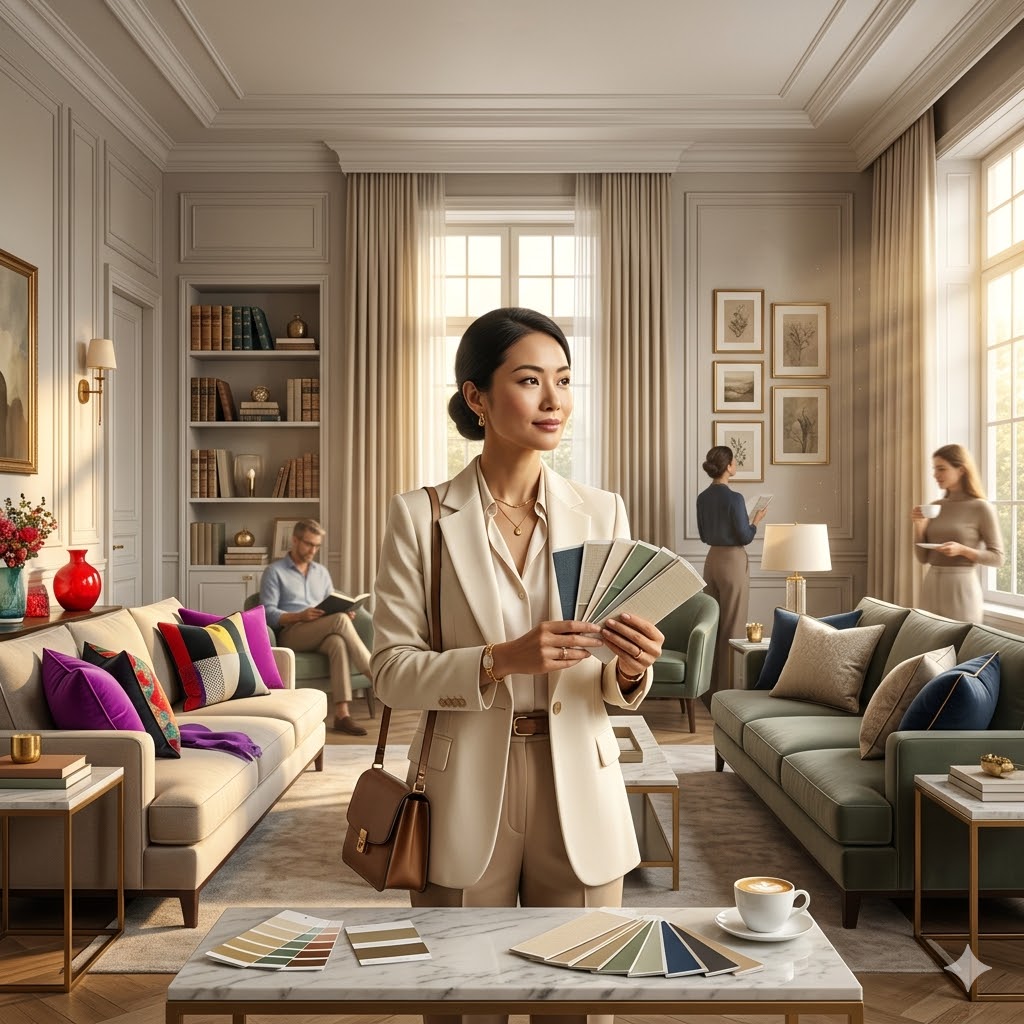
5 Color Mistakes Killing Your Home’s Elegance — Old Money Designers Never Do This
Why Your Color Choices Either Elevate or Embarrass Your Home
Your home can look cheap even when you have spent real money on it, and most times, the problem is not the furniture or the flooring — it is the old money color palette approach you are missing entirely.
Old money style is not about spending more.
It is about choosing with intention, layering with purpose, and understanding that color is the first thing a room communicates before anyone even touches a surface or reads a price tag.
Most people walk into a paint store, grab something that looks nice under fluorescent lights, and call it a day.
Then they wonder why the room feels flat, cold, or somehow wrong once everything is in place.
The truth is, color scheme mistakes are some of the most invisible problems in interior design, meaning you feel the damage before you can name it.
You walk into a room and something is off, but you cannot point to exactly what.
This article is going to name it for you — five color scheme mistakes that are quietly making your home look cheap, and the old money interior design color strategy that fixes each one.
We strongly recommend that you check out our guide on how to take advantage of AI in today’s passive income economy.
Table of Contents
Mistake 1: Painting Every Room a Different Bold Color With No Connection Between Spaces
Why This Makes Your Home Look Cheap
Imagine walking through a home where the living room is painted terracotta orange, the hallway is a bright teal, the bedroom is deep purple, and the kitchen is a pale yellow.
Each room might look fine in isolation, but together, the whole home feels like a patchwork quilt sewn from completely unrelated fabrics.
This is one of the most common color mistakes homeowners make, and it is one of the loudest signals of a lack of design intention.
It tells anyone who walks through your door that each room was decorated in a separate session, possibly on different days, probably with different moods, and with no overarching plan guiding the choices.
Old money homes never feel like a collection of unrelated spaces.
They feel like one long, considered story told through rooms that speak the same visual language even when they are not identical.
The walls shift, the tones evolve, but there is always a connecting thread running through the home like a quiet signature.
The Old Money Fix: Build a Whole-Home Color Story
Interior designers who work on high-end homes always start with a whole-home palette before they touch a single wall.
They choose three to five colors — usually anchored around one neutral family — and then use variations of those tones throughout the home.
Think of how architect and designer Bunny Williams approaches interior color: she often begins with a warm neutral base and layers deeper, richer tones in rooms that are meant to feel intimate, while keeping lighter versions of the same tones in open, active spaces.
To apply this in your home, choose one anchor color — ideally a warm white, a soft greige, or a muted sage — and then build every room around different shades and depths of that same color family.
The living room might carry the lightest version.
The dining room goes two shades deeper.
The bedroom uses the richest, most enveloping shade.
This creates visual continuity without making every room look identical, and it is the number one technique behind homes that feel effortlessly elevated.
The old money color palette for home interiors almost always works this way: quiet, connected, and never loud enough to shout.
Mistake 2: Using Bright White Paint Everywhere Because It Feels “Safe and Clean”
Why This Makes Your Home Look Cheap
Bright white paint — specifically the stark, cool, blue-toned whites that come standard on most paint store shelves — is one of the most deceptive choices in interior design.
It feels safe.
It feels neutral.
It feels like it cannot possibly be wrong.
But in practice, pure bright white walls drain warmth from a space in a way that is surprisingly hard to reverse without repainting entirely.
Under natural daylight, stark white walls reflect the coldest tones of the light spectrum and flatten every surface around them.
Your wooden floors look less warm.
Your furniture reads as cheaper than it is.
Your soft furnishings lose their depth.
The result is a room that looks less like a sophisticated minimalist retreat and more like a freshly emptied apartment waiting to be leased.
Bright white paint without warmth is one of the most reliable ways to make a home feel generic, institutional, and — yes — cheap.
The Old Money Fix: Swap Bright White for Aged, Warm, or Off-White Tones
Old money aesthetic color choices for interiors almost never include pure white on the walls.
Instead, they lean toward what designers call “broken whites” — whites that carry undertones of warm cream, soft beige, pale stone, or antique linen.
Paint brands like Farrow and Ball, Benjamin Moore, and Sherwin-Williams all have well-known warm whites that interior designers reach for repeatedly.
Farrow and Ball’s “Pointing” (color 2003) is an off-white with warm yellow undertones that reads as sophisticated and layered in most lighting conditions.
Benjamin Moore’s “White Dove” (OC-17) is another designer favorite for the way it picks up warmth from natural light without looking yellow.
Sherwin-Williams “Alabaster” (SW 7008) has been one of the most-used warm whites in high-end residential design for years, particularly in traditional and transitional homes.
The difference between these tones and a standard bright white is subtle in the paint chip and enormous on the wall.
A warm off-white transforms a room the same way a warm lamp transforms a face — it softens, it flatters, and it immediately elevates everything around it.
That shift, from cold white to aged white, is one of the simplest and most impactful old money room color techniques you can apply this weekend.
Mistake 3: Repeating the Same Accent Color in the Exact Same Shade Across Every Object
Why This Makes Your Home Look Cheap
You have probably seen this in a thousand homes and on a thousand design blogs.
The living room has a navy blue throw pillow, a navy blue candle, a navy blue vase on the shelf, and a navy blue border on the rug — all in the same shade, all carrying the same visual weight, all sitting together like a color that has been instructed to repeat itself until it loses all meaning.
This approach to accent color is called “matchy-matchy” in design circles, and it is one of the clearest signs that a space was decorated without a nuanced understanding of how color actually works.
When you repeat a single shade identically across multiple surfaces, the eye does not experience it as cohesion.
It experiences it as limitation — like the designer could not think of anything else to do with the color, so they simply cloned it.
The result is a room that looks less like a curated interior and more like a themed display unit in a department store.
It reads cheap, not because the color itself is wrong, but because the application is one-dimensional.
The Old Money Fix: Layer Tones and Textures Within One Color Family
The old money interior design color strategy for accent colors is never about one shade repeated everywhere.
It is about one color family expressed across many shades, depths, and materials.
If your anchor accent is green, then your accent color appears as deep forest green in a velvet cushion, as sage green in a ceramic vase, as pale eucalyptus in a linen throw, and as earthy olive in a woven basket.
Same family.
Completely different expressions.
This creates the visual depth and layering that makes a room feel like it was built up over time — like someone with taste and patience made intentional decisions about each piece rather than grabbing identical items off the same shelf.
Legendary interior decorator David Hicks, whose old money aesthetic remains one of the most referenced in traditional design, was famous for this kind of tonal layering.
He would introduce a color in a bold upholstery, then soften it in a background textile, then ground it in a darker accessory — always the same family, never the same shade.
Apply this principle to your own accent colors and your room will immediately feel more sophisticated, more layered, and more expensive.
Mistake 4: Choosing Paint Colors Without Considering How Lighting Changes Them
Why This Makes Your Home Look Cheap
This is the color mistake that catches even smart, thoughtful homeowners completely off guard.
You test a paint chip in the store, or you stare at it on a screen, and it looks perfect — warm, sophisticated, exactly the tone you have been searching for.
You paint the room.
You step back.
And the wall looks nothing like what you expected.
What happened is that color does not exist independently of light.
Every paint color shifts dramatically depending on what direction the room faces, what time of day you are viewing it, whether the light source is incandescent, LED, or natural, and what other colors are already in the room bouncing light back at the walls.
A warm beige in a north-facing room with limited natural light can turn dingy and yellow in a way it never did on the chip.
A sophisticated grey in a south-facing room with strong afternoon sun can look lavender by 4pm.
These shifts make rooms feel wrong in ways people often cannot diagnose, so they compensate by adding more decor, brighter accessories, and louder colors — which only deepens the problem.
The Old Money Fix: Test Large Samples in Real Lighting Before Committing
Old money homes are never painted on impulse, and every serious interior designer will tell you the same thing: never commit to a color based on a small chip.
The correct approach is to buy sample pots — most paint brands sell them for a few dollars — and paint large test patches of at least 30 by 30 centimeters on the actual walls of your room.
Then observe those patches across multiple times of day: morning light, midday light, afternoon light, and evening under your artificial lighting.
Watch how each tone shifts across those conditions.
Pay attention to what happens to the color at 7pm under your lamp light, because that is often when you use the room most and it is the version of the color your guests will experience most often.
Interior designers like Young Huh and Nate Berkus have both spoken extensively about this testing process as non-negotiable — even they do not skip it on professional projects.
If a color holds its warmth and sophistication across all lighting conditions in your specific room, it is the right choice.
If it flatters in one condition and dies in another, keep testing.
This discipline is a core part of the old money color palette for home interiors and it saves you from the expensive mistake of repainting an entire room you never loved.
Mistake 5: Using Too Many Colors With No Neutral Anchor to Hold the Room Together
Why This Makes Your Home Look Cheap
This is the colorful cousin of the first mistake, and it is just as damaging.
Some homeowners, often encouraged by the idea that more color means more personality, fill a room with multiple competing hues — a rust orange sofa, a cobalt blue rug, mustard yellow curtains, and blush pink cushions — without any neutral base to anchor and calm the whole composition.
The result is visual chaos.
Your eye does not know where to land.
Every color is fighting for attention at the same volume, and the room ends up feeling less like a bold, confident design statement and more like a space where someone could not make a decision and chose everything instead.
This kind of color overload reads cheap because it signals that no editing happened.
Good design is always the result of choosing and also of removing.
The best rooms in the world are not the ones with the most color — they are the ones where every color earns its place.
The Old Money Fix: Use the 60-30-10 Rule With a Strong Neutral Foundation
The old money aesthetic color choices for room design almost always follow a version of the 60-30-10 color rule, a proportion guideline that professional interior designers have used for decades.
Sixty percent of the room is your dominant neutral — this appears on the walls, the largest furniture piece, and the flooring tone.
Thirty percent is your secondary color — this lives in upholstery, curtains, and mid-size accessories.
Ten percent is your accent color — this is used sparingly in smaller objects like cushions, vases, trays, and decorative pieces.
This structure gives the eye a clear hierarchy to follow.
The neutral foundation stops the room from feeling overwhelming, the secondary color creates warmth and depth, and the accent color adds the moment of interest that makes the room memorable.
Interior designer Charlotte Moss, one of the most respected voices in traditional American interior design, frequently speaks about restraint as the foundation of elegance — the idea that a room reaches its peak beauty not when you add more, but when you stop adding.
The old money interior design color strategy is built on exactly this kind of editing: choosing fewer colors, anchoring them to a strong neutral, and trusting that simplicity, done well, always reads as expensive.
Conclusion: Color Is the Foundation, Not the Finish
Most people treat color as the last decision in a room — the thing you choose after the furniture arrives and the rugs are laid.
Old money homes treat color as the first decision, the foundation on which every other choice is built.
When your color scheme is wrong, no amount of expensive furniture will save the room.
When your color scheme is right, even modest, affordable pieces will look intentional, elevated, and considered.
The five mistakes in this article — disconnected room-to-room colors, cold bright whites, identical accent repetition, ignoring lighting shifts, and unanchored color chaos — are all fixable.
None of them require a renovation.
None of them require a designer’s budget.
They require only the willingness to slow down, look carefully, and choose with the kind of quiet intention that has always been the true signature of old money aesthetic color choices.
Start with one room.
Test your colors properly.
Build a whole-home story rather than decorating room by room in isolation.
Layer your accent tones across materials and shades instead of repeating one shade identically everywhere.
And always anchor your palette with a warm, broken neutral that holds the entire composition together with the kind of calm confidence a cold white can never deliver.
That is the real old money fix — and it costs far less than you think.

We strongly recommend that you check out our guide on how to take advantage of AI in today’s passive income economy.