How Claude AI Helped a Solo Creator Hit 20K in One Month on a Brand-New Channel
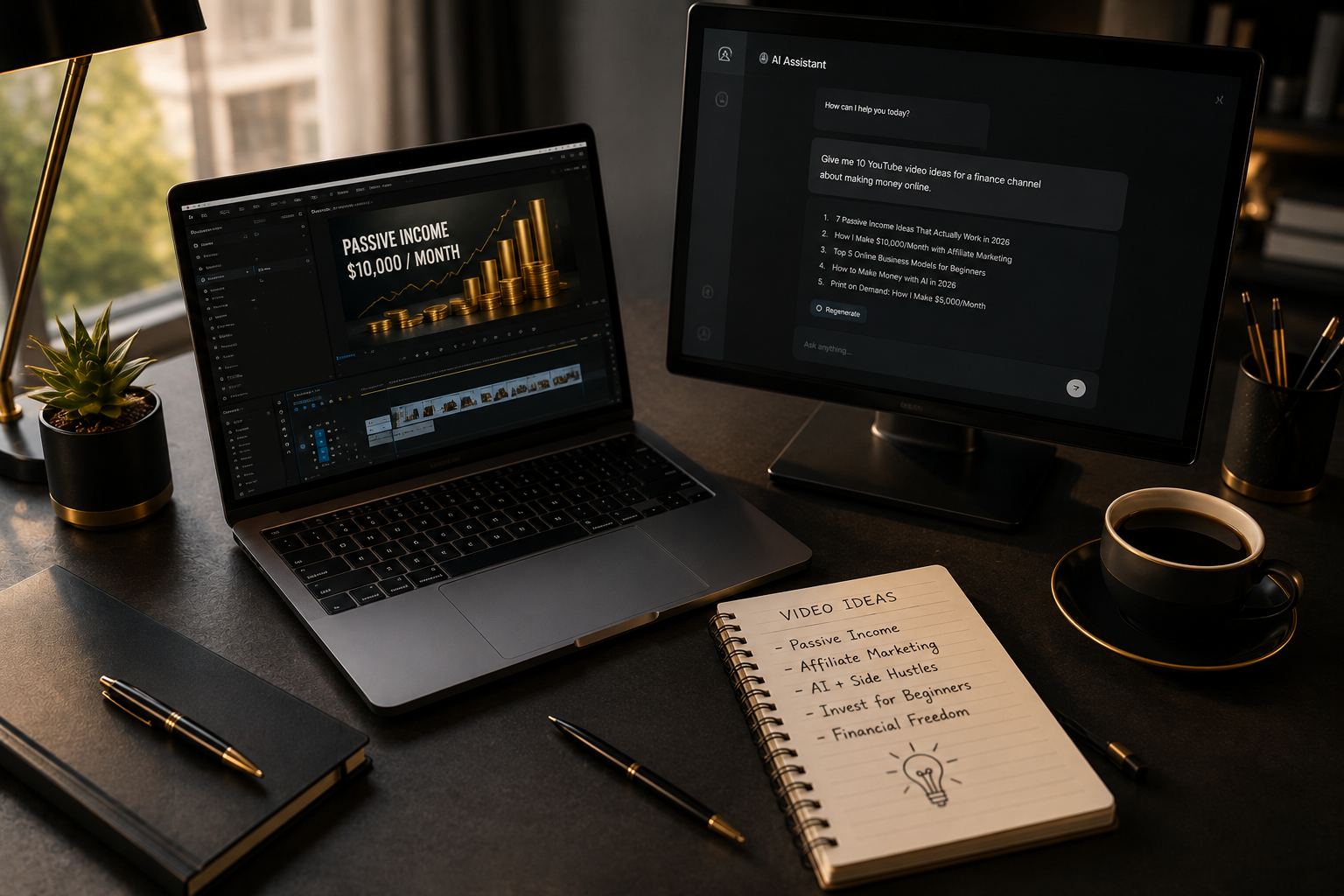
Claude AI is helping solo creators build faceless YouTube channels by researching high-RPM niches, spotting untapped content gaps, and writing full video scripts from a single prompt.
This strategy works because finance and health niches carry unusually high advertiser demand, which pushes RPMs up to $8–$10 per 1,000 views.
Creators are pairing that ad income with low-cost digital products, so a single video can earn money twice — once from YouTube ads, and again from viewers who buy an ebook or template.
We strongly recommend that you check out our guide on how to take advantage of AI in today’s passive income economy.
Table of Contents
What Is a Faceless YouTube Channel, and Why Is It Working Right Now?
A faceless YouTube channel is a channel where no host ever appears on camera.
Instead, the video runs on AI-generated avatars, animated explainer visuals, or simple text-and-image slideshows layered over a voiceover.
You’ve probably already seen these channels without realizing it.
They cover topics like personal finance, ancient history, or self-improvement, and they’re often narrated by a calm, steady voice while charts or illustrations move across the screen.
What makes this format worth paying attention to in 2026 is not the format itself.
It’s the pairing of high-RPM niches with a tool that can now handle almost the entire research and writing process.
Finance and health content sit at the top of advertiser demand because the audiences watching them tend to be older, financially established, and ready to spend.
One finance video referenced in recent creator breakdowns pulled 79,000 views with a $9 RPM, translating into roughly $700 from ad revenue on a single upload.
That is the kind of number that gets creators paying attention, and it’s also the kind of number that gets copied badly.
👉 Free download: Start a 1-Person Business With Claude AI — Free Quick-Start Guide
Why the RPM Gap Matters So Much
Most content niches pay YouTube creators somewhere between $1 and $4 per 1,000 views.
Finance, and to a lesser extent senior health and personal development, routinely pay $8 to $10 per 1,000 views.
That gap means a channel getting 100,000 views a month in a finance niche can earn $800 to $1,000 from ads alone, while a similarly sized channel in a lower-RPM niche might earn a quarter of that.
Scale that to 30 videos a month, and even modestly performing uploads start adding up to a meaningful passive income stream.
The Two-Income Model: Ads Plus Digital Products
The channels actually making consistent money in this space rarely rely on AdSense alone.
They stack a second income layer on top of it, usually a low-cost digital product like an ebook, template pack, or private community membership.
This works because finance and health audiences have real buying power, and a $5 product is an easy impulse purchase for someone who just spent ten minutes watching a video about building wealth.
One creator running this exact model built a private membership priced at $49 a month and grew it to 183 members, which works out to roughly $8,900 in recurring monthly income, separate from ad revenue entirely.
Another channel reportedly crossed $20,000 in its first month by combining consistent uploads with a digital product funnel.
Even conservative estimates hold up well: if a video gets 10,000 views and just 1% of viewers buy a $5 product, that’s $500 in additional revenue on top of whatever AdSense pays for the same video.
👉 Get Access to: The AI Blog Monetization Quickstart Guide
Why This Model Doesn’t Require Monetization to Start
One detail that surprises a lot of new creators is that you don’t need YouTube’s Partner Program to start earning.
Digital product sales happen independently of AdSense, so a brand-new, completely unmonetized channel can still generate income from day one if it has a product link in the description and a call-to-action inside the video.
This removes the usual waiting period where creators post for weeks with zero income while waiting to hit the subscriber and watch-time thresholds required for ads.
The Mistake Almost Everyone Makes: Copying Word-for-Word
Here’s where most people go wrong, and it’s worth slowing down on this part.
The obvious move, when you see a channel doing well, is to pull its most successful video titles and simply recreate them.
Tools like channel research platforms make this dangerously easy, since they let anyone export a competitor’s full video list, view counts, and transcripts in a few clicks.
The problem is that if a video idea has already been made once, twice, or a dozen times, YouTube has already decided how much reach that specific idea deserves, and it usually isn’t much.
Searching a copied idea on YouTube often reveals a graveyard of near-identical uploads sitting at 3 views, 29 views, and 200 views, spread across the past few months.
That pattern is what creators in this space call landing on the “slop page,” where an idea has been recycled so many times that the algorithm no longer has a reason to push it to new viewers.
Claude AI plays its most useful role here, not in generating more of the same ideas, but in helping a creator avoid this trap entirely.
How Claude AI Finds Untapped Niches Instead of Copying Them
The more reliable approach, and the one behind most of the channels quietly earning four and five figures a month, involves feeding Claude AI a batch of research from five to ten similar channels rather than just one.
That means pulling video titles, view counts, and transcripts from a handful of channels in a shared niche cluster, then asking Claude AI to analyze what’s actually driving the audience’s interest, not just which titles performed well.
Claude AI can then cross-reference that research against what’s currently under-supplied in the niche, surfacing specific angles, formats, or sub-audiences that haven’t been fully covered yet.
This is sometimes called niche bending, where a creator takes a proven format and applies it to an adjacent audience or angle nobody has fully tapped, arriving there before anyone else does.
For example, combining research from a Japanese personal finance channel, a European economics explainer, and a general money-psychology channel might surface an idea like “how Japanese households save on almost nothing,” which borrows structural elements from all three without directly copying any single one.
Being first to a specific angle matters more than most creators realize, since YouTube tends to reward early movers in a topic with disproportionate reach before the format becomes saturated.
👉 Free download: The Claude AI Digital Product Starter Pack — 10 Done-For-You Prompts for Beginners
Turning Research Into an Actual Script
Once Claude AI has helped narrow down a specific, under-supplied niche angle, the next step is turning that idea into a full script.
Rather than starting from a blank page, creators are feeding Claude AI the original research data alongside the chosen video idea and asking it to write a full script modeled on the structure of proven, high-performing videos in that niche.
Because Claude AI already has the context of what made the reference videos successful, the resulting script tends to follow a similar pacing and hook structure, opening with a strong claim or contrast in the first ten seconds and building toward a clear takeaway.
This is also the point where a call-to-action for a digital product gets built directly into the script, rather than bolted on afterward.
A common structure is to place a short product mention roughly every four to five minutes of a video, so a 12-minute video might include a natural product mention around the 4-minute and 8-minute marks.
Verifying an Idea Before You Film It
Before any video gets made, it’s worth running the exact idea through a YouTube search to confirm nobody has already covered it recently.
If the same idea shows up repeatedly with low view counts across the past few months, that’s a signal to adjust the angle rather than proceed, since the data is telling you the idea has already been tested and didn’t hold audience interest.
If the idea returns few or no close matches, that’s the green light to move forward with scripting and production.
Producing the Video Without Ever Showing Your Face
Once a script exists, the production side of a faceless channel has become significantly faster than it was even two years ago.
Creators are pairing their Claude AI-written script with AI avatar tools or animated explainer templates, choosing a proven thumbnail style rather than inventing one from scratch, since thumbnail formats that already perform well in a niche tend to keep performing.
A full video, from script to finished render, can now be produced in under an hour for many of these formats, which is what makes daily posting realistic even for a single person managing everything alone.
Posting consistency turns out to matter more than most new creators expect.
YouTube needs volume and time to figure out who your audience is, so creators running this strategy typically commit to posting daily for at least the first 30 days before drawing any conclusions about whether a niche is working.
👉 Get Access to the full Package: Start a 1-Person Business With Claude AI
Why Consistency Beats Perfection Early On
A channel with 30 mediocre videos posted consistently over a month will almost always outperform a channel with 3 highly polished videos posted sporadically.
This is because the algorithm needs repeated signals about your content and audience before it starts recommending your videos more broadly, and infrequent posting simply doesn’t generate enough of that signal.
Even videos with average production quality will earn ad revenue at niche RPMs, so the priority in the first month should be volume and verified ideas, not perfection.
Bringing It All Together
The channels quietly earning $8,900 a month or more from a single membership tier, or $20,000 in their first month from ad revenue and product sales combined, aren’t relying on luck or a single viral video.
They’re combining three specific things: a high-RPM niche, a research process that avoids copying saturated ideas, and a second income stream from a digital product that matches what the audience already wants to buy.
Claude AI fits into every stage of that process, from analyzing competitor data and surfacing blue ocean angles, to writing scripts that follow proven structures, to helping plan where product mentions naturally belong inside a video.
None of this requires showing your face, owning expensive equipment, or having an existing audience to start.
It does require research before filming, a willingness to post daily for the first month, and a product to sell once viewers arrive.
👉 Free download: Start a 1-Person Business With Claude AI — Free Quick-Start Guide
👉 Get Access to: The AI Blog Monetization Quickstart Guide
We strongly recommend that you check out our guide on how to take advantage of AI in today’s passive income economy.