7 Proven Ways a Flipboard Publisher Identity System Gets Your Content Cited in 2026
A Flipboard publisher identity system shows readers who wrote your article and where to find it.
It uses a clear author, publication, and original link.
Google can show your content in search and AI answers.
But readers may still not visit your site.
Flipboard Magazines can send readers straight back to you.
Together, they make your work easier to find and trust.
It is a name tag for every article.
Here is how to build one in 2026.
Great identity is only half the job.
You also need steady visitors who show up every week.
Steady traffic is the best answer for any online business, because it makes every other task easier.
When readers keep arriving, your email list grows, your products get seen, and your brand becomes familiar.
Flipboard is a strong place to build that habit, because magazines keep your article in front of topic-focused readers long after publishing day.
The Flipboard Traffic Workflow Kit turns that habit into a repeatable routine you can follow each week.
It is a natural fit for this topic, because it helps your identity work turn into real visits.
A clear identity gives people a reason to click, and a steady routine gives them a place to find you.
👉Get Access to : The Flipboard Traffic Workflow Kit
Table of Contents
Why Rankings Alone Are Not Enough Anymore
Many publishers spend hours on headlines, keywords, and images.
Then they forget one thing that matters just as much.
They forget to show who made the article and where it came from.
A Flipboard publisher identity system fixes that gap in a simple way.
Picture a plain white page with a good title and no name under it.
A reader lands there and feels like they walked into a store with no sign on the door.
Now picture the same page with a clear byline, a small photo, and a short line about the writer.
That second page feels like a place where a real person is ready to help.
Search in 2026 looks very different than it did a few years ago.
Google now shows AI-written answers in many searches.
Axios reported in July 2026 that publishers are losing Google traffic as AI answers replace links.
The same report says smart publishers now treat AI engines as a distribution layer, not only a source of visits.
That means your name and your source must travel with your words.
A strong Flipboard publisher identity system helps because it keeps your details the same everywhere.
It also gives you a second path to readers when search does not send enough clicks.
If you want to turn that attention into a small business, you can build the plan step by step with Claude.
👉 Get Access to the full Package: Start a 1-Person Business With Claude AI
The 3-Layer Publisher Identity System Explained
The 3-Layer Publisher Identity System is a simple way to make your content easy to trust.
Each layer answers one question a reader may have.
Layer one asks, “Who wrote this?”
Layer two asks, “What is this website about?”
Layer three asks, “Where does the original article live?”
When all three answers are clear, a reader, a search engine, and an AI tool can follow the trail.
That is the heart of a good Flipboard publisher identity system.
Let us walk through each layer with plain steps you can use today.
Layer 1: Make the Author Recognizable
Start with the author, because people trust people.
Use a real byline at the top of each article.
Link that byline to a useful author page.
On that page, add a short bio, a clear photo, and a few lines about your experience.
Picture a small round photo beside a name, with a short line that says “Founder and editor” or “Writer on online business topics.”
That tiny detail tells readers a real person stands behind the advice.
Google’s own guidance encourages accurate bylines and author information.
Even a solo blogger can set this up in under an hour.
Next, keep the author story honest.
Share only experience you really have.
If you use AI tools to help with drafts, say so and check every fact yourself.
Flipboard’s Community Guidelines ask publishers to disclose content produced whole or in part by AI.
They also hope publishers include humans in the editing and fact-checking of AI content.
That is good advice for any website, not only Flipboard.
A clear, honest author page is a strong part of any Flipboard publisher identity system.
It protects your name and makes every article feel safe to share.
Layer 2: Build a Publication Readers Can Recognize
The second layer is the publication itself.
Your website should have a clear focus that a new reader can understand in five seconds.
Say what you cover, who you help, and what readers can expect each week.
Name the person or team in charge of the content.
Imagine your homepage as a shop window with one clear sign above the door.
A shopper should know in a moment whether this is the right store.
Do not let each article feel like it came from a different website.
Keep your colors, tone, topics, and About page steady.
A clear publication identity also helps with money.
Readers buy from sites they trust, and so do partners and email subscribers.
A steady focus lets you build guides and offers that fit your readers.
Your Flipboard publisher identity system should match that same focus, from your site menu to your magazine names.
A focused blog is also easier to monetize, because readers know why they came.
That is where a simple monetization plan can help.
Here is a guide built for that exact step.
Use it to connect your content, your audience, and your offers.
👉Get Access to : The AI Blog Monetization Quickstart Guide
Layer 3: Make Your Original Source Easy to Trace
The third layer is the original source.
Every article needs one clear, working web address.
Use a canonical URL so search engines know which version is the main one.
Keep your publication name and publish dates correct.
Think of the canonical URL as the home address printed on a package.
If the package gets passed around, the address still shows where it started.
This step keeps your Flipboard publisher identity system tidy and trustworthy.
It also saves you from sending readers to broken or duplicate pages.
Your RSS feed is the quiet messenger behind this layer.
An RSS feed is a file that lists your newest posts with titles, links, dates, and authors.
Many platforms, including Flipboard, can read that information.
Check that your feed shows the right author name, often through a field called dc:creator.
Also check that your headlines, images, topic tags, and short excerpts look clean.
Open your feed in a browser and read it like a stranger would.
If something looks messy, fix it in your website settings or SEO plugin.
A clean feed gives your Flipboard publisher identity system a strong base.
Where Google Helps and Where It Falls Short
Google gives publishers real tools for this work.
Its Search Central guidance explains Article structured data, which can include the author’s name and a link to the author’s profile.
You can add this data with your website theme, an SEO plugin, or custom code.
Then you can test a page using Google’s Rich Results Test.
Google Search Console can also show whether your pages are indexed and how they appear in search.
These tools do not promise rankings.
They simply help Google understand who wrote the page and what it is about.
That is a smart first step in any Flipboard publisher identity system.
Here is the tension, though.
Google may show your ideas in a search result or an AI-written answer.
That does not always mean the reader will click.
A link may sit on the screen, but the reader still has to choose to visit.
Google has added a Preferred Sources feature that lets readers pick news sites they want to see more of in Top Stories and AI search.
That shows why a recognizable name matters.
It also shows that readers can help decide which sources they trust.
So you need another path back to your website, and a Flipboard publisher identity system can give you one.
How Flipboard Adds Another Path Back to Your Website
Flipboard is a place where people follow topics and read curated magazines.
Publishers and creators can collect articles into magazines about one subject.
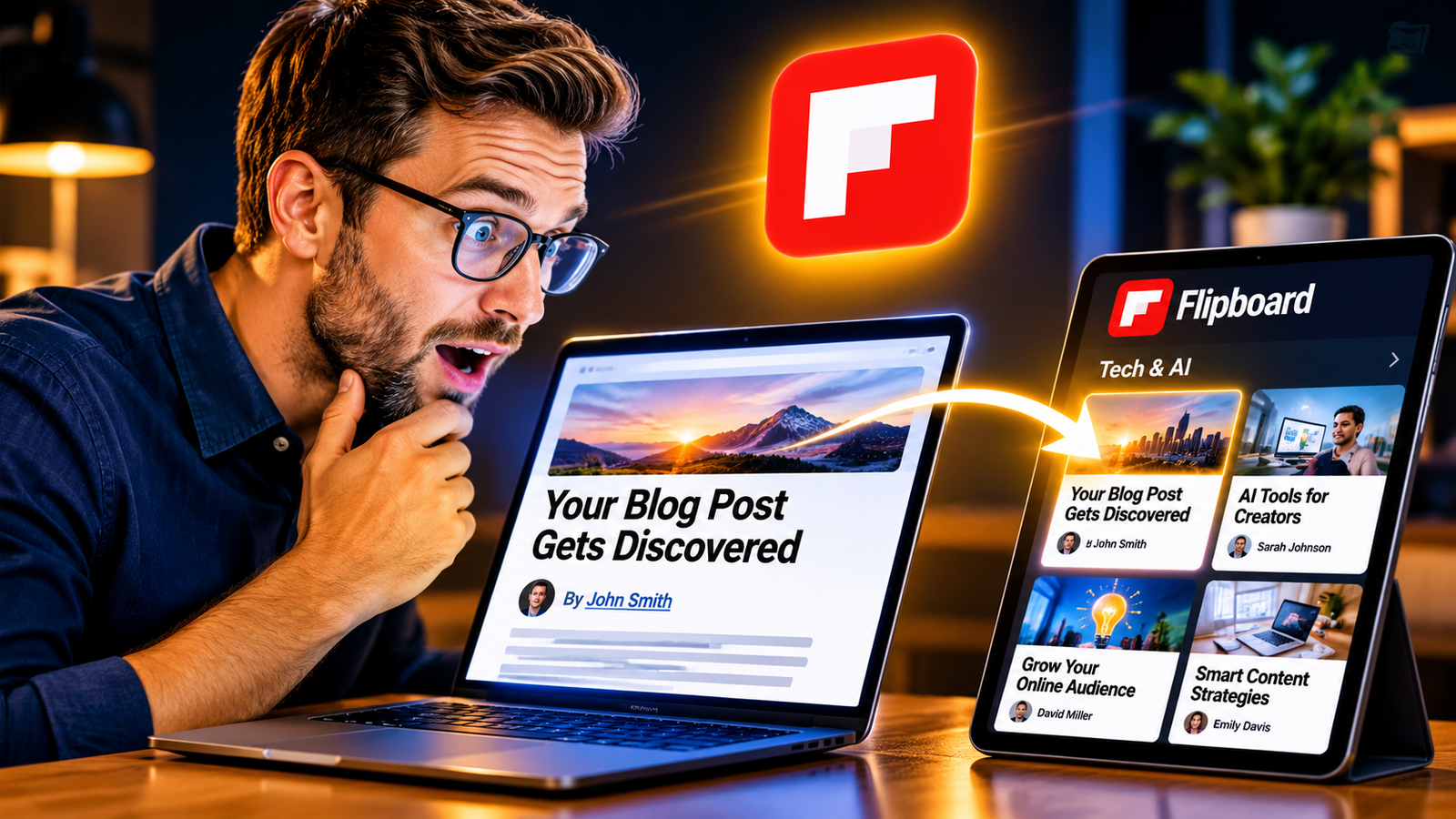
Each flipped article links back to the original website.
Picture a glossy digital magazine with a bold cover photo, a topic title, and a grid of story cards.
Each card has a headline, a small image, a short excerpt, and a name under it.
A reader taps one card and lands on your site.
That is a direct path from curiosity to visit.
This is why Flipboard Magazines are a smart part of any Flipboard publisher identity system.
Flipboard also says it wants to help smaller publishers get seen.
According to PPC Land, the company says its algorithm team works to give smaller platforms a better chance to surface.
The same report notes that Flipboard does not claim to solve the AI scraping problem.
It describes Flipboard as a channel that works apart from Google’s search algorithm and Discover feed.
That is a fair and honest way to see it.
Flipboard is not magic, and it does not replace search.
It is one more door into your website.
A tidy Flipboard publisher identity system helps readers walk through that door with confidence.
Flipboard Edition and AI-Assisted Discovery
There is a newer idea worth watching in 2026.
Flipboard Edition is experimenting with AI-assisted content discovery.
It uses publisher-feed details such as headlines, bylines, images, topic tags, and excerpts.
Its AI-assisted question-and-answer feature can connect readers to original publishers through source links.
Flipboard has also described plans to measure how publisher content appears and gets cited across AI assistants.
Notice how much of that depends on clean feed data.
If your bylines are missing or messy, there is less for any system to work with.
That makes your Flipboard publisher identity system more than a nice extra.
Now let us be careful and honest.
This is an early experiment, not a promise.
Using ordinary Flipboard Magazines will not guarantee AI citations.
It will not guarantee website visits from every AI search either.
What you can control is the quality of your identity details.
Clear authors, a clear publication, and a working original link give every system a better chance to credit you.
That is a calm and realistic goal.
It is also the best way to use a Flipboard publisher identity system without chasing hype.
What a Strong Article Looks Like on Screen
Let us build a picture so you can see the finished result.
At the top of the page sits a clear headline in dark, bold type.
Right under it, a small circular photo of the author sits beside a linked name and the publish date.
Below that, a short line says what the publication covers and who it helps.
At the bottom, a neat box shows the author’s bio with a link to their full profile.
Now picture the same article as a card inside a Flipboard Magazine, with the same name, headline, and image.
The reader sees the same identity in both places, and that sameness builds trust.
This is the quiet power of a Flipboard publisher identity system.
Three Mistakes That Hide Your Identity
Some publishers make the same few mistakes.
They use different author names on different posts.
They hide the About page deep in the footer.
They let the RSS feed show a default name like “admin.”
They flip their own posts into magazines again and again, with no other helpful stories.
Each mistake makes your content feel less trustworthy.
The good news is that every one of them is easy to fix.
Fix them once, and your future posts inherit the benefits.
Your Practical Identity Checkup
Choose one article and check it today.
Is the author’s name clearly shown?
Does the byline link to a real author profile?
Is the purpose of your publication easy to understand?
Does the article have a working original URL?
Does your RSS feed share the right author and publication details?
Can readers find the article through a relevant Flipboard Magazine?
Each yes moves your Flipboard publisher identity system forward.
If you answered no to any question, do not worry.
Fix one problem at a time.
Start with the author page, since it takes the least time.
Next, tidy your About page so your focus is clear.
Then check your feed and your canonical URLs.
Finally, add the article to a magazine that fits its topic.
Write a short comment with each flip that tells readers why the story is worth opening.
Small steps like these make a Flipboard publisher identity system stronger every week.
A Simple Weekly Flipboard Routine
Steady habits make any Flipboard publisher identity system work.
Pick two or three magazines that match your topic.
Flip your newest article into the best-fit magazine first, then the others over the next day or two.
Also flip useful articles from other trusted publishers, so your magazines stay helpful and not self-promotional.
Keep each magazine focused on one subject, with a clear title and a short description.
Check which flips get clicks, and make more of that kind.
This is also where a bigger system can save you time.
If you want Flipboard, Medium, AI search, and Claude workflows in one place, this ebook covers all of it.
👉Get Access to : The AI Traffic Vault
Final Thoughts: A Recognizable Creator, a Recognizable Publication, and a Clear Path Back
Your content needs more than a headline and a ranking.
It needs a creator people can recognize.
It needs a publication people can understand.
And it needs a clear path back to the original source.
Google can help people find you, and Flipboard can give them another way to reach you.
Together they build a stronger Flipboard publisher identity system for 2026 and beyond.
Start with one article this week, and fix what you find.
Then repeat the same steps, and your Flipboard publisher identity system will grow with every post.
Want to start small and build your first income stream? Grab these free guides.
👉Free download : Start a 1-Person Business With Claude AI — Free Quick-Start Guide
👉Free download : The Claude AI Digital Product Starter Pack — 10 Done-For-You Prompts for Beginners

We strongly recommend that you check out our guide on how to take advantage of AI in today’s passive income economy.