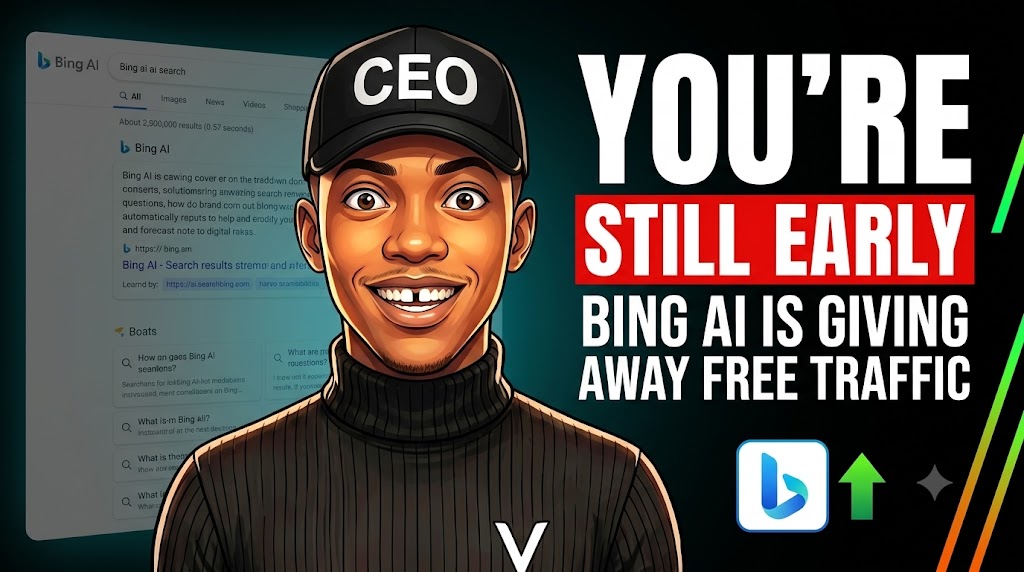
I Tested the Internet’s Most Unethical Free AI Traffic Hacks
AI Traffic Hacks
While the rest of the make-money-online space is fighting over Google page-one rankings that take months to build and are increasingly dominated by paid results and AI-generated summaries, Microsoft Bing AI is quietly doing something fundamentally different — and in 2026, the creators who have noticed are building a free traffic advantage that is compounding every week.
This article covers the complete Bing AI citation traffic strategy. What Bing AI is doing differently from Google. What content it selects as citations in its answers. How to optimize existing content to become a citation candidate. How to create new content specifically built to be cited. And how to connect that citation traffic directly to a digital product.
👉 Get Access to the full Package: Start a 1-Person Business With Claude AI
Table of Contents
Step 1 — Understanding How Bing AI Cites Sources Differently From Google
The fundamental difference between Google traffic and Bing AI traffic starts with how each platform presents information to its users.
Google shows ten blue links and the reader chooses which one to click based on title and meta description. Every result competes equally for the same click and position determines almost everything — the top three results receive the significant majority of all clicks on a given search.
Bing AI generates a conversational answer to the search query — a direct natural-language response to what the user asked. Embedded within that answer, at the top of the response, are three to five citation links. These are the specific source pages Bing AI used to construct its answer. They are not selected based primarily on domain authority or backlink count. They are selected based on how directly and clearly the content of that specific page answers the specific question being searched.
The reader who receives a Bing AI answer is already in a high-trust state when they see those citations. They trusted Bing AI enough to read and accept its answer. When Bing AI then indicates these as its sources, that trust extends directly to those pages. The click-through rate on a Bing AI citation consistently outperforms a standard Google search result at the same position because the reader is clicking with established trust rather than uncertain curiosity.
In 2026 this distinction creates a competitive opportunity that is still early enough to be meaningful. The content creators who are optimizing specifically for Bing AI citation traffic in the AI tools and make-money-online niche are a fraction of the number competing for the same Google rankings. The barrier to citation is lower. The reward per citation is higher quality traffic. And the window to establish position before the broader space catches on is open right now.
👉 You can also watch the video here
Step 2 — What Content Bing AI Actually Selects as a Source
After analyzing citation patterns across multiple Bing AI searches in the AI tools and digital products niche, three consistent patterns emerge in the pages that get selected as citations.
Pattern one — the page directly answers the exact question the search query asked in the first 100 words. Bing AI constructs its answers by pulling the most directly relevant sentences from source pages. A page that gets to the answer in the first 100 words gives Bing AI exactly what it needs to surface that content. A page that buries the answer deep in the article rarely gets cited regardless of the quality of what comes later.
Pattern two — the content is structured clearly with section headers, short paragraphs, and logical flow. Bing AI reads content the way a smart editor would — scanning for the clearest most quotable version of the answer to the question asked. Well-structured content with descriptive section headers tells the AI exactly where each piece of information lives. Unstructured content in long unbroken paragraphs is harder to pull from and less likely to be cited.
Pattern three — the content is written in natural human language rather than optimized for traditional keyword density. Bing AI has been trained on natural language and consistently selects content that reads like a knowledgeable person giving a clear direct answer over content that reads like it was written for a search engine crawler.
👉Get Access to: The AI Blog Monetization Quickstart Guide
Step 3 — Optimizing Existing Content for Bing AI Citations
The highest-leverage optimization action for Bing AI citation traffic is restructuring the first 100 words of existing articles. The rest of the article does not need to change. Only the opening needs to lead with the direct answer.
The test is straightforward. Read the first 100 words of an existing article and ask — if Bing AI pulled only these 100 words to construct an answer, would they directly and clearly answer the question this article is about? If the opening is a general introduction, a storytelling hook, or context-setting content that does not reach the core answer until later in the article — that page is not optimized for Bing AI citation.
The fix uses Claude AI. Open Claude and type: “Rewrite the opening paragraph of this article to be optimized for AI search citations. The opening must directly answer the question the article is about in the very first sentence. It must be written in clear natural language that reads like a knowledgeable person giving a direct answer. It must be 60 to 80 words maximum. Here is the current opening paragraph: paste the existing opening here.”
The Claude output will lead with a direct answer in the first sentence, written in natural language, at the right length. Replace the existing opening with this optimized version and the page immediately becomes a stronger Bing AI citation candidate. This process takes under 10 minutes per article using Claude and can be applied to every existing article on a blog systematically.
👉 Get Access to the full Package: Start a 1-Person Business With Claude AI
Step 4 — Creating New Content Specifically Built for Bing AI Citations
The proactive side of the Bing AI traffic strategy is creating new content that is specifically designed to answer the questions Bing AI is already responding to in the niche.
Start by identifying those questions using Claude. Open Claude AI and type: “Generate a list of 10 specific questions that someone interested in making money with AI tools would type into Bing AI search. Format them as natural conversational questions the way a real beginner would phrase them.”
Claude will produce 10 specific natural questions — the exact types of queries already generating Bing AI answers in this space. Each question is a content opportunity. A well-optimized article answering one of those questions has a realistic chance of becoming a citation in the Bing AI answer for that query.
To create that article use Claude again: “Write a blog article answering this specific question for a beginner audience. Structure it for AI search citation — direct answer in the first sentence, clear section headers, short paragraphs, natural conversational language throughout. Length 600 to 800 words.”
Publish the article, submit the URL to Bing Webmaster Tools for indexing, and monitor the Bing AI answers for that query over the following days. The timeline from publishing a well-optimized article to appearing as a Bing AI citation for a low-to-medium competition question in this niche is typically one to three weeks — significantly faster than achieving a comparable Google ranking.
👉 You can also watch the video here
Step 5 — Connecting Bing AI Traffic to Your Digital Product
Bing AI citation traffic is high-trust traffic arriving at a blog post with established credibility. Converting that traffic into digital product sales requires a deliberately structured path from citation to product.
The path has three steps. The Bing AI citation lands the reader on a blog post. Within the first half of that blog post — while the reader still has full attention on the content — a clear contextual link appears to the relevant digital product. That link should feel like a natural extension of what the article is already covering, not an interruption. The reader clicks through to the product page and has everything needed to make the purchase decision.
Each element of this path reinforces the trust established by the previous one. The reader was endorsed by Bing AI. The blog post delivered on that endorsement. The product is the natural next step for someone who found real value in both.
As more Bing AI optimized content is published and more pages get cited, more entry points are created into this same conversion path. Two traffic engines — Flipboard sending daily curated referral traffic and Bing AI sending endorsed citation traffic — feeding into the same blog and the same product creates a compounding free traffic system that grows with every piece of content added.
The next video covers the home base that receives all of this traffic — how the blog is set up as a digital product sales system that converts consistent traffic into consistent revenue.
👉 You can also watch the video here
We strongly recommend that you check out our guide on how to take advantage of AI in today’s passive income economy.