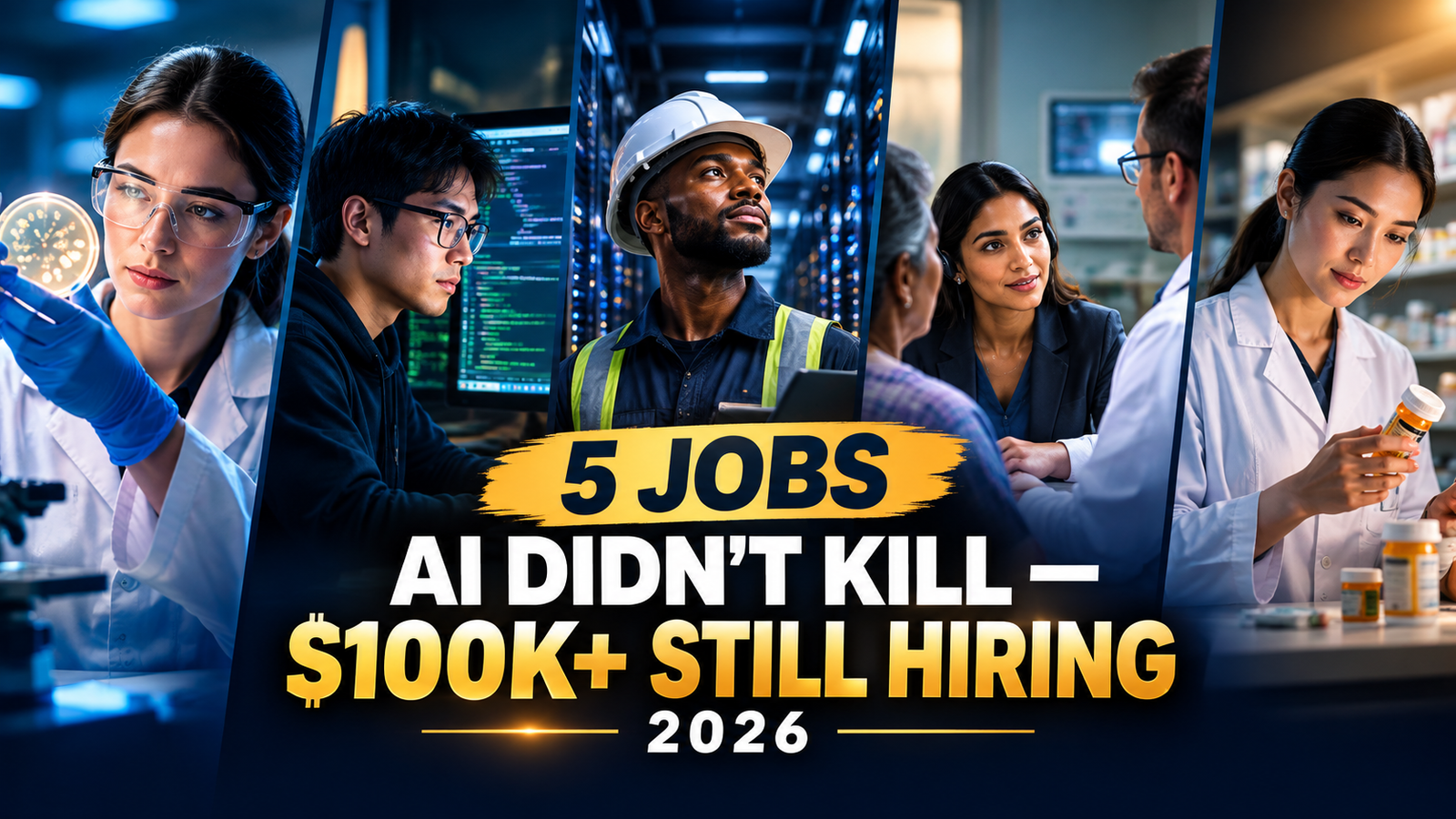
These 5 Careers Pay Up to $157K a Year and AI Made Them More Valuable, Not Less
AI-proof high-paying jobs still hiring are not a myth — they are open right now, and employers cannot fill them fast enough.
Five careers across science, tech, trades, healthcare, and language are experiencing a worker shortage so severe that salaries are climbing past $100,000 a year, some reaching $157,000, even as AI tools keep advancing around them.
If you were laid off, if you are picking a career for the first time, or if you have been quietly telling yourself it is too late to start over, this article was written for you.
👉 Start a 1-Person Business With Claude AI — Free Quick-Start Guide
Table of Contents
Why AI-Proof High-Paying Jobs Still Hiring Are the Smartest Career Bet of 2026
Most people hear the words “AI took that job” and walk away without checking the data.
The people who actually check the data are finding empty job listings, desperate employers, and pay packages that keep climbing year over year.
That pattern is not new.
When farm equipment arrived, it wiped out 40% of agricultural jobs in the United States, but it created entirely new roles in food processing, equipment manufacturing, and supply chain logistics.
When factories scaled up, they killed blacksmiths and home craftsmen, but they opened doors in industrial production, trade skills, and mechanical engineering.
When the internet arrived, it ended most travel agencies, video rental stores, and classified print ads, but it gave birth to e-commerce, digital marketing, app development, and an entirely new creator economy.
AI is following that exact same pattern right now in 2026, and the five jobs in this article are living proof that when the world writes a career off, that career usually starts paying more, not less.
The reason is simple: fear drives applicants away, demand stays the same or grows, employers get desperate, and salaries rise.
Every job on this list is experiencing that cycle in real time.
The stats shared throughout this article come from named sources, not opinions, because you deserve to see the receipts before you make a career decision.
And if you want to take what you learn here and turn it into an income stream of your own, the resources below will help you build that on the side of whatever career you choose.
👉 Get Access to: The AI Traffic Vault
Job 1: Clinical Embryologist — Earning $96,000 to $157,000 a Year
What an Embryologist Actually Does
An embryologist is a laboratory scientist who works inside a fertility clinic, handling human eggs, sperm, and embryos under controlled conditions to help people conceive through treatments like in vitro fertilization, which most people know as IVF.
Every petri dish they work with holds somebody’s future child, and the precision required in that role cannot be overstated.
The hands must be steady, the protocols must be followed to the letter, and the judgment calls made inside that lab affect real human lives in a way that no automated system has fully replicated.
Imagine a room bathed in soft amber lighting, temperature-controlled to match the exact warmth of the human body, where a scientist wearing magnifying lenses leans over a microscope and gently guides a single sperm toward a waiting egg with a tool thinner than a strand of hair.
That is what an embryologist does every working day, and right now, there are not nearly enough of them doing it.
Why AI Made This Job More Valuable, Not Less
The headlines from the past few years made it sound like AI had already taken over fertility medicine.
MIT Technology Review confirmed that AI systems are being used to rank embryos, and a robotic IVF system has already helped produce at least 19 live births.
But here is the part those headlines buried: the fertility industry’s own trade publications project that the field needs 43,000 more human embryologists and 4,000 new IVF labs built by 2035 just to keep up with demand.
The same reports state clearly that the embryologist shortage has become as severe as the shortage of fertility doctors themselves, and that shortage is pushing salaries upward at a rapid pace.
When everyone assumes a job is gone, the job starts overpaying, and embryology is a clear example of that principle playing out in real time in 2026.
Salaries for clinical embryologists currently sit between $96,000 and $157,000 a year depending on location, clinic size, and level of experience.
This is one of those careers where AI tools assist the human expert rather than replace them, because the stakes involved in human reproduction are too high for any employer to hand that responsibility entirely to a machine.
The human judgment required to oversee, validate, and ethically manage fertility procedures is not something any current AI system can fully replicate.
👉 Get Access to: The AI Blog Monetization Quickstart Guide
Job 2: COBOL and Mainframe Developer — Earning $83,000 to $138,000 a Year
Why a Programming Language From the 1960s Is Paying Six Figures in 2026
COBOL is a programming language that was built in 1959, and it is still running the financial backbone of the world.
Banks, insurance companies, government agencies, and large healthcare networks all run critical operations on COBOL-powered mainframe systems, and the code that processes most paychecks, pension distributions, and insurance claims in the United States runs through these same aging systems every single day.
Picture a massive underground data center, servers stacked floor to ceiling, humming quietly in climate-controlled air, processing billions of transactions every hour, and at the center of all of it is a programming language that most computer science programs stopped teaching two decades ago.
That disconnect between what the world still runs on and what schools have been teaching is now a serious crisis for employers.
Why AI Cannot Simply Replace COBOL Expertise
The assumption was that modern AI translation tools would make COBOL developers obsolete by automatically converting the old code into modern languages.
An Amazon Web Services executive addressed this directly in a statement to IT Pro, explaining that AI tools cannot and should not replace COBOL experts because human developers are still needed to validate the converted code and explain the business logic embedded inside decades of legacy systems.
That business logic — the rules, exceptions, and institutional knowledge baked into millions of lines of code — exists nowhere except inside those systems and inside the heads of people who have worked with them.
ZipRecruiter currently lists over 64 open COBOL developer positions, and a well-known tech recruiter named Chris is actively posting YouTube videos pitching remote mainframe roles at $102 per hour because he cannot fill the seats.
When a recruiter starts making video content just to find candidates, the talent shortage has reached a critical level.
COBOL and mainframe developers earn between $83,000 and $138,000 per year, and the demand is only increasing as the consulting firms running AI-powered mainframe modernization projects discover that they need more human experts to oversee the machines doing the translation work.
👉 Get Access to: Start a 1-Person Business With Claude AI
Job 3: Data Center Electrician and Trades Worker — Earning $100,000+ With No Degree Required
The Irony of AI Creating a Blue-Collar Boom
Here is the most important thing to understand about AI-proof high-paying jobs still hiring in the trades sector: AI cannot turn itself on.
Every response you have ever received from ChatGPT, every image generated by an AI tool, every recommendation made by an AI-powered algorithm — all of it came from physical servers sitting inside enormous buildings that consume massive amounts of electricity.
Those buildings have to be built, wired, cooled, maintained, and repaired by human hands, and right now there are not nearly enough of those hands.
Visualize a warehouse-sized building in the middle of a desert or on the edge of a city, the size of several football fields, its exterior walls lined with industrial cooling units pushing hot air out into the open sky, while inside, rows of server racks stretch from floor to high ceiling, each one blinking with thousands of small green and amber lights, all of it powered by a web of copper wire, industrial switchgear, and backup generators the size of city buses.
Every single electrical connection in that building was made by a licensed electrician.
The Numbers Behind the Shortage
Wired published a story specifically covering why there are not enough electricians and plumbers to build AI data centers at the speed the industry demands.
CBS Evening News reported approximately 400,000 unfilled trades jobs in the United States alone, with the data center construction boom stacking additional demand on top of an already stretched workforce.
Data centers also require plumbers and pipe fitters for cooling water systems, a trade already projected to fall 550,000 workers short of demand, HVAC technicians to prevent server overheating, welders for structural steel, fiber technicians, and generator specialists.
Bloomberg has given this labor market a name: the blue-collar gold rush.
The godfather of modern AI himself, Geoffrey Hinton, who famously warned the world to stop training radiologists because AI would replace them, has since publicly stated that his best career recommendation for 2026 is, in his own words, to become a plumber.
NVIDIA CEO Jensen Huang stated that a single AI data center requires up to 1,500 skilled trade workers to build, and that hundreds of thousands of these workers will be needed globally in the years ahead.
Meta has committed $115 million into a free trades academy program where graduates receive an industry credential and placement with Meta’s own contractors on active data center construction sites — a guaranteed job funded by the biggest tech company in the world.
Many of these trade roles clear $100,000 a year without requiring a four-year degree.
👉 Get Access to: The Flipboard Traffic Workflow Kit
👉 Get Access to: The AI Traffic Vault
Job 4: Medical Interpreter — Earning $79,000 to $147,000 a Year
The Job Google Translate Was Supposed to Kill — But Didn’t
Medical interpreters were supposed to be made obsolete first by Google Translate, and then finished off entirely by AI language models.
Neither happened.
A medical interpreter works in real time inside a hospital, clinic, or emergency room, converting what a doctor says into the patient’s native language and converting what the patient describes back into language the medical team can act on.
Picture a hospital emergency room at 2 a.m., fluorescent lights humming overhead, a Spanish-speaking child sitting on an examination table with a frightened parent beside her, and a pediatrician trying to understand whether the child has a known allergy before administering medication.
In that moment, the medical interpreter standing between the doctor and the family is not a convenience — they are a safety system, and getting one word wrong can send the treatment in a dangerous direction.
Why AI Language Tools Are Not Solving the Problem
The Hastings Center, a leading bioethics research organization, published findings confirming that inadequate medical interpretation in the United States is actively harming patients, contributing to delayed emergency care for children, increased medical errors, and higher overall healthcare costs.
HIMSS, the health technology industry’s own governing body, reported that hospitals are exploring AI translation tools specifically because of the interpreter shortage, while simultaneously admitting that no consistent method exists to verify whether those AI tools are safe enough to use in clinical settings.
When the industry is reaching for tools it cannot even properly test, that is not a sign that the human job is gone — it is a sign that the human job is more urgent than ever.
The Journal of the American Medical Association, which is the country’s most respected medical journal, has been publishing debates about whether AI can safely perform clinical interpretation, which tells you the answer is still very much undecided.
Language services companies are now producing entire podcast series just to recruit candidates into interpreter careers because the shortage has become that critical.
Medical interpreters currently earn between $79,000 and $147,000 per year, with the highest earnings going to interpreters working in hospital settings with rare or high-demand language combinations.
👉 Get Access to: The Medium Mastery
Job 5: Pharmacist — Earning a Median of $137,000 a Year
AI Took the Applicants, Not the Jobs
Pharmacy is the career that proves the central argument of this entire article more clearly than any other: AI-proof high-paying jobs still hiring are often the ones where the fear of automation drove applicants away while the actual job openings stayed exactly where they were.
Pharmacy school applications in the United States collapsed by 64% according to Axios, dropping from approximately 100,000 applicants per year down to around 36,000.
The Walgreens Chief Pharmacy Officer went on record saying that the company needs to evolve how it presents the profession just to get people excited about entering the field again.
Meanwhile, the Bureau of Labor Statistics still projects 14,200 pharmacy job openings every single year, and the median salary sits at $137,000 annually.
What Is Actually Happening Inside a Pharmacy in 2026
Imagine a hospital pharmacy the size of a small warehouse, located two floors below the main patient wards.
Robotic dispensing machines line the walls, sorted by drug category, moving automatically along tracks and dropping precisely counted pills into labeled containers.
But in the center of that room, a pharmacist in a white coat is at a computer workstation, reviewing flagged prescriptions, catching the drug interactions the automation identified but cannot resolve without understanding the patient’s full medical context, calling the prescribing physician to clarify an ambiguous dosage, and counseling a patient over video call about managing side effects.
The robots handle the counting.
The pharmacist handles everything that requires judgment.
That distinction — machine as tool, human as decision-maker — is what makes this career stable regardless of how advanced AI dispensing technology becomes.
Violin MD, a popular medical YouTube channel, documented a full shift shadowing a hospital pharmacist and the video received 643,000 views, with the footage clearly showing pharmacy robots operating in the background while the pharmacist managed every clinical decision in the foreground.
If you are someone who wants to build an income stream alongside a career like this, the resources below are specifically built for professionals who want to turn their knowledge into online revenue without starting from scratch.
👉 Start a 1-Person Business With Claude AI — Free Quick-Start Guide
👉 The Claude AI Digital Product Starter Pack — 10 Done-For-You Prompts for Beginners
What Every Job on This List Has in Common
Every single career covered in this article went through the same cycle.
AI arrived, or AI was rumored to be arriving, applicants panicked and left, employers needed workers more than ever, and salaries climbed to attract whoever was brave enough to stay.
That pattern has repeated itself through every major technological shift in human history, from the arrival of farm equipment to the rise of the internet, and it is repeating itself again right now with AI-proof high-paying jobs still hiring across multiple industries.
The people who are winning in 2026 are not the ones who avoided technology.
They are the ones who understood that technology changes what jobs look like — it rarely eliminates the underlying need those jobs serve.
IVF demand is not going away.
Legacy banking code still needs to be managed by humans.
AI data centers still need to be built by electricians.
Patients who speak minority languages still need interpreters who understand cultural nuance.
Pharmacists are still the final checkpoint before medication enters a human body.
These are not jobs at the edge of extinction.
They are jobs that are actively begging for workers, and in 2026, that is one of the most powerful career advantages a person can have.
👉 Get Access to: The AI Traffic Vault
Turning Career Knowledge Into a Second Income Stream
One more thing worth saying before you go.
If you are already working in any of these fields, or if you are just now entering one of them, you are sitting on knowledge that other people will pay to access.
The same pattern that creates job shortages — people assuming the career is gone — also creates an audience of people who are desperately searching for real information about how to get into these fields.
A medical interpreter who films their workflow and explains the certification process on YouTube or a blog is giving something valuable to thousands of people who would otherwise have no idea where to start.
A data center electrician who documents their career path and explains what the trade actually pays is building an audience that companies and training programs will eventually pay them to reach.
The AI tools available in 2026 make it possible to build that kind of content operation as a solo creator, even as a side project alongside a full-time role.
The resources below are designed specifically for solo operators who want to build content-based income using AI tools without needing a team, a large budget, or years of experience.
👉 Get Access to: The Medium Mastery
👉 Get Access to: The Flipboard Traffic Workflow Kit
👉 Get Access to: The AI Blog Monetization Quickstart Guide
Final Thoughts: The Real AI Opportunity Is the Gap Everyone Else Left Behind
The five careers covered in this article — embryologist, COBOL developer, data center trades worker, medical interpreter, and pharmacist — are all paying $100,000 or more per year in 2026 precisely because AI-proof high-paying jobs still hiring are being overlooked by a workforce that is too busy being afraid to look at the actual data.
The headlines told people to walk away.
The people who checked the data found open doors.
Some of those doors lead to six-figure salaries with no degree required.
One of them, according to the man who helped build the technology that everyone is afraid of, is a plumber.
If you are ready to stop walking away from opportunity and start walking toward it — whether that is a new career, a content-based side income, or a full digital product business — the resources below will help you take the first step today.
👉 Get Access to: Start a 1-Person Business With Claude AI

We strongly recommend that you check out our guide on how to take advantage of AI in today’s passive income economy.