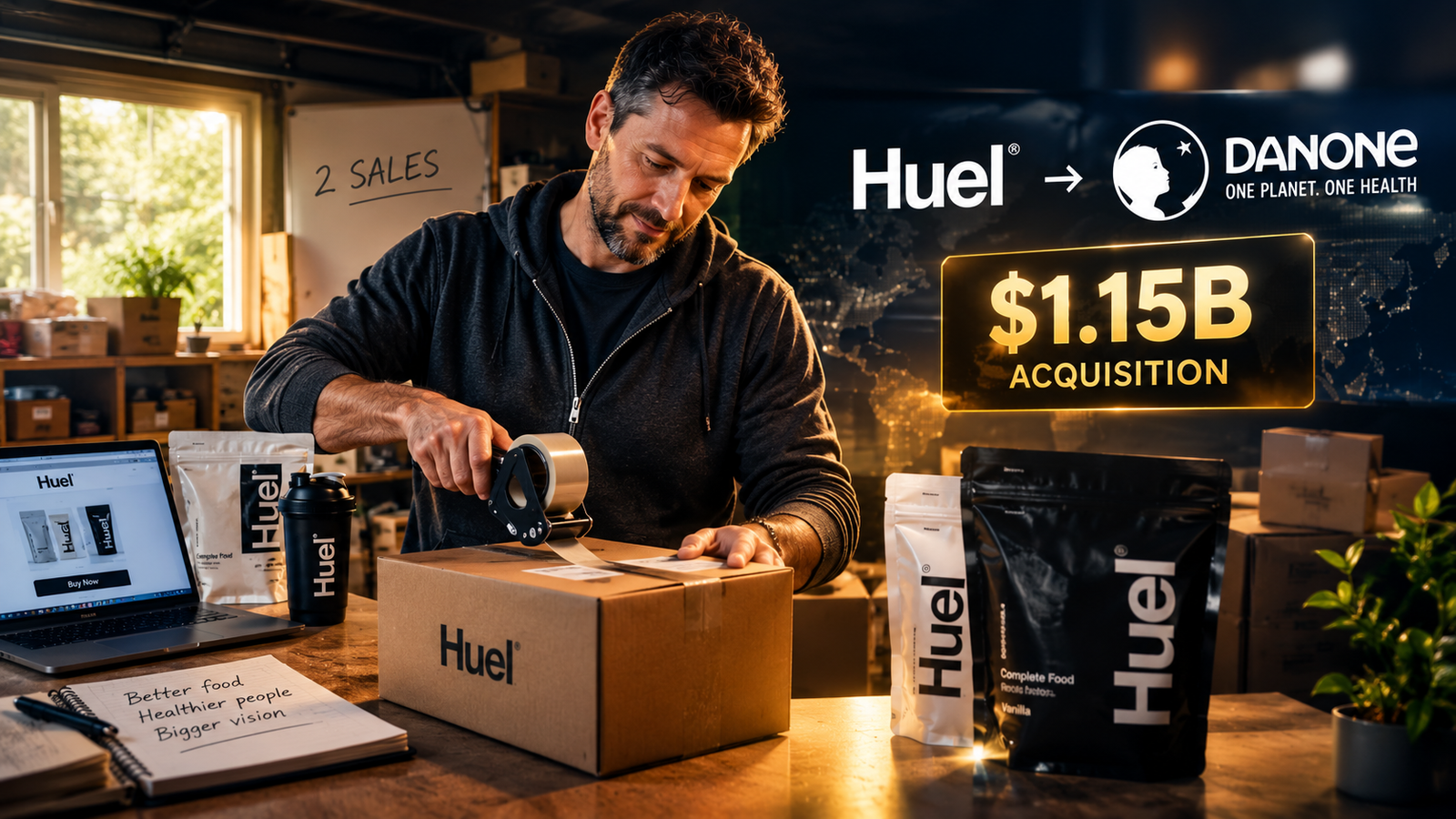
How Huel Grew From a Garage Startup to a $1.15 Billion Acquisition in 10 Years
Huel, the British meal replacement brand, grew from 2 garage sales in 2015 to a $1.15 billion acquisition by French conglomerate Danone in 2026 — not through massive ad spend or venture capital firepower, but through a community-first strategy that any solo founder can copy starting today.
👉 Start a 1-Person Business With Claude AI — Free Quick-Start Guide
Most people scrolled right past the August 2026 announcement that Danone acquired Huel for $1.15 billion.
It did not trend on X. It did not dominate the business news cycle the way a Silicon Valley IPO would have.
And yet, buried inside that quiet announcement was one of the most important business case studies of the decade — one that did not require a Harvard MBA, a venture capital war chest, or a celebrity co-founder.
It required a man in his mid-40s, a garage, two customers, and a Facebook group.
This is the story of how the Huel billion-dollar business growth strategy was built — and why it is completely, unapologetically copyable by you.
👉 Get Access to: The AI Traffic Vault
Table of Contents
The Acquisition Nobody Talked About — And Why It Matters in 2026
In the last 18 months leading up to mid-2026, the e-commerce world has seen a remarkable wave of big-ticket acquisitions in the consumables and food brand space.
Grüns, the daily greens gummy brand, sold for $1.2 billion.
Dr. Squatch, the natural men’s soap brand, was acquired for just over $1 billion.
And now Huel — the UK-based complete nutrition powder that Julian Hearn launched from his home — has been acquired by Danone, one of the world’s most powerful food and beverage conglomerates, for $1.15 billion.
What makes the Huel billion-dollar business growth strategy so different from those other exits is not the size of the check.
It is how the company got built in the first place.
Grüns and Dr. Squatch were, in many ways, products of experienced operators, investor capital, and structured growth playbooks built by people with decades of consumer goods experience behind them.
Huel was built by a guy who had already failed once, who packed boxes in his own garage, who drove them to the post office himself, and who launched his product to the world by typing a message into a Facebook group with fewer followers than most small-town bulletin boards.
That is the part that should make every solo founder sit up straight right now.
Because if this story had happened to a 28-year-old Stanford dropout with a $5 million seed round, you could dismiss it as luck or privilege.
But it did not happen to that person.
It happened to Julian Hearn — and that changes everything about how you should read this story.
👉 Get Access to: The AI Blog Monetization Quickstart Guide
Julian Hearn Was Not an Overnight Success — He Was a Comeback Story
Before Julian Hearn built the Huel billion-dollar business growth strategy, he was not sitting on a pile of wins.
He had one modest success — an affiliate marketing website that he built, grew, and eventually sold — but the details of that exit were never made fully public, so we cannot tell you exactly how much he walked away with.
What we do know is what came next.
He poured much of what he had earned into a fitness information website called Body Hack — a platform that ranked and compared popular diets, workout programs, and fitness systems.
Body Hack failed.
Not quietly. Not gently. He lost several hundred thousand pounds on that venture — wiping out a significant portion of the gains from his earlier success and leaving him back near the starting line.
But here is what is easy to miss when you read that sentence: Body Hack was not just a failure.
It was research.
Because while Julian Hearn was running that fitness website, he was watching real people try and fail to follow diets and workout plans, and he was able to see the exact reasons why they kept falling off.
The answer he kept coming back to was not that people lacked willpower.
It was that the whole system was too complicated.
Too many meals to prep. Too many macros to track. Too many steps between a person and the result they actually wanted.
And from that observation — born entirely out of a business failure — came the idea for Huel.
A complete, nutritionally balanced meal in powder form that removed all the friction between a person and eating well.
This is not a unique pattern. It shows up again and again in founder stories.
The team behind Magic Spoon — the high-protein, low-sugar cereal brand that now sits in Target stores across the United States — went through the exact same arc before they built something that worked.
Before Magic Spoon, Nick Hamburger and Gabi Lewis ran a company called Exo Protein.
Exo Protein made protein bars from cricket flour — ground-up crickets pressed into bars and marketed as a sustainable protein source.
The product made sense on paper. The market did not agree.
Exo Protein never broke through at scale, but what Hamburger and Lewis learned inside that business gave them the raw material for their next idea.
They learned that people want protein.
They learned that people do not want to change their habits or feel weird about what they are eating.
They learned that the easiest path to a growing food brand was to take something people already love and make it healthier — not to force them into something new.
So they made cereal. Protein cereal. Delicious, colourful, nostalgic cereal that happened to have the macros of a gym meal.
Nick Hamburger came on Ryan Daniel Moran’s podcast — the Capitalism.com show — and said it was the first time in his career as a founder that he truly felt what product-market fit was, because the product solved a problem people already knew they had, in a form they already knew they wanted.
Julian Hearn’s story with Huel follows the exact same trajectory.
The Huel billion-dollar business growth strategy did not start in a boardroom.
It started in the wreckage of a failed idea, with a founder who was paying very close attention to why people fail — and decided to solve for that directly.
Two Sales, a Garage, and a Facebook Group — The Actual Beginning
On June 17, 2015, Julian Hearn launched Huel.
He did not hire a PR firm for the launch.
He did not run Facebook ads.
He did not seed the product to influencers or buy placement in a food subscription box.
He typed a post in a London Startups Facebook group.
Two people clicked through to his website and bought the product.
Two.
Not two hundred. Not two thousand. Two.
Julian Hearn packed those two orders himself, carried them to the post office in his car, and drove them there himself.
That was the beginning of the Huel billion-dollar business growth strategy — two boxes, a garage, and a founder willing to do the work that nobody ever puts on the front page.
Picture this: a 40-something entrepreneur with a failure still fresh on his record, standing in a modest home garage, sealing up cardboard boxes by hand, knowing full well that the entire customer list of his new company could fit inside a single elevator with room to spare.
That is what the beginning of a billion-dollar brand actually looks like.
And most people who want to build something never see that part — because we only ever celebrate the exits.
What Julian Hearn did next is the part of the Huel billion-dollar business growth strategy that separates it from almost every other brand story you will read this year.
He did not immediately try to go find customer number three.
He picked up the phone — or more accurately, opened his inbox — and asked those two customers a very simple question.
Why did you buy?
Their answers became his marketing playbook.
He learned what language those early buyers used to describe the problem they were trying to solve.
He learned what motivated them to click through and spend money on a product they had never heard of, from a person they had never met, on a website that had been live for approximately five minutes.
And he used those exact words, those exact motivations, to go find more people just like them.
That is not a hack. That is not a growth trick.
That is a fundamental principle of building a business that actually lasts — and it costs you nothing but the willingness to listen.
The 1,000 True Fans Framework That Became Huel’s Growth Engine
Most early-stage founders spend the majority of their time obsessing over scale.
They want to go from zero to ten thousand customers as fast as possible.
They want viral content. They want paid traffic that blows up overnight.
Julian Hearn had a different goal.
He wanted one thousand customers who truly loved what he was building.
This idea did not belong to him originally. It was articulated by Kevin Kelly — the founding executive editor of Wired magazine — in a now-legendary 2008 essay titled “1,000 True Fans.”
Kelly’s argument was simple: if you have one thousand people who genuinely love what you create, who will buy everything you put out, and who will tell other people about you without being asked, you have the foundation of a real, sustainable business.
Julian Hearn applied this framework directly to Huel.
In his own words, as documented in early interviews and podcast appearances, he described his thinking like this: the internet is a big place. Surely he could find a thousand people willing to pay £45 a month for a product that genuinely solved a problem in their lives.
At £45,000 a month, that was £540,000 per year — enough to run a lean, profitable lifestyle business and prove the concept.
That was the first version of the Huel billion-dollar business growth strategy: not a moonshot, but a math problem.
And in 2015 alone — the company’s very first year of trading — Huel generated approximately $800,000 in revenue.
That is not bad for a brand that launched from a Facebook group post.
It is also a number that should make any solo founder or solopreneur rethink what is actually possible when you commit to finding your one thousand true fans before you ever try to buy your first ad.
👉 Get Access to: The Flipboard Traffic Workflow Kit
Building the Community Before Building the Machine
The first major raving fan community that adopted Huel did not come from Julian Hearn’s own outreach.
It came from Reddit.
Specifically, it came from the r/soylent subreddit — a community built around Soylent, an American meal replacement brand that competed in the same space as Huel.
Members of that community discovered Huel, started talking about it on the subreddit, and a small but genuinely enthusiastic group began to form around the British alternative.
Julian Hearn and his small team leaned all the way into that.
They did not sit back and watch the discussion happen from the outside.
They got inside the conversation.
They answered questions. They responded to criticism. They engaged with the people who were excited about the product in a way that made those people feel like they were part of something — not just customers of a powder company.
From that organic community, Hearn created a group he called the Hooligans.
The Hooligans were Huel’s earliest buyers — the people who had been there from the beginning, who cared about the brand’s mission, and who were willing to help shape what it became.
Hearn built a dedicated forum on the Huel website to host this community — a place where early buyers could talk to each other and, more importantly, talk directly to the founders.
You can still visit that forum today at discuss.huel.com.
It is a live, active space — a real community that has been running continuously since the brand’s earliest days.
The Huel billion-dollar business growth strategy was built on this community before it was built on anything else.
No ad campaigns. No celebrity endorsements. No retail distribution deals.
Just real people talking to each other about a product they believed in — and a founder who was in the room with them, listening to every word.
This approach to early growth mirrors exactly what business strategist and author Ryan Daniel Moran teaches inside his Capitalism.com framework.
Moran describes what he calls the Traffic Triangle — a three-part structure made up of a product that solves a real problem, an audience of raving fans, and a sales channel that compounds over time.
Inside that framework, Moran talks about something he calls the Hopper — the owned space where you house and engage your most loyal audience members.
For some brands, the Hopper is an email list.
For others, it is a private Facebook group.
For Huel, it was their own branded forum.
The format was less important than the principle: keep your raving fans together, keep them engaged, and give them a place where they feel heard.
Because once you have that, you have an asset that no competitor can simply purchase or replicate — no matter how much money they have.
That lesson became very important when Danone tried to build a competitor to Huel in January 2026.
They launched a product called Elvie Meal To Go.
They had the capital.
They had the distribution infrastructure.
They had the marketing budget.
And they shut the whole project down within months.
Because they could reverse-engineer the product. They could replicate the packaging. They could buy their way into retail shelves and run ads all day long.
But they could not manufacture ten years of community trust.
They could not recreate the Hooligans.
And so instead of trying to compete, they wrote Julian Hearn a check for $1.15 billion.
From $800K to $5 Million — The PR and Media Play That Unlocked Real Scale
By the time Huel had been running for roughly two years, the brand had moved past its earliest scrappy phase and was beginning to figure out how to grow more deliberately.
The company was already doing approximately $5 million in annual revenue by this point — a trajectory that took them from two garage orders to a multi-million-dollar run rate in a remarkably short window.
A portion of that growth came from a decision to bring in a PR agency to help generate earned media coverage.
This was not a big-budget paid media play.
It was the classic content-and-outreach approach — pitching journalists and writers at publications that reached health-conscious consumers, offering them product samples, and positioning Huel as a story worth telling.
It worked.
Coverage in UK health and lifestyle publications introduced Huel to audiences who would never have found it through a Reddit thread — and each new wave of press coverage brought another surge of curious buyers into the Hooligans forum.
In today’s market, this same playbook looks different but runs on identical logic.
Instead of pitching magazine editors, the most effective version of this strategy involves reaching out to creators on TikTok, Instagram Reels, and YouTube — people with focused audiences in the health, fitness, productivity, and lifestyle spaces.
You offer them product.
You give them a story worth sharing.
And if your product genuinely solves a problem, the content they create about it does your marketing for you.
The Huel billion-dollar business growth strategy at the mid-growth stage was built on this exact combination: a passionate community on their own platform, supplemented by outreach to distribution partners who could bring new eyeballs into the funnel.
If you are building a digital product business or a content-based brand, this framework translates directly.
👉 Get Access to: The Claude AI Digital Product Starter Pack — 10 Done-For-You Prompts for Beginners
The Steven Bartlett Moment — What One Relationship Can Do
Of all the things that accelerated Huel’s growth from seven figures toward the nine-figure threshold, one relationship stands out above almost every other marketing decision the company made.
In 2019, Julian Hearn appeared on a podcast called Diary of a CEO — hosted by British entrepreneur and Dragons’ Den investor Steven Bartlett.
At the time, Diary of a CEO was only 35 episodes in.
It had not yet become one of the most-downloaded business podcasts in the world, with episodes routinely featuring guests like Simon Sinek, Mel Robbins, and Gary Vaynerchuk.
But the audience it had was exactly the kind of audience Huel needed — curious, ambitious, health-conscious entrepreneurs and professionals who were already predisposed to care about optimizing how they lived and worked.
The appearance introduced Huel to a wave of new customers.
It also introduced the brand to a wave of investors and business-minded people who began watching the company’s trajectory very closely.
Two years later, in 2021, Steven Bartlett became an investor in Huel.
And here is why that matters beyond the capital he brought to the table.
When a person with millions of podcast listeners, Instagram followers, and LinkedIn connections becomes a financial investor in your brand, their incentive to talk about your product changes completely.
They are no longer just a fan. They are a stakeholder.
And so every time Bartlett mentioned Huel on his show, shared it in his content, or referenced it in an interview — which he did regularly — he was driving warm, pre-qualified traffic to a brand that already had one of the strongest community retention rates in the meal replacement space.
The Huel billion-dollar business growth strategy did not engineer that relationship through a clever influencer deal.
It happened because Julian Hearn and his team committed to building real relationships with every customer who walked through the digital door — and eventually, one of those customers turned out to be one of the UK’s most influential media personalities.
You cannot plan for that.
But you can absolutely make the conditions for it more likely by choosing to treat your audience like the most valuable asset in your business — because it is.
Absorbing a Loss to Protect the Community — The Decision That Defined the Brand
There is one chapter of the Huel story that rarely gets told in the headline-friendly version of this case study — and it is arguably the most important chapter of all when it comes to understanding what actually built this business.
In the period following the COVID-19 pandemic, Huel faced the same inflationary pressures that crushed hundreds of consumer brands.
Input costs rose sharply.
Ingredient prices went up.
Shipping and logistics costs climbed.
Supply chain disruptions made everything more expensive to produce and deliver.
Most brands responded the only logical way: they raised their prices and passed the cost increase on to their subscribers and customers.
Huel made a different choice.
They absorbed the loss.
They chose to take a financial hit for an entire period rather than ask their most loyal subscribers — the people who had been with them from nearly the beginning, who had recommended the product to their friends and families, who had built the Hooligans community into what it was — to pay more.
It was a decision that defied the spreadsheet logic most operators would apply to that situation.
But it was entirely consistent with the values that had driven every strategic decision the company had made since Julian Hearn packed those first two boxes in his garage.
The community was not a marketing channel.
The community was the business.
And you do not ask the foundation of your business to carry the extra weight when times get hard. You carry it yourself for as long as you can.
That decision — to absorb the loss and protect the subscriber base — arguably did more for Huel’s eventual valuation than any ad campaign or retail distribution deal the company ever ran.
Because what Danone was ultimately buying when they wrote that $1.15 billion check was not a powder.
They were buying a decade of trust.
And that is not something you can price on a spreadsheet.
The Three Pillars Behind Every Business That Exits for 8 or 9 Figures
The Huel billion-dollar business growth strategy is not complicated when you zoom all the way out.
It comes down to three things — the same three things that Ryan Daniel Moran has been teaching inside the Capitalism.com ecosystem for years, and that you can see operating in almost every brand that has achieved a meaningful exit in the last decade.
Pillar One: A Product That Solves a Real Problem
Julian Hearn did not guess at what people wanted.
He spent 18 months formulating a product based on direct, lived observation of why people fail at eating well — and he built something that removed every major obstacle between a person and good nutrition.
If you are trying to build a digital product, a course, a software tool, or a physical product brand, this is your starting point.
Not “what can I make?” but “what problem am I watching real people fail to solve — and what would it look like to remove all the friction from that solution?”
Pillar Two: An Audience of Raving Fans
Before the ads, before the PR, before Steven Bartlett, before the Series A — there were the Hooligans.
A small group of early believers who were treated with genuine care, engaged with directly, and given a space to belong.
That community became the engine that compelled every other stage of growth.
If your current business has nine customers, your job right now is not to go find nine thousand more.
Your job is to make those nine people feel like the most valued members of the most exciting community they have ever been part of.
And then let them bring you the next nine.
Pillar Three: A Sales Channel That Compounds
Huel’s initial sales channel was a basic Shopify website that Julian Hearn coded himself — no developers, no custom builds, no complicated tech stack.
It did not need to be beautiful. It needed to work.
What compounded on top of that was the forum, the word-of-mouth, the Reddit threads, the PR hits, the Diary of a CEO episode, and eventually the Steven Bartlett investment — each layer of distribution feeding the next.
The Huel billion-dollar business growth strategy was not built on a single channel.
It was built on a simple foundation that was allowed to compound over ten years.
What This Means for the Solo Founder Building Something in 2026
Here is what makes the Huel story genuinely exciting if you are building a one-person digital product business, a content brand, or an online audience right now in 2026.
The tools available to you today are dramatically more powerful than what Julian Hearn had access to in 2015 when he coded his own Shopify site from scratch before AI-assisted development was even a concept.
You have AI tools that can help you build faster, create content more consistently, distribute more intelligently, and connect with your audience at a scale that would have required a full team just five years ago.
The Huel billion-dollar business growth strategy was built with far fewer resources than you currently have access to.
And the principles that made it work — a real product, a genuine community, a simple sales channel — are just as valid and just as actionable today as they were on June 17, 2015, when Julian Hearn pressed publish on that Facebook group post.
You do not need a million followers.
You do not need a venture-backed war chest.
You do not need to have gone to the right school or worked for the right company.
You need a product that actually solves something.
You need the commitment to show up for the early buyers who believe in you before the world does.
And you need the patience to let those relationships compound into something that surprises even you.
That is what Huel did.
And the fact that Julian Hearn cleared more than $500 million personally from this exit — after starting from a garage, after a major failure, after two customers, after a Facebook group post — is the most important business story of 2026.
Not because it is glamorous.
Because it is possible.
👉 Get Access to: The AI Traffic Vault

We strongly recommend that you check out our guide on how to take advantage of AI in today’s passive income economy.