The New Filmmaking Economy Where Anyone With a Laptop Can Direct a Cinematic Masterpiece
The $500 Blockbuster Nobody Saw Coming
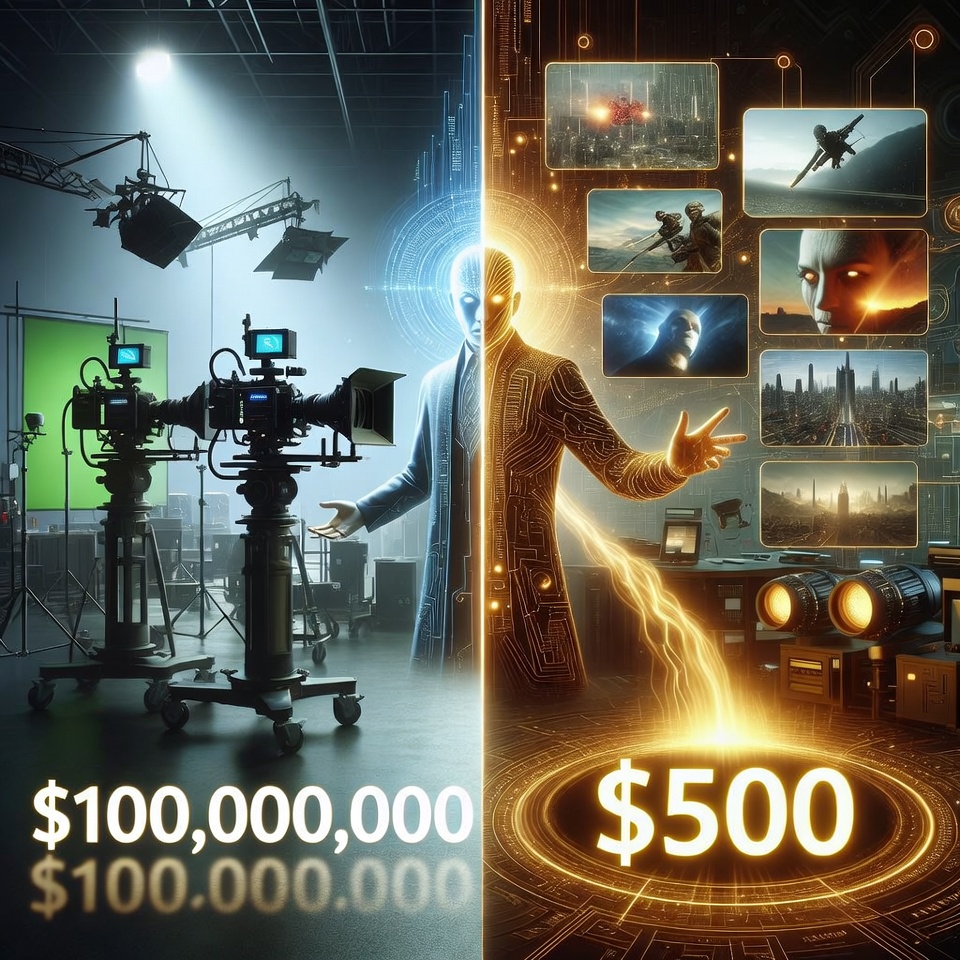
Blockbusters used to cost a fortune — and that was the whole point.
Big studios spent $100 million, $150 million, even $200 million on a single film because the barrier to entry was the only thing protecting them from competition.
Giant green screen sets, armies of VFX artists, celebrity agents, union contracts, rental equipment, post-production houses — all of it stacked up into a wall of money that kept everyday people out.
That wall just got knocked down.
Right now, in 2026, solo creators are making cinematic content that looks every bit as stunning as the kind of blockbusters you see in a packed multiplex on opening night.
They are doing it with AI video tools, AI voice generators, AI scriptwriters, and AI music composers — spending less than $500 total.
This is not a prediction about the future — this is already happening, and the smartest creators are already turning this shift into real online income using systems like faceless video income to monetize their AI-generated content right now.
Hollywood is not just nervous — Hollywood is scared.
Table of Contents
The Numbers That Are Keeping Producers Up at Night
Think about what it actually costs to make a traditional Hollywood blockbuster.
According to industry reports, the average studio film with major visual effects now runs between $100 million and $300 million before even a single dollar of marketing is spent.
Producing one action sequence — a single car chase, an explosion, or a city being destroyed — can consume $10 million to $15 million in VFX labor alone.
That is for one scene.
Now compare that to what AI tools are delivering in 2026: photorealistic digital crowds, fully generated background environments, explosion physics, fluid dynamics, cinematic lighting, and even lip-synced dialogue — all from a prompt typed into a tool like Kling 3.0 or Google Veo 3.1.
Advanced AI models like OpenAI Sora 2 Pro, Google Veo 3.1, and Kling 3.0 now enable creators to generate photorealistic dynamic storyboards, complex background plates, and native audio-synced sequences without expensive on-location shoots.
The economic math of blockbusters has been completely rewritten.
A creator sitting in their bedroom in Lagos, Nairobi, Austin, or Manila can now generate scenes that would have required a $20 million VFX contract just three years ago.
Faceless video income tools are designed exactly for this moment — helping regular people package this kind of AI-generated cinematic content into income-producing video channels with no camera, no crew, and no studio deal required.
How the Viral Moment That Shook Hollywood in Early 2026 Changed Everything
Nobody in Hollywood expected what hit them in February 2026.
A 15-second AI-generated video clip of Tom Cruise battling Brad Pitt on a burned-out highway overpass went viral — created by Irish filmmaker Ruairi Robinson using a generative AI tool called Seedance 2.0, developed by ByteDance, the company behind TikTok.
The clip did not look like a glitchy AI experiment.
It looked like a scene pulled from a $150 million blockbuster — crisp, cinematic, perfectly lit, with two A-list faces rendered so accurately that millions of viewers could not immediately tell it was AI.
Unlike most AI-generated videos, the subjects did not look creepy, uncanny, or animated — the clip almost perfectly mimicked live-action footage.
The entertainment world reacted with a mix of admiration, outrage, and what can only be described as existential panic.
Because the message was clear: you no longer need a $100 million budget, a studio contract, or even a film crew to create content at the quality level of major blockbusters.
You need AI tools, a creative idea, and the strategy to turn that content into income — which is exactly what systems like faceless video income are built to help you execute.
The AI Tools Turning Bedroom Creators Into Blockbuster Directors
Google Veo 3.1 — The Cinematic Engine Nobody Talks About Enough
Google Veo 3.1 is quietly one of the most powerful AI video generation models alive in 2026.
It generates fully photorealistic scenes from text prompts, meaning you describe what you want — a rain-soaked city street, a medieval battle, a spaceship entering orbit — and the tool renders it in stunning cinematic quality.
The color grading looks like something that came out of a $10 million DaVinci color suite.
The lighting reads as naturally as if a gaffer and a DP spent two days on set setting it up.
Tools like these are drastically reducing VFX budgets and accelerating pre-production for both major Hollywood studios and independent creators, enabling blockbuster-level visual effects at a fraction of the traditional cost.
This is a complete rewrite of what it means to be a filmmaker in 2026.
You are no longer limited by money — you are only limited by imagination.
And if you pair this creative power with a monetization framework like faceless video income, you now have a full pipeline from idea to income, no studio deal or six-figure budget required.
Kling 3.0 — The Physics Engine That Makes Blockbusters Feel Real
One of the biggest gaps in early AI video was physics.
Explosions looked off, water moved wrong, fire behaved like a screensaver — and trained eyes could spot it instantly.
Kling 3.0 fixed that.
Kling 3.0’s physics engine now excels at rendering complex fluid dynamics, realistic fire, and explosions without the agonizingly long CGI rendering times that traditional studios rely on.
Think about what that means for someone making blockbusters independently.
You can generate a battle sequence with real-looking fire and explosions in the time it takes a Hollywood VFX team to just write the brief for the project.
What used to cost $8 million and take four months now takes four hours and $50 in tool credits.
Creators using platforms built around this technology — like faceless video income — are already packaging these kinds of visually stunning videos into niche YouTube channels that generate passive affiliate income around the clock.
Runway Gen-4.5 — The Consistency Tool That Makes Blockbusters Look Like Blockbusters
One of the hardest problems in AI video has always been character consistency.
A character would look one way in frame one and slightly different in frame two — enough to break the cinematic illusion.
Runway’s Gen-4 model has solved one of the biggest challenges in AI video generation — keeping characters and scenes visually consistent across shots.
This is enormous.
Without consistency, you cannot tell a story.
With it, you can produce multi-scene, multi-chapter blockbusters where the same character walks through different environments, fights enemies, speaks dialogue, and drives vehicles — all looking like the same person throughout.
Independent creators are using this capability to produce full short films, episodic YouTube series, and cinematic content channels that compete directly with studio-produced content — and they are monetizing every view through faceless video income strategies that do not require them to ever appear on camera.
Hollywood’s Real Fear — It’s Not Just About Costs
Here is what makes the suits in Los Angeles truly nervous.
It is not just that AI is cheaper.
It is that AI removes the gatekeeping entirely.
For decades, Hollywood’s power came from controlling access to the tools of blockbuster production — the cameras, the VFX houses, the sound stages, the distribution networks.
As one filmmaker summarized at a recent FilMart event: “Hollywood is scared. Generative AI is going to help small, less-capitalized film industries compete with multi-million dollar budgets on a visual scale.”
That quote landed because it is true — and it applies far beyond Asia.
It applies to every individual creator on the planet who has ever had a cinematic story to tell but no studio willing to fund it.
A McKinsey report from January 2026 forecasts more AI adoption throughout the entertainment industry, with one studio executive acknowledging that AI could represent a more significant platform shift than anything the industry has seen before.
The blockbusters of tomorrow may not come from Universal, Disney, or Warner Bros.
They may come from a solo creator in a small apartment who figured out how to use faceless video income tools to build a channel, grow an audience, and fund their own cinematic universe.
The Job Disruption Nobody Wanted to Talk About Is Now Undeniable
This shift does not come without pain.
Over the past three years, 41,000 jobs in film and television have disappeared in Los Angeles County alone.
The Animation Guild warned in 2024 that by 2026, creative workers would face an era of disruption defined by role consolidation, job replacement, and outright elimination of certain positions.
That prediction has come true faster than most people expected.
Set designers, background actors, junior VFX artists, storyboard illustrators, location scouts — roles that once supported the machinery of blockbusters are evaporating as AI handles those tasks.
AI tools can now instantly populate stadium scenes or city streets with AI-generated crowds, eliminating the need to pay hundreds of background actors.
This is a painful reality for people whose livelihoods were built on those jobs.
But for creators who are willing to adapt — who are willing to learn how these tools work and build new income streams around them — the opportunity is enormous.
Systems like faceless video income exist precisely to help people on the right side of this shift turn AI video production skills into sustainable, scalable income.
What a $500 AI Blockbuster Actually Looks Like in 2026
Let us paint the full picture so you can see exactly what this looks like in practice.
Imagine you have a story — a sci-fi thriller set in a near-future city where AI has taken over public infrastructure.
You write the script using an AI assistant in about two hours.
You generate photorealistic city environments using Google Veo 3.1, with glowing neon streets, hovering drones, and fog rolling between glass towers.
You create your main character using a consistent avatar model in Runway Gen-4.5, fully voiced using ElevenLabs text-to-speech, with dialogue that syncs naturally to their rendered face.
You add an original cinematic score using Suno AI, which generates sweeping orchestral music that sounds like it came from the Hans Zimmer school of blockbuster composition.
You edit it all in CapCut or DaVinci Resolve, add color grading, and export a 10-minute short film that looks every bit as polished as the blockbusters people pay $15 to see in theaters.
Total cost: under $500.
Total time: one weekend.
And if you are running this through a faceless video income framework, that short film becomes a trailer, a YouTube channel, a TikTok series, and an affiliate marketing asset — all working together to generate passive revenue without a single film festival submission or studio pitch.
The Independent Creator Is the New Micro-Studio
As AI lowers the cost of producing polished films and shows, it is allowing more micro-studios and independent filmmakers to create professional-quality content that competes on a visual scale with traditional studio output.
This is not a metaphor — this is the new structural reality of the content economy in 2026.
A single creator with the right AI stack is now a development team, a production company, a post-production house, and a distribution channel all rolled into one.
An independent filmmaker in Austin recently made waves when they created a 7-minute short film using AI-generated video in just three weeks — a project that would normally take three to four months and cost ten times more.
The blockbusters coming out of these one-person micro-studios are not rough drafts or proof-of-concept demos.
They are finished, polished, cinematic works that are pulling millions of views on YouTube, going viral on TikTok, and building subscriber bases that rival mid-size media companies.
Producers who built deliberate AI frameworks in 2024 and 2025 are now running production cycles 25 to 35 percent leaner than their traditional counterparts.
When you layer a smart monetization system like faceless video income on top of this kind of lean AI production workflow, you have a business model that is hard to beat.
Amazon, Netflix, and the Big Platforms Are Already Inside This Shift
The major platforms are not standing still while all of this happens.
Amazon MGM Studios announced plans to begin testing AI tools for film and TV production in March 2026, opening a closed beta program inviting industry partners to evaluate proprietary AI technology designed to streamline content creation and reduce production costs.
Netflix is already using it too.
Netflix co-CEO Ted Sarandos revealed that the series The Eternaut used generative AI to create a building collapse scene, demonstrating that multiple major streaming platforms are actively experimenting with AI production techniques.
This matters because it legitimizes AI-generated video at the highest level of the entertainment industry.
When the biggest platforms in the world are using these tools to produce their own blockbusters, it signals to the market that AI-generated cinematic content is not a gimmick — it is the new standard.
And that standard is now accessible to individual creators at a fraction of the cost.
Creators who combine these production capabilities with income systems like faceless video income are not chasing a trend — they are riding the front edge of a structural industry shift.
How to Start Making AI Blockbusters and Turning Them Into Income Today
You do not need a film degree.
You do not need a studio.
You do not need a crew, a green screen, or a $100,000 camera package.
Here is the simplest version of what your AI blockbuster production workflow looks like in 2026.
Step 1 — Pick your niche and story genre. Sci-fi, fantasy, action, thriller, historical drama — choose a genre that has a passionate audience on YouTube and TikTok.
Step 2 — Write your script with AI. Use Claude, ChatGPT, or any large language model to write a tight, engaging script for a short film or episodic series.
Step 3 — Generate your visuals. Use Kling 3.0, Google Veo 3.1, or Runway Gen-4.5 to generate your scenes based on detailed visual prompts. Think like a director — describe lighting, camera angles, environment, and character movement.
Step 4 — Add voice and music. Use ElevenLabs for cinematic narration and character voices. Use Suno AI or Udio to generate an original score that makes your blockbusters sound like they have a $10 million music budget.
Step 5 — Monetize your content. This is where faceless video income becomes your most powerful asset. It gives you the system to turn your AI-generated cinematic content into a channel that earns affiliate commissions, ad revenue, and digital product sales — completely without showing your face on camera.
Why the Blockbuster Format Is Perfect for Faceless Video Channels
Blockbusters are built on drama, spectacle, and emotion — and all three of those things travel perfectly through AI-generated video.
You do not need a famous actor’s face to tell a story that grips people.
You need a powerful visual world, a compelling narrative, and production quality that signals to the viewer that this content is worth watching.
AI tools deliver all three in 2026.
And the faceless video income model is built around exactly this kind of content — niche-specific, high-quality, AI-generated video that builds audience trust and drives affiliate conversions without requiring the creator to ever step in front of a camera.
The people winning right now are not waiting for Hollywood to give them permission.
They are building their own studios, one AI prompt at a time, and producing blockbusters on their own terms.
This technological shift allows both major Hollywood studios and independent creators to execute visual effects at a level that was previously reserved for the most expensive productions in the world.
The playing field has never been this level — and the creators who move now will own their niches before the mainstream catches up.
Conclusion: The Blockbuster Belongs to Everyone Now
The story of Hollywood’s dominance was always a story about who controlled the tools.
For a hundred years, that control belonged to the studios — to the executives with the budgets, the lawyers with the contracts, and the distributors with the theater relationships.
That era is over.
AI has handed the tools of cinematic production to anyone with a laptop, an internet connection, and the willingness to learn.
The blockbusters of 2026 are no longer being greenlit in studio boardrooms — they are being generated in bedrooms, home offices, and co-working spaces by people who understand that the content economy has completely changed.
AI filmmaking tools have revolutionized the entertainment industry in 2026, acting as creative partners rather than simple assistants — altering the map of story development from concept to screen.
If you have a story to tell, a niche to serve, or an audience to build, the moment to act is right now.
The tools are here.
The income systems are here.
And faceless video income is the bridge between your AI-generated blockbusters and the kind of consistent, scalable online income that lets you build a real business from your creativity — no camera required, no studio deal needed, no $100 million budget in sight.
Hollywood is scared.
You should be excited.
We strongly recommend that you check out our guide on how to take advantage of AI in today’s passive income economy.