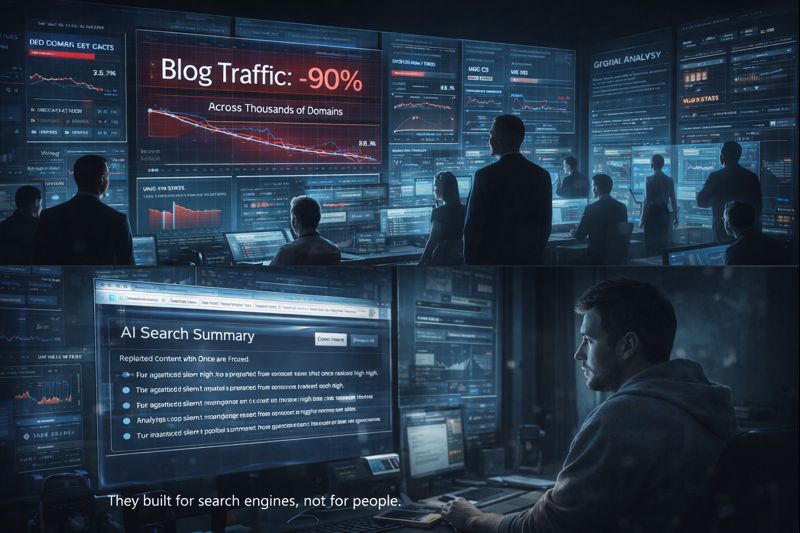
The Silent Collapse Behind Most Blogs
How Smart Creators Are Rebuilding With UGC and AI
A blog traffic drop often feels like waking up to an empty room where your audience once sat.
One day your blog feels alive, busy, and full of comments and clicks.
The next day the numbers crash, and nothing you post seems to work anymore.
Many bloggers think they did something wrong overnight, but the truth is deeper.
Search engines, user behavior, and content formats shift quietly while creators stay still.
This gap between change and awareness is where most traffic losses begin.
What looks sudden is usually slow damage finally showing up.
Understanding this pattern is the first step to survival.
Table of Contents
The False Sense of Safety Bloggers Rely On
Most bloggers trust rankings more than relationships with readers.
They build content only for search engines and hope traffic stays forever.
When algorithms change, that trust breaks instantly.
A blog traffic drop happens fastest when all visitors come from one source.
Search traffic feels stable until it disappears without warning.
No email list, no community, and no social reach makes the fall brutal.
Blogs built on borrowed attention always pay the price.
Ownership of audience is what separates survivors from casualties.
Algorithm Changes Do Not Announce Themselves
Search platforms rarely send warnings before updates roll out.
Bloggers keep publishing while invisible rules quietly change.
Then rankings fall, impressions vanish, and panic begins.
This is where another blog traffic drop hits without mercy.
The content did not suddenly get worse.
The system simply decided to reward different signals.
Speed, engagement, freshness, and format start to matter more.
Blogs stuck in old formats get left behind.
Thin Content Is No Longer Forgiven
Years ago, short posts could rank with little effort.
Today, shallow answers lose visibility fast.
Readers want depth, clarity, and real experience.
A blog traffic drop often follows when content feels recycled.
Search engines measure satisfaction through behavior, not words.
High bounce rates quietly damage rankings over time.
Low engagement sends a clear signal of low value.
Depth and usefulness are now non-negotiable.
Over-Optimization Is a Hidden Trap
Some bloggers stuff keywords hoping to stay visible.
This tactic worked before smarter algorithms arrived.
Now it raises red flags instead of rankings.
Another blog traffic drop appears when content feels forced.
Natural language matters more than rigid formulas.
Content should sound like a human conversation.
Readers stay longer when writing feels real.
Authenticity beats technical tricks every time.
Platform Dependency Is the Real Killer
Relying on one platform creates fragile businesses.
Search traffic alone is not a strategy.
When rules change, there is nowhere else to go.
This kind of blog traffic drop feels permanent.
Smart creators spread attention across channels.
Short-form video, email, and communities act as insurance.
Traffic diversification reduces fear during updates.
Control beats convenience in the long run.
Why UGC Is Quietly Replacing Traditional Blogging
User-generated content moves faster than written posts.
Short videos answer questions instantly.
People trust faces more than headlines.
A blog traffic drop accelerates when blogs ignore this shift.
UGC turns ideas into stories people share.
Engagement happens before a click ever reaches a blog.
Distribution now matters more than publication.
Visibility starts outside the website.
How FlipITAI Repositions Blogs for Survival
This is where flipitai changes the game for creators.
Instead of fighting algorithms, it works with human behavior.
Blog posts are transformed into viral short-form content.
A blog traffic drop becomes reversible with the right system.
Creators use flipitai to turn articles into UGC at scale.
Each video acts as a traffic funnel, not a replacement.
The blog becomes the destination, not the discovery engine.
This shift rebuilds visibility from the outside in.
The Creator and Flipper Model Explained
flipitai connects two powerful roles in one ecosystem.
Creators supply valuable written content.
Flippers turn that content into viral videos.
This reduces the impact of a blog traffic drop instantly.
Traffic flows from social platforms back to blogs.
Creators focus on expertise while flippers handle reach.
This partnership removes distribution friction.
Growth becomes collaborative instead of lonely.
Why Viral Loops Matter More Than Rankings
Search rankings rise and fall without permission.
Viral loops are powered by people, not systems.
Each share multiplies reach organically.
A blog traffic drop loses power inside a viral loop.
UGC feeds algorithms with engagement signals.
Videos spark curiosity before links are clicked.
Traffic arrives warm, not cold.
This improves dwell time and conversions.
Rebuilding Trust After a Traffic Crash
Losing traffic hurts confidence more than revenue.
Many bloggers stop publishing after a major drop.
This pause often makes things worse.
Another blog traffic drop follows inactivity.
Consistency signals reliability to platforms and readers.
Fresh formats restore interest faster than new articles.
UGC keeps content alive across networks.
Momentum returns when visibility returns.
How FlipITAI Creates Sustainable Recovery
Using flipitai, creators regain control of reach.
Every article becomes multiple traffic entry points.
Short videos lead audiences back to long-form depth.
A blog traffic drop becomes a data point, not a disaster.
Creators can direct traffic to flipitai at https://flipitai.io for onboarding.
Flippers join through flipitai at https://flipitai.io/auth/flipper to monetize skills.
This system turns loss into leverage.
Recovery becomes predictable, not emotional.
The Future Belongs to Adaptive Bloggers
Static blogging is fading quietly.
Adaptive creators evolve with behavior shifts.
They blend written content with visual storytelling.
A blog traffic drop becomes less frightening with flexibility.
AI and UGC now shape content discovery.
Those who adapt early gain compounding advantage.
Those who resist fade slowly.
The choice is made daily through action.
Final Thoughts
Most blogs do not fail overnight by accident.
They fail because systems change while habits stay frozen.
Understanding the real causes removes the fear.
A blog traffic drop is not the end of a business.
It is a signal to evolve distribution, not abandon writing.
Tools like flipitai exist to bridge this new gap.
Blogs that adapt will grow stronger than before.
Those that do not will disappear quietly.
We strongly recommend that you check out our guide on how to take advantage of AI in today’s passive income economy.