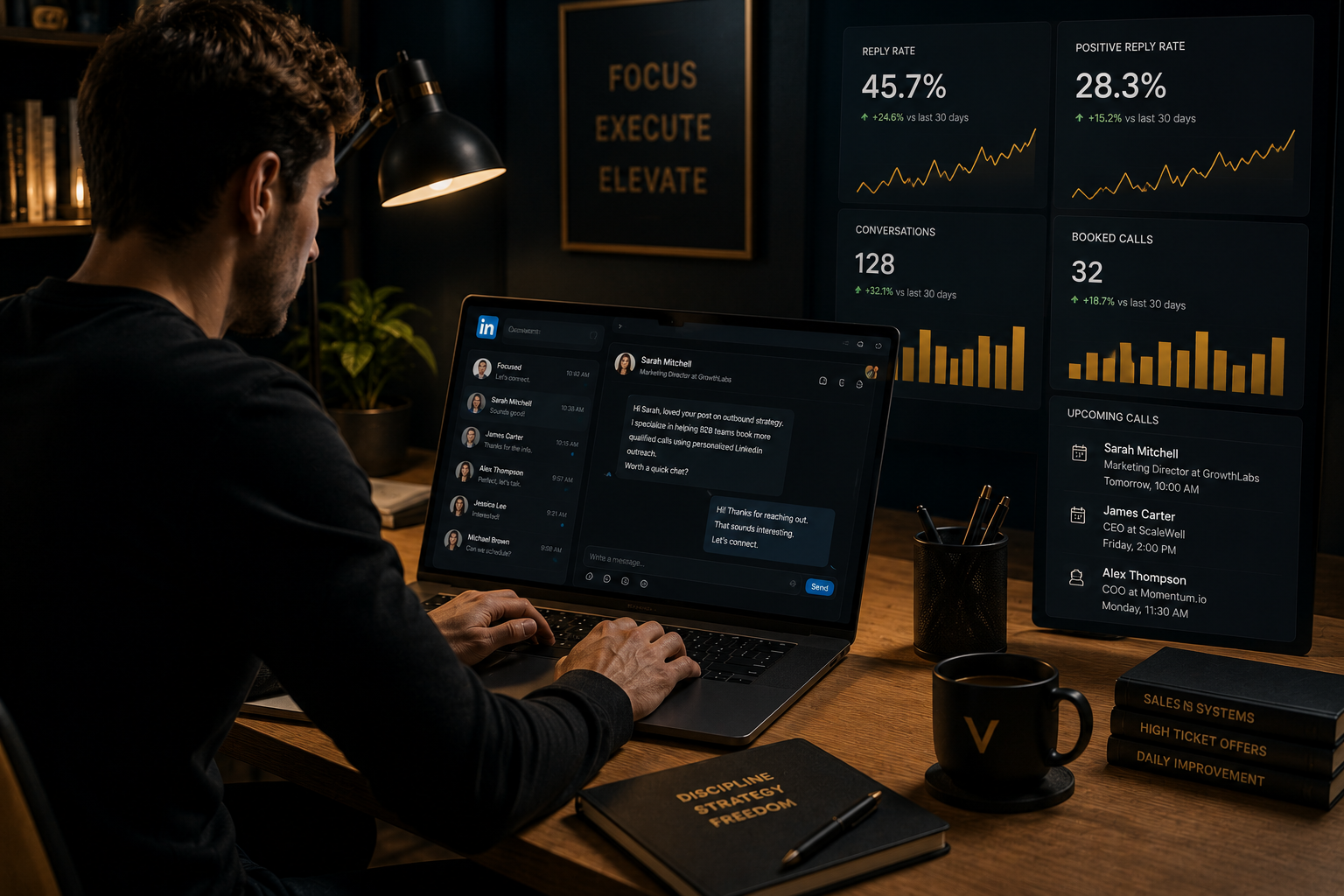
I Tracked 9,000+ LinkedIn DMs in 12 Months — These 10 Patterns Changed Everything
Sending LinkedIn DMs that actually get replies comes down to three things — relevance, specificity, and a repeatable system.
Most people skip all three.
After sending over 9,000 LinkedIn DMs across 12 months, tracking every reply, every booked meeting, and every message that flopped — the patterns became impossible to ignore.
This is the full breakdown of what actually works in 2026.
👉 Get Access to: Start a 1-Person Business With Claude AI — Free Quick-Start Guide
Table of Contents
Why LinkedIn DMs Are the Most Underrated Outbound Channel in 2026
Cold email is having a crisis in 2026, and the numbers make it hard to ignore.
Roughly 80% of cold emails either land in spam or never get opened at all.
That means for every 10 messages you carefully craft and send, only two even have a chance of being read.
Cold calling is fighting the same battle from a different angle.
Pickup rates have dropped so low that hitting a meaningful number of conversations now requires dialing for several exhausting hours every single day.
Sales teams are burning out trying to squeeze enough pipeline from channels that are getting harder and noisier every single month.
LinkedIn is different in two important ways.
First, once you are connected with someone, there is no spam filter standing between your message and their inbox.
Second, you are meeting your buyers in a place they already visit every single day — not interrupting them with a random phone call or a cold email from a domain they have never seen.
The problem is not LinkedIn as a channel.
The problem is that most people are doing LinkedIn DM outreach completely wrong in a way that screams “I want to sell you something” before any trust has been built.
Generic intros, copy-paste pitches, and zero personalization are killing response rates across the platform every single day.
The good news is that fixing these mistakes is not complicated — it just requires understanding what buyers actually respond to when a message lands in their inbox.
The Experiment That Changed Everything — 25 DMs a Day for an Entire Year
The system started with a simple commitment — send 25 LinkedIn DMs every single weekday, no exceptions, and track everything.
Over 12 months, that added up to 9,125 messages sent to real prospects across multiple industries.
Every reply was logged, every booked meeting was tracked, and every message template was tested against real outcomes in the pipeline.
The result was a consistent 20 to 30% reply rate on cold LinkedIn DM outreach — a number that most sales professionals would consider nearly impossible on any cold outbound channel in 2026.
The experiment also revealed something just as valuable as the reply rate itself.
A system — not a single clever message — was the real engine behind every result.
Without the right daily workflow, 25 DMs a day quickly becomes chaotic, leads get forgotten, follow-ups get missed, and the pipeline dries up before it ever gets a chance to build.
The 10 rules below are what that experiment produced — each one is a direct lesson drawn from sending thousands of real messages and watching what buyers actually respond to.
👉 Get Access to: Start a 1-Person Business With Claude AI
Rule 1 — Skip InMails Entirely and Focus Only on Direct Messages
LinkedIn InMails are paid messaging credits that come with LinkedIn Premium, Sales Navigator, and LinkedIn Recruiter accounts.
The issue is not the feature itself — it is how it has been used by thousands of sales professionals over the last five years.
InMails have become so associated with pushy sales pitches that most buyers now ignore them the moment they land.
They also look different inside the LinkedIn inbox — visually marked in a way that immediately signals a sales approach before a single word is read.
Direct messages, on the other hand, can only be sent to people you are already connected with.
That creates a natural filter — a prospect who has accepted your connection request has already given a small signal of openness before the first message is ever sent.
Every connection request is an opportunity to earn the right to a real conversation, and that framing alone changes how outreach should be approached from the very first step.
When a connection request is accepted, treat it as an invitation to start a conversation — not as a green light to immediately pitch.
Rule 2 — Voice Notes Create Human Connection at Scale
Sending a voice note inside a LinkedIn DM delivers something that typed words simply cannot — the sound of a real person who cares about the conversation.
Voice adds a human layer that is harder to dismiss than text because text can come from anyone, including automation tools.
A voice note signals that actual time and effort went into the outreach, and buyers notice that effort even when they do not consciously register it.
Tone, energy, and personality come through in a 30-second voice message in a way that takes several paragraphs of text to even attempt to convey.
The key is using voice notes strategically rather than sending them to every single person on a contact list.
Voice notes work particularly well as a follow-up to a text message that received no response — a quick, warm reminder that a real person sent that first message and is genuinely interested in connecting.
They also work well for re-engaging a cold lead who went quiet several months ago, or for reaching out first to a high-priority prospect who is actively posting and engaging on the platform.
The strategic placement of voice notes throughout a LinkedIn DM sequence can meaningfully lift reply rates without requiring hours of additional daily effort.
Rule 3 — Video DMs Are the Most Powerful Trust Builder Available
A video DM inside LinkedIn outreach is the closest thing to a face-to-face conversation that cold outbound can produce.
The reason it works is rooted in how human communication actually functions — research has consistently shown that the majority of communication is non-verbal, carried through body language, facial expressions, environment, and energy.
A 60-second video delivers all of that in a single message.
It is also a genuine pattern interrupt in a sea of copy-paste text messages — most sales reps do not use video in their outreach because it requires stepping outside a comfort zone, which means the ones who do it immediately stand out.
The message is also personal in a way that simply cannot be faked — a buyer watching a video knows immediately that it was made specifically for them, and that perception alone changes how the message is received.
Video DMs are best reserved for three situations — a high-priority prospect who did not respond to a text or voice message, a warm lead who went quiet after an encouraging early conversation, and re-engagement with someone met at an event or through a referral.
Using video selectively makes each one feel more special and worth the time it takes to watch.
Rule 4 — Sales Navigator Is a Non-Negotiable Part of the System
Sending 25 LinkedIn DMs a day without an organization system is a recipe for chaos that will eventually collapse the entire effort.
LinkedIn Sales Navigator is the tool that makes consistent high-volume outreach manageable without spending the entire workday on LinkedIn.
It functions less like a prospecting tool and more like a lightweight CRM built specifically for social selling — allowing leads to be segmented, tracked, and prioritized at each stage of the outreach funnel.
The most effective way to use it is through separate lead lists that mirror the natural stages of a sales pipeline.
A cold list holds all connected prospects who have never received a message yet.
A DM sent list tracks everyone awaiting a follow-up.
A responded list holds warm leads who have replied and need to move toward a booked meeting.
A meetings scheduled list covers upcoming sales conversations that need preparation and multi-threading.
A nurture list captures potential buyers who are not ready yet but need a light monthly touchpoint.
And a closed lost list holds past opportunities worth revisiting every three to six months.
With this system running, the entire daily outreach workflow can be completed in under one hour — making the volume sustainable over months and years.
If you are also building traffic systems for your content and digital products alongside your LinkedIn outreach, 👉 Get Access to: The AI Traffic Vault — it covers the full framework for driving consistent traffic through AI-powered channels.
Rule 5 — Give Real Value Before You Ever Ask for Anything
The single biggest mistake in LinkedIn DM outreach is leading with a pitch before establishing any value or relevance to the person receiving the message.
A message that says “Hey John, I help sales teams book more meetings on LinkedIn — would love to chat this week” is 100% about the sender’s agenda, the sender’s service, and the sender’s calendar.
The buyer has no reason to respond because nothing in that message is about their world.
Compare that to a message that opens with a specific observation about the buyer’s business, diagnoses a problem they may not have identified themselves, and offers something useful with no strings attached.
The difference in response rate between those two approaches is not marginal — it is dramatic.
The formula that works consistently follows four steps.
Start with a specific observation about their business or LinkedIn presence.
Then explain the implication — why that observation matters in terms of cost, missed opportunity, or avoidable risk.
Follow with a value offer — a useful framework, a resource, or an insight they can use right now without needing to buy anything.
Close with a low-friction ask that is easy for them to say yes to without feeling any pressure.
The guiding principle behind this approach is simple — people do not buy solutions to problems they do not know they have, so showing them the problem clearly is always the first job of the message.
Rule 6 — Hyper-Specific Personalization Is What Separates a Reply From Silence
Generic personalization is not personalization — it is lazy outreach wearing a costume.
A message that says “Congrats on your new role, would love to connect” could have been sent to thousands of different people without changing a single word, and the person receiving it knows that immediately.
Real personalization is specific enough that the reader knows the sender actually spent time on their profile, their content, or their company before typing a single word.
That means referencing a specific LinkedIn post from the last two weeks and quoting a line that was genuinely memorable.
It means noting a recent company development like a funding round, a new product launch, or a significant hiring push.
It means referencing something from their About section or their career history that is actually relevant to the conversation being opened.
The research required to do this well takes 30 to 60 seconds per prospect — one specific detail found by spending a minute on their profile is all that separates a generic message from one that earns a reply.
The signal that specificity sends is powerful — it tells the buyer that this message was meant for them and only them, which immediately makes it worth reading.
Rule 7 — Ask Exactly One Question Per Message
Every extra question added to a LinkedIn DM cuts the response rate — this is not a theory, it is a pattern that shows up consistently across thousands of sent messages.
A message that ends with four questions is asking the reader to do four separate mental tasks before they can respond, and most buyers will simply close the conversation rather than work that hard.
The best single question for a LinkedIn DM is binary — something the reader can answer with a yes or no without stopping to think carefully.
Permission-based questions also perform well — “Open to learning more about this?” gives the reader a low-pressure on-ramp into a real conversation.
Clarifying questions work in later exchanges when a conversation has already started — “What does your current approach to outbound look like?” is appropriate once trust has been established.
The questions that consistently kill response rates are open-ended questions about challenges, compound questions that combine two different asks, and multiple-choice questions that create decision fatigue before the reply even starts.
The follow-up strategy built on single questions is to let each answer naturally lead to the next question — building the conversation one exchange at a time rather than front-loading every question into the first message.
Rule 8 — Every Message Should Be Entirely About the Person Receiving It
There is a simple test that every LinkedIn DM should pass before it gets sent.
Count the number of times the message uses the words I, we, our, or my.
Then count the number of times it uses you or your.
If the first count is higher than the second, the message should be deleted and rewritten from the beginning.
A message built around “we specialize in this,” “I’ve worked with companies like these,” and “I’d love to show you what I can do” is entirely about the sender’s credentials and desires — none of which the buyer cares about before trust is established.
A message built around a specific problem the buyer is currently facing, the real cost of that problem to their business, and a concrete offer to help address it immediately — that is a message that earns a response.
The reframe is simple but powerful — stop leading with what you do and start leading with what you have noticed about their world.
If you are building a content business where this same principle applies to your blog writing and digital product marketing, 👉 Get Access to: The AI Traffic Vault — the full framework covers how to attract and convert the right readers using the same audience-first approach.
Rule 9 — Mirror How Your Prospect Communicates
One of the most counterintuitive lessons from 9,125 LinkedIn DMs sent across an entire year is that matching the communication style of the person on the other side of the conversation builds trust faster than almost anything else.
A prospect who replies in short sentences, casual language, and no punctuation is communicating something about how they prefer to interact — responding with three formal paragraphs creates an invisible friction that can slow or kill the conversation.
Matching their pace means responding within a similar timeframe when possible — if they reply quickly, a quick response signals that you are present and engaged.
Matching their length means not writing a paragraph reply to a three-word answer and not sending a single sentence back when they have shared a thoughtful, detailed response.
Matching their tone means reading whether they are formal or casual and adjusting accordingly — a response that mirrors their energy feels natural to them without them ever consciously noticing why.
Human psychology research consistently shows that people feel more comfortable and trusting around others who communicate similarly to how they do — mirroring taps into that instinct without any manipulation involved.
The mistake most sales reps make is defaulting to their own preferred communication style regardless of how the prospect writes — and the result is conversations that feel slightly off even when the content of the messages is perfectly good.
Rule 10 — End Every Message With a Clear and Specific Next Step
Ambiguity is where momentum goes to die in a LinkedIn DM conversation.
Ending a message with “Great, let’s stay in touch” is not a next step — it is an open loop that leaves both people unsure who is responsible for following up and when.
A clear next step names a specific deliverable, a specific timeline, and a specific time for reconnecting — all in a single short sentence.
“I’ll send you the framework by Thursday — let’s reconnect Friday morning to see if it fits. Does 10 a.m. work for you?” creates three clear anchors in one ask.
The low-friction questions that work best at the close of a message are binary — “Open to learning more?”, “Want me to send you the breakdown?”, or “Worth a quick chat?”
These are easy to say yes to because they require almost no commitment and carry almost no risk for the buyer.
When the conversation reaches the point of scheduling a call, avoid sending a calendar link and asking the prospect to find an available time themselves.
That approach forces the buyer to do work on your behalf before the meeting even happens.
Instead, suggest two specific options — “How does Thursday at 3 p.m. work? Or Friday morning at 9?” — and let them pick one with a single reply.
The Three Core Principles Behind a 25% Reply Rate
Every one of the 10 rules above connects back to three foundational principles that separate a 5% reply rate from a 25% reply rate on LinkedIn DM outreach.
The first is relevance — every message must be built around the buyer’s world, their challenges, their business, and their current priorities.
If the sender cannot clearly articulate why this specific message matters to this specific person before hitting send, the message is not ready yet.
The second is specificity — referencing real details, real observations, and real context proves that the sender did the work, and buyers respond to proof of effort far more reliably than they respond to clever writing.
The third is system — 25 DMs a day is 500 a month and roughly 6,000 a year, and the only way to sustain that volume without burning out or losing track of leads is through a repeatable daily workflow that handles the logistics automatically.
Consistency over a long period of time beats intensity over a short burst — every single time.
If you want to pair a LinkedIn DM system with a content and traffic engine that brings buyers to you at the same time, 👉 Get Access to: The Flipboard Traffic Workflow Kit — it shows you how to build inbound traffic through Flipboard curation alongside your outbound outreach.
How This Connects to Building a Larger One-Person Business System
LinkedIn DM outreach does not have to be a standalone sales activity — it can be one piece of a larger system where content, traffic, and outbound all work together to bring in consistent leads and revenue.
When a daily writing habit on platforms like Medium produces articles that rank in Bing AI search and Copilot recommendations, the same buyers that a DM reaches are already encountering that content organically in other places.
That kind of multi-channel presence means a buyer might see a LinkedIn DM, read a Medium article the next day, and see a Flipboard post the day after — creating a compounding trust effect that makes the eventual sales conversation far easier.
Building that kind of system from scratch requires a clear roadmap for which platforms to prioritize, how to use AI tools like Claude to produce content faster, and how to monetize both the traffic and the relationships being built.
👉 Get Access to: The AI Traffic Vault — the full system covers every piece of this, from Medium traffic growth to AI-assisted content creation and monetization across multiple platforms.
For readers who are just getting started and want a clear, simple entry point into building with AI tools, 👉 Get Access to: The Medium Mastery — the foundational guide to driving consistent organic traffic through Medium that feeds directly into a broader business system.
What to Do Next
The best action to take after reading 10 rules is not to try all 10 at once.
Pick three.
Apply those three to 25 LinkedIn DMs this week, track the reply rate carefully, and make notes on what is landing and what is not.
The data from just one week of intentional testing will reveal more about what works for a specific audience and niche than any amount of additional reading.
The real edge in LinkedIn DM outreach in 2026 is not a secret script — it is the willingness to send consistently, iterate based on real feedback, and keep going past the point where most people quit.
Most sales reps send 20 messages, see no instant results, and abandon the channel entirely.
The results that come from 9,000 messages look very different from the results that come from 20 — and the gap between those numbers is almost entirely explained by consistency and system.
Final Thoughts
LinkedIn DMs that convert consistently in 2026 share the same qualities — they are specific, they are about the buyer, they offer value before asking for anything, and they end with a clear and frictionless next step.
Voice notes and video DMs add a human dimension that text alone cannot replicate, and using them strategically in the right moments can meaningfully lift response rates without requiring hours of extra effort.
A tool like Sales Navigator transforms volume outreach from chaotic to manageable, and the lead list system it enables is what makes 25 DMs a day feel like one focused hour of work rather than an overwhelming task.
The LinkedIn DM strategy that works is not magic — it is the result of sending thousands of messages, tracking everything, and applying the lessons that the data reveals over time.
That is the only real shortcut that exists in outbound sales.
👉 Get Access to: The Flipboard Traffic Workflow Kit
We strongly recommend that you check out our guide on how to take advantage of AI in today’s passive income economy.