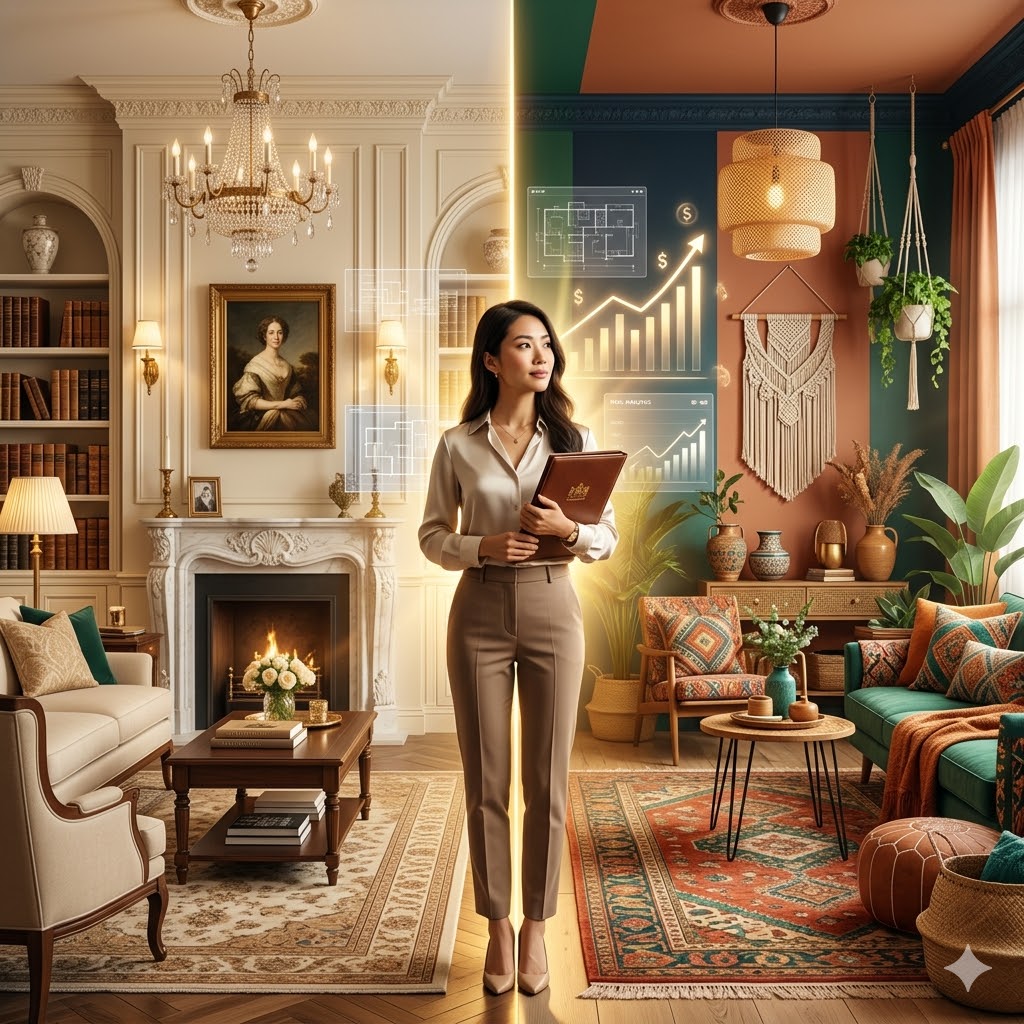
Two Iconic Styles, One Big Question — What Does Your Home Say to a Future Buyer?
The Style War Playing Out in Living Rooms Across the World
Old money home decor has been pulling people in like a magnet for years now, and in 2026, it still shows no signs of slowing down.
Walk into a home built around this aesthetic and you immediately feel something shift inside you.
There is a calm that washes over the room.
The furniture is solid.
The colors are quiet.
The rugs are slightly worn in the best possible way.
Now walk into a well-done bohemian space and you feel something completely different.
Color hits you first.
Then texture, then pattern, then the smell of incense lingering faintly in the warm air.
Both styles are deeply personal and genuinely beautiful in their own right.
But if you are a homeowner in 2026 thinking about resale value, renovation returns, or long-term interior investment, you need to ask one very honest question.
Which style actually holds its value when it is time to sell?
This article breaks it all down for you, room by room, dollar by dollar, and aesthetic by aesthetic.
We strongly recommend that you check out our guide on how to take advantage of AI in today’s passive income economy.
Table of Contents
What Is Old Money Home Decor and Why Does It Matter?
Old money home decor is a design philosophy built around the idea that quality, history, and restraint matter more than flash.
Think of the kind of home that has been passed down through generations.
The kind of home where the sofa is a roll-arm style in a linen fabric that has aged into a deeper, richer shade of cream over the last twenty years.
The kind of home where the bookshelves hold real books, read and re-read, with spines that are cracked and worn from actual use.
The walls have crown molding.
The floors are hardwood, real hardwood, not laminate.
The artwork was collected slowly over time, not ordered as a set from an online marketplace.
Every single piece in the room looks like it has a story attached to it.
Old money home decor rooted in timeless interior design values is not about spending a fortune overnight.
It is about building a home that looks like it has lived through decades gracefully.
The shapes used in this style, roll-arm sofas, wing-back chairs, pedestal dining tables, gilded or wood-frame mirrors, have been around for over a century.
They looked right in a 1920s townhouse.
They look right in a 2026 living room.
And they will look right fifty years from now.
That kind of staying power is extremely rare in the world of interior design, and it is a major reason why this aesthetic holds up so well at resale.
What Is Bohemian Home Decor and Why Do People Love It?
Bohemian style, also called boho chic, is the complete opposite of restraint.
It is expressive, layered, colorful, global, and completely unapologetic about how much it loves texture.
A well-done bohemian room might include a woven macramé wall hanging, a vintage Persian rug layered over a simple jute rug on the floor, low-level seating with Moroccan-style poufs and floor cushions scattered across the space, hanging plants like Monstera, pothos, and tropical greenery cascading from woven baskets, and warm string lights and lanterns creating soft clusters of illumination throughout the room.
The colors are rich and earthy.
Think deep terracotta, mustard yellow, forest green, and dusty purple working together with no apology.
Patterns live everywhere.
Kilim prints, ikat weaves, block-printed linens, and bold tapestries all coexist in the same space.
Boho decor is, at its heart, about storytelling.
Every piece is meant to feel like it was picked up during a journey, whether that journey was across the world or simply across a local flea market on a Saturday morning.
Vintage chairs sit beside handmade ceramics.
Painted doors in turquoise or mustard yellow catch the eye and invite curiosity.
There is a looseness and warmth to bohemian spaces that is genuinely hard to replicate.
It feels lived in, loved, and personal in a way that more formal styles sometimes struggle to achieve.
And yet, that same looseness is exactly what creates a complicated relationship with resale value.
The Resale Value Question — What Buyers Actually See
Old Money Decor and the Perception of Permanence
When a potential buyer walks into a home decorated with old money home decor built on classic and timeless principles, something very specific happens in their brain.
They stop thinking about changing things.
The crown molding on the walls looks original and intentional.
The warm neutral palette, soft ivory, warm greige, muted sage, feels calm and easy to live with.
The hardwood floors, the real furniture, the curated antiques, all of it signals that this home was taken care of by someone who valued quality.
Buyers do not have to work hard to picture themselves living there.
The space already feels finished, established, and permanent.
Real estate professionals in the United States, the United Kingdom, and increasingly in Nigeria’s growing luxury property market consistently report that homes with strong architectural detailing and classic interior choices tend to attract more serious offers and stronger pricing.
Millwork like paneling, wainscoting, and built-in shelves adds perceived value to a home in a way that trendy décor simply cannot.
These features make the house itself feel more substantial.
They are built in, not brought in.
Bohemian Decor and the Personalization Problem
Here is where boho runs into trouble with resale.
Bohemian style is deeply personal.
That is its biggest strength and its most significant weakness at the same time.
A stunning boho room that perfectly reflects the current owner’s travels, tastes, and collections may feel completely overwhelming to a buyer who does not share those same sensibilities.
The layered rugs, the bold tapestry behind the sofa, the hanging plants everywhere, the mismatched textiles in six different patterns, all of that can feel like too much to someone who walks in with fresh eyes.
And because boho relies so heavily on accessories, textiles, and personal objects to create its effect, the style essentially disappears once those items are removed.
What a buyer is left with, when all of those objects and textiles are packed away for a showing, is often a relatively bare and unremarkable space.
The bones of a boho home frequently do not have the architectural character of an old money-inspired interior.
The walls tend to be flat.
The floors are often covered rather than showcased.
The structural elements of the home, the things that actually stay when the owner moves out, have received less investment.
The Materials Question — What Ages Better Over Time?
Old Money Choices That Hold Up for Decades
One of the foundational rules of old money home decor grounded in quality and timeless craftsmanship is to buy the best quality you can reasonably afford and then wait.
This means solid wood furniture rather than particleboard or MDF.
It means linen and cotton upholstery rather than polyester blends.
It means wool rugs rather than synthetic pile.
It means real hardwood floors rather than vinyl plank.
These materials do something remarkable over time.
They age beautifully.
A solid mahogany dining table develops a patina after years of use that actually makes it more beautiful, not less.
A linen sofa softens and deepens in color with time.
A wool rug from a company like Pottery Barn, Restoration Hardware, or a specialist like The Rug Company develops character with age rather than looking worn out.
A small scratch or dent on a quality piece of furniture tells a story.
It makes the home feel real and inhabited in a way that no showroom setup ever can.
This is not about perfection.
It is about things that were built to last.
Bohemian Materials and the Durability Gap
Boho style does value texture, and many of its favored materials, woven cotton, jute, leather, handmade ceramics, are genuinely durable and beautiful.
The problem is that boho style also leans heavily on accessories, printed textiles, and mass-produced decorative items that are trending at any given moment.
The macramé wall hanging that was everywhere in 2019 already looks dated to many eyes in 2026.
The specific shade of terracotta that dominated boho Instagram feeds a few years ago has shifted.
Boho is, at its core, a style that is connected to cultural trends, and trends move fast.
The underlying materials in a boho room can be perfectly solid and durable, but if the overall aesthetic has dated, that durability does not help the home’s resale value the way it would in a more classically structured interior.
The Trend Trap — Which Style Falls Into It More?
Old money home decor rooted in enduring design principles is explicitly built to resist trends.
That is the entire point of the aesthetic.
When you furnish a home around classic silhouettes, neutral palettes, real materials, and architectural detail, you are making a bet that taste in its most fundamental form does not change.
And so far, that bet has been correct for over a hundred years.
Roll-arm sofas still look elegant.
Wing-back chairs still look distinguished.
Crown molding still communicates quality and craftsmanship.
Stripes, florals, and checks still feel right in a traditional interior.
Bohemian style, on the other hand, is inherently connected to a moment in cultural time.
It emerged as a counter-cultural movement and has always been tied to a specific kind of free-spirited lifestyle aesthetic.
When that aesthetic shifts, as it inevitably does, boho spaces can age very visibly.
The good news for boho lovers is that the core principles of the style, quality natural materials, vintage pieces, plants, layered rugs, and personal collections, can absolutely be timeless if executed with restraint and intention.
The problem is that most boho interiors are executed with the full visual language of the trend, not just its foundational principles.
Can You Blend Both Styles and Still Hold Resale Value?
The Hybrid Approach That Smart Homeowners Are Using in 2026
Here is something that experienced interior designers and property stylists know well.
The homes that hold the strongest resale value in 2026 are often not purely one style or the other.
They are homes that use the structural and material principles of old money home decor with lasting appeal and quiet sophistication as their foundation, while incorporating the warmth, texture, and personal character of bohemian style as a layer on top.
What does that look like in practice?
It looks like a room with paneled walls painted in a warm off-white.
The floors are solid oak, slightly wide-plank, sealed rather than heavily lacquered.
A linen roll-arm sofa anchors the seating area.
Then the bohemian layer comes in.
A vintage Persian rug sits beneath the coffee table.
A woven basket holds a trailing pothos plant on the floor near the window.
A vintage wooden chair with an upholstered seat in a warm ikat print sits in the corner.
Macramé is used sparingly, one small hanging rather than a wall-sized installation.
The lighting mixes a classic brass floor lamp with a woven pendant over the reading corner.
The result feels layered, warm, and personal, but it also has the bones and the material quality to hold its value when it matters.
The One Rule That Makes Blending Work
The rule is simple.
Let old money principles govern the structural and material decisions.
Let bohemian sensibility govern the accessories, textiles, and plants.
When it is time to sell, the structure of the home, the floors, the walls, the furniture bones, will all read as classic and quality.
The boho accessories will either travel with the owner or be styled down for showings.
What remains will still feel warm and characterful, not sterile.
This is how you get the best of both worlds without sacrificing the value of either.
The Patience Factor — The Hidden Advantage of Old Money Style
One of the most overlooked aspects of building an old money home decor style with a foundation in timeless quality is that it takes time by design.
You cannot build it overnight.
You are not supposed to.
The layered, evolved look that makes old money interiors feel so established comes from years of adding, rearranging, reupholstering, and collecting.
Estate sales, antique markets like Portobello Road Market in London or the Round Top Antiques Fair in Texas, Facebook Marketplace, and local thrift stores are where many of the best pieces in these homes come from.
A pedestal dining table picked up at an estate sale.
A gilded mirror found at a flea market for a fraction of its value.
A set of botanical prints in simple frames discovered at a second-hand shop.
These pieces cannot be rushed.
And that patience is not a weakness.
It is the entire source of the style’s power.
Because when a home is built over time with intention, care, and an eye for quality, it shows.
Every room feels earned.
Every piece feels chosen.
Nothing looks like it was ordered as a bundle from an online retailer on a Tuesday afternoon.
Boho style shares some of this patience in its truest form.
The global, collected feel of a well-built bohemian interior takes years to develop authentically.
But because the market has flooded with mass-produced boho accessories, the shortcuts are much more tempting and much more visible.
A home built on genuine old money home decor principles that value substance over performance will always look more intentional and more invested than a boho space assembled quickly from trending sources.
Final Verdict — Which Style Actually Holds Its Resale Value?
After everything, the honest answer is that old money home decor rooted in quality materials and architectural permanence holds its resale value more reliably and more consistently than bohemian style.
The reasons are structural, not just aesthetic.
Old money interiors invest in the bones of the home.
Millwork, hardwood floors, quality upholstery, and solid wood furniture all stay with the house or at minimum communicate a level of care and investment to buyers that bohemian accessories simply cannot.
Classic palettes are easier for a wider range of buyers to picture themselves living in.
Architectural detail adds perceived and real value that survives changing trends.
Bohemian style, at its best, creates deeply personal and genuinely beautiful spaces.
But at resale, personal tends to work against you.
Buyers need to see themselves in a space, and the more specific and expressive the décor, the harder that becomes.
If you love bohemian style and you want to hold your home’s value, the move is to use old money principles as your foundation and boho as your personality layer.
Get the structure right.
Invest in the bones.
Then let your personality come through in the textiles, the plants, the vintage pieces, and the collections.
That balance will serve you beautifully both in the years you live there and on the day you decide to sell.

We strongly recommend that you check out our guide on how to take advantage of AI in today’s passive income economy.