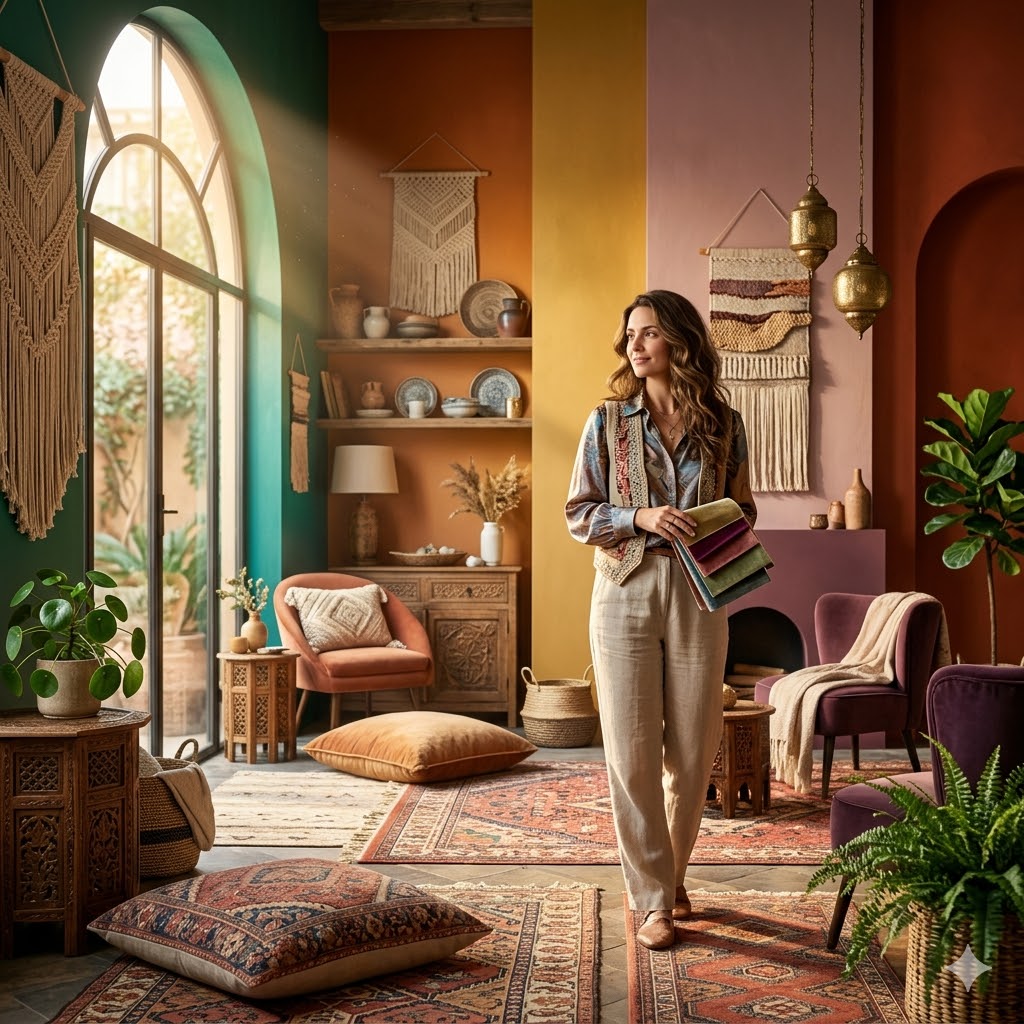
How to Choose the Right Boho Palette for Your Space Without Guessing
Why Bohemian Color Is Different From Every Other Design Style
Bohemian room color schemes do something that most other design styles simply cannot — they tell a story without saying a single word.
Walk into a well-executed boho room and you immediately feel it.
There is warmth on the walls.
There is depth in the corners.
There are colors that look like they were gathered from different corners of the world — earthy terracottas, dusty wine reds, deep forest greens, soft peachy clays — all living together in one space without fighting each other.
That layered, rich, wildly personal feeling is not an accident.
It comes from a very deliberate understanding of how color works in a bohemian setting, and once you understand the logic behind bohemian room color schemes, choosing your own palette becomes one of the most exciting decisions you will ever make for your home.
This article walks you through 8 bold boho color palettes, explains how each one works on real walls, and gives you the confidence to build your own interpretation — whether you are starting from scratch or refreshing a room you have lived in for years.
We strongly recommend that you check out our guide on how to take advantage of AI in today’s passive income economy.
Table of Contents
What Makes a Color “Bohemian” in the First Place?
Before you start pulling paint chips or scrolling through mood boards, it helps to understand what separates a bohemian room color scheme from any other warm or earthy palette.
Bohemian color is not just about being colorful or eclectic.
It is about colors that feel lived-in, collected, and honest — like they came from nature, from travel, from textiles, from art, and from the kind of life that does not follow a strict formula.
The best bohemian room color schemes tend to lean warmer rather than cooler, which is why you rarely see icy blues or stark grays anchoring a boho space.
Instead, you will find greens with brown undertones, reds that have been quieted down by dust and age, pinks that carry just enough earth to feel grown-up, and neutrals that glow rather than simply sit.
You will also notice that boho palettes almost always include a range of values — meaning you have light colors, mid-tone colors, and some genuinely deep, dark shades — all working together.
This range is what creates the contrast and dimension that makes a bohemian room feel layered and visually rich rather than flat or one-note.
Think of it the way you would think of a beautiful vintage rug — no single color is doing all the work, but every color belongs.
Palette 1 — The Soft Foundation: Off-White to Warm Greige
Every great bohemian room color scheme needs at least one lighter, breathing color to give the rest of the palette room to speak.
Benjamin Moore’s Silver Bells is a perfect example of this kind of foundational light color — sitting at a Light Reflectance Value (LRV) of around 69, it is soft and slightly warm without being a bright white.
It is not the kind of color you mistake for a crisp trim white, and that is exactly the point.
In a bohemian room, you do not want anything too sharp or clean — you want colors that feel natural, as if they were borrowed from sand, stone, or unbleached linen.
Imagine your walls painted in a color like this: the light bounces gently off the surface, the room feels open and unhurried, and every piece of layered decor — from a woven wall hanging to a stack of vintage books on a low shelf — pops clearly against it.
If you want to take this even further into grounded territory, a color like Benjamin Moore’s Pale Oak or a warm greige from Sherwin-Williams’ Accessible Beige sits at that perfect midpoint between gray and beige, offering a palette base that works with almost every bohemian accent color you can imagine.
This foundation layer is not the star — it is the stage.
And every bohemian room color scheme needs a strong stage to let everything else perform.
Palette 2 — Dusty Pink and Blush Clay
One of the most misunderstood colors in bohemian room color schemes is pink — but not the sugary, sweet, nursery version of pink.
Boho pink is a pink that has been aged, softened, and infused with just enough brown or clay to feel earthy and adult.
Benjamin Moore’s Shabby Chic is a brilliant example of this kind of tone, sitting at an LRV of just under 50, which puts it firmly in mid-tone territory — not light enough to disappear, but not so dark that it dominates.
Picture a bedroom wall in this color: it reads warm and inviting from across the room, catches the afternoon light with a soft, almost amber glow, and pairs naturally with the kinds of textures that define bohemian spaces — macramé wall hangings, linen curtains, terracotta plant pots, and layered cotton throw blankets.
For a living room, this blush clay palette works especially well when you ground it with darker accents — a deep charcoal cushion, a vintage wood side table, or a Persian-style rug in burgundy and navy.
Sherwin-Williams’ Dusty Pink or their Romance shade offers a similar energy, and if you want to push the clay quality even further, Benjamin Moore’s Pale Blush brings in that raw, mineral quality that feels genuinely connected to the earth.
The key rule with this palette is grounding — always anchor your blush walls with something that has real visual weight.
Without that contrast, the whole room risks floating away into something that feels more pastel nursery than bold bohemian statement.
Palette 3 — Warm Taupe and Peach Clay
The Color That Reads Gray Until the Light Hits It
One of the most interesting moves in bohemian room color schemes is using a color that appears to be one thing from a distance and reveals something completely different up close.
Benjamin Moore’s Hazelwood is exactly that kind of color — from across the room it reads as a warm mid-tone gray, but walk closer and you begin to notice something peachy, something reddish, something with a distinct clay quality hiding in the undertone.
With an LRV of 49.27, this color is a true mid-tone, which means it has enough presence to anchor a wall without needing to be a deep or dramatic accent shade.
This is a palette that works particularly well in modern bohemian rooms — spaces that draw on boho’s love of texture and warmth while keeping the overall composition cleaner and more edited than a full maximalist boho scheme.
Imagine a living room with Hazelwood on the walls, whitewashed wooden furniture, a large jute area rug from a brand like Dash & Albert, floor cushions in terracotta linen, and copper or brass light fixtures from a retailer like West Elm.
The walls do not scream — they hum.
Everything in the room feels connected because Hazelwood is warm enough to feel boho but restrained enough to let your collected objects and vintage pieces take center stage.
This palette is ideal for anyone who loves bohemian room color schemes but wants something slightly more contemporary in its execution — the color walks the line perfectly.
Palette 4 — Soft Sage and Muted Olive Green
Green is one of the most quietly powerful colors in a bohemian room color scheme, and its power comes from how naturally it connects to the plant life, woven baskets, and organic textures that define boho interiors.
Benjamin Moore’s London Fog is a sophisticated entry point into boho green — it is not a bright, vivid green, but rather a gray-green with just enough warmth to feel at home in an earthy palette without pushing into cool or cold territory.
This is an important distinction because overly cool greens can feel clinical in a boho space, and the whole point of bohemian room color schemes is that they feel warm, human, and alive.
Sherwin-Williams’ Privilege Green or their Rosemary shade takes the green palette a step deeper — sitting in that rich sage or olive territory that has become one of the most requested boho colors of 2026.
Picture a bedroom with Privilege Green on three walls and a lighter greige on the fourth as a featured headboard wall — the room immediately feels like a lush, calm retreat.
Add layered throw pillows in mustard and rust from a brand like Anthropologie Home, a wooden bed frame in walnut, and a trailing pothos plant cascading from a macramé plant hanger, and you have a room that feels genuinely enveloping.
Green in bohemian room color schemes does not just look beautiful on walls — it acts as a bridge between every other color in the palette, connecting the warm earthy tones and the richer accent colors without any visual friction.
It is the color that makes everything else feel intentional.
Palette 5 — Deep Greeny Tan and Cabot Trail
When Mid-Tone Gets Interesting
Moving deeper into the bohemian room color scheme palette, Benjamin Moore’s Cabot Trail is one of those colors that feels like it was pulled directly from a forest floor.
It is a darker, more green-forward version of a warm tan, sitting at an LRV just under 27 — which means it has real presence on a wall without quite crossing into accent-color territory.
The beauty of this color is how it reacts to natural light — in a bright, well-lit room it almost seems to glow with a warm golden-green quality, while in lower light it deepens into something rich and moody.
This dual quality makes Cabot Trail an excellent wall color for rooms that see different light conditions throughout the day, like a living room that catches morning sun from one window and settles into shadow by the afternoon.
Imagine this color on the walls of a spacious bohemian living room: a large jute rug from IKEA’s LOHALS range anchors the floor, big floor cushions in rust and cream are scattered around a low wooden coffee table, trailing string lights are draped along the ceiling, and framed vintage botanical prints hang at varying heights across the walls.
The whole scene feels rooted, intentional, and genuinely warm.
Pair this palette with natural materials at every turn — rattan furniture, woven textiles, unglazed ceramics from a brand like Hawkins New York — and your bohemian room color scheme starts to feel less like a design choice and more like a way of living.
Palette 6 — Terracotta, Baywood Brown, and Pinky Red-Earth
Terracotta has been the defining color of the modern bohemian room color scheme conversation for the past several years, and in 2026 it remains as powerful as ever — not because it is trendy, but because it is genuinely timeless.
Benjamin Moore’s Baywood Brown sits in this family — a color with a strong pinky-terracotta quality that becomes especially vivid and warm when placed next to the greeny-beige tones of the other palettes explored in this article.
With an LRV of 33.46, it is slightly lighter than the deep accent territory but darker than most mid-tone choices, which gives it a rich, grounded quality on a wall.
Picture a study or creative room painted in Baywood Brown: the walls have a warmth that makes the room feel like a private sanctuary — the kind of space where books are read slowly, candles are lit in the afternoon, and every object feels like it has a story.
Add a kilim rug from a retailer like Rugs USA, a cluster of mismatched vintage frames above a low wooden desk, and a collection of earthy ceramic vessels from local artisans, and the room feels genuinely collected rather than simply decorated.
Sherwin-Williams’ Cavern Clay or their Copper Harbor are paint equivalents in this terracotta-earth family that work just as powerfully, and both have been featured extensively in real-world interior design projects that lean into the warm, grounded side of bohemian room color schemes.
This palette is also one of the most accessible — because terracotta works with almost everything, it is an excellent starting point for anyone who is new to boho color but wants an immediate, confident result.
Palette 7 — Dusty Wine Red and Bourbon Street Deep Plum
The Accent Color That Changes Everything
If there is one color category in bohemian room color schemes that consistently surprises people with how well it works, it is the deep dusty wine red — and Benjamin Moore’s Bourbon Street (color code 1257) is the finest example of this kind of shade done right.
This is not a bright, glossy red — it is a red that has been weathered, quieted, and infused with purple and brown until it arrives at something that feels ancient, luxurious, and deeply bohemian.
The dusty wine quality of Bourbon Street means it carries a sense of age and depth that more saturated reds simply cannot achieve, and against a backdrop of warm greiges, browns, and muted greens, it absolutely commands the room.
Used as a full wall color in a bedroom, Bourbon Street creates a space that feels genuinely immersive — the kind of room where you draw the curtains in the afternoon, light a few candles from Homesick or Boy Smells, and feel completely cocooned.
Used as a single accent wall in a living room behind a low-slung sofa in caramel leather or rust velvet, it acts as a dramatic focal point that ties together all the earthy tones in the rest of the space.
Sherwin-Williams’ Merlot or Dusty Damson from Farrow & Ball’s palette offer similar dusty wine qualities for those who want to explore this direction further.
The important design principle when working with this kind of deep color in your bohemian room color scheme is intentionality — do not scatter it randomly, but rather use it in concentrated doses that give the eye a clear place to rest and the room a clear sense of drama.
Palette 8 — Almost-Black Deep Green and Otter Brown
The Darkest Move in the Bohemian Palette — and Why It Works
The deepest, most dramatic choice in a bohemian room color scheme is a near-black dark green or dark brown-green, and Benjamin Moore’s Otter Brown is exactly this kind of color — with an LRV of just 5.66, it is so dark that some people initially mistake it for an off-black.
But look more closely in good natural light and you begin to see the dark, warm brown-green hiding inside — a color that is absolutely stunning as a full room color in a boho space precisely because it defies easy categorization.
Unlike pure black, which can feel cold, stark, and unforgiving in any room that does not get exceptional natural light, Otter Brown carries enough warmth to feel enveloping rather than oppressive.
Imagine a home office or reading nook with Otter Brown on all four walls and ceiling — the room becomes a cave in the very best sense of the word, with every piece of warm-toned furniture, every brass lamp, every collection of vintage books glowing against the dark background like something out of a beautifully styled editorial spread.
Farrow & Ball’s Juniper Ash or their Studio Green offer similar dark green-brown qualities, and both have been used extensively in high-end bohemian interiors to create exactly this effect.
The key design rule for using very dark colors in bohemian room color schemes is to ensure there are enough warm light sources in the room — floor lamps with warm Edison bulbs, candles, string lights — because dark walls absorb light rather than reflect it, and the atmosphere you create with artificial light in these rooms is entirely part of the design.
Do not fight the darkness — design with it.
How to Build Your Own Bohemian Room Color Scheme Step by Step
Now that you have explored eight distinct boho palettes in detail, the question becomes: how do you actually build your own bohemian room color scheme from scratch without getting overwhelmed?
The first step is to start with how you want the room to feel, not with what colors you think look nice — because feeling always leads to better color decisions than aesthetics alone.
Ask yourself whether you want the room to feel open and breathable (lean toward the lighter palette options in palettes 1, 2, and 3), warm and mid-toned and lived-in (look at palettes 4, 5, and 6), or deeply immersive and dramatic (palettes 7 and 8 are your territory).
Once you have established the emotional register, the next step is to look at your existing fixed elements — your flooring, your largest furniture pieces, any rugs or textiles you are keeping — and identify the undertones already present in the room.
If your floor is a warm honey-toned wood and your sofa is a rust linen, you are already working in warm territory, which means almost every color in this guide will cooperate naturally with your space.
If your floor is a cool gray tile, you will want to be more careful about which palette you choose, being sure to select warm-undertoned versions of each color to counteract the coolness already coming from the floor.
Always test paint colors in real conditions — order peel-and-stick paint samples from a brand like Samplize, which makes real paint samples that show the actual color rather than the printed approximation you get from a standard paint chip, and live with the sample on your wall for at least 48 hours before committing.
The best bohemian room color scheme you will ever build is not the one that looks perfect on someone else’s Instagram feed — it is the one that feels entirely like you.
Final Thoughts — Let the Color Tell Your Story
The single most important thing to understand about bohemian room color schemes in 2026 is that there are no strict rules — only principles, and even those are meant to be questioned.
Boho is a design philosophy that celebrates individuality, collected beauty, warmth, and the idea that a space should evolve over time rather than arrive fully formed and perfect from a single shopping trip.
The eight palettes explored in this article — from the lightest, most breathable foundation tones all the way to the darkest, most immersive near-black greens — are not prescriptions.
They are invitations.
They invite you to consider what story your walls are currently telling and ask whether that story is actually the one you want to live inside every single day.
Whether you go with the dusty wine drama of a deep plum accent wall, the grounded warmth of a terracotta living room, the muted sage of a bedroom that feels like a forest retreat, or the almost-black depth of a reading nook that feels like your own private world, your bohemian room color scheme will always work as long as it genuinely reflects who you are.
Mix the palettes.
Break the formulas.
Layer the textures.
And trust that in the world of bohemian design, bold is almost always the right answer.

We strongly recommend that you check out our guide on how to take advantage of AI in today’s passive income economy.