The Moment AI Productivity Stopped Being a Theory and Became a Data Problem
AI productivity is no longer a conversation happening in conference rooms and tech podcasts alone — it is now showing up in the kind of hard economic data that governments, central banks, and serious institutions cannot simply wave away.
For years, the dominant argument against the transformative power of artificial intelligence was straightforward: if AI were really that powerful, we would see it in the numbers.
Well, the numbers are beginning to speak, and what they are saying is reshaping everything we thought we understood about how technology and the economy interact with each other.
Tools like flipitai are already helping creators and entrepreneurs navigate this shift intelligently, and understanding the macro picture makes it clear why getting ahead of this moment matters more than ever.
The conversation this year has taken on a noticeably different tone, not because the anecdotes have gotten louder, but because the underlying structure of the economy appears to be quietly bending under the weight of a genuine AI productivity transformation.
The key inflection point that AI builders and the most experienced AI users have been sensing for some time now is finally finding its reflection in actual economic statistics, and what it implies is both exciting and sobering depending on where you sit in the labor market.
Productivity, when stripped to its simplest definition, is just GDP divided by the number of workers in the economy, and when both of those variables move in opposite directions at the same time, it produces results that are hard to explain without pointing at something structural.
Something structural is happening right now, and AI productivity sits at the center of that explanation.
Table of Contents
Why the White Collar Recession Is the Real Backdrop to This Story
Before getting into the data itself, it is worth understanding the human landscape against which this economic story is unfolding, because the numbers do not exist in isolation.
White collar hiring in the United States has entered what several economic commentators are now calling a full-blown recession, and the statistics backing that claim are striking in their consistency.
There are currently just 1.6 job openings per 100 employees in the professional and business services sector, which is the lowest that ratio has been in eleven years, and it has more than halved since its peak in 2021.
That ratio is now lower than it was at the very bottom of the 2020 pandemic period, which by any reasonable measure represents an extraordinary deterioration in the white collar job market.
Total job openings in the sector have fallen by 1.4 million since their March 2022 peak, sitting now at just 1 million, and the hiring rate in the same period has dropped to 4.2 percent, a level that matches the conditions seen during the 2008 financial crisis.
AI productivity gains, in other words, may not be arriving alongside a booming job market — they may be arriving precisely by replacing the need for the kind of information-processing work that millions of white collar professionals have built entire careers around.
Andrew Yang captured this dynamic in vivid human terms when he described a family member having a website built entirely by AI in minutes — work that previously would have consumed days of effort and the billing hours of an entire design firm.
The broader extrapolation Yang makes is uncomfortable but logically coherent: how many professional roles essentially consist of gathering information, processing it, and presenting it to a decision-maker, and what happens to those roles when AI can do all three steps faster and cheaper?
The 400,000 Missing Jobs That Changed the Entire Productivity Calculation
Here is where the macroeconomic story gets genuinely fascinating, and where AI productivity moves from theory into something approaching empirical evidence.
The Bureau of Labor Statistics recently revised its job creation figures for the prior year downward in a significant way, removing approximately 400,000 jobs from the official count.
Instead of the previously reported 584,000 net jobs created, the revised figure now stands at just 181,000, a reduction that would normally suggest economic weakness or at least a cooling of labor market conditions.
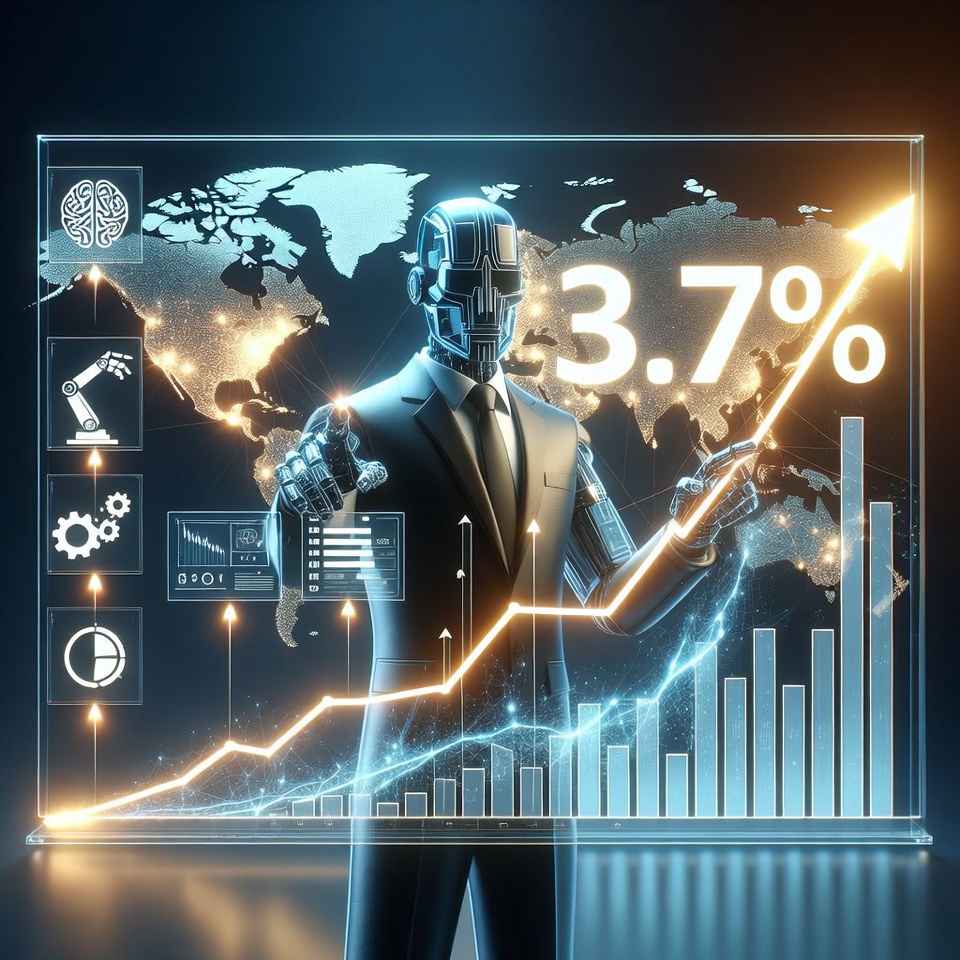
But here is what makes this revision so important for the AI productivity debate: GDP growth figures for the same period remained remarkably strong, with provisional statistics showing growth at 3.7 percent and the Atlanta Federal Reserve’s GDP Now forecast sitting even higher at 5.4 percent.
When you divide strong GDP by a significantly smaller workforce number, the resulting productivity figure becomes exceptional, and Stanford economist Erik Brynjolfsson has done exactly that calculation and arrived at a conclusion that is hard to dismiss.
Brynjolfsson estimates that productivity growth for the period will come in at approximately 2.7 percent, which is nearly double the average pace recorded over the previous decade, and he argues in a piece for the Financial Times that this is not a coincidence.
AI productivity, in his reading of the data, is finally crossing the threshold from invisible to measurable, from investment phase to harvest phase, and that transition has enormous implications for everything that follows.
Understanding that transition, and knowing how to position yourself within it, is exactly the kind of insight that flipitai is designed to help creators act on in practical, immediate ways.
The Productivity J-Curve and Why This Moment Was Always Coming
To understand why this AI productivity surge is significant beyond just the current numbers, it helps to understand a concept that Brynjolfsson and his colleagues developed back in 2018, known as the productivity J-curve.
The J-curve theory holds that when a genuinely transformative general purpose technology enters the economy, productivity does not rise immediately — it actually dips first, because resources must be diverted from existing productive uses toward the learning, restructuring, and co-invention that the new technology requires.
This is not a new pattern: the steam engine did not produce an overnight industrial revolution, and the computer famously prompted Robert Solow to observe in 1987 that you could see the computer age everywhere except in the productivity statistics, despite decades of investment in IT infrastructure.
What Brynjolfsson and his team argued in 2018 was that AI, as a general purpose technology, would follow the same curve, suppressing measured productivity in its early years while organizations made the necessary but poorly measured investments in new processes, business models, and human capital development.
Those intangible investments — the ones that do not show up cleanly in national accounts but that create enormous value for firms — would eventually be harvested, and when they were, measured productivity would jump in a way that appeared to overstate gains relative to the prior suppression.
The 2025 data, in Brynjolfsson’s current reading, suggests that the United States is now crossing the inflection point between the suppression phase and the harvest phase of the AI productivity J-curve.
That is a significant statement, and it is one that carries real implications for workers, businesses, policymakers, and anyone building a career or a company in this environment — including the creators and entrepreneurs who use tools like flipitai to stay ahead of structural shifts in the economy.
The Apollo chief economist had recently noted that AI seemed to be everywhere except in the incoming macroeconomic data, wondering aloud whether a J-curve effect might explain the lag — and Brynjolfsson’s answer, backed by revised statistics, appears to be: the lag is ending now.
What the Skeptics Are Saying and Why the Debate Is Not Fully Settled
Not everyone reading the same data arrives at the same conclusion, and intellectual honesty requires acknowledging where the evidence is genuinely uncertain or contested.
Economist Guy Berger offered a careful caution against drawing strong inferences from the revised labor statistics, pointing out that the bulk of the downward job revision appears to be explained by factors that have little to do with AI productivity directly.
A significant portion of the removed jobs were government positions affected by federal workforce reductions, with additional layoffs concentrated in mining, logging, transportation, and manufacturing — sectors that are not the primary landscape for AI disruption in the white collar sense.
This is a legitimate point, and it underscores the difficulty of attributing macro-level shifts to a single technological cause when the economy is simultaneously being shaped by interest rate cycles, political decisions about public employment, and global trade pressures.
Brynjolfsson himself, to his credit, acknowledged in his follow-up work on the earlier Canaries in the Coalmine paper that some of the employment declines in AI-exposed occupations observed in 2022 and 2023 were likely caused by a combination of factors rather than AI exposure alone, with the clearest AI-specific signal only becoming statistically robust in 2024.
AI productivity as an economic force is real and measurable, but the precise mechanisms by which it is reshaping employment — who bears the costs, who captures the gains, and how quickly the transition happens — remain genuinely unclear, and anyone claiming certainty in either direction is going beyond what the evidence currently supports.
What is not seriously in dispute is that white collar hiring is exceptionally weak, that GDP growth has been strong, that the combination implies remarkable productivity gains, and that AI is the most plausible structural explanation for the pattern being observed.
What Politicians Are Starting to Say Out Loud About AI Productivity and Jobs
The conversation about AI productivity and job displacement is no longer confined to economists and technology commentators — it has reached the floor of political debate, and the range of voices engaging with it reflects how broad the implications are becoming.
On one side, a Republican lawmaker with a master’s degree in AI and three decades in the technology industry acknowledged plainly that AI will be disruptive, that job displacement is a certainty rather than a speculation, and that the historical record does not support the conclusion that technological disruption permanently destroys total employment.
His position — that workers in displaced industries will need active reskilling and that a social safety net will be necessary for those who fall through the cracks — represents the more optimistic pole of the political debate, grounded in a reading of past technological transitions.
On the other side, a progressive senator expressed deep concern about the speed of the coming disruption, warning about the possibility of millions of workers returning from lunch one day to find that their roles no longer exist, and calling for immediate preparation at the policy level.
Both perspectives, despite their political differences, share a common acknowledgment that something real is happening in the AI productivity space, and that the moment for preparation is now rather than after the full impact has materialized.
For individuals navigating this environment — whether as employees, freelancers, or entrepreneurs — flipitai offers a concrete way to engage with AI-driven productivity tools rather than simply watching the structural shift happen from the outside.
The Research That Gives Reason for Cautious Optimism Amid the Disruption
Even within a landscape that carries genuine uncertainty and real economic pain for many workers, there are signals in recent research that suggest the AI productivity transition does not have to be purely zero-sum.
A study from the Hoover Institution at Stanford found that individuals who used AI tools in their work actually spent more time engaged with their tasks rather than less — a finding that runs counter to the simple narrative that AI just eliminates work by automating it away.
Research from Brookings went beyond simply identifying which jobs face the highest disruption risk and examined which workers possess the strongest capacity to adapt, recognizing that displacement and adaptability are not uniformly distributed across the workforce.
These more nuanced studies reflect a maturing of the AI productivity research field, moving beyond the blunt question of whether AI will replace jobs and into the more productive territory of how the transition is actually unfolding and what interventions might shape better outcomes.
The emerging picture is of a technology that is genuinely transforming the structure of productive work, creating real gains at the macroeconomic level, concentrating costs on specific categories of workers — particularly those earlier in their careers and in information-processing roles — and demanding a level of adaptability from individuals and institutions that has few historical parallels in its speed and scope.
AI productivity is not a future event to be debated — it is a present reality to be navigated, and the quality of that navigation will depend heavily on the information, tools, and frameworks that individuals and organizations bring to bear on the challenge.
flipitai was built precisely for this moment, helping creators and entrepreneurs move from passive observation of these trends to active participation in the productivity opportunities they are creating.
What This All Means for Anyone Building a Career or Business Right Now
The single most important takeaway from everything the data is currently showing is that the harvest phase of the AI productivity J-curve has likely begun, and that means the pace of visible disruption is likely to accelerate rather than stabilize in the period ahead.
If productivity growth is already running at nearly double its decade average, and if the organizational learning and restructuring that enables AI adoption is still early in most industries, then the downstream effects on hiring patterns, skill requirements, and business models are still in their early stages of manifestation.
For anyone building a career in a white collar field that involves information gathering, processing, or presentation, the challenge is not to decide whether AI productivity will affect their role but to understand specifically how and to begin developing the complementary skills and capabilities that remain distinctly human in their value.
For entrepreneurs and content creators, the AI productivity boom represents one of the most significant leverage opportunities in a generation — the ability to produce at a scale and quality that previously required much larger teams and much larger budgets.
flipitai is designed specifically to help creators capture that leverage in practical ways, and for those ready to flip that opportunity into a real income stream, flipitai is where that journey begins in earnest.
Change is not arriving on a schedule that allows for comfortable preparation — it is already here, already measurable in the data, and already reshaping the landscape of work in ways that are only beginning to be fully understood.
The best response to that reality is not fear or denial but informed, active engagement with the tools, knowledge, and communities that are built for exactly this moment.

We strongly recommend that you check out our guide on how to take advantage of AI in today’s passive income economy.